The Ministry of Foreign Affairs of Turkmenistan informs that the staff members of the diplomatic service and other state agencies of the country carry out regular contacts with the representatives of the “Taliban” movement on the issues of protection of state borders, provision of customs, sanitary, phytosanitary and other types of supervision and control implemented during the transportation of freights through the borders.
In this context, we note that the check-points on the Turkmen-Afghan border “Ymamnazar-Akina” and “Serhetabad-Torghundi” function in the regular mode and provide the passing of the necessary number of automobile trailers and railway wagons in accordance with the order agreed by both sides.
Press service of the MFA of Turkmenistan (undated, but between 15 and 18 August 2021)
Towraghondi
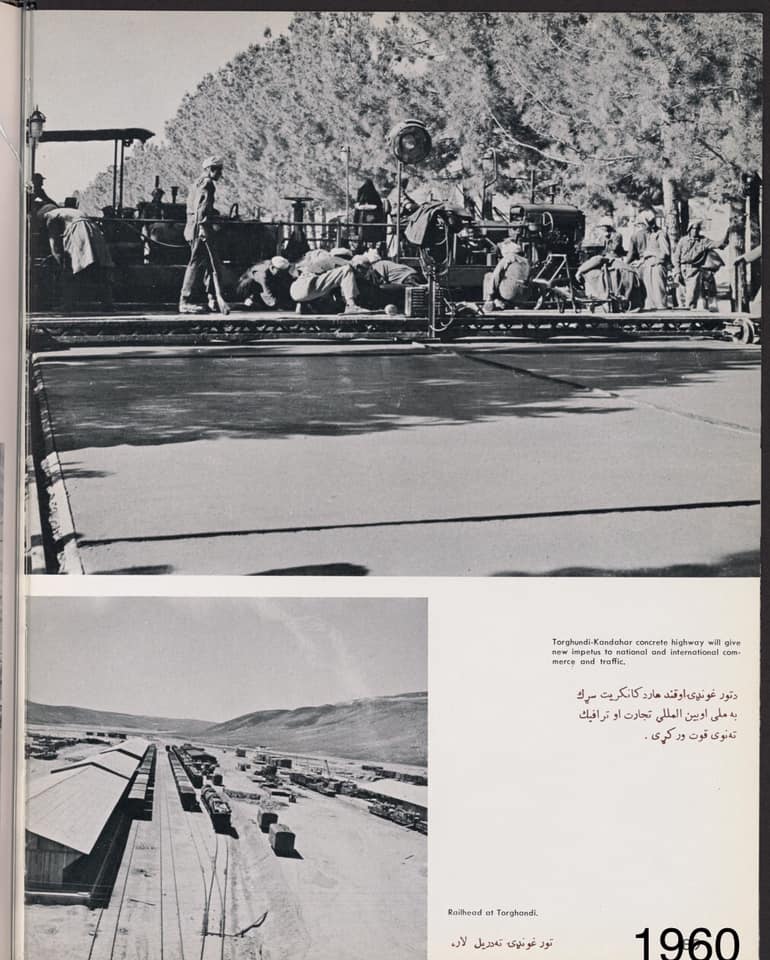
Torghundi rail terminal in 1960
A photo of a page of an unknown bilingual book showing photos of the “railhead at Torghandi” and the construction of a “Torghundi-Kandahar concrete highway”. Someone has added “1960” to the electronic image; presumably the date of the book.
The railway across the Afghan border from the USSR (now Turkmenistan) might have been built as part of the USSR – Herat – Kandahar road project.
Anyone know the name of the book?
Consultancy services for detailed survey and design or Torghondi – Herat railway
Project Description: Consultancy services for detail survery and detail design for Torghondy Herat Railway project (THR) length (113 Km)
More👇https://t.co/KDq9MYx0iS#Bidding_Opportunity #NPA_Afghanistan pic.twitter.com/KqrqxHbRZd
— National Procurement Authority-Afghanistan (@npa_aop) May 16, 2021
International connections
Afghanistan is almost connected with #Iran via Herat- Khaf railwys.
Also Afghanistan will be connected with #Chabahar port through railways. pic.twitter.com/ywNl6YkEUw
— Waheed Faizi (@Imwaheedfaizi) July 7, 2020
Turkmen-Afghan talks in the field of transport
TURKMEN-AFGHAN TALKS IN THE FIELD OF TRANSPORT
On April 16, 2020, a video conference was held between the representatives of the “Türkmendemirýollary” agency [=Turkmenistan’s national railway], open joint-stock company “Demiryollary” and the Railway Authority of the Ministry of Transport of the Islamic Republic of Afghanistan.
The Turkmen side was headed by the Chairman of the “Türkmendemirýollary” agency A.Atamyradov. The Afghan side was led by the General Director of the Railway Authority of Afghanistan Mohammad Yamma Shams.
During the meeting, issues related to the construction of the Akina-Andkhoy railway line, the work carried out under the project for the construction of the Turgundi-Herat railway were discussed.
The participants also exchanged views on optimizing transit freight traffic and wagons passing through the IRA, further developing of the transport corridor between the Lapis Lazuli agreement participating countries. Separately, issues of obtaining visas for railway workers and other issues were considered.
Source: Ministry of Foreign Affairs of Turkmenistan
Turkmenistan and Afghanistan sign railway agreements
President of Afghanistan Mohammad Ashraf Ghani made an official visit to Turkmenistan at the invitation of President Gurbanguly Berdimuhamedov on 21 February 2019.
As part of the visit, an MoU was signed for Turkmenistan to build the 30 km railway extension from Aqina, on the border, to Andkhoy, the first significant place inside Afghanistan.1 Agreements were also reached for the regulation of cross-border rail traffic, while the possibility of building a Towraghondi to Herat railway is to be studied.
رؤسای جمهوری افغانستان و ترکمنستان، معاهده مشارکت استراتیژیک میان دو کشور را به امضاء رساندند
—-
برای معلومات بیشتر روی لینک کلیک نمایید:https://t.co/ykRtdQLz5n pic.twitter.com/ZMIwDeLE30— ارگ (@ARG_AFG) February 21, 2019
Dwelling on the key areas of economic cooperation, the heads of state specifically focused on the transport and communications sphere. […] The Presidents highly commended the finalization of works and commissioning of the Serhetabat–Torghundi and Kerki–Imamnazar railway networks, and the Rabat–Kashan–Kalai-nau power line.2
[Ghani] noted the presence of big opportunities in different directions of cooperation including in railway transport and communication, having expressed the confidence that Afghan part would also take part in the construction of the railroads of international importance.
In this context, President Mohammad Ashraf Ghani highlighted the importance of the initiative about the continuation of Serhetabat – Turgundy railroad to Herat, having assured that Afghan side would make relative work for the implementation of this project.
[…]
Speaking about the partnership in railway sphere, President Mohammad Ashraf Ghani noted the future of continuation of construction of Kerky – Ymamnazar – Akina railroad as well as continuation of Serhetabat – Turgundy railroad to Herat.3
During the visit
Afghanistan Railway Authority (ARA) and Ministry of Transpiration and Communication of Turkmenistan, in the presence of presidents of Afghanistan and Turkmenistan, singed Memorandum of Understanding (MoU) for construction of railway from Aaqina port to Andkhoy district. This project will be designed and constructed with the length of 30 km from Aaqina railway’s station to Andkhoy railway’s station by technical facilities and professional experts of Turkmenistan’s railway.
It is worth mention that based on the pre-signed contract between the railway authorities of both countries, construction of 10 km new railway for development of Aaqina railway’s station is in progress. Also during the official trip of the president of Afghanistan and containment delegation to Turkmenistan, two other agreements signed between railway authorities of both countries for administration and organizing of Tor Ghondai port railway’s affairs. The parties as well agreed to jointly assess extension possibility of railway from Sarhadabad-Tor Ghondi to Herat city.4
The lines in question are 1520 mm gauge, as with the route from Uzbekistan to Afghanistan.
An “Agreement on International Railway Transit Point on Turkmen – Afghan State border” was signed “on the government level”, and regulations for the organisation of railway communications between Serhetabat and Turgundy [Towraghondi, etc] adopted.5
- Railway Cooperation Development Between Afghanistan and Turkmenistan, Afghanistan Railway Authority, 23 February 2019 ↩
- Joint Statement by the President of Turkmenistan, Gurbanguly Berdimuhamedov, and the President of Afghanistan, Mohammad Ashraf Ghani, State News Agency of Turkmenistan, 21 February 2019 ↩
- Turkmenistan and Afghanistan enter new level of strategic cooperation, State News Agency of Turkmenistan, 21 February 2019 ↩
- Railway Cooperation Development Between Afghanistan and Turkmenistan, Afghanistan Railway Authority, 23 February 2019 ↩
- Regulatory and legal framework of Turkmen – Afghan cooperation is supplemented with ten documents, State News Agency of Turkmenistan, 21 February 2019 ↩
Experimental shipments on the Lapis Lazuli route
Afghanistan to send first cargo to Europe through Lapis Lazuli route https://t.co/rNESRPE0iB via @1TVNewsAF @RECCAfghanistan @HassanSoroosh @WahidWaissi
— Lapis Lazuli Route (@RouteLapisL) August 27, 2018
Torghundi railway photos
Some photos Tweeted in December 2017.
13 km #railways work completed at #torghondi dry #port btwn #Afghanistan & #Turkmenistan #transport#transit #trade pic.twitter.com/um61N5XbOb
— Sawabdin Makhkash (@smakhkash) December 9, 2017
Turkmenistan Railways train in Afghanistan
Today 1st Train come to #Afghanistan via Torghondi railroad's from #Turkmenistan with high rink officials for the official inauguration of #TAPI project in #Herat province of #AFG. pic.twitter.com/M8gSX8Ub1U
— Rezwanullah Shpoon🇦🇫 (@shpoon1919) February 23, 2018
Serhetabat – Torghundi railway (re)inauguration
Two ceremonies marking stages of work on the Turkmenistan–Afghanistan–Pakistan-India (TAPI) gas pipeline were held on 23 February 2018, one in Turkmenistan to mark completion of the Turkmen section of the pipeline, and the second in Afghanistan’s Herat province to mark the start work on the Afghan section.1
From #TAPI to #Railway connectivity between Central #Asia to South Asia. Dream becoming true – as #AFGHANISTAN heart of ASIA pic.twitter.com/pYYW5GvemD
— Syed Anwar (@Sayed_Anwer) February 23, 2018
The events included a first train on the recently modernised railway between Serhetabat in Turkmenistan and the freight terminal just across the border at Torghundi in Afghanistan.2
Today we stepped forward wth another pragmatic action to connect north 2 south & replace negative security rivalry wth a positive economic cooperation.Todays #TAPI, TAP500, Railway & Fiber Optic inauguration in AFG soil proves our resolve commitment to economic integrated region. pic.twitter.com/EJnSRqQkOu
— Mirwais Nab (@nab_mn) February 23, 2018
TAPI, TAP500 & Railway will change the role of game in AFG & region. Durable stability comes through addressing poverty & unemployment.TAPI would provide 20000 job opportunities 2 AFG youth. Vital step 2 fight terrorism & extremism. No peace in absence of economic growth.
— Mirwais Nab (@nab_mn) February 23, 2018
Guests included the President of Turkmenistan, Gurbanguly Berdimuhamedov; President of Afghanistan, Ashraf Ghani; Prime Minister of Pakistan, Shahid Khaqan Abbasi; and India’s Minister of State for External Affairs, Mobashar Jawed Akbar.
Multiple high-level events on mega energy, power transmission, fiber optics and railways took place today in Herat province between heads of states of Afghanistan 🇦🇫 Turkmenistan 🇹🇲 Pakistan 🇵🇰 India 🇮🇳 @RECCAfghanistan pic.twitter.com/cRBF0QrGc7
— Afghan Embassy AUS (@AfghanEmbassyAu) February 23, 2018
Goods expects to use the railway include oil products, food, industrial goods and construction materials.
Although described in some reports as “new” railway, the line dates from the Soviet area; it possibly opened in the in the mid to late 1950s, although I have been unable to confirm this. It has now been modernised by Turkmenistan’s national railway company at Turkmenistan’s expense as part of “comprehensive help and support to the people of Afghanistan”, following the 7th Regional Economic Cooperation Conference on Afghanistan that took place in Ashgabat in mid-November 2017.3
Railway from Turkmenistan to Torgundi of #Afghanistan's #Herat inaugurated
— 1TVNewsAF (@1TVNewsAF) February 23, 2018
The Afghan terminal is in Herat province, but is not in Herat city, which sometimes leads to confusion in news reports. There is also no consistency at all in the spelling of its name: Torghundi, Turghondi, Torghondi, Towraghondi, Turghundi, Torag Hundi, Turgundy, Tuurgundy…
I visited #Torghundi port in 2007, an empty & dry place with a small office, the contrast between two sides were huge: #AFG side being dry, dusty & dark while Turkmen side green, lighted & full of life! We envision #TAPI to enlighten our part too!
— Orzala (@Orzala) February 23, 2018
References
- Construction of Afghan section of TAPI begins, 1TVNews.af, 23 February 2018 ↩
- Train Service Opens on New Turkmen–Afghan Railway: Serhetabat–Torghundi, State news agency of Turkmenistan – Turkmenistan today, 23 February 2018 ↩
- Train Service Opens on New Turkmen–Afghan Railway: Serhetabat–Torghundi, State news agency of Turkmenistan – Turkmenistan today, 23 February 2018 ↩