Soviet rail extensions
Previous page: International plans

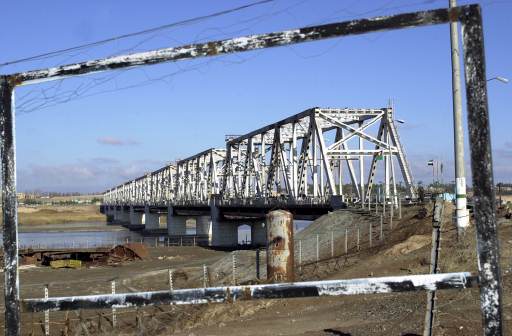
Uzbekistan-Afghanistan Friendship Bridge, 18 December 2001 (Photo: Staff Sgt Cecilio Ricardo/US Air Force).
During its military involvement in Afghanistan the USSR extended two 1 520 mm gauge railway lines to carry troops and military supplies across the Soviet-Afghan border.
The Friendship Bridge
A 15 km railway line was built running east from Termez in Uzbekistan, then over the River Amu Amu-Darya (Oxus) into Afghanistan. It terminated at a transhipment point at Hayratan, near Kheyrabad. Termez has rail connections eastwards to Dushanbe in Tajikistan, and westwards via Kerichi in Turkmenistan to the Uzbek cities of Bukhara and Samarkand.
Work on the 34m rouble combined road, rail and oil pipeline "Friendship Bridge" began with the Soviet intervention in the winter of 1979-1980. An agreement for use of the 1 000 m bridge was reached between the Afghan and Soviet authorities in May 1982,1 and it opened that June.
The bridge strengthened the strategic transport capabilities of the USSR by establishing a railhead on the south side of the river, and so early in 1985 Pakistan’s Inter-Service Intelligence began to formulate plans for Mujahideen fighters to destroy it.2 The CIA provided advice on the types of explosives needed, and where they should be placed to demolish two or three spans. The underwater demolition operation was planned for the summer, to obtain maximum benefit from the current flows in the Amu-Darya. A team of troops was to practice the assault on an Afghan dam. The CIA did not supply good reconnaissance photographs of the bridge, so local commanders provided details of the sentries and company post on the Afghan end of the bridge, and an armoured personnel carrier permanently on duty. However later in the year the President of Pakistan vetoed the proposed assault, fearing reprisal attacks on vital bridges in Pakistan.
The Hayratan line was planned to form the first stage of a 250 km 1 520 mm gauge railway to Pul-i-Khumri, 150 km north of Kabul.3 From the river crossing the railway was to have run southwest to Kholm, east towards Kunduz and Khanabad, then would climb south through Ab Kul and Bahlan, and reach the Surkhab river valley and a military supply depot at Pul-i-Khumri in the foothills of the Hindu Kush mountains.4 The second stage of the extension plans would have taken the line to Bagrami air base, then on to Kabul. The complete line to Kabul was expected to cost 3.1bn rubbles.
Towraghondi
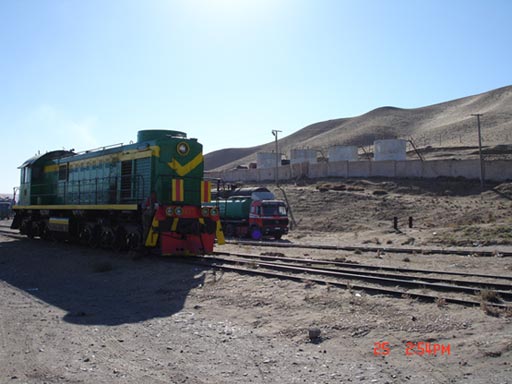
The second Soviet line into Afghanistan ran for 9.6 km from Kushka (now Serhertabat in Turkmenistan) to Towraghondi.

Turkmen Railways locomotive at Towraghondi (Photo: Afghanistan Customs Department)
In April 1983 a Modern Railways correspondent reported that the Soviet-backed Afghan Government had contacted the Economic & Social Commission for Asia and the Pacific (ESCAP) seeking financial and technical assistance for a rail network.5
This was to link Kabul, Kandahar and Herat. Pakistan would be reached by a line from Kandahar to Chaman, and there would be a branch from Herat to Islam Qala on the Iranian border. However the governments of Pakistan and Iran did not recognise the existing Afghan regime. Surveys drawn up by a Franco-German consortium in 1928 were presented. ESCAP sent two missions, including railway experts, to Afghanistan.
The railways parallel to the Amu-Darya on the Soviet side of the border these were subjected to cross-border sabotage and military attacks during the war. Both lines into Afghanistan fell out of use with the Soviet withdrawal in 1989, and Uzbekistan closed the Friendship Bridge on 24 May 1997, following the rise to power of the Taliban across the border.
Next page: War and reconstruction
References
- USSR-Afghan link, Modern Railways, August 1982 p342, quoted at University of York ↩
- Afghanistan - The Bear Trap - Defeat of a Superpower, Brigadier Mohammad Yousaf, (published 1992, 2001 edition referred to) ↩
- Kabul to be linked to Soviet Railways, Railway Gazette International April 1983 p236, accessible at University of York ↩
- Afghanistan - a Country Study, Area Handbook Series, 5th edition, 1986 ↩
- Rail links with Pakistan and Iran, Modern Railways, April 1983, quoted at University of York ↩