Posts Tagged ‘Turkmenistan’

Railway Gazette International on Afghan rail plans

Monday, June 28th, 2010

Railway Gazette International on the latest Afghan rail plans:

Afghan rail strategy takes shape

[...]
The first phase would start at Sher Khan Bandar on the Tajik border, connect at Naibabad with the 1520 mm gauge line now under construction from Uzbekistan, and continue through Mazar-i-Sharif to Herat, with the possibility of a link to the Turkmemistan Railways line at Towraghondi. A branch would run from Shirbirghan via Andkhvoy to the Aqina border crossing with Turkmenistan.
[...]
A second phase would see a Chinese-backed line built from Mazar-i-Sharif to Kabul, Jalalabad and Torkham, near the Khyber Pass. The long-proposed extension of Pakistan Railways’ Chaman line to Kandahar is also planned.
Source: Railway Gazette International, 2010-06-28

Afghan government plans three standard gauge railways

Sunday, June 13th, 2010

The Minister of Mines and “Coordinator of Cluster for Economic & Infrastructure Development” said last month that the Railway Development Program of Afghanistan plans three lines totalling 2000 km and costing $5.938 billion [presumably US dollars].

  1. Shirkhan Bandar [for Tajikistan border] - Kunduz province - Balkh province - Herat [link to Iran]
    Branch: Mazar-i-Sharif - Hayratan [Uzbekistan border]
    Branch: Andkhoy - Aqina [Turkmenistan border]
  2. Mazar-i-Sharif - Pul-i-Khumri - Kabul - Jalalabad - Torkham [Pakistan border].
  3. Chaman [Pakistan] - Spin Boldak - Kandahar.

The statement says these lines would be 1435 mm (standard) gauge, designed for 25 ton axle loads, speeds of 100-160 km/h and capacity for 10-12 pairs of trains a day.

Building the northern corridor to standard gauge might make sense, however Hayratan - Mazar-i-Sharif is already being built to 1520 (Russian) gauge, and it is hard to see any possible justification for building Chaman - Kandahar to anything other than 1676 (Indian) gauge for compatibility with Pakistan.

Consultation Workshop on Railway Development Study

The “Consultation Workshop on Railway Development Study” took place at Kabul Serena Hotel. Topics of discussion included the development and acceleration the international trade, improvement of transportation networks in Afghanistan, providing competitive trade facilities and transit across Afghanistan, and the development plan of a railway that will join major trade centers of Afghanistan to neighboring countries.

His Excellency Wahidullah Shahrani, the Minister of Mines, and Coordinator of Cluster for Economic & Infrastructure Development, commented during his introduction, “Accelerating of the international trade requires the modernization of roadways and development of transport infrastructures, and, fortunately, the government of Islamic Republic of Afghanistan accepted the strategic goals of regional cooperation of Central Asia which is included the development of six transport routes in the region, and three of that will extend through Afghanistan.”

“Currently under construction is 75 Km of railway between Hairatan and Mazar-e-sharef, part of the first phase of the northern corridor railway plan. The second and largest stage of this project is generating an additional 1000 Km of railway”,said Mr. Shahrani.
Mr. Shahrani added, “The government of Afghanistan has a plan to generate a 2000 Km of railway, which could join the some of the country’s major cities to our neighboring countries.”

According to the Railway Development Program of Afghanistan, the first route begins from the port of Shirkhan and passes through the Kunduz and Balkh provinces, ending in Herat province. It will have two branches originating at Hairatan- Mazar, and, Andkhoi- Aqina. The second route will begin from Mazar, pass through Polikhomri, Kabul, Jalalabad, and end in Toorkham. and the third route in south of the country will begin at Spinboldak/Chaman and end in Kandahar city.

Commenting on some of the technical aspects of the railway, the Minister said, “The internal gauge of the lines is planned to be similar to 1435mm European railways, with a tonnage of 25 tons per axel and a speed of 100-160 Km per Hour. In the areas where a change of gauge is impossible, there will be special arrangements to replacement cargo. The primary capacity of the railway is 10-12 pairs of daily trains.”

The total cost of the project, including construction, engineering, environmental work, advisory services, and materials is estimated to be 5.938 billion dollars.

Attending the conference were some members of the Cabinet, members of the parliament, foreign ambassadors, representatives of European Union in Kabul, as well as some members of the private sector and international organizations.
Source: Ministry of Mines, 2010-05-23

Russia’s March to the East

Sunday, January 10th, 2010

An April 1899 article form the Timaru Herald, based a journey through the Russian empire, and the railway from Merv to Kushka (Serhetabat in Turkmenistan).

RUSSIA’S MARCH TO THE EAST

Mr John W. Bookwalter, of Ohio, who has just returned to London from a two months’ journey through Russia, informed a press correspondent in an interview that he enjoyed unusual facilities for observing what is going on in that country. He travelled 17,000 miles to the terminus of the Trans-Siberian Railway, to the end of the line reaching the frontier of Afghanistan, and to the end of the one penetrating China through Manchuria. Mr Bookwalter says :—

“Russia in three years has done more to open the doors of China than Great Britian and all the rest of the world has done in 50 years. No one who has not seen it with his own eyes can have the faintest conception of what Russia has done and is still doing in Central Asia. I have travelled over twelve hundred miles of railway which she was built from the Caspian Sea to Tashkend. in Turkestan ; over a branch of this line which runs to the northern frontier of India, and over another branch which goes from Merv to the border of Afghanistan. This last branch was not completed when I was there, but it will be open to traffic shortly. There are also Russian lines all along the Persian frontier and penetrating into that country, either completed or rapidly approaching completion. All the work on these lines has been done by soldiers, who in this way are not in Russia, as elsewhere, non-producers.

“All this tremendous Asiatic railway system is owned and operated by the Government. All the lines are admirably built and splendidly equipped. Why, I saw a bridge across the Amu-Daria, in Central Asia, at a point where the river is three miles wide, that cost 20,000,000 roubles, and is the greatest piece of engineering work ever accomplished. There is nothing like it anywhere else m the world, the celebrated Forth Bridge, near Edinburgh, Scotland, not excepted.

“Wherever I went I saw cities and towns springing up - such as Askabad, in Turkomania, for example, which already has 25,000 inhabitants. Near Merv the Czar is building a magnificent palace. New Bokhara, twelve miles from Old Bokhara, has 12,000 inhabitants. The Russian policy in Central Asia is not to bring the new and the old in too close a contrast, and so she builds her railway stations a few miles away from the old centres of population, thus forming newand entirely modern centres. Where do the people come from to inhabit these towns? Why, from European Russia. The Government is turning her surplus European population into Central Asia, just as the United States turned the surplus population of her Atlantic States into her great Western territories. What I have just seen in Central Asia is almost an exact reproduction of what I witnessed years ago in Illinois, Indiana, and Missouri, when the emigrants from the East were pouring into the West. No human power can stay the onward march of the Slav through Russia, which will be the feature of the twentieth century, just as the the march of the Anglo-Saxon through America has been the feature of the nineteenth.”
Source: Timaru Herald, Volume LXII, Issue 2916, 4 April 1899, page 4, accessible at the National Library of New Zealand

Locomotive at Towraghondi

Wednesday, November 12th, 2008

A photograph captioned Rail Port in Turghundai Border with Turkmenistan from the Afghanistan Customs Department.

The diesel locomotive - a TEM2? - presumably belongs to Turkmen Railways.

The cross-border line from Serhetabat (Серхетабат, and formerly known as Gushgy) was built in the early 1980s - does anyone know more precisely when? It was rehabilitated in 2007 at a cost of USD550 000.

Afghan-Turkmenistan border photos

Sunday, October 26th, 2008

Train at the Afghanistan - Turkmenistan border

There are photographs of the railway across the Turkmenistan-Afghanistan border at www.wuestenfuchs.com, the website of Norbert Ratzke of Köln who was in Herat from January to April 2004.

The pictures show a 1520 mm gauge diesel loco (half of a 2ТЭ10Л?) crossing the border, and the freight yard at Towraghondi.

There is no railway transport in the country. At the Turkmen-Afghan border a Russian train runs about 500 meters on Afghan territory. There it is unloaded and returns to Turkmenistan.

In 2007 Turkmenistan launched a USD 550 000 programme to upgrade the line.

15th ministerial conference of non-aligned countries in Tehran

Wednesday, August 13th, 2008

News dated August 6 2008 from the Ministry of Foreign Affairs of Afghanistan, regarding the 15th ministerial conference of non-aligned countries.

Minister Spantas Press conference in Kabul

In the sidelines of this conference the Foreign Ministers of Afghanistan and Turkmenistan had a bilateral meeting they talked about the cementing of the bilateral ties between the countries, construction of a railway track from the border areas of Turkmenistan to Afghanistan and various issues of interests came under discussion.

Atamyrat to Afghanistan railway plan

Tuesday, July 15th, 2008

On July 12 the State News Agency of Turkmenistan reported a plan for the construction of a new railway to Afghanistan, starting from Atamurat (formerly Kerki) in eastern Turkmenistan.

The project was discussed at the first meeting of the snappily-titled intergovernmental Turkmen-Afghani commission for trade and economic and technical co-operation, which was held in Ashgabat this month.

Intergovernmental Turkmen-Afghani commission meets in Ashgabat

The opportunities for further co-operation in energy industry and the sphere of transport and communication including railway and motor transport were a focus of the talks. It was noted that by concerting efforts Turkmenistan and Afghanistan occupying the favourable geographical position could ensure transit freight traffic across their territories to the north-south and the east-west. In this regard the Turkmen partners expressed the willingness to connect the national railway networks of Turkmenistan and Afghanistan. In particular, Turkmenistan intended to finance the construction of a branch line from Turkmen town of Atamurat to the Turkmen-Afghan border that would give Afghanistan an outlet to other countries of the region.

Atamurat/Atamyrat was formerly called Kerki, until the previous president (of personality cult fame) renamed it in honour of his father, who had been born there. While Afghanistan doesn’t really have a “national railway network” yet, the 1520 mm gauge Turkmen line from Turkmenabat to Atamyrat opened in 1999, providing a link between two parts of the Turkmen network to eliminate the need to go round through Boukhara in Uzbekistan.

Turkmentel – 2007 explains:

Owing to the thought over, far-sighted and steady decisions of the First President of Turkmenistan Saparmurat Turkmenbashy the Great for years of independence the railway branch became one of priority directions in the field of communications and has achieved the new high level of development.

In the end of 1999 construction of railway Turkmenabat-Atamyrat by extention of 203 km is completed. This branch line, having connected five regional centers of Lebap area with the city of Turkmenabat, and also with capital Ashgabat, passes on the left coast of Amu Darya river.

Supermap might help explain the arrangement of railways in Turkmenistan.

Searching Google Earth, this could well be the station at Atamyrat, with a line heading off south then looping round towards the construction site for a bridge over the Amu Darya (which seems to have run into political complications during construction).

View Larger Map

The railway appears to carry some Afghan traffic at present, presumably transhipped to or from road transport (or maybe barge?):
Text of report by Turkmen newspaper Neytralnyy Turkmenistan on 26 January 2007.

A [railway] loading station for cargo transported via the Turkmenabat-Atamyrat railway line [in eastern Turkmenistan] has been put into operation. Weighing facilities and a set of loading and unloading equipment are located on the station’s territory, which measures 80,500 sq m.

A network of storage facilities is being installed at the station as well. Some of them are designed for short-term storage of cargo from neighbouring Afghanistan. The others will be used for goods from economic entities in the Gulustan newly-developed desert area and along the Garagum canal.

Turkmenistan already has a short cross-border railway link to Towraghondi in Afghanistan.

Freight operations in Afghanistan

Thursday, December 6th, 2007

Samuel Rachdi of Fahrplancenter has provided me with some information on train operations across Afghanistan’s northern borders.

The Turkmen government has rehabilitated earlier in 2007 the line to Towraghondi and about 20 to 25 wagon loads are brought over this rail line to Afghanistan per week. This line is operated by Turkmen Railways.

In contrast the Termez (Uzbekistan) - Hayratan line is very busy, nearly every day a train is entering Afghanistan, mainly with petroleum products, building material, machines, agricultural products. Every train consits of up to 30 wagons. In the opposite direction very little merchandise is transported, less than 10% against import, so most wagons are leaving the country empty. This line is operated by Uzbek Railways, but with some Afghan employees at Hayratan.

Reconstruction of Afghanistan - Turkmenistan rail link begins

Friday, July 13th, 2007

Turkmenistan starts reconstruction of Afghan railway

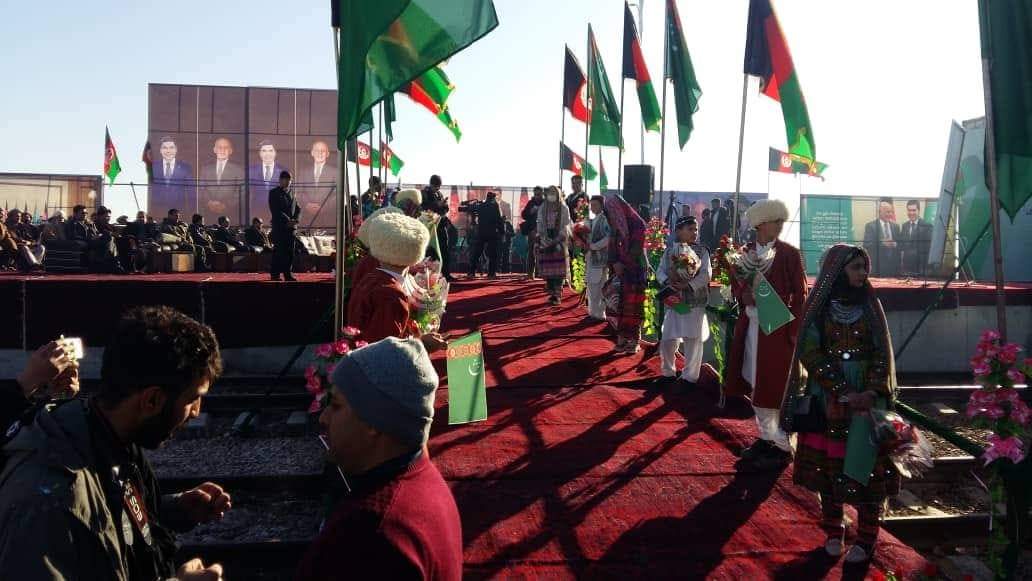
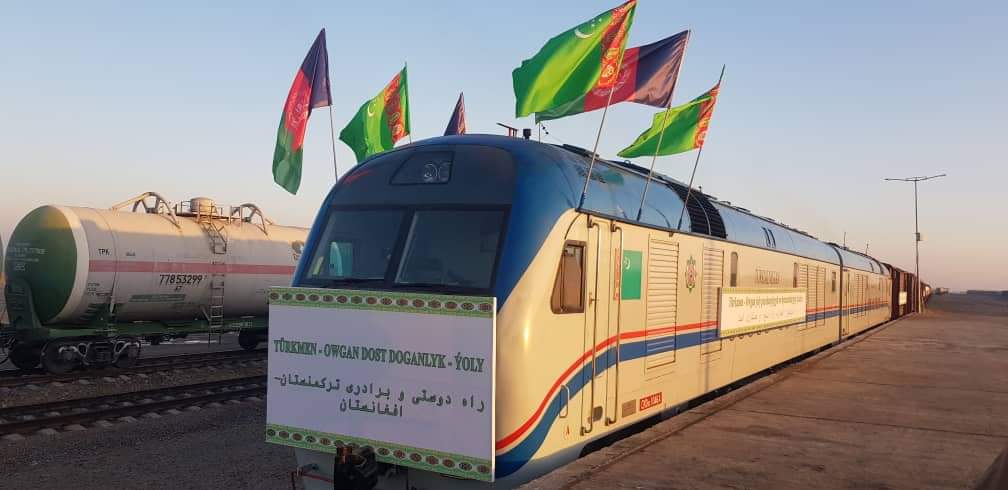
A ceremony of launching the reconstruction of a 2 km section of the railway in the territory of Afghanistan that runs into the territory of Turkmenistan was held in Afghan Turgundi and Turkmen Serhetabat towns yesterday. As is known, Turkmen President Gurbanguly Berdimuhamedov put forward this initiative during his recent meeting with Afghan President Khamid Karzai. The initiative relates to the overhaul of the railway including full replacement of mechanisms and equipment at the expense of Turkmenistan including financing of works for the total value of US$ 550,000.

As the Turkmenistan.ru’s correspondent reports, after laying the first symbolic pair of sleepers in the Afghan territory in Turgundi the similar ceremony was held in Serhetabat. The ceremonies were attended by the delegations of two countries. Public Affairs Minister Sohrab Ali Safari, Minister of Labor and Social Security and on Disabled and Shaheed Affairs Nurmuhammet Garkyn, Governor of Herat Seyit Hoseyin Anvari, Afghan Ambassador to Turkmenistan Abdulkarim Haddam represented the Afghan side. The ceremony was also attended by representatives of bordering Afghan settlements where ethnic Turkmens live. Turkmen Minister of Railway Transport Deryaguly Muhammetguliev led the Turkmen delegation.

from TURKMENISTAN.RU 2007-07-12.

This cross-border line was originally built by the USSR to support its forces after their invasion of Afghanistan. The line stretches for around 9.6 km from Kushka in Turkmenistan to Towraghondi. The route is parallel to the Amu-Darya river on the Soviet side, which made it vunerable to cross-border sabotage and military attack during the Soviet-Afghan war. The line fell out of use sometime around the time of the Soviet withdrawal in 1989. Map.

Turkmen Railways to Provide Gratuitous Assistance to Afghanistan

The Ministry of railways of Turkmenistan will construct a railway line in Afghanistan at its own expense.

The cost of the project is USD 5.5 Mln, reports Railway Market-CEE Review referrin to Altaqata.

As the Ashgabat correspondent of Turkmenistan.ru reports quoting the press service of the head of state, Gurbanguly Berdimuhamedov signed a decree to this effect “with a view to further developing and strengthening the neighborly relations between Turkmenistan and the Islamic Republic of Afghanistan as well as providing assistance to the people of Afghanistan in reconstruction of the national economy.”

from RZD Partner 2007-07-13.