On the Map: Supplying Troops in Afghanistan looks at some routes into Afghanistan.
Posts Tagged ‘NATO’
Afghan supply routes
Sunday, April 12th, 2009German firms to use Herat railway?
Sunday, April 5th, 2009A German firm is reported to be negotiating to use the future railway from Iran to Herat to suply NATO.
German Army spokesman confirms negotiations with Iranian Pvt Firms
Berlin, April 2, IRNA – A spokesman of German Army here Wednesday confirmed in an interview with IRNA representatives of Iranian private firms negotiated with Germans regarding transferring some non-military facilities for German forces situated in Afghanistan.
The spokesman who spoke on condition of anonymity said, “The German sides negotiating with Iran are representatives of private firms that provide foodstuff and fuel for the German forces serving at NATO units in Afghanistan.
He added, “These companies are after finding alternative routs for Pakistan to forward those goods to Afghanistan thorough it.”
…
According to him, those companies have considered using the Chabahar-Zaranj road, or the Tehran-Harat railroad to transfer their logistical, non-military facilities to Afghanistan.
Source: IRNA 2009-04-02
Military transport routes to Afghanistan
Wednesday, February 18th, 2009An interesting 17 February 2009 article from Der Spiegel about the problems of supplying military forces in Afghanistan. This problem is nothing new of course – various armies over the centuries have faced it before.
Allies Struggle to Find Safer Supply Routes
By Dieter Bednarz, Rüdiger Falksohn and Alexander Szandar
The Taliban has staged repeated attacks on Afghanistan’s perilous Khyber Pass against trucks loaded with NATO supplies. The international security forces, including Germany’s Bundeswehr, are scrambling to find safer routes – and might even consider one through Iran.
Interesting bits
- Three-quarters of all the military equipment and goods for Afghanistan goes through Karachi.
- Germany is the only NATO country with permission to transport war materiel through Russia by rail. But other countries, including Kazakhstan and Uzbekistan, have refused permits so no trains have actually run.
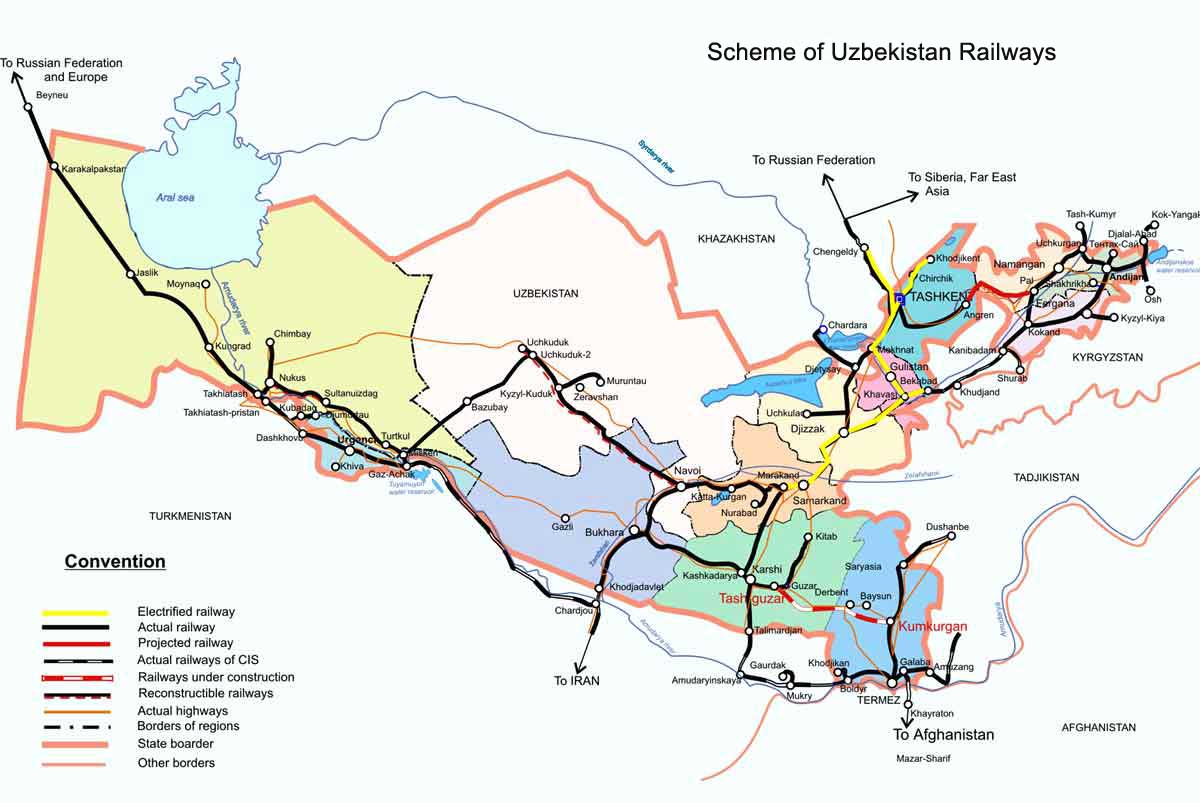
The Bundeswehr has also looked into the feasibility of building additional stretches of track in Afghanistan. There are already 20-year-old plans from the days of the Soviet occupation. The railroad could connect the border town of Hairatan with Mazar-e-Sharif, 67 kilometers away. Thanks to a bridge built in 1982 across the Amu Darya River, which serves as the border between Afghanistan and Uzbekistan, Hairatan has a direct connection to the rail network in Termes.
The financing is still up in the air, though. But given that the project would both make it easier to bring supplies to NATO troops and promote the region’s economy, military officials hope to receive funds from the German Federal Ministry for Economic Cooperation and Development and international organizations. For example, the Asian Development Bank plans to prepare a feasibility study with the support of the Uzbek government.
In December, a privately owned Uzbek railroad company, which already operates in Afghanistan’s Herat Province, contacted the German Embassy in Kabul. According to a confidential report the embassy sent to the German Foreign Ministry in Berlin, the Uzbek company “would like to work with German companies” to implement projects sponsored by the development bank.
Source: Der Spiegel
NATO to Afghanistan through Kazakhstan
Monday, December 1st, 2008Following on from the recent Russian agreement to let Germany ship military equipment to Afghanistan by rail, other countries are reported to be getting in on the act.
Kazakhstan: US continues to probe rail route via central Asia to Afghanistan
American military officials are continuing to press for alternative transport routes to Afghanistan, with senior commanders exploring the feasibility of a rail route through the Caucasus and Central Asia.
According to a press release issued by Kazakhstan’s Ministry of Defense [here], Deputy Defense Minister Bulat Sembinov met with the commander of the US Transportation Command, Duncan McNabb, to look into “opportunities for organizing transit and providing material and technical assistance to the process of reconstruction and backing forces in Afghanistan.” Earlier in November, McNabb met with Azeri President Ilham Aliyev.
Separately, Kazakhstan’s transport minister, Serik Akhmetov, met Richard Hoagland, the US envoy in Astana, to discuss various transit ideas involving Afghanistan. The high level meetings in Astana follow on Russian permission to Germany to use the country’s extensive railway network to transit military goods bound for Afghanistan. It is the first time Russia has permitted a NATO ally to transit military supplies via an overland route.
A spokeswoman for NATO said the alliance was now actively pursuing agreements with Azerbaijan, Kazakhstan and Uzbekistan to gain access to Afghanistan.
Meanwhile, Uzbekistan, Afghanistan, and the Asian Development Bank (ADB) have signed a Memorandum of Understanding to expand trade and economic opportunities through railway transport. Zhao Xiaoyu, ADB Vice-President, said the agreement “will be taking a major step toward realizing the dream of expanded trade and economic opportunities for larger Central Asia.”
Source: Eurasianet, posted 27 November 2008
© Open Society Institute.
The Kazak Ministry of Defense’s website says:
Developing military cooperation
Today deputy minister of defense of the Republic of Kazakhstan general–lieutenant Bulat Sembinov met commander of Transport Command Staff of the USA (TRANSCOM USA) general Dunkan McNab in the defense office. During the meeting there were discussed perspectives of bilateral cooperation possibilities of transit organization, rendering material and technical assistance to the process of reconstruction and support of forces and means in Afghanistan in particularly.
USA TRANSCOM – is the one detachment which manages all the aviation, land and sea transport of the Ministry of defense of the USA. And Kazakhstan is the one state in the region which has 5 year cooperation Plan with the USA between defense offices which includes such important directions of cooperation as development f peacekeeping potential of the Armed Forces RK, improvement of Kazakhstan military education system and mutual participation in exercises.
[more]
Source: Ministry of Defense, Kazakhstan, 21 November 2008
Russia allows arms to Afghanistan by rail
Monday, November 24th, 2008The Russian government has decided to permit the German military to ship arms and military hardware by rail through Russia to the International Security Assistance Force in Afghanistan. Previous transit agreements only covered non-lethal cargo.
Question: Has the present crisis in Russian-NATO relations affected the agreements concluded by Russia with individual member countries of the alliance regarding transit through Russian territory of military cargoes for the needs of the NATO-led International Security Assistance Force (ISAF) in Afghanistan?
Answer: The Russian side, including at the highest political level, has reaffirmed its interest in continuing and increasing cooperation with the alliance in the Afghan sector. This also concerns the fulfillment of the obligations under the transit agreements concluded with Germany, France and other partner countries acting as suppliers of troops for the International Security Assistance Force in Afghanistan.
During the 10th round of Russian-German Interstate Consultations at summit level (St. Petersburg, October 2, 2008), the President of Russia and the FRG Chancellor gave a high assessment of the practical interaction experience accumulated in a bilateral format with regard to Afghanistan, and spoke for expanding it. In particular, it was about launching in addition to the functioning air bridge of supply for the German ISAF contingent the railway transit of Bundeswehr military cargoes to Afghanistan, which is also provided for in the 2003-2004 bilateral intergovernmental agreements currently in force.
By way of the realization of the political decision adopted at the summit, the Federal Customs Service on November 10 issued a general permit to carry out in accordance with a request from the FRG Government railway transit through Russian territory of Bundeswehr arms and military hardware and equipment to Afghanistan. This will be the first experiment of this kind in Russian relations with foreign states, taking into account close cooperation with Germany in the field of combating the common security challenges and threats.
Source Ministry of Foreign Affairs of Russia website
Georgian conflict a threat to Afghan transit plan?
Monday, August 11th, 2008The potential implications of the current Georgian situation for proposed NATO rail transit traffic to Afghanistan via Uzbekistan are considered at Ghosts of Alexander. The initial Central Asian transit route agreement that was reached earlier this year had the approval of Russia
says Russia, Georgia, NATO and Afghanistan, asking Is it doomed? Is it just one of several bargaining chips that Russia has (the big one being energy)?
There is a link to a handy map of Uzbekistan’s railways.
An earlier posting on Registan.net, Termez, Where the “T” Is for “Transit”, considers the problems of supplying NATO in Afghanistan. The few rails that operate along the Amu Darya have major rail break problems, in that they operate at a different gauge than their neighbors. This tells me freight can make it only as far as Termez, and from there is must be either shipped or flown to its final destination.
This is not quite right – the break-of-gauge is between the former USSR and elsewhere (except Finland and Mongolia, which use “Russian” gauge). There are transhipment and dual-gauge facilities around the various borders, so a wagon could in theory run from (say) Poland to Afghanistan without the gauge being an issue.
The two existing lines in Afghanistan are to the 1520 mm Russian gauge, though the line from Iran to Herat will be standard gauge.
NATO’s Europe to Afghanistan rail plan under discussion
Wednesday, May 7th, 2008NATO is “Making progress on Afghanistan rail route”, according to a Eurasia Insight report dated May 5. It seems NATO is hoping to move freight between Europe and Afghanistan via the rail connection from Uzbekistan to Hayratan, across the Friendship Bridge.
NATO is striving to rapidly conclude a deal with Central Asian states on an inter-continental rail link that would ease the supply of non-lethal equipment and assistance for both military and reconstruction operations in Afghanistan.
The rail project is an outgrowth of NATO’s efforts to reinvigorate its Afghan operations. Discussions on how to improve Afghan reconstruction efforts featured prominently at the alliance’s early April summit in Bucharest. [see previous posting] …
At present, the cost of supplying NATO operations in Afghanistan is astronomical, due mainly to the fact that most supplies must be brought in by air. According to NATO estimates, airlifting supplies to Afghanistan costs a whopping $14,000 per ton, or roughly $7 per pound. In addition to the high cost, the air option may not be able to handle the requirements necessitated by an expansion of NATO forces in Afghanistan.
A Europe-Afghan rail link could cut supply costs to roughly $300-$500 per ton, allowing the bloc to both save tremendously on transportation and increase supply for its Afghanistan operations. The optimal route envisioned at this time would traverse Ukraine, Belarus, Russia, Kazakhstan and Uzbekistan. By all appearances, NATO has secured approval in principle from all the potential transit states.
…
… no new railroads are expected to be built at this point; the route will follow existing Soviet-era high-capacity tracks. … NATO indicated that if route proves reliable and efficient, the alliance will seek the permission of transit states to allow military equipment to travel over the railway. This option would necessitate closer cooperation between NATO and the Russia-led Collective Security Treaty Organization (CSTO), of which several transit states are members.
The full article has a lot of background to the political implications of allowing such traffic through the surrounding countries.
Other than the Europe-Afghan railway, there would seem to be no other viable options for the overland supply of Afghan reconstruction efforts.
NATO rail access to Afghanistan
Tuesday, April 8th, 2008The address by Uzbekistan’s President at the NATO Summit in Bucharest on April 3 2008 mentions rail access on the Uzbek Railways line to Afghanistan.
Taking this opportunity, I would like to state that Uzbekistan stands ready to discuss and sign with NATO the Agreement on providing for corridor and transit through its territory to deliver the non-military cargos through the border junction Termez-Khayraton, practically the sole railway connection with Afghanistan.
At the same time, the sovereign interests on maintaining the security and legislation of our country must be observed.
The agreement on railway transit of Bundeswehr cargos through the territory of Uzbekistan signed by Uzbekistan with the German side on March 4 this year could be taken as basis for the future Agreement.
An agreement has also been reached “to allow the alliance to ship non-lethal freight across Russian territory to military forces in Afghanistan”
The Kabul locos
Tuesday, May 22nd, 2007Two photos of an Old loco in Afghanistan taken by Major Rob Fraser of the Oregon Army National Guard were posted on Trainorders on 6 December 2006 (thumbnails only – full pics requires a subscription). Accoring to the report, The builders plate says: Henschel & Sohn, G.m.b.H., Cassel, 1929, 12 ATM, Kessel No. 1968.
. The two locos previously in the shed have previously been reported as 19680 and 19681 of 1923, so this could be the mysterious third loco (and perhaps the last digit of the number has become illegible)?
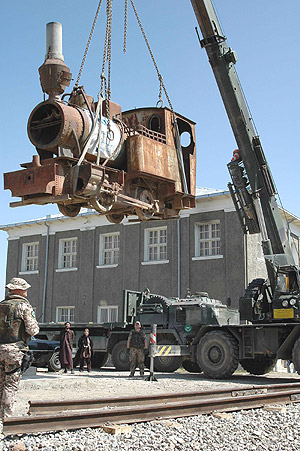
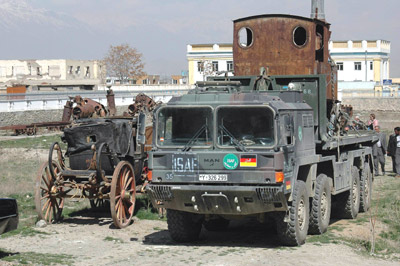
The May 2007 Rail Passion magazine article is broadly similar to this April 2006 article from NATO: German ISAF Personnel relocate historical railway engine. I’ve borrowed ISAF’s photos of the loco being moved, and from the un-bent cab it looks to be the one in Major Fraser’s photos (above). Other reports suggest that one of the three locos is actually 2′ gauge, rather than the 2’6″ of the other two engines, so all three are unlikely to have worked on the same line (if anyone happens to be passing Darulaman and has a tape measure, it would be interesting if the gauges could be confirmed). Quite where it did work is still a bit of mystery, as until recently all reports only mentioned two locos at the museum site.
The locos can (just) be seen on this photo at Kabul guide.
Une vapeur Henschel
Thursday, May 10th, 2007The May 2007 issue of French magazine Rail Passion (issue no.115, page 86) has a one-page article by Dimitri Beck about the plinthed steam locomotive at Kabul museum.
“Une vapeur Henschel devant le musée de Kaboul” has two photos, including a rather nice view showing German NATO soldiers putting one of the locos on a four-axle military lorry; moving the loco 200m to the museum for safe-keeping took about 3 hours.
There is a mention of Wim Brummelman, who sent me some photos of the three locomotives in the past.
Thanks to Thomas Kautzor for alerting me to it.