Railway not in use yet

“Hairatan-Mazar Railway Not Yet Utilised” writes Tamim Shaheer at Tolo News on 12 April 2011.

The work of the railway connecting Hairatan border with the northern city of Mazar-e-Sharif has not been completed as planned. … The Afghan Ministry of Public Works said an operational team is to come to Afghanistan from the neighboring Uzbeskistan to help speed up the work.

The Ministry says the construction company is to employ 600 workers soon to complete the project so that the railway can be utilised soon.

[More…]

The Russian march on India

Poverty Bay Herald, Volume XXVIII, Issue 9118, 11 April 1901, Page 4 at the National Library of New Zealand. The author is presumably Sir Henry Norman, 1st Baronet.

THE RUSSIAN MARCH ON INDIA.

A SECRET RAILWAY LINE.

(By Henry Norman, M.P., in Scribener’s Magazine.)

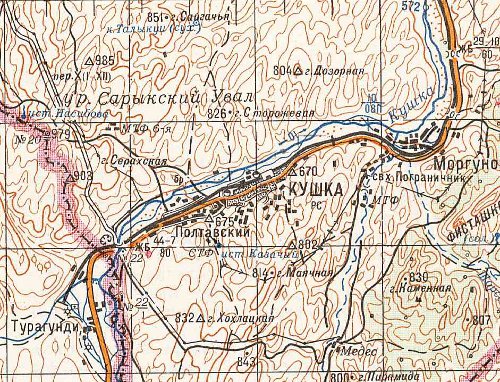
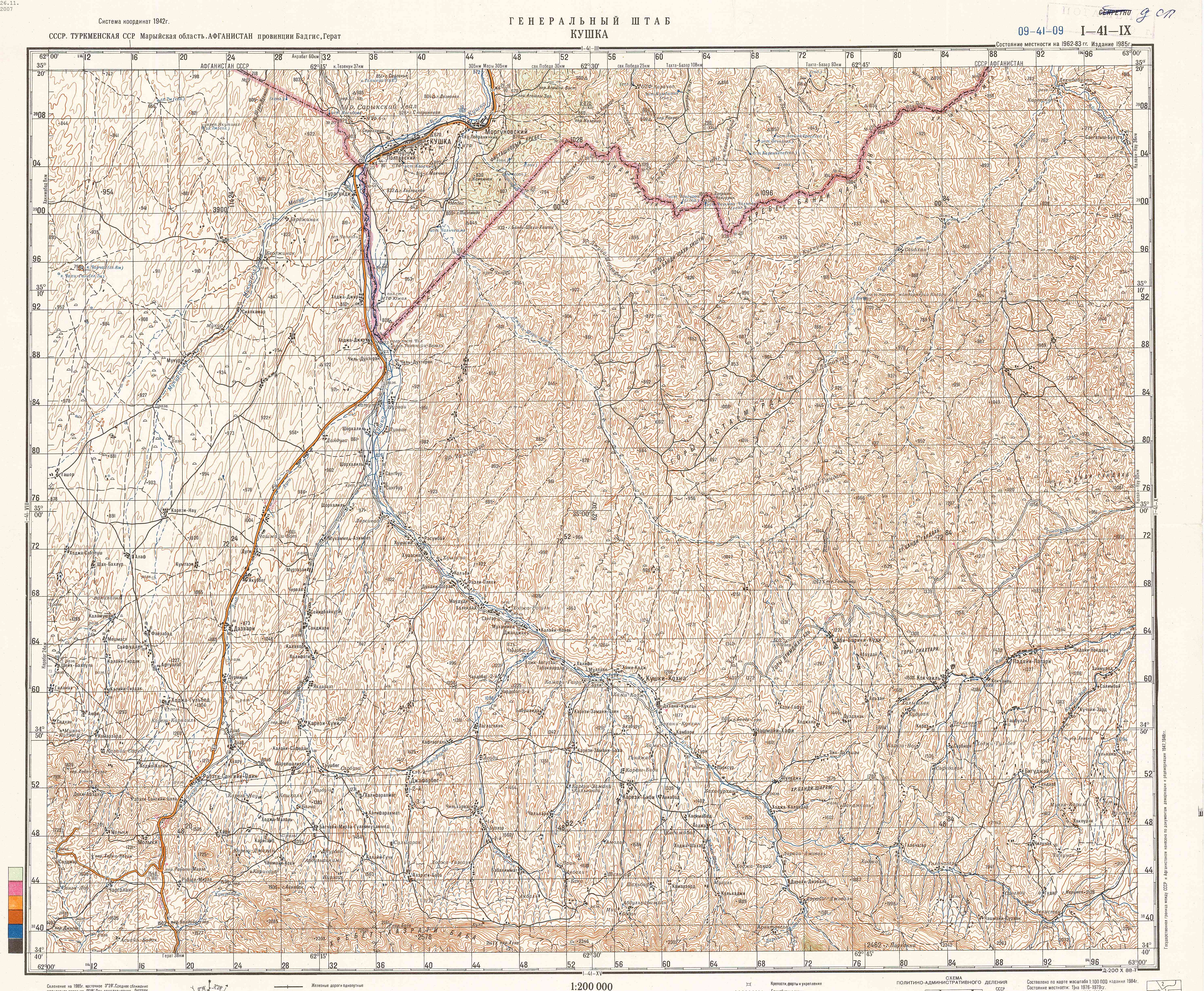
Merv – once the “Queen of the World,” and a household word in England, thanks to O’Donovan and Marvin and Vambery, as the possible cause of war with Russia, whose absorption of Central Asia brought her here m 1884— just a year before Parliament, at Gladstone’s behest, voted £11,000,000 of war money at a sitting in view of Rusia’s next step south. Now the whole oasis of Merv, one of the most fertile spots m the whole world, is as Russian as Riga, and when you say “Merv” in Central Asia you mean a long, low, neat stone railway station, lit by a score of bright lamps in a row, where the train changes engines, where in a busy telegraph office a dozen operators sit before their clicking instruments; and if you are a Russian officer or official you mean also a bran new town where a pestilent malarial fever is sure to catch you sooner or later, and very likely to kill you. But Merv has long ceased to be a Russian boundary, for m the dark you can see a branch line of railway stealing southward across the plain. This is the famous Murghab branch, the strategical line of one hundred and ninety miles along the river to the place the Russians call Kushkinski Post, on the very frontier of Afghanistan, a short distance from Kushk itself, and only eighty miles from Herat. The Russians keep this line absolutely secret, no permission to travel by it having been ever granted to a foreigner. My own permission for Central Asia read, “With the exception of the Murghab branch.” A foreigner once went by train to Kushk Post, however, but this was an accident and it is another story.
This line is purely strategic and military. Neither trade nor agriculture is served by it; nor would anybody ever buy a ticket by it, if it were open to all the world. Moreover, it runs through such a fever-haunted district that Russian carpenters, who can earn two roubles a day, throw up the job and go back to earn fifty kopecks at home. The line is simply a deliberate railway menace to Great Britain. It serves, and can ever serve, only the purpose of facilitating the invasion of India, or of enabling Russia to squeeze England by pretending to prepare the first steps of an invasion of India, whenever such a pretence may facilitate her diplomacy in Europe. This fact should always be borne in mind. Nothing would embarass Russia more than to “have her bluff called,” in poker language — to be compelled to make her threat goood. But it may safely be prophesied that many a time we shall hear of troops going from the Caucasus to the Afghan frontier, as she did for an “experiment” last December, and when this happens England must look, not at Afghanistan, but to China or Persia or the Balkans. Some day — and perhaps before long — she will collect a mixed force there without England’s knowledge, and seize Herat by a coup de main, m the confident belief that the British Government will do once more That it has so often done before, namely, accept tamely the accomplished fact. In simple truth, Herat is at her mercy. And the cat does not look at the cream for ever. The Merv-Kushk line, I may add, is now completed, and two regular trains a week run over it, at the rate of something less than ten miles an hour, reaching the Afghan frontier terminus in eighteen hours. But I do not fancy that Kushk Post itself has anything very wonderful to show yet in the way of military strength. It is interesting, however, as one stands here on the edge of the platform and looks down the few hundred yards of this mysterious line visible in the dark, to reflect that if the future brings war between England and Russia its roaring tide will flow over these very rails for the invasion of India, and that if it brings peace this will be a station on the through line between Calais and Kandahar. Some day, surely, though it may be long, long hence, and only when tens of thousands of Russian and British soldier-ghosts are wandering through the shades of Walhalla, the traveller from London will hear on this very platform the cry, “Change here for Calcutta !”

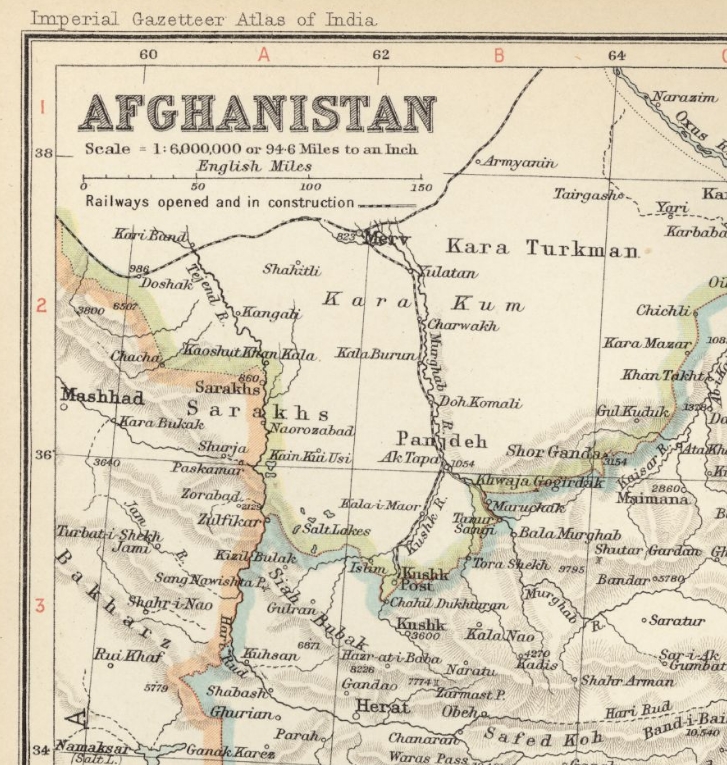
Imperial Gazetteer of India 1909 map of Afghanistan

Imperial Gazetteer of India map of Afghanistan from 1909 showing the Russia railway from Merv (Mary) to Kushka (Serhetabat). (Source: Digital South Asia Library)

Soviet (troop?) train at the Turkmenistan border crossing

There is a train in the backgrounds of this RIA Novosti photo of the Kushka (Serhetabat) area.

  • Photo #644466: First stage in the Soviet troop withdrawal from AfghanistanSoviet soldiers-internationalists returning home from the Democratic Republic of Afghanistan. Turkmenistan, Kushka. 18.10.1986, Yuriy Somov

Also of interest:

  • Photo #578559: Reproduction of “View of the Trans-Caspian Railway” sketch by artist N. Karazin. The State Historical Museum. Russia, Moscow. 01.01.1910

Trains on Afghan trucks

In a second-hand book shop in Beverley over Christmas I came across (though didn’t buy) Afghan Trucks, a book of photos by Jean-Charles Blanc published in 1976.

It has very few words, just an introduction, but contains lots of photos of brightly-painted lorries in Afghanistan; there are some examples at Tabsir.net.

The pictures painted on the lorries have themes including aerial battles; rockets and interstellar spacecraft; armadas of galleons and fleets of steamers; duels fought to the death between savage beasts, and there were even some lorries decorated with pictures of trains.

One picture was of a train from the USA’s Santa Fe railway, and one was of an exotic-looking streamlined passenger train which I couldn’t identify – perhaps Russian?

Opening of the Friendship Bridge, 1982

The RIA Novosti news agency has various photos online, including these showing officials at the formal opening of the Friendship Bridge between the USSR and Afghanistan on 11 May 1982, and Soviet military use of the bridge.

  • Photo #481959: Secretary General of the Central Committee of the People’s Democratic Party of Afghanistan, Chairman of the Revolutionary Council of the Democratic Republic of Afghanistan Babrak Karmal and First Secretary of the Central Committee of the Communist Party of Uzbek Soviet Socialist Republic Sharaf Rashidov at the opening ceremony of the highway and railroad bridge between the USSR and Afghanistan. V. Chistiakov, 11.05.1982
  • Photo #481950: Babrak Karmal, general secretary of the People’s Democratic Party of Afghanistan and chairman of the Revolutionary Council of the Democratic Republic of Afghanistan, at the ceremony opening a motor and railroad bridge between the Soviet Union and Afghanistan. V. Chistiakov, 11.05.1982
  • Photo #481951: Automobile and rail bridge across Amu Darya River between USSR and Afghanistan. The bridge is 816 meters long. V. Chistiakov, 11.05.1982

A Soviet freight train at Hayratan, with freight being unloaded from railway vans into custom-painted lorries:

  • Photo #660247: Unloading humanitarian aid from Soviet Union. Hairaton port. Democratic Republic of Afghanistan. V. Zupharov, 01.08.1986.

And the road at the time:

  • Photo #636884: The road from Hairaton to Kabul. V. Kiselev, 01.10.1989

The Soviet withdrawal:

  • Photo #476670: The first military convoy crosses the Friendship Bridge over the Amu Darya River during the Soviet troop pullout from Afghanistan. V. Kiselev, 18.05.1988
  • Photo #482919: The last Soviet combat vehicle leaves Afghanistan. The USSR conducted a full pullout of its limited troop contingent from Afghanistan in compliance with the Geneva accords. A. Solomonov, 15.02.1989
  • Photo #482941: Back to homeland. A welcome ceremony for Soviet troops returning from Afghanistan near Termez, Uzbek Soviet Socialist Republic Alexander Liskin, 06.02.1989
  • Photo #644825: Soviet troop withdrawal from Afghanistan. Soviet troop column returns to homeland. V. Kiselev, 01.02.1989

On a railway-related subject:

  • Photo #483133: On November 1986 Moscow customs officers found 1217 of hashish in a railway container which was bound from Afghanistan to FRG. The owner of contraband goods is American company Specific International. The drug was destroyed at the training ground of the Fire Inspection Administration of the Moscow region in the presence of Soviet and foreign journalists. Yuryi Abramochkin, 13.10.1987

Turkmenistan to Afghanistan railway discussed

Prospects for Turkmen-Afghan cooperation in railway sector discussed in Ashgabat

A meeting with a delegation of the Ministry of Public Works of the Islamic Republic of Afghanistan led by Advisor to Minister Abdul Jamil Haser took place at the Ministry of Railway Transport of Turkmenistan.

During the meeting it was noted that currently economic cooperation between Turkmenistan and the Islamic Republic of Afghanistan was developed dynamically in many fields. For many years Turkmenistan has been supplying electricity to the northern regions of Afghanistan. This February President of Turkmenistan Gurbanguly Berdimuhamedov issued the Resolution on construction of a new power transmission line towards Afghanistan that would enable to increase exports of Turkmen electricity to the neighbouring country as high as 5 times. The preparations for implementation of the Turkmenistan-Afghanistan-Pakistan-India gas pipeline project are underway. Trade cooperation between the two countries is enhanced steadily.

In this context emphasis was put on the timeliness of the international initiatives to strengthen peace and stability in Afghanistan put forward by the leader of the Turkmen state at the 65th session of the United Nations General Assembly. These included the vitally important task to provide assistance to Afghanistan in development of transport infrastructure suggested by the President of Turkmenistan. In particular, the Turkmen leader put forward the proposal to implement the project of construction of a railway line from Turkmenistan to Afghanistan with a view of extending it onward in the territory of Afghanistan. International organisations, donor countries and international financial institutions could collaborate actively on this project.

The meeting participants discussed the specific aspects of this project and the possibilities to construct a new railway route, which would become an important link of the international railway network connecting countries of the Asian region.

In particular, the project provided for construction of the two sections of the railway route: the 85-km section Atamyrat-Imamnazar in the territory of Turkmenistan and the 35-km section from Imamnazar to Akina [Aqina] settlement in territory of Afghanistan.

The Turkmen partners informed the Afghan counterparts that the design work under the project for construction of the Atamyrat-Imamnazar section was nearly completed. This section will be built by the subdivisions of the Ministry of Railway Transport of Turkmenistan. The members of the Afghan delegations suggested that Turkmen specialists be involved in conducting a feasibility study and building the Imamnazar-Akin section in the territory of Afghanistan.

The meeting participants emphasized that dynamic trade and economic partnership between the two countries as well as implementation of new joint infrastructure projects would offer a powerful impetus to boost Afghan economy, address social challenges such as employment of local population, attract investment and have a positive influence on the current situation in the country.

Source: State News Agency of Turkmenistan, 2011-03-10

Border checks at Hayratan

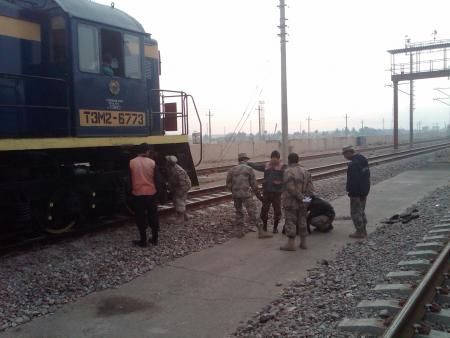
TEM2 locomotive at Hayratan in Afghanistan

Members of the Afghan National Border Police listen to an instructor as they search locomotive TEM2 6773 near the Hayratan border crossing point (Photo: DVIDS, 2011-01-10).

Ready, CET, Go! A new training program begins at Afghan border

HAIRATAN, Afghanistan — Recently, soldiers of the Military Police “Mohawk” Platoon of 10th Mountain Division’s 1st Brigade Special Troops Battalion in conjunction with the Border Management Task Force trained members of Afghan National Border Police for a Contraband Enforcement Team at the Friendship Bridge border crossing in northern Afghanistan.

[Lots more]

Source: DVIDS press release, 2011-01-16

Afghanistan: Crossroads of the Ancient World

This afternoon I was at the British Museum (along with what seemed to be half of London and a significant proportion of Europe) for the newly-opened exhibition Afghanistan: Crossroads of the Ancient World.
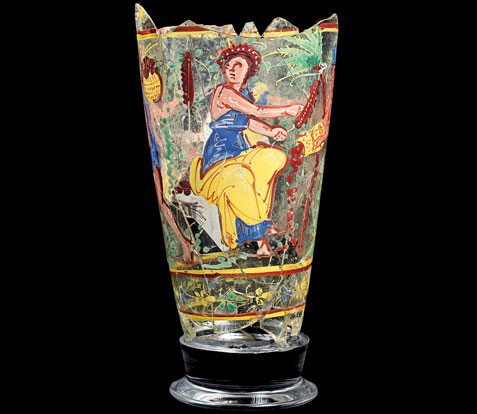
Enamelled glass goblet from Begram, 1st century AD
Enamelled glass goblet from Begram, 1st century AD (© Trustees of the British Museum)

The exhibition offers an impressive display of shiny things from the National Museum of Afghanistan’s archaeological collections, ranging from Classical sculptures, polychrome ivory inlays originally attached to imported Indian furniture, enamelled Roman glass and polished stone tableware brought from Egypt, to delicate inlaid gold personal ornaments worn by the nomadic elite.

These showcase the trading and cultural connections of Afghanistan and how it benefited from being on an important crossroads of the ancient world.

The highlight for many visitors seemed to be a gold crown, though I was impressed by the enamelled glass (above).

All of these objects were found between 1937 and 1978 and were feared to have been lost following the Soviet invasion in 1979 and the civil war which followed, when the National Museum was rocketed and figural displays were later destroyed by the Taliban. Their survival is due to a handful of Afghan officials who deliberately concealed them and they are now exhibited here in a travelling exhibition designed to highlight to the international community the importance of the cultural heritage of Afghanistan and the remarkable achievements and trading connections of these past civilisations.

The earliest objects in the exhibition are part of a treasure found at the site of Tepe Fullol which dates to 2000 BC, representing the earliest gold objects found in Afghanistan and how already it was connected by trade with urban civilisations in ancient Iran and Iraq. The later finds come from three additional sites, all in northern Afghanistan, and dating between the 3rd century BC and 1st century AD. These are Ai Khanum, a Hellenistic Greek city on the Oxus river and on the modern border with Tajikistan; Begram, a capical of the local Kushan dynasty whose rule extended from Afghanistan into India; and Tillya Tepe, (“Hill of Gold”), the find spot of an elite nomadic cemetery.
Source: British Museum, November 2010

The exhibition was very busy on a Sunday afternoon, but I manged to get a ticket for timed admission within 40 min of arrival (you can pre-book online) and spent a bit over an hour inside. It isn’t heavy on detailed labels, just impressive exhibits. The exhibition is on from 3 March to 3 July 2011.

Some reviews

  • BBC
  • Guardian
  • Independent
  • Londonist
  • Telegraph
  • And the trains…?

    At risk of stating the blindingly obvious, this exhibition of ancient artefacts contains nothing about railways. Having said that, flicking through the catalogue I found a description of the problems the Kabul museum has suffered. In 1995,

    In the no-man’s-land behind the museum, one locomotive from King Amanullah’s railway stood rusting, the second one was stripped down for scrap metal.
    Source: Afghanistan: Crossroads of the Ancient World, Fredik Hiebert and Pierre Cambon (editors)

    This again suggests that there was once two locomotives at the museum, which agrees with some other past news reports. Photos show three locomotives now, so where did the third one come from?
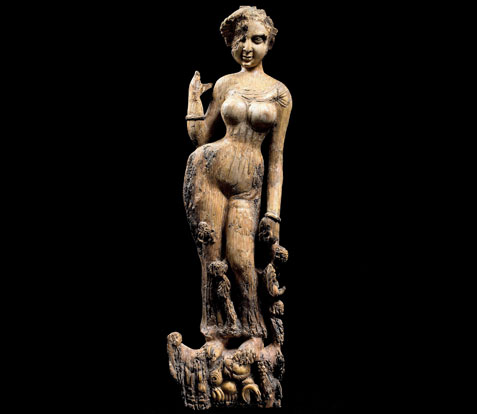
    (© Trustees of the British Museum)
    Indian ivory furniture support from Begram, 1st century AD (© Trustees of the British Museum)