Photos of a train crossing the Uzbekistan-Afghanistan border, taken by Australian humanitarian relief worker Liz Johnson. The loco is an Uzbek Railways’ TEM2 diesel, built at the Bryansk Engineering Works in Russia to a design which evolved from some US Alco locos supplied to the USSR under the World War II lend-lease scheme.
Afghanistan’s railways
Chaman – Spin Boldak railway plans in the 1960s
Some old articles from Railway Gazette regarding a unrealised 1960s scheme for a rail link from the Pakistan Railways railhead at Chaman to Spin Boldak, a short distance across the border in Afghanistan.
Spin Boldak is a major border crossing point, and it seems that railway extension plans have been talked about every so often.
20 May 1966
Talks between Afghanistan and Pakistan were held on May 4 1966 regarding building a railway to Spin Baldak. 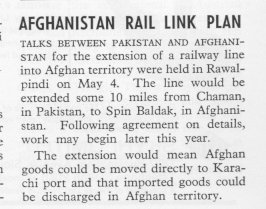
2 September 1966
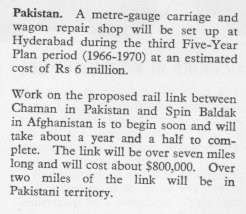
Construction to Spin Baldak “is to begin soon”.
17 May 1968
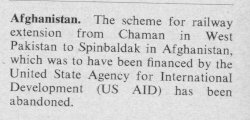
Bad news: the Spinbaldak scheme, which was to have been financed by the US Agency for International Development, has been abandoned.
(clippings © Railway Gazette International)
Photos of the Hayratan rail terminal
 The website of the UAE-based Azizi Hotak General Trading Group has some December 2007 photographs of rail operations at Hairaton terminal in Afghanistan, showing Uzbek Railways’ loco TEM2 3199.
NATO rail access to Afghanistan
The address by Uzbekistan’s President at the NATO Summit in Bucharest on April 3 2008 mentions rail access on the Uzbek Railways line to Afghanistan.
Taking this opportunity, I would like to state that Uzbekistan stands ready to discuss and sign with NATO the Agreement on providing for corridor and transit through its territory to deliver the non-military cargos through the border junction Termez-Khayraton, practically the sole railway connection with Afghanistan.
At the same time, the sovereign interests on maintaining the security and legislation of our country must be observed.
The agreement on railway transit of Bundeswehr cargos through the territory of Uzbekistan signed by Uzbekistan with the German side on March 4 this year could be taken as basis for the future Agreement.
An agreement has also been reached “to allow the alliance to ship non-lethal freight across Russian territory to military forces in Afghanistan”
Azizi Hotak Rail Ops
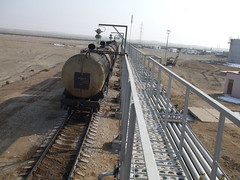
Some more photos of Hayratan, taken by Donald Hill.
Afghan locos found in Austria
Simon Darvill has found four more industrial locos which were supplied to Afghanistan – and two of them survive in Europe.
Ruhrtaler seem to have delivered more locos to the same Mahipar project as the other Ruhrtalers. However these were delivered to Siemens-Bauunion GmbH, München. They were 3800 and 3812-4 of 1965. They were of the same G 60 O/V type, and 600 mm gauge.
The Siemens website describes Siemens-Bauunion.
Siemens-Bauunion GmbH was founded in 1921 as a subsidiary of Siemens & Halske AG and Siemens-Schuckertwerke GmbH. Previously the Siemens parent companies had contracted out the civil engineering works necessary for the building of power plants, tramways and subways to external companies, but because they worked with these companies they had their own experienced staff of civil engineers and building workers. In order to make better use of this potential and to be in a position to offer large-scale building projects from a single source, it was clear that the parent companies would have to have their own construction company. In the 1920s, Siemens-Bauunion was responsible for the building of numerous hydroelectric power plants and subways (Athens, Buenos Aires). Much of the motorway construction in the 1930s was also carried out by the Bauunion. In 1972 Siemens sold the company to Dyckerhoff & Widmann AG.
Loco 3800 went back to Austria and was used by a company called Bauhof AKB in Bludenz. It then went to Kärntner Museumsbahn as their number 284. It is now at the Montan- und Werksbahnmuseum in Graz, Austria.
Number 3814 also came back for use by Hochtief Bauunternehmung, on Frankfurt/Main’s U-Bahnbaustelle Bf Westend project [lines U6/U7?]. It was in use here by 1987, then went to the same two preservation sites, numbered 285.
There are details of the locos at Werkbahn.de (in German), which also mentions the Kabul steam locos. It seems the Montan- und Werksbahnmuseum (Mountain and Industrial Railway Museum) in Graz is not currently open to the public.
Anyone got an pictures of these locos?
The third loco identified
Simon Darvill has identified the “third” steam locomotive in Kabul. It is Henschel 19691 of 1923. The entry for it (and for 19680-1) is “Ferrostaal for Kabul-Darulaman, Afghanistan, British India”.
Meanwhile, a blogger in Kabul called Liz went to visit the Kabul museum last month, and provides links describing the revival of the museum. There is also a big photo of the plinthed loco in the snow.
King of Afghanistan’s visit to Swindon works
The Railway Magazine of May 1928 (p410) has photo of the “Time-table of Royal Train in English and Persian” for the King of Afghanistan’s visit to Swindon works, G.W.R. On March 21.
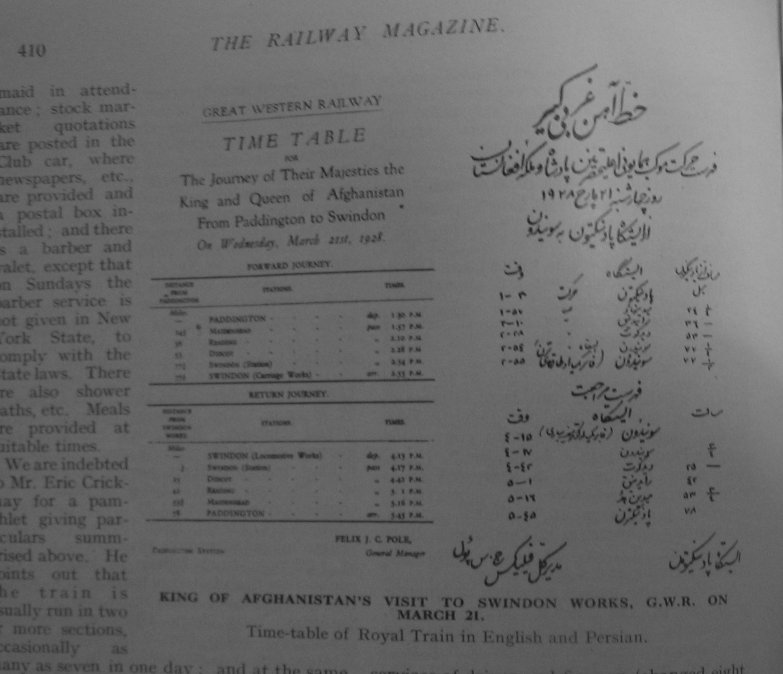
GREAT WESTERN RAILWAY
TIMETABLE
for
The Journey of Their Majesties the
King and Queen of Afghanistan
From Paddington to Swindon
On Wednesday, March 21st, 1928.
More details of King Amanullah’s tour of Europe, with some wonderfully fawning quotes from Railway Gazette. On his peregrinations he also visited Berlin in March 1928, where he went for short ride on – and was allegedly invited to drive – one if the then-new A2 small-profile U-bahn trains, leading to the type becoming known as the “Amanullah-Wagen”.
The March 2008 issue of Majesty magazine has an article: Roaring Twenties: A compelling account of the King and Queen of Afghanistan’s state visit to Britain, by Russell Harris
. When I get chance to pop into one of WH Smith’s public reading rooms I’ll see if there is any railway content.
More industrial diesels supplied to Afghanistan
Records of more locos delivered to Afghanistan have been found by Simon Darvill.
These are two 600mm Deutz OMZ117 F 4wDM locos built in 1938 (w/ns 22732 & 3). They left Deutz on 25/2/1938 and were delivered to “Regierungseinkaufsstelle von Afghanistan, Berlin, für Karachi”. I believe that this translates as Government Purchase Place of Afghanistan – I am showing them as delivered to the Afghanistan Government. I assume that the Karachi reference is where they were shipped to and then were collected by whoever the end user was. Interestingly they were still working in 1954 as Deutz delivered two new A2L514 engines for them in that year. I have no idea the moment what they were used for but it is interesting that all industrial locos supplied to Afghanistan appear to be of the same gauge.
Funicular at Mahipar
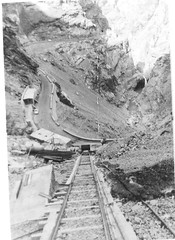
On Flickr is this 1965 photo of some kind of funicular line at Mahipar, used during the construction of tunnels for a power station(?) on the Kabul River.