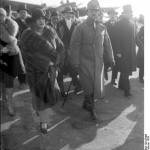
King Amanullah in Berlin

King Amanullah in Berlin (Photo: Deutsches Bundesarchiv <a href="http://creativecommons.org/licenses/by-sa/3.0/de/deed.en">License</a>)

22.2.1928: Afghanischer König in Berlin is a German-language article from Deutsche Welle about King Amanullah’s visit to Berlin during his 1928 European tour.

In the 1920s a number of German engineers, doctors and other experts were Afghanistan to assist with modernisation and development.

King Amanullah’s visit was particularly significant for Germany, because it was the first state visit to the country since its defeat in World War I.

Afghanistan had remained neutral in the Great War, which was useful for Britain as this meant that some of the troops who would otherwise have been needed to defend the Northwest Frontier were available for deployment elsewhere. However the Third Afghan War took place in 1919.

While in Berlin the King drove a type A-II U-Bahn train, which led to the class being known as the Amanullah-Wagen.

Does anyone know where he drove the train – someone must have made a note of which stations he visited?

ADB article about the Hayratan railway project

An article from the Asian Development Bank’s Media Center about the Hayratan to Mazar-i-Sharif project – with the first photographs I’ve seen of railway construction work underway.

The ADB also has an article about railway modernisation in Uzbekistan.

Railway to Regional Integration

by Philip Wood
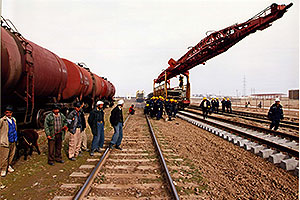
Photograph of railway construction works in Afghanistan

Today, as new trade routes connect landlocked Central Asia with the booming economies of South Asia and the Middle East, Afghanistan’s geographic position is proving a valuable asset.

Hairatan, Afghanistan—For centuries, Afghanistan’s strategic location has been a liability, inviting unwanted attention from countries near and far. But today, as new trade routes connect landlocked Central Asia with the booming economies of South Asia and the Middle East, Afghanistan’s geographic position is proving a valuable asset.

The bulldozers on the dusty northern plains of Hairatan attest to the fact that Afghanistan is poised to become a regional hub for trade and commerce. It is here, across the river from neighboring Uzbekistan, that the building blocks of a 75-kilometer single-line railway are being laid—thanks to a $165 million ADB grant.
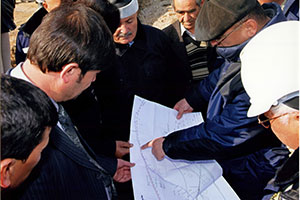
Photograph of railway construction works in Afghanistan

The Hairatan border post is the gateway for almost half of Afghanistan’s road imports, but the existing transport infrastructure cannot cope with expanding trade and humanitarian relief. When completed in late 2010, the new rail line will remove the major bottlenecks that have formed at the border, quadrupling capacity and boosting regional trade.

As part of the Transport Strategy and Action Plan under the Central Asia Regional Economic Cooperation Program (CAREC), the project will open alternative routes of supply for national and international trade, as well as for humanitarian relief coming into Afghanistan.

The new line will connect Afghanistan to Uzbekistan’s expansive rail network. The initial segment will run between Hairatan and Mazare-e-Sharif, Afghanistan’s second largest city. Future links are planned that will run across the north to other parts of the country and region, including Herat, Pakistan, Tajikistan, and Turkmenistan.

“The new train line will boost freight volumes, lower costs, and raise the profile of Afghanistan as a transit route,” said ADB Afghanistan Country Director Craig Steffensen. “In addition, Central Asian states and Xinjiang, People’s Republic of China, will be able to access world markets more cheaply and easily via Afghanistan and seaports on the Gulf, thus improving their competitiveness in world markets.”

Founded in 1997, CAREC is a partnership of eight countries: Afghanistan, Azerbaijan, the People’s Republic of China, Kazakhstan, the Kyrgyz Republic, Mongolia, Tajikistan, and Uzbekistan; and six multilateral institutions: ADB, the European Bank for Reconstruction and Development, the International Monetary Fund, the Islamic Development Bank, the United Nations Development Programme, and the World Bank.

At the heart of CAREC is a plan to develop a seamless network of transport corridors connecting member countries to one another, to fast-growing economies of East and South Asia, and to established markets in Europe and the Russian Federation.
Source: Asian Development Bank, 2010-03-30
Tajik rail link feasibility study

Tajik leader, Asian bank official discuss energy projects, Afghanistan

[Director-General of Asian Develop Bank’s Central & West Asia Department] Juan Miranda said the ADB had been very successful in drawing up a feasibility study of a project to build several other power plants in Tajikistan, power transmission lines from Tajikistan to Afghanistan and a railway line between Tajikistan and Afghanistan, which will link with railways in Turkmenistan and Iran. […] It was also said that the construction of a regional railway had started in the part of Hayratan-Mazar-e Sharif and a feasibility study of the Tajikistan-Herat railway will be ready by this summer. …

Source: Excerpt from report by state-owned Tajik Television First Channel on 2010-03-15, quoted at PennEnergy

Tajik leader, Afghan minister mull electricity exports

Tajik President Emomali Rahmon and Afghan Minister of Economy Abdol Hadi Arghandiwal discussed trade and economic cooperation between Tajikistan and Afghanistan, in Dushanbe today.

At a meeting with journalists following the talks with the Tajik president, the Afghan minister of economy said that “during the conversation with the president, export of Tajik electricity to Afghanistan, the construction of a railway and the construction of a hydroelectric power station on the River Panj were discussed”.
[…]
According to him, at present a railway line from Iran is being constructed in Afghanistan, and it will stretch up to the Tajik Panj, where it will connect with a railway branch of Tajikistan.

Source: Avesta website, Dushanbe, in Russian 2010-03-17, quoted at Hydroworld

Wheat by rail in Afghanistan

There is a small photo from 2007 on the website of the Private Sector Development Directorate of Afghanistan’s Ministry Of Commerce And Industry, which shows the off-loading of wheat imported from Uzbekistan at Hayratan.

The caption says The rail-wagons carry the wheat from Uzbekistan, off-load, and return empty. In the absence of facilities in Hairaton, these wagons could be utilized to export/transit goods from Afghanistan to Uzbekistan and beyond. However, there is no formal arrangement between the two countries to allow such exports or transit of goods through Uzbekistan.

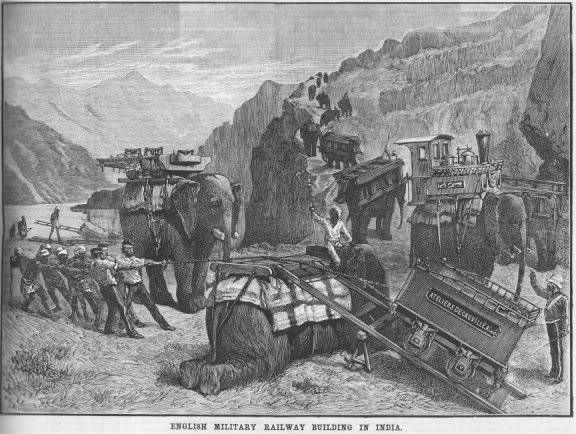
Elephants carrying locomotives through the Bolan Pass

Posted by Robert Grauman at Practical Machinist is an article about railway construction during the Great Game which appeared in 15 August 1885, issue of Scientific American, having originally appeared in French magazine L’Ilustration. I guess it is now out of copyright, so I’ll post it here too.

The Bolan pass is now in Pakistan.

An English military railway

Sketch of elephants carrying dismantled railway locomotives in the Bolan Pass
“The English army has succeeded in establishing a portable railway on several points of the Bolan Pass. This railroad is of the Decauville system, formed in sections of small steel rails, which can be put down or taken up very quickly. This ingenious railway – which has been used considerably for work on the Panama Canal and for the transportation of sugar cane in Australia and Java – has become the indispensable means of transport in all wars. It is at present being used in Tonquin and Madagascar by the French army, and is also being used on the Red Sea by the Italian army. When the Russian government commenced the war in Turkestan, in 1882, it bought one hundred versts, or about 66 miles, of the Decauville railroad, which Gen. Skobeleff used with great success for the transportation of potable water and for all the provisions for his army. This railroad was taken up as the army marched forward, and when the Russians advanced recently, in Afghanistan, the little railway appeared at the advance posts, and was described to the English army by the officers who watched the operations for the Afghans. An order for a similar apparatus was given by the English government to M. Decauville, directions being given that the road should be of the same type as that furnished to the Russians. The object of this was, probably, that any sections of road which might be captured from the Russians during the war could be used by the English. In this last order there was one problem which was very difficult to solve; all the material had to be carried by elephants, and they wanted a locomotive. M. Decauville had the locomotive made in two parts, the larger of which weighed on 3,978 pounds, the greatest weight that an elephant can carry.”

“This episode of the Anglo-Russian conflict, illustrated in the annexed cut, is a great conquest for our national industry, for the works of M. Decauville are at Petit-Bourg, that is, in France, and only an hour from Paris. They cover about 20 acres on the bank of the Seine, and adjoin the P.L.M. The great hall is 525 feet long by 525 feet deep. The material is brought in at both ends (at one end the rails and steel for the road, and at the other end the sheet metal and iron for the cars), and the manufactured products are taken out at the middle, loaded in the cars of the P.L.M Co. In July, 1884, the works of Petit-Bourg attained their greatest development, with a thousand workmen, and 350 machines, which do the work of 3,000 men. Among others, there are four painting machines, which do the work of 60 painters. Three thousand cars and 93 miles of road are produced each month.”
Source: Scientific American, 15 August 1885, quoted at Practical Machinist‘s Antique Machinery and History forum 2010-02-26

Mazar-i-Sharif line to be extended to Dara-i-Sauf

MAZAR-I-SHARIF: Work on railway line to begin soon: Officials from Uzbekistan and Afghanistan have agreed to launch construction work on a 75-kilometre railway line, linking Mazar-i-Sharif with the Hairatan dry port.

An agreement to the effect was reached at talks between the two sides on January 16.

The construction of another railway line — linking the airport in Mazar-i-Sharif to Dara-i-Sauf district of neighbouring Samangan province — would be launched in the second phase, he revealed.

[more]

Source: South Asian Outlook quoting Pajhwok Afghan News, 2010-02-??