Railway “Just like pushing a knife into my vitals”

The Amir of Afghanistan’s colourful and often-quoted description of British railway expansion towards his country being like a knife in his vitals comes from his autobiography.

having cut a tunnel through the Khojak Hill they were pushing the rail line into my country just like pushing a knife into my vitals
Source: The Life of Abdur Rahman, Amir of Afghanistan, volume 2, page 159
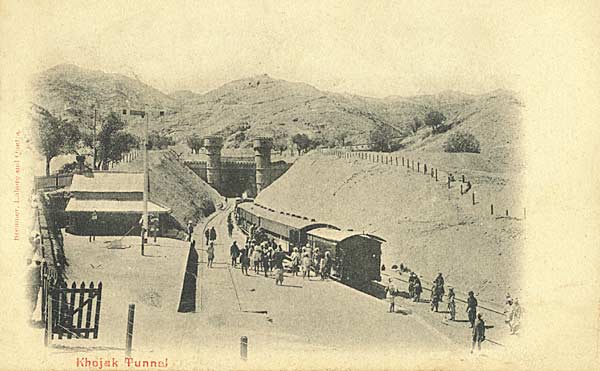
the Khojak tunnel, circa 1905

The Khojak Tunnel is on the Chaman Extension Railway, which opened in September 1891 to link Quetta with Chaman on the Afghan frontier. Chaman would have been the starting point for the construction of a British railway to Kandahar, had the military situation required it.

The book The Life of Abdur Rahman, Amir of Afghanistan, G.C.B., G.C.S.I. (John Murray, London, 1900; reprinted in 1980), is nominally the autobiography of the monarch known as the “Iron Amir” who ruled Afghanistan from 1880 to his death on 1 October 1901.

However the introduction to the 1980 reprint by Malcolm E Yapp suggests the book was written by state secretary Sultan Mahomed Khan, who travelled England to study at Christ’s College in Cambridge where he wrote a dissertation on the laws of Afghanistan. Sultan Mahomed Khan corresponded with the Amir while writing the book, but the Amir died before seeing the finished work.
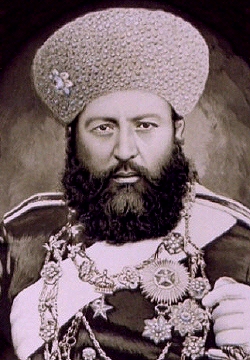
Abdur Rahman, Amir of Afghanistan

Yapp calls the book “a careful piece of propaganda designed to present the Amir to British readers in the most favourable light”. Meanwhile, in Afghanistan “it was better for the Amir’s reputation that he did not appear as the author.”

Yapp notes that the Amir “was absorbed by the latest mechanical contrivances (he claimed to mend all the watches in Kabul) and had a vast store of miscellaneous items of information.”

He was “a man of depth and complexity. […] On the one hand he murdered his opponents with a relish which bordered on the sadistic and on the other he could spend hours arranging flowers in vases.”
Osama and Bush on a train

This thing actually exists… an Operation Enduring Freedom “Get Osama” model railway wagon.

The O-gauge model features Osama bin Laden on a flying carpet, and George W Bush riding a missile, Strangelove style: The war against terrorism is not for the weary. When the leader of the free world mounts his trusty missile, the bad guys need to watch out. He always gets his man.

Afghanistan allocated Railway Country Code

Railway Country Code 68 has been assigned to Afghanistan by the International Union of Railway (UIC) and the Organisation for Cooperation Between Railways (OSJD), the Afghanistan Railway Authority has announced.

AfRA said “all current railway stations, such as Hairatan, Naibabad and Mazar-e-Sharif will also be assigned Station Codes, to enable location identification for rail operations movements.”

Afghanistan joins OSJD

The Organisation for Cooperation Between Railways (OSJD or ОСЖД) approved Afghanistan Railway Authority’s request for membership on 6 June 2014, with Afghanistan becoming the 28th country to join.

The XLII session accepted the application of the Government of the Islamic Republic of Afghanistan for OSJD membership and accession to the SMPS and SMGS Agreement.
Source: XLII session of OSJD Ministers (Vilnius, 3 – 6 June 2014), UIC eNews No.404, 17 June 2014

OSJD was established in 1956 to promote technical co-operation and provide a common legal framework to facilitate international passenger and freight transport between member states. Its members are mostly in the former USSR and Eastern Europe, and also include Iran, China, North Korea, Vietnam and Cuba (presumably there is not much through-running to Cuba).

The Intergovernmental Organisation for International Carriage by Rail (OTIF) does similar things in western Europe and beyond; some countries are members of both OSJD and OTIF (if you think this is a confusing acroynm-fest, note that at the XLII session of OSJD Ministers, UIC, CCTT and OTIF all signed MOUs with OSJD…).

In order for Afghanistan railways to connect and integrate with regional and international rail networks, the Afghanistan Railway Authority must align its policies and regulations with that of regional and international organisations such as the International Union of Railways (UIC), Organisation for Carriage of International Freight by Rail (OTIF) and the Organisation for Cooperation between Railways OSJD.
Source: Afghanistan’s Membership to the Organization for Cooperation of Railways (OSJD) Ministry of Public Works/Afghanistan Railway Authority, 25 June 2014

The Afghanistan Railway Authority joined the International Union of Railways (UIC) at the end of 2013.

Concrete sleepers in Kandahar

A company at the Shorandam Industrial Estate in Kandahar says it has a sleeper factory, using Italian technology to produce concrete sleepers to Russian standards.

Mahmoud Star Steel Mills is the first company in Afghanistan to set up mobile factory to manufacture Railway Sleepers for the reconstrution of the Afghanistan Railway Line project across the whole Afghan Region […] MSSM Railway Concrete Sleepers Plant for the production of concrete sleepers uses modern technologies from Italy to produce Quality Certified Concrete Sleepers for the future development of Afghan Railway Project.

Can anyone confirm whether this is actual rather than aspirational? Kandahar is a long way from the Mazar-i-Sharif line.

Stars & Stripes in Hairatan

A report from Stars & Stripes about US support for the development of rail capabilities at Hairatan. US Army Captain Donald Moyer “estimates that Afghan rail is still at least a decade away from being self-sufficient”.

There are some good aerial photos of the railway facilities, including an unusual view of a TEM2 seen from high above.

[…]
In their 10 months at Port Hairaton, the five rail team members say that while much has improved, it’s been challenging to get Afghans to buy into the concept of the railroad as part of an interconnected transportation system, instead of an independent entity. Their work has been slowed, too, by bureaucracy: Several ministries are trying to have a say about the future of Afghan rail.
[More…]

Source: Work on Afghanistan’s sole rail line falls to five soldiers, Heath Druzin, Stars and Stripes, 24 May 2014

Afghanistan buys two locomotives

Afghanistan has bought two locomotives of its own, according to a recent report about the Hairatan – Mazar-i-Sharif railway. This is significant because these are probably Afghanistan’s very first mainline locomotives.

Afghanistan is expected to eventually take control of the railroad. It has already assumed responsibility for some tasks and purchased its first two locomotives.
Source: U.S. works to get Afghans on track with rail network, Drew Brooks, Fayetteville Observer, 2 May 2014.

Until now, rail operations in Afghanistan have (as far as I know) always been handled by Soviet and subsequently Uzbek/Turkmen railways locomotives from across the border.

But what are the two Afghan locos?

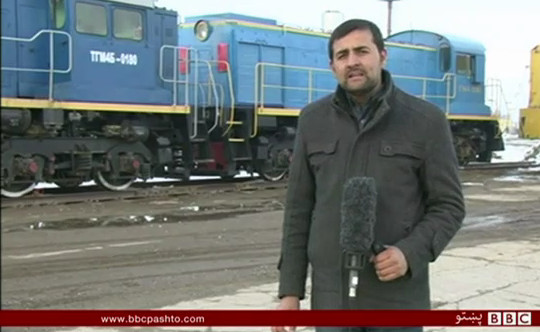
A recent BBC Pashto video about Hairatan showed a couple of diesel locomotives of a type I’ve not previously spotted in images of Afghanistan (at about 1:10 in the video):

Screenshot of BBC Pashto video showing railway locomotives at Hairtatan in Afghanistan

These are diesel locos ТГМ4Б-0180 (TGM4B) on the left and what looks to be a ТГМ4А (TGM4A) on the right. There are details of the TGM4 family (in Russian) at tgm4.ru

Russian enthusiast website Trainpix lists ТГМ4Б-0180 as having been built by the Lyudinovskiy Locomotive Works (now part of the Sinara Group) in 1990. As of 2013, it was owned by locomotive repair company Remzheldorteh at Yaroslavl in Russia, where it was for sale.

So I wonder if the video shows one (or both) of the two locos which Afghanistan has bought? It would make sense for the Afghan locos to be shunters, as all long-distance rail traffic on the Hairatan line has to go to or from Uzbekistan anyway, so may as well use Uzbek locos.

Unfortunately the number of the second loco in the video is not legible, and I don’t know what the presenter says about them, as I don’t speak the language.

If anyone has any more information about these two locomotives, I’d be very keen to hear from you!

Rail developments in northern Afghanistan

An interesting article about the Uzbekistan – Hayratan – Mazar-i-Sharif railway from the Fayetteville Observer: U.S. works to get Afghans on track with rail network, Drew Brooks, Fay Observer, 2 May 2014.

The article is well worth a read. Some highlights:

  • About 4 600 wagons a month use the line between the border and Mazar-e-Sharif.
  • More than 90% of the fuel used by coalition forces enters Afghanistan by rail through Hayratan.
  • The railway from Camp Marmal near Mazar-i-Sharif is a “secondary outlet” for military equipment leaving for ports in Latvia or Estonia.
  • The line is a “major thoroughfare” for coalition military equipment being shipped to Germany or France, but has only carried about 600 to 700 US containers
  • The line is operated by Uzbekistan as part of a bilateral agreement. The Uzbek government – not Afghanistan – collects money from the imports.
  • Afghanistan is expected to eventually take control of the line.
  • Afghanistan has already assumed responsibility for some tasks and purchased its first two locomotives [does anyone know what they are?].
  • The international co-operation that helped create the line is seen as integral to the development of a larger network.
  • “This is the safest place in all of Afghanistan.”

There are also a couple of photos, including a good aerial view of the area around the Friendship Bridge.

Finally: “The idea of a transportation network is a new idea for them,” Hakey said before motioning to a small wooden tabletop. “Back home, you have a lot of interest groups, there are rail fans. Here, you could probably lay out all the photos of Afghan rail on this table.”