Afghan railway terminals from above

The two railway terminals in Afghanistan are now visible at a half-decent resolution in Google Earth.

Hayratan

Unfortunately the eastern-most part of the railway line is still low-resolution, including the Friendship Bridge from Uzbekistan. Some sidings are visible, but no trains.


View Larger Map

Towraghondi

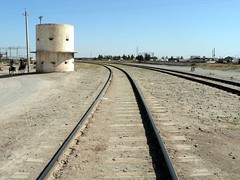
There is more to see on the line from Turkmenistan, with lots of sidings and buildings, and various wagons.


View Larger Map

Freight operations in Afghanistan

Samuel Rachdi of Fahrplancenter has provided me with some information on train operations across Afghanistan’s northern borders.

The Turkmen government has rehabilitated earlier in 2007 the line to Towraghondi and about 20 to 25 wagon loads are brought over this rail line to Afghanistan per week. This line is operated by Turkmen Railways.

In contrast the Termez (Uzbekistan) – Hayratan line is very busy, nearly every day a train is entering Afghanistan, mainly with petroleum products, building material, machines, agricultural products. Every train consits of up to 30 wagons. In the opposite direction very little merchandise is transported, less than 10% against import, so most wagons are leaving the country empty. This line is operated by Uzbek Railways, but with some Afghan employees at Hayratan.

Balochistan Rail Link

A news report which is floating round the web

Plan Ready To Make Balochistan Rail Link For Central Asia

QUETTA, Oct 26 Asia Pulse – [Pakistan’s] federal government has prepared a blueprint for Balochistan to make it a rail bridge for Pakistan trade and a traffic corridor connecting it to Iran, Turkey, Europe and Central Asia.
According to official sources, Pakistan Railway’s blueprints provide for rail access from Gwadar, Pakistan’s third deep seaport along Arabian Sea, to Afghanistan and Central Asian Republics as well as Russia on one side.

On the other side, they said, Gwadar would have a rail link with Iran, Turkey, Europe and beyond. Both these vital rail links would go through southern, central and northern Balochistan. The blueprints show a link between Gwadar-Mastung-Taftan and Zahidan (Iran) on one hand, while on the other from Gwadar to Kandahar (southern Afghanistan) via Mastung-Quetta-Chaman-Spinboldak.

The sources added that at present Gwadar had no rail network, therefore, the government had decided to build 940-kilometer broad gauge from Gwadar (southern Balochistan) to Mastung (central Balochistan) at an estimated cost of Rs75 billion. Mastung is already connected with Quetta on the main line linking Pakistan with Iran via Taftan and Zahidan (Iran). The Quetta-Taftan-Zahidan section (612-km) though Mastung is in process of upgrading to international standard.

Such standard would be at par with Iranian railways, already catering for passengers and freight services to Turkey and the European countries, they added. They said the PR had already set aside a sum of Rs10billion for upgrading of Quetta-Taftan-Zahidan section.

Rail plan for Afghan copper mine

AFP reports on November 21:

Afghanistan has chosen a Chinese bidder to lease a copper mine which is possibly the world’s largest, in a contract that is set to bring in hundreds of millions of dollars, the mines ministry said Tuesday [20 November 2007].

The 30-year lease has been offered to China Metallurgical Group Corporation (MCC) to develop the Aynak mine 30 kilometres (20 miles) east of Kabul, a Afghan mines ministry spokesman said.

China’s commerce ministry said in a statement on its website that MCC, a state-owned metal producer and contractor, and Jiangxi Copper Co. would jointly develop the mine.

MCC, expected to sign a deal in the coming months, is to invest around three billion dollars to explore and develop the mine, which will also provide jobs for thousands of Afghans, Afghan ministry spokesman Kozhman Ulomi said.


The company also said it would build a railway line from the town of Hairatan on the Amu Darya (Oxys River) bordering Uzbekistan, through Logar and to Torkham on the Pakistan border to export the minerals, the official said.

It added that it would construct a town near the mine for 1,500 families. Other spinoffs would include extra demand for Afghan coal and the creation of small industries using other metal taken from the mine, he said.

First discovered in 1974, the mine is estimated to contain 11.3 million tonnes of copper. About 200,000 tonnes could be extracted a year, Ulomi said.

Afghan bogies cancelled

The IANS news story of October 24 Pakistan forfeits $500,000 from Chinese firm says

A Chinese firm that was prevented by Beijing from supplying 300 railway bogies [meaning bogie passenger coaches] that Pakistan had contracted for has lost the Rs.30 million (about $50,000) guarantee money it had paid toward the Rs.1.6 billion contract after Islamabad forfeited the deposit.

Pakistan railway ministry officials were ‘shocked’ to learn that the firm that had been awarded the contract ‘was forcibly stopped by the Chinese government from delivering the consignment’, The News said Wednesday.

The contract for the bogies, meant for developing rail links with Afghanistan, has now gone to an Iranian firm.
[more]

Rail link rebuilt at Turkmenistan’s expense

The 2 km cross-border railway between Turkmenistan and the Torghundi freight terminal is once again operational, reports Turkmenistan.ru, after being “fully reconstructed by the Turkmen specialists in the shortest time” at cost of USD550,000.1.

In early July Turkmenistan’s President Gurbanguly Berdimuhamedov had signed a decree under which Turkmenistan would “overhaul” the railway at its own expense, “with the aim to further develop and strengthen good neighborly relations and to provide assistance to the Afghan people in restoration of the national economy”. The Ministry of Railway Transport told Turkmenistan.ru that the work included replacing “out-of date equipment and mechanisms”

Festivities to mark the reopening of the line were held in Turgundi and Serhetabat. The Afghan side was represented by Governor of Herat province Seyit Hoseyin Anvari, top management of the province’s Chamber of Commerce, staff from the Afghan embassy and representatives of the Turkmen diaspora living in the border regions of Afghanistan. The Turkmen delegation was led by Minister of Railway Transport Deryaguly Muhammetguliev.

References

Reconstruction of Afghanistan – Turkmenistan rail link begins

Turkmenistan starts reconstruction of Afghan railway

A ceremony of launching the reconstruction of a 2 km section of the railway in the territory of Afghanistan that runs into the territory of Turkmenistan was held in Afghan Turgundi and Turkmen Serhetabat towns yesterday. As is known, Turkmen President Gurbanguly Berdimuhamedov put forward this initiative during his recent meeting with Afghan President Khamid Karzai. The initiative relates to the overhaul of the railway including full replacement of mechanisms and equipment at the expense of Turkmenistan including financing of works for the total value of US$ 550,000.

As the Turkmenistan.ru’s correspondent reports, after laying the first symbolic pair of sleepers in the Afghan territory in Turgundi the similar ceremony was held in Serhetabat. The ceremonies were attended by the delegations of two countries. Public Affairs Minister Sohrab Ali Safari, Minister of Labor and Social Security and on Disabled and Shaheed Affairs Nurmuhammet Garkyn, Governor of Herat Seyit Hoseyin Anvari, Afghan Ambassador to Turkmenistan Abdulkarim Haddam represented the Afghan side. The ceremony was also attended by representatives of bordering Afghan settlements where ethnic Turkmens live. Turkmen Minister of Railway Transport Deryaguly Muhammetguliev led the Turkmen delegation.

from TURKMENISTAN.RU 2007-07-12.

This cross-border line was originally built by the USSR to support its forces after their invasion of Afghanistan. The line stretches for around 9.6 km from Kushka in Turkmenistan to Towraghondi. The route is parallel to the Amu-Darya river on the Soviet side, which made it vunerable to cross-border sabotage and military attack during the Soviet-Afghan war. The line fell out of use sometime around the time of the Soviet withdrawal in 1989.

Turkmen Railways to Provide Gratuitous Assistance to Afghanistan

The Ministry of railways of Turkmenistan will construct a railway line in Afghanistan at its own expense.

The cost of the project is USD 5.5 Mln, reports Railway Market-CEE Review referrin to Altaqata.

As the Ashgabat correspondent of Turkmenistan.ru reports quoting the press service of the head of state, Gurbanguly Berdimuhamedov signed a decree to this effect “with a view to further developing and strengthening the neighborly relations between Turkmenistan and the Islamic Republic of Afghanistan as well as providing assistance to the people of Afghanistan in reconstruction of the national economy.”

from RZD Partner 2007-07-13.
Golra Sharif Railway Museum

In 2003 Pakistan’s Dawb newspaper published A journey into the past by Amer Sial, describing the Pakistan Railways heritage museum at Golra Sharif near Islamabad (there is a similar document here). The article says A few historic pictures hanging on the outside walls of the platform included one of Afghan King Amir Abdur Rehman at the Rawalpindi Railway Station in 1886. Another one shows the passing of a steam train through the Khyber Pass in the late nineteenth century.

While I haven’t been to check(!), it seems unlikely there is a C19th photo of a train through the Khyber Pass, as the metre-gauge railway along the Kabul River was extant c.1905-1909, and the more famous broad-gauge Khyber Pass railway opened on 3 November 1925.

I’ve never seen any pictures of the short-lived metre-gauge line – if anyone has one, or knows where I might find one, please let me know.