Coal mining loco identification

There is some discussion of the coal mine railways on the Feldbahnforum website; see the Afghanistan Kohlenminen thread from 20 Okt 2010, 14:29 (you may need to register, and it is auf Deutsch).

The locomotive in this photograph is identified as a BND15. The hopper wagons at the mine are apparently the Czechoslovakian JDV (“unified mining car” design), manufactured by Zelezárny Vítkovicé (Vítkovice iron works).

If I have understood the thread correctly, some BND15 locomotives and also one BND30 were supplied to Afghanistan.

Minister says Turkmenistan link is next

Megha Bahree of Forbes interviews Afghanistan’s Minister of Mines, Wahidullah Shahrani, about mining projects. The article includes this about the next phase of the railway plans:

Shahrani: Right now we have up the railway line from Uzbekistan to Mazar-i-Sharif, which is a big commercial center. This 75 km long railway line cost $175 million and was funded by the ADB. Next phase will be from Afghanistan to the Turkmenistan border. This is 257kms and will take three years and we expect the tenders out by early next year. Apart from this, MCC is also constructing a 921km long railway line that will link Kabul with Turkmenistan, Pakistan, central highland to Mazar-i-sharif.

Source: In The Shadow Of The Taliban, Afghanistan’s Mining Sector Is Open For Business, Megha Bahree, Forbes, 2010-10-21

Turkmenistan to fund Andkhoy line

Turkmenistan is to fund, survey, design and construct a 126 km railway to northern Afghanistan, Ahmad Shah Wahid, Financial & Administrative Deputy at Afghanistan’s Ministry of Public Works said in a 17 October 2010 interview with TOLOnews.1 This would be Turkmenistan’s second line to Afghanistan, after the Towraghondi line.

Starting from the existing 1520 mm Turkmen rail network at Atamurat (also written Atamyrat, previously known as Kerki) the proposed line will run to Aqina on the Afghan border, then run 36 km within Afghanistan to Andkhoy district in Faryab province. It is not clear whether 126 km is the total length, or the length of the section within Turkmenistan.


View Turkmenistan – Andkhoy railway plan in a larger map

Although the article refers to “Aqina harbor”, looking at Google Maps I suspect this is a mis-translation for a border crossing facility, which appears to be well away from any river – well away from anything, in fact.

The Turkmen frontier post is Kolodets Imam-Nazar (also Imamnazar etc), where new border facilities were formally opened on 13 August 2007 with assistance from the USA and United Nations.2

The railway project was discussed in July 2008 and again by various officials from the Afghan and Turkmen governments in August 2010, when ministers also talked about the railway which will connect the Afghanistan via Shabarghan, Aqina and Imamnazar to Turkmenistan.3 An extension from Andkhoy could connect with the planned Mazar-i-Sharif to Herat line at Shirbirghan (Shabarghan and variants).

According to the Ministry of Public Works the railway will boost trade, help to grow the Afghan economy and provide Afghanistan with access to the Caspian Sea and Europe.

However there are no timescales given for construction.

  1. Afghanistan to Build 36km Railway in the North, Tamim Shaheer, TOLOnews, 17 October 2010
  2. Imamnazar new post control was opened at the Turkmen-Afghan border, State News Agency of Turkmenistan (TDH) | 15 August 2007
  3. The Agreement of Support for Implementation of TAPI Project was Signed, Ministry of Mines, 30 August 2010

Construction of the Friendship Bridge

Just south of Termez, at Heratan, on the Amu Darya river, diplomats understand that a reinforced steel bridge is being constructed. The aim, it would seem, is to improve the roads and garrison facilities right from the Soviet border to Kabul

Russians switch to commando-type raids in Afghanistan, Karan Thapar, The Times, 19 September 1980, p1 and p6 (Issue 60728; col C)

Video of Hayratan to Mazar-i-Sharif construction works

From the northern Afghan city of Mazar-e Sharif to the Uzbek border, the land runs flat with barely a hillock to block the way. It is perfect terrain for building a railway

says Afghanistan’s First New Railroad On Track, an 14 October 2010 by Charles Recknagel at Radio Free Europe/Radio Liberty.

There are details of construction and security on the new line from the Uzbek border to near Mazar-i-Sharif:

Currently, the railroad is guarded by a force of 500 police. The headquarters of the force is a small, windswept outpost halfway between Mazar-e Sharif and the Afghan border crossing of Hairaton, where the new rail line starts.

There is also a video showing construction work. This feature a twin-unit locomotive (a 2TE10?) in action at 55 sec, and then a smaller blue locomotive, both presumably belonging to Uzbek state railway UTY.

Revolution on the rails

Historically, Afghans have regarded railways with suspicion. But now the government is embracing a plan that could help the country tap into global markets, delivering prosperity and even peace, says Afghanistan’s revolution on the rails, an article by Jonathan Gornall at UAE newspaper The National.

It includes some interesting comments from railway consultant David Brice, who is working in Afghanistan:

And, [Brice] believes, the Afghans may finally have lost their once well justified distrust of foreigners bearing blueprints for railways. “The local people we talk to are thoroughly behind it all. They want to be able to move around much more easily, and in safety. “Afghanistan never has been a self-sufficient country, and any move towards making that happen is clearly highly desirable. The whole population sees this; they are living in terrible poverty and they need access between labour and jobs and medical services. Everything hangs on a decent transport network, and this is the way to provide it.”
Source: The National, 2010-10-09

ADB funding more studies

On 16 June 2010 Asian Development Bank approved a further USD700 000 from its Technical Assistance Special Fund for:

A study on railway development for Afghanistan completed for the following routes: (i) From Hairatan at the border with Uzbekistan to Heart [Herat] in the west, via Mazar-e-Sharif; (ii) from Shirkhan Bendar at the border with Tajikistan, via Kunduz to Naibabad [which is on the line under construction from Hayratan] joining Mazar-e-Sharif to Heart; (iii) from Torkham at the border with Pakistan to Jalalabad; and (iv) Spainboldak at the border with Pakistan to Kandahar.

Source: Railway Development Study (Supplementary) : Afghani., Is Rep. of, 2010-06-16

Taking it literally, this seems to miss out the link needed from Chaman in Pakistan over the border to Spin Boldak in Afghanistan.

Narrow gauge railways in Tajikistan

Narrow gauge railway Dushanbe – Kurgan-Tube – Kulyab, Nizhniy Panj” – in Russian, but Google Translate works pretty well.

The 750 mm gauge railway network in the southwest of Tajikistan was started in 1929. Originally there were two unrelated lines: Kurgan-Tube – Nizhniy Panj…

Nizhniy Panj is on north side of the river which forms the border with Afghanistan. The railway closed in the 1990s, but there is some talk of building a new line in the area with a bridge to Afghanistan and onward connections to Kunduz, Mazar-i-Sharif and beyond.

There is also a link to a general history of railways in Tajikistan (in Russian).

Turkmen train times

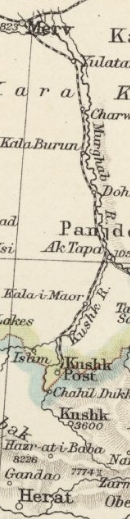
1909 map of Merv to Kushka railway

It seems that Turkmenistan’s national railway Turkmendemiryollari doesn’t have a website, and it is not easy to find information about its train services.

However Samuel Rachdi has done a lot of research, and as a result Turkmendemiryollari timetables can be found at his fahrplancenter.com website.

This includes a timetable for the daily return passenger train on the line built by imperial Russia from Mary to Serhetabat (Kushka), close to the Afghan border.

From Serhetabat the railway continues across the border to the freight terminal at Towraghondi in Afghanistan, but (as far as I know) this section carries only goods traffic. “Two kilometers of the 7-kilometer link lies in the territory of Afghanistan”, according to the Afghan Ministry of Foreign Affairs.