China to Afghanistan via Tajikstan

Zeitschrift der OSShD is a magazine published six times a year in German, Russian and Chinese versions by OSJD, the Organisation for Co-Operation between Railways. The 2/2011 (316) issue has an article (pp1-6) “Tadjik steel railway lines – conquering the mountain peaks” by Amonullo Hukumatullo, head of Tajikistan’s national railway Rohi Ohani Tojikiston. It gives an overview of the railway company, and includes some information about proposed rail links to Afghanistan.

A map accompanying the OSJD article shows a proposed railway from Kashgar (Kashi) in China to Afghanistan. From Kashgar the line runs though Sary-Taşh in Kyrgyzstan (from where a branch would run north to Osh), crossing the Kyrgyzstan/Tajikistan border near Карамык (Karamyk), meeting the existing line from Душанбе (Dushanbe) at Иляк (Ilyak?) a short distance southeast of Ваҳдат (Vakhdat), then running to Яван (Yavan?), and onwards over a line which is currently under construction1 to reach Курган-Тюбе (Kurgan-Tyube, and countless other romanisations).

Leaving the existing Uzbekistan to Kurgan-Tyube line at Джалоліддіна Румі (Jaloliddina Rumi) a new 59 km line costing USD73.2m will run to the Tajik border post at Нижний Пяндж (Nizhniy Panj, which is the Russian name; it’s Панҷи Поён (Panji Poyon) in Tajik).

(There was once a 750 mm gauge line on this section of the route, built in 1929-31 and opened in early 1932 but closed in the 1990s.2 In 2007 a road bridge was opened over the river Amu or Panj Darya which forms the Tajik-Afghan border, called – inevitably – the “Bridge to Friendship”.)3

The map shows the railway entering Afghanistan at Shirkhan Bandar, and continuing to Kunduz. From Kunduz proposed lines are shown running south to Kabul and the Khyber Pass, with a spur to Aynak for the mine, and also west along the northern corridor to Mazar-i-Sharif, Herat and Iran.

There are the usual comments in the article about transit traffic, and how a line though Afghanistan would would mean [insert name]-stan would not have not send traffic though [next door]-stan in order to reach Iran. Tajikistan currently has three sections of railway, but they run east-west and are not interconnected with each other except through Uzbekistan, and there have been claims that Uzbekistan has been delaying Tajikistan-bound traffic.

The magazine article also discusses the gauge problem, coming down in favour of 1435 mm standard gauge for the China – Iran route, rather than the 1520 mm of the existing lines Tajikistan.

Here is a rough attempt at plotting the places in question on a map.


View China – Tajikistan – Afghanistan railway in a larger map

This posting is based on the German version of the OSJD magazine, because I can read a little German. However the place names in the magazine have gone from Cyrillic (and probably Russian rather than Tajik) to German romanisation, though the map itself is in Cyrillic. While I have tried to sanitise the names, they have possibly got mangled en route. No offence is intended if your favourite spelling has been missed! It doesn’t help that some places have changed their names over the years – while it’s perhaps no surprise that Stalinabad has disappeared from the map (it is now Dushanbe), it is less obvious that Kolkhozobod became Jaloliddina Rumi in 2007, in honour of a C13th poet.

Tajikistan is a bit of an information black hole – I can’t even find many photos of trains there, or an official railway website.

Back in January 2011, Hukumatullo told a news conference that more than 160 000 tons of freight were shipped to Afghanistan via Tajikistan in 2010: Since there is now direct rail link connecting Tajikistan and Afghanistan, the cargo was transported from the Tajik railroad station Kolkhozobod to the Afghan settlement of Sherkhan Bandar by vehicles.4 I suspect now should read no, and vehicles means road vehicles.

  1. Tajikistan: Rail Link to Afghanistan under Construction, 19 March 2009, www.EurasiaNet.org
  2. Road vs. Rail. A Note on Transport Development in Tadzhikistan, MV Hambly, Soviet Studies Vol. 19, No. 3 (Jan., 1968), pp. 421-425, Taylor & Francis Ltd
  3. News: Afghanistan, Tajikistan dedicate ‘Bridge to Friendship’, 3 September 2007, Combined Joint Task Force – 82 PAO, DVIDS
  4. More than 160,000 tons of cargo shipped to Afghanistan via Tajik territory, 20 January 2011, Payrav Corshanbiyev, ASIA-Plus news agency, Dushanbe

Vivid evidence for brotherly assistance from neutral Turkmenistan

Afghanistan’s President Hamid Karzai made an official visit to Turkmenistan on 28 May 2011. He discussed the Atamurat to Andkhoy railway proposal with Turkmenistan’s President Gurbanguly Berdimuhamedov, and a “framework agreement” on its construction was signed.

A rather magnificently wordy report on the visit was published the following day by the official new agency “Turkmenistan: the golden age”:

President Gurbanguly Berdimuhamedov invited his Afghan counterpart to enter the Golden Hall where the one to one top level talks were held.
[…]
Along with natural wealth, including abundant energy resources, Turkmenistan situated on transport routes from north to south and from east to west had the profound potential for collaboration in the transit transport sector due to its geographical location. In this contest the Turkmen leader dwelt upon the aspects of bilateral cooperation on the construction of a railway line from Turkmenistan to Afghanistan. In this context President Gurbanguly Berdimuhamedov expressed belief that this railway would facilitate freight traffic in the Asian region and all over the world.
[…]
[Karzai noted that] Currently, the construction of a railway line that would connect our states was being negotiated.
[…]
After the ceremony of signing documents was concluded, the leaders of Turkmenistan and the Islamic Republic of Afghanistan entered the Bayram Khan Hall where they held a press conference.
[…]
Expressing profound gratitude to President Gurbanguly Berdimuhamedov for paying much attention to the aspects of intergovernmental cooperation, the distinguished guest put particular emphasis on the Resolution issued by the national leader Gurbanguly Berdimuhamedov aimed at increasing electricity exports to Afghanistan and the initiative of the leader of the Turkmen state to build a railway line from Turkmenistan to Afghanistan.
[…]
After the talks with the participation of the government delegations were concluded the ceremony of signing the bilateral document took place in the Seljuk Khan Hall.

These included […] the Framework Agreement on the construction of the Atamurat-Ymamnazar (Turkmenistan)-Akina-Andhoi (the Islamic Republic of Afghanistan) between the Government of Turkmenistan and the Government of the Islamic Republic of Afghanistan;
[…]
Upon concluding the official reception, the leaders of the two states bade farewell cordially to each other expressing satisfaction with the outcomes of the talks and exchanged the best wishes to the brotherly nations.

Source: Talks between President of Turkmenistan and President of the Islamic Republic of Afghanistan, State News Agency of Turkmenistan, 2011-05-29.

Here is a map I made for a previous posting on the project:

View Turkmenistan – Andkhoy railway plan in a larger map

Why Hairatan Gate matters

Railway

The rail line at the Hairatan Gate Border Crossing provides residents in Northern Afghanistan not only a chance for economic stability, but a means for helping troops get cargo and equipment back home during the future drawdown.

[Photo: Peter Mayes/DVIDS, 2011-04-26]

Why Hairatan Gate matters

[…]

[Hayratan] is the first and only border crossing with a functioning rail line which currently runs from Hairatan all the way to Mazar-E-Sharif. The intent is to re-establish the distribution network in the north through Europe and Central Asia, and tie that line into its infrastructure.

[…]

Finally, while promoting economic stability in the region, establishing a rail line at the Hairatan gate border crossing fits firmly into the intent laid out by International Security Assistance Forces Commander Gen. David Petraeus to create a means of a future withdrawal from Afghanistan.

“We’re trying to think two to three steps ahead of where we’re at. A safe, reliable route from Afghanistan is a plus,” Wentworth said. “But we also need to ensure that we’re meeting [President Obama’s] intent and conditions that are being laid out.

The rail line was funded by the Central Asian banks and the Uzbekistan government built it.

“It’s just one step in the development of this region,” Wentworth said. “It’s been tested and shown to be functional. All that needs to be agreed upon is the day-to-day operation of it. That’s something that has to be figured out between the two governments.”

[…]
Source: Why Hairatan Gate matters, Sgt. 1st Class Peter Mayes, 101st Sustainment Brigade, 101st Airborne Division (AA) Public Affairs, 2011-05-13

DVIDS also has a video:

Articulated steam locomotives planned for Kandahar

With Azerbaijan being in the news this weekend, it might be a good time1 to mention the book The Transcaucasian Railway and the Royal Engineers by RAS Hennessey (Trackside Publications, 2004. There is a review of it at The International Steam Pages).

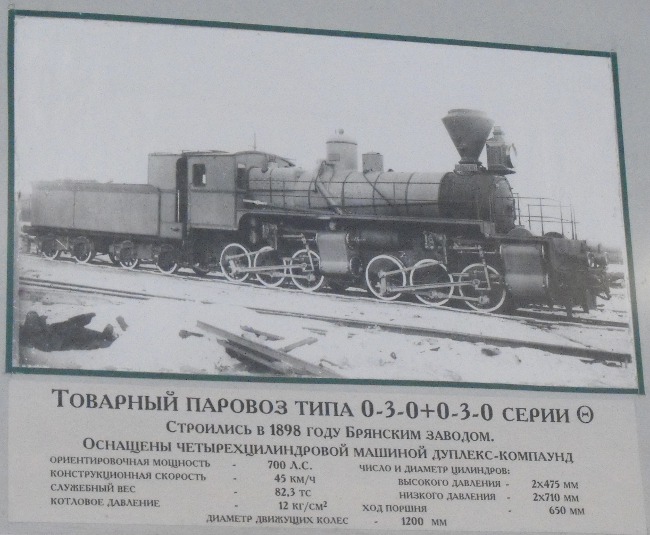
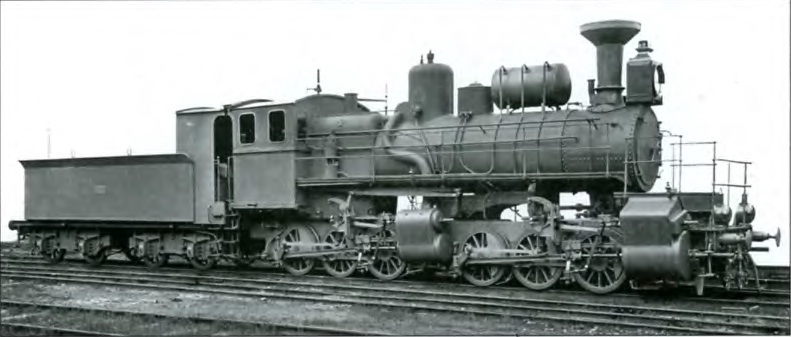
On page 26 the book mentions the use of class Ѳ (an obsolete Russian letter, fita), Bryansk-built 0-6-6-0 Mallet articulated compound steam locomotives on the Transcaucasian Railway.

“An interesting speculation about these Mallets is that their basic design had in mind imperial Russian dreams of a line from Merv to Kandahar, Afghanistan, and thence to Quetta, then in British India (now in Pakistan). The tough conditions of the TCR’s Armenian lines provided a good testing ground for possible locomotives to work this line.”

The reference says this information comes from J Nurminen and FM Page’s book Russian Locomotives vol 2 1836-1904 (I think this should read 1905-24, as 1836-1904 is volume 1, by A De Pater and FM Page). I haven’t yet found a library with a copy of the book to look up the reference.

According to Hennessey, the TCR locomotives “were costly to acquire and their complexity resulted in slow, expensive servicing and maintenance […] Two were apparently spotted derelict in the 1930s at Kars, by then in Turkey.”

There are no photographs of a fita class locomotive in the book. However this photo I spotted on display at the St Petersburg railway museum in March 2011 shows one:

The Russian-language Wikipedia has some basic information on the Ѳ class, though with no mention of Afghanistan. There is also a public domain image from the Kirov plant’s archive showing one with detail differences to the machine in the St Petersburg museum photo:

  1. Tenuous link to popular culture or what? And anyway, I thought the Moldovan gnomes should’ve won.

Hairaton Gate rail port

Gate could open doors to something much bigger” is a 29 April 2011 report on the Hayratan border facilities by Philip Grey, military affairs reporter of The Leaf-Chronicle, who is embedded with the US 101st Airborne Division in Afghanistan.

Some highlights:

  • “The Hairaton Gate Border Crossing rail facility, after years of post-Soviet invasion neglect, is beginning to garner renewed attention and resources as an important piece of the economic effort in Afghanistan.”
  • “Commerce and freight is moving through here – a lot of it. The majority of fuel coming into Afghanistan, for example, moves through this point”
  • “the Afghans are also getting some help from Uzbek railway contractors, whom Maj. Wentworth calls some of the best in the world”

There also photos of the Hayratan facilties, and a Colin Kelly/Military Times video dated 27 April 2011 which suggest the “about 72 km” railway to Mazar-i-Sharif is operational.

There seems to be a rebranding of the Friendship Bridge as the Freedom Bridge, which I have also seen in reports elsewhere. Different name, or different translation?

A linked 30 April 2011 article (the Leaf Chronicle website’s dates seem a bit broken, changing depending where you click – I’ve found an article which apparently isn’t going to be written for another two years!), ‘Most Diverse Force’ keeps train rolling in Afghanistan, gives some more details of what is happening at the Afghan-Uzbek border:

For example, there is the mission to develop the Northern Distribution Network in Afghanistan, of which the centerpiece is the rail yard at Hairaton Gate. The 101st SB team on the ground has been tasked with teaching the Afghans how to handle the complex issues of cross-border commerce and the utilization of road and rail assets to restore the economy of the region for the long term, a mission that will greatly improve the U.S. military’s logistical situation in the near term if it is successful.

The effort requires more than logistical skills. It requires a genuine, full-fledged effort at partnering with the Afghans as equals, requiring a flexible mindset and reams of patience.

[More…]

And a 29 April 2011 story about a visit to the Friendship (or Freedom) Bridge: Afghan officials bristle at bridge photos:

Frankly, the bridge itself is no great shakes to look at, being a completely utilitarian piece of Soviet construction totally absent of any aesthetic value. In other words, it’s kind of ugly, gray and dull, which describes about 90 percent (being charitable) of everything built by the Russians during the Soviet era.

However, the bridge is a big deal to the Afghans – not because the Soviets built it, but because they used it to leave. As a matter of fact, the Afghans just celebrated that event a few days ago, on April 27.

[More…]

Czechoslovakian wagons for the Karkar coal mine

The Williams Afghan Media Project has a picture in the Louis and Nancy Hatch Dupree collection of slides which shows narrow gauge coal mine wagons after delivery to Afghanistan.

The caption says These coal cars are from Czechoslavakia and are waiting for locomobile installation. The photo was taken at Pul-i-Khumri and is dated 10/1959.

The end of one wagon is marked, in English “made in Czechoslovakia”, while the ends of others say “Karkar” and writing I can’t quite read, but which may include “Afghanistan via Termez”(?). The wagons also have numbers, if anyone is into extreme wagon spotting…

There is also a photo captioned There are Coal Union lorries coming from Karkar on the right side, taken at Doab to Pul-I-Khumree in 1959.

More details of the Afghan coal mine railways.

“The most irresistible of all civilizers”

The movements of Russia and England in the East continue to keep pace with each other, and whatever may be the result of the pending dispute, the gain to civilization will be unquestionably great.

The projected Afghan railway is a report from the New York Times of 26 October 1879 about plans for a railway to Kandahar from Shikarpore, in what was then British-ruled India but is now Pakistan.

They don’t write ’em like that any more….

Maps of Afghan rail projects

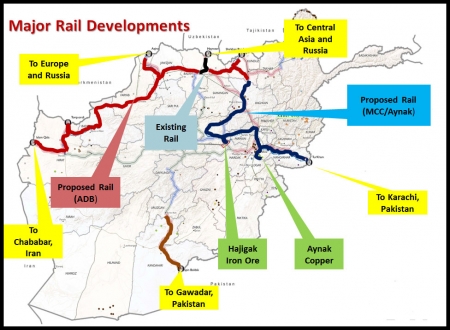
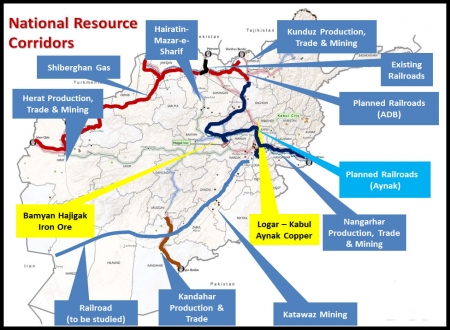
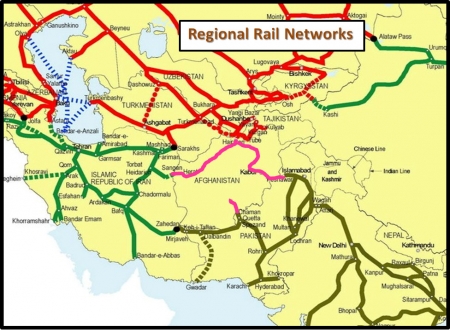
The Ministry of Mines website now features a new photo gallery with some maps of proposed railways.

Map of major rail developments in Afghanistan

The National Resource Corridors map includes a Kabul to Kandahar railway “to be studied”. Historically this route was seen as a priority for developing a national rail network, but in recent years the focus has been on the more stable north of the country.

Map of national resource corridors in Afghanistan

The Regional Rail Networks map shows how things fit into the bigger picture. The Kazakhstan – Turkmenistan – Iran line paralleling the Caspian Sea appears to be absent, although recent news reports suggest part of it will open by October this year.

Map of railways in Afghanistan and surrounding countries

Pakistan – Afghanistan feasibility studies

Peshawar-Jalalabad railway route

ISLAMABAD: The Pakistan Railways (PR) has completed a feasibility report of the Chaman-Qandahar railway track and it has now requested the World Bank to assist in the feasibility of the Peshawar-Jalalabad route.

Director Planning Ministry of Railways Aftab Akbar told APP that the PR’s top priority is rehabilitation, upgradation of infrastructure and lying of new tracks with an aim to be a hub of economic activities for regional countries.

[More about Pakistan Railways’ plans]

Source: The News International, 2011-03-28

In January 2010 a Chaman – Kandahar study was reported as having been submitted to the Afghan government.