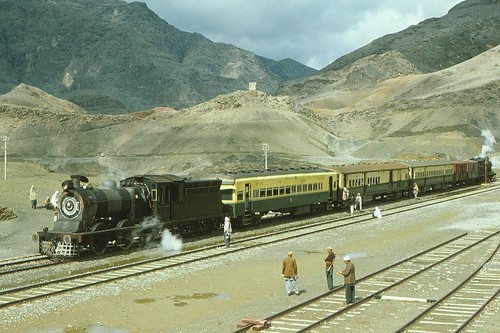
“Steam train to Afghan border 1997” is a pair of videos uploaded to YouTube by Willy Kaemena showing the Khyber Pass railway in Pakistan.
Photos of the first commercial train on the Mazar-i-Sharif line
Photographs of the first commercial train to Naibabad (terminus of the new railway from Hairatan to Mazar-i-Sharif), on 3 February 2012.
All photos by David Brice.
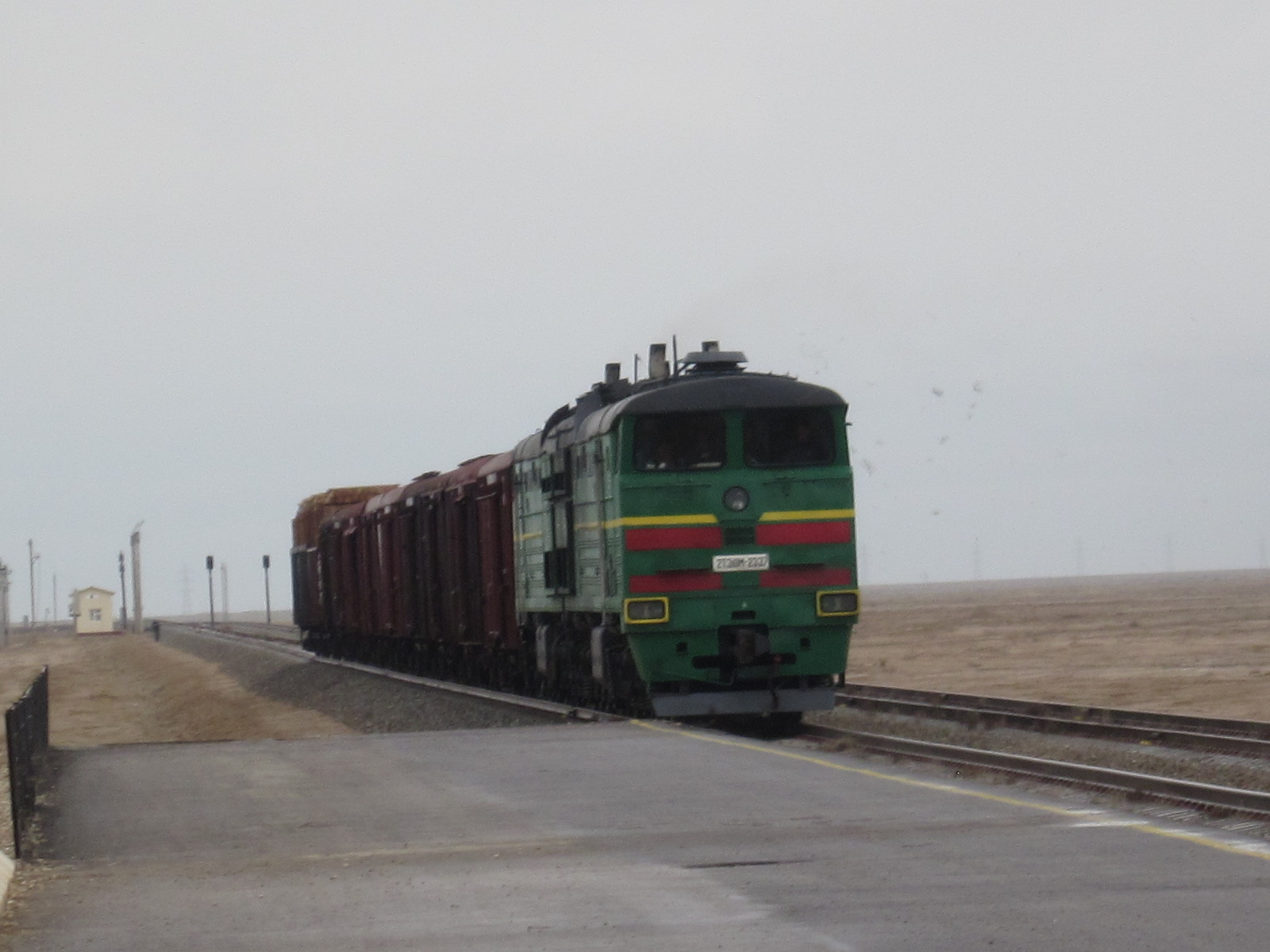
The train was hauled by locomotive 2ТЭ10М-2337.
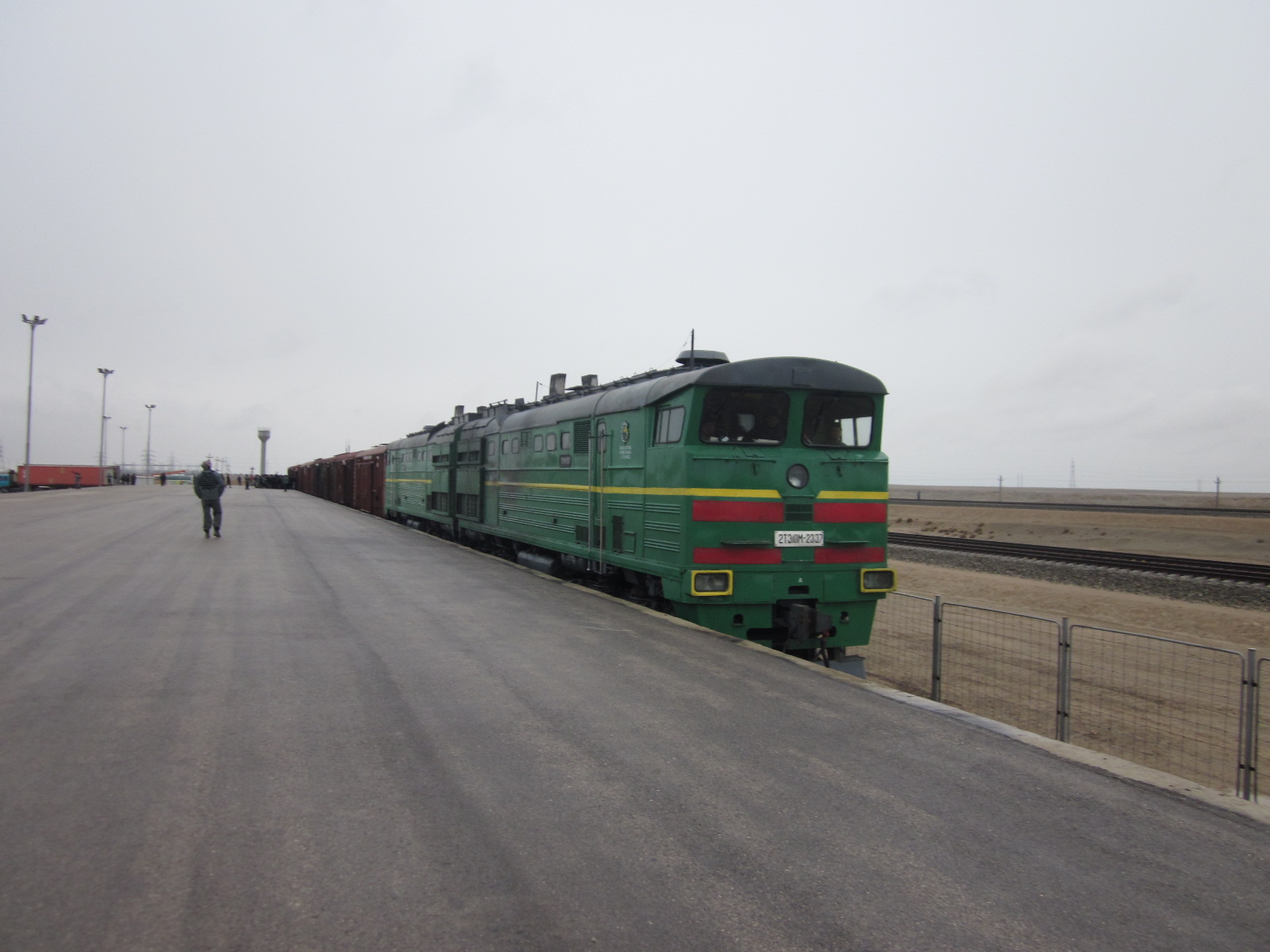
The train comprised nine wagons carrying flour from Kazakhstan and three wagons of Siberian timber.
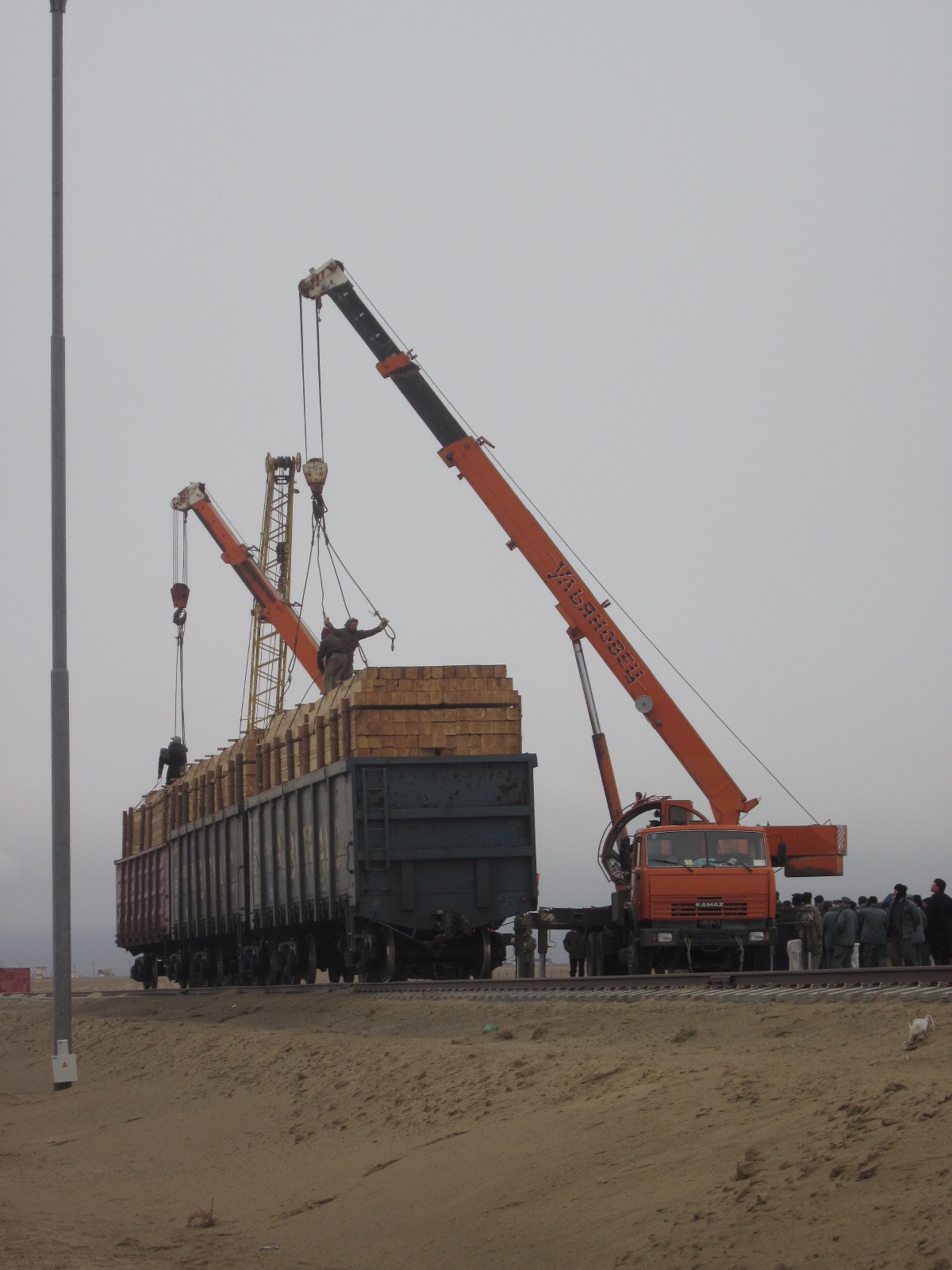
There is another photo on a 7 February 2012 story from Ariana News For the first time transport of goods by rail commenced in Afghanistan: “The Naibabad port has the capacity of loading and unloading 34 trucks at a time while the local officials are looking to upgrade the capacity of that port.”
The CAREC article Hairatan-Mazar-e-Sharif railway opens, highlights country-to-country cooperation has a photo of an inaugural train arriving at the “newly built Naibabad Station in the city of Mazar-e-Sharif” on 21 December 2011. “Although the seven-carriage train carried no cargo, it brought great opportunity for increased trade and cooperation between Afghanistan and its neighbors in Central Asia”.
First commercial freight train on Mazar-i-Sharif railway
Celebrations were held at Naibabad freight terminal at 12.00 on February 3, when ‘a substantial reception party’ greeted the arrival of the first train carrying commercial traffic on the 75 km rail link between Hairatan and Mazar-i-Sharif. [more…]
Source: Afghan railway starts commercial traffic, Railway Gazette International, 3 February 2012
The train was hauled by locomotive 2ТЭ10М-2337, and comprised nine wagons carrying flour from Kazakhstan and three wagons of Siberian timber.
Andkhoy railway studies complete, work to start ‘soon’
Design studies for the second Turkmenistan – Afghanistan railway line have been completed, and work will start “soon”, the Afghan President’s office reports following a meeting between Presidents Karzai and Berdimuhamedov in Türkmenbaşy on 25 January 2012.
… President Karzai met Wednesday morning President Gurbanguly Berdimuhamedov to discuss a number of important economic projects including the TAPI, the Afghan-Turkmenistan railway and electricity export to Afghanistan.
[…]
Accompanying the President on the trip was Afghan Mining Minister, who said a design and full study of a separate project involving the establishment of an 84 km of railway extending across the Atamyrat-Ymamnazar in Turkmenistan to Akina-Andhoi in Afghanistan had been finalized with actual work expected to begin soon.Source: Afghan and Turkmen Presidents Vow to Implement Critical Projects, Office of the President, Islamic Republic of Afghanistan, 26 January 2012
From Turkmenistan comes this report:
The Presidents also noted the great potential of cooperation in transportation and communications sector. They discussed the project on construction of the railway Atamyrat-Ymamnazar-Akin-Andhoy. A framework agreement on construction of this railway was signed during the official visit by the President of Turkmenistan to Afghanistan in May 2011. According to the interlocutors, construction and commissioning of the new railway will not only serve the development of transport infrastructure in Afghanistan but can become a significant element in the regional and international transit transportation in the long term.
Source: Turkmen-Afghan high level talks held in Turkmenbashi, Turkmenistan.ru, 26 January 2012
Here is a map I put together previously:
View Turkmenistan – Andkhoy railway plan in a larger map
Turkmenistan railways
“Turkmenistan” magazine had an issue about the country’s railways (PDF) in March 2006, which you can read online in English and Russian.
Turkmenistan is a bit of an information black hole, beyond the legendary revolving gold statue of the late president. There doesn’t even seem to be a website for the national railway company (unless anyone knows better?).
It appears that since 2004 Chinese suppliers have replaced most of the Soviet-era fleet with a range of single and double-unit diesels. I’m attempting to put together a list of the different types they have, but am finding the supplier and official news agency’s numbers don’t add up – if you can help, please do get in touch!
Steam locomotive on top of an Uzbek mountain
On top of a hill in a remote area of Uzbekistan is a steam locomotive painted in the colours of the national flag. What is it, and how on earth did it get up there?
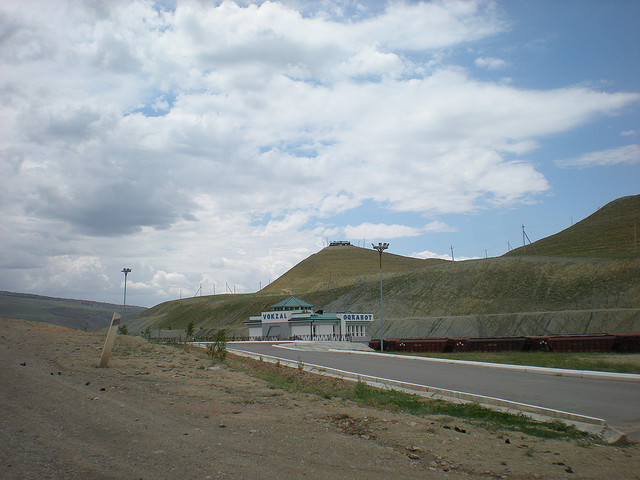
(Photo: Lisa K Walker 2009-06-13)
The locomotive stands on a hill overlooking at Oqrabot (or Акрабат (Akrabat) in Russian) station. Oqrabot is on the railway line from Karshi to Kumkorgan which opened in August 2007, providing a route to Termez which runs entirely within Uzbekistan, eliminating the need to for trains to transit Turkmenistan.
The station is said to be the highest point on the route, at 1510 m, and possibly the highest point on the rail systems of the whole CIS.
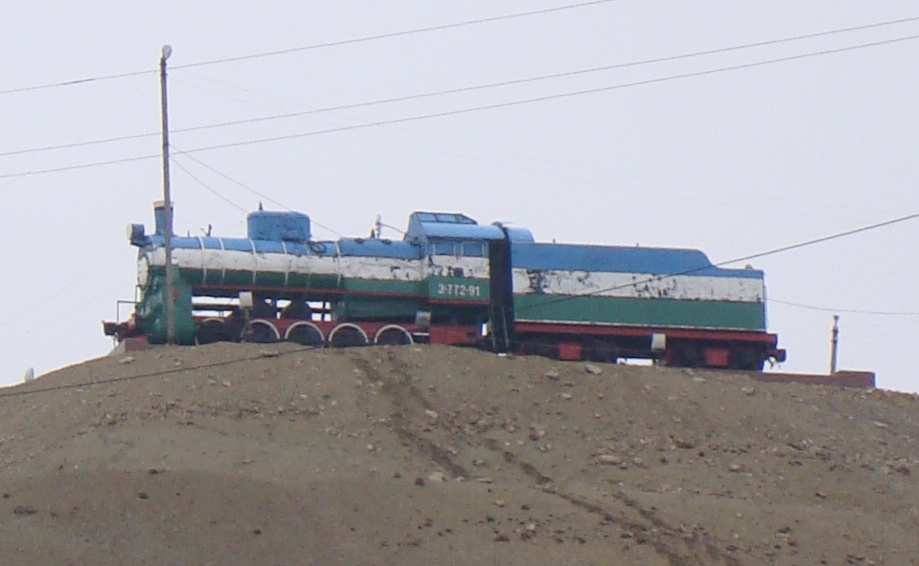
(Photo: Dmitry Kolesnikov 2009-03-06)
There is a close-up view of the locomotive in August 2010 on the Steam Engine IS website.
The locomotive carries the number Эр772-91, which transliterates to Er772-91. A vast number of Series E locomotives were built by a factories across eastern Europe, and this one has a plate showing it was built by CKD at Prague in Czechoslovakia; a date of 1951 is mentioned in the comments on Steam Engine IS (it is of course possible that the plate is a modern addition and the number is incorrect for the particular locomotive).
In an article “Red Star Steam” over at the The International Steam Pages, Colin Boocock provides a summary of Soviet standard steam locomotive classes. The Series E was based on a pre-Soviet design. This was developed into the Eu for mass production, followed by the Em and then from 1935-36 the Er, which had a larger grate area and higher superheat; nearly 3000 were built.
More than 10 670 Series E were locos were built in total, “by far the largest number of a single type ever to run in the world”. Despite making “a German Kriegslok look small”, many ended their days as shunters as the USSR really didn’t go in for small locomotives.
According to Tim Littler, locomotive Эр772-9 previously formed part of the “strategic reserve” at Buvaida, around 23 km northeast of Kokand; the reserve is understood to have had 20 Type Er locomotives, which even into the mid-1990s (and possibly into the 2000s?) were maintained at Kokand depot and steamed and run for 100 km every year. They were reported as scrapped 2001, but confirmed to still exist in September 2002 and October 2009. There is reported to be an ‘Eu’ preserved in a park in Kokand, which is also probably an Er.
There are some more photos of Эр772-9, taken by Rifat Irmuhamedov, at the My Tashkent website, where Volodya explains that the locomotive was cut into several pieces and pulled up the hill by a heavy tractor, before being welded together again.
I assume the livery, which replicates the Uzbek flag, is down to modern imagination rather than a colour scheme which the loco would have carried in service.
The poles and wires are apparently for floodlighting the locomotive at night – anyone got any pictures of that?
Thanks to Harvey Smith and Tim Littler for providing background information and to Lisa Walker and Dmitry Kolesnikov for the photographs.
Herat railway construction and Afghan coal mining on video
There are downloadable MP4 format videos entitled Afghanistan Train Line, Coal Baghlan Province and Gold Mine on the website of Awaz News, “an Afghan independent news agency operating throughout Afghanistan and providing in-depth reporting to television and radio networks.”
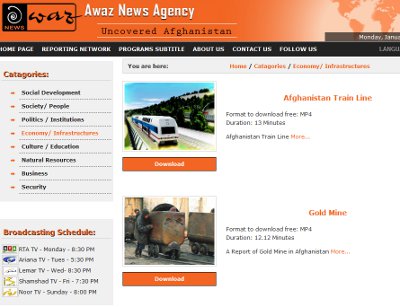
On the “Economy/Infrastructures” section of the website, the “Afghanistan Train Line” (13 minutes) video includes images of bridges and construction sites, along with Iranian flags. While the commentary is not in English (presumably it is Dari – can anyone confirm?) there are some recognisable place names. From this, I think the video might well show hard evidence of construction works underway for the Iran to Herat railway. The video shows bridges and cuttings, but no sign of tracklaying or railway systems installation.
The computer generated impressions of trains are clearly not of Afghanistan – they appear to show Skoda CityElefant electric trains from the Czech Republic.
The “Gold Mine” video (12.12 minutes) has some brief railway shots, I suspect of the Karkar and Dudkash coal mines.
The mines are covered depth in the “Coal Baghlan Province” video (13.5 min) on the Natural Resources section of the Awaz News website, this video is well worth a watch if you are interested in industrial things.
Hairatan railway photos
A couple of photographs of Hairatan which the Asian Development Bank has uploaded to Flickr. They are dated 27 August 2011 – and I think they might have the captions the wrong way round.

“A private wagon enters from Uzbekistan to the border of Afghanistan Hiaratan in the new rail way line.”

“Main station of Rail way in Hairatan border between Uzbekistan and Afghanistan new rail way line. “
Museum photos and an angle iron plan
We saw the old trains of Kabul as well, which was very cool. I knew there was an original railway here but I didn’t know where or if it was still in Kabul.
A Day at the Afghanistan National Museum is an article by Jim Rentfrow at the website of the Green Gem Foundation, “new non-profit organization established to promote the development of ethical gemstones“.
He describes a visit to the museum on 17 December 2011, with some good photos of the “non-plinthed” Henschel steam locos, which along with the remains of the coaches seem to have gained a roof over them, which is good news.
Angle iron
Angle Iron Rail Project is Green Gem Foundation project to fund a “rudimentary rail system” based on trolleys running on angle iron tracks to ease work in gem mines in Kunduz, Nuristan or elsewhere. Apparently coal and peridot mines in Pakistan use this system.
Photos of Pakistan Railways in 1978
George Woods has uploaded to Flickr some wonderful photos of Pakistan Railways in 1978. There is lots of steam, including on the Khyber Pass. Well worth a browse.