Edmund Rich’s Kabul River Railway archive

Bonhams auction 19952 on 4 December 2012 included this lot 283, which sold for £3750.

283 RICH (EDMUND TILLOTSON)

A very good archive representing the military career of Edmund Rich (1874-1937), an officer of the Royal Engineers and surveyor, mostly on the North-West Frontier and in Burma (at first in conjunction with the Survey of India and latterly as one of its directors), also relating to survey in South Persia during World War I, and with the British forces in Southern Russia in 1919, comprising a series of photographs albums, loose photographs, autograph letters, orders, draft reports, maps ephemera, etc., together with a small quantity of photographs, letters and documents relating to Rich’s ancestors, those of his wife Aileen Owen (d.1918), and their son (quantity)

[…]
In 1905 Rich was sent to Peshawar in charge of No. 12 Party with orders to survey the sensitive area north of Kohat Pass. This work lasted four years and included the Bazar Valley and Mohmand campaigns of 1908. The archive contains Rich’s alternative survey for the Kabul River Railway which resulted in the cancellation of the line then under construction, and the dismantling of track and bridges already in place. 1909-1911 were spent in England (Rich married in 1910).
[…]
Source: Bonhams

According to the auction listing, the most substantial of the items include “An album containing titled in manuscript ‘Views of the Khyber Pass…taken chiefly by E.T. Rich when surveying there 1905-1909, approximately 176 gelatin silver prints”.

From this it can be inferred that photos of the Kabul River Railway might well exist.

If you bought this archive, and you happen to read this webpage, is there any chance that I could have a look at it, please? :-)

(a different Edmund Rich was Archbishop of Canterbury in the 13th century, which complicates web searches for any information about this particular one)

ADB photos of Afghan railways

The Asian Development Bank has uploaded some photos of the Hairatan – Mazar-i-Sharif railway to Flickr today.

Unfortunately ABD seems to have turned off the ability to embed the photos on external websites, so to see them try this link: ADB’s Afghanistan photo set and click around the lninks to railway, railroad etc.

The photos include construction work underwayfor the Mazar-i-Sharif line, freight wagons being unloaded, the Afghan deputy minister of city rehabilitation posing in front of a TEM2 in Mazar-i-Sharif in June 2012 (text says 6 June, metadata says 7 June), and a passenger train(! possibly carrying the minister?) with TEM2-6561 hauling an Uzbek Railways liveried coach.

There are lots of other interesting photos of railway projects in Asia.

Afghan railways in Modern Railways magazine

The February 2013 issue of Modern Railways magazine has a two-page article on Afghan railways by John Glover, “Starting from scratch in Afghanistan”.

Based on a lecture by Richard Brown at the Railway Study Association on 5 December 2012, it covers the political, policy and economic situations, the new line to Mazar-i-Sharif and the gauge question.

There are photos by David Brice showing wagons being unloaded in Naibabad and 2TEM10 locomotives.

Afghanistan gives historic tank to Poland

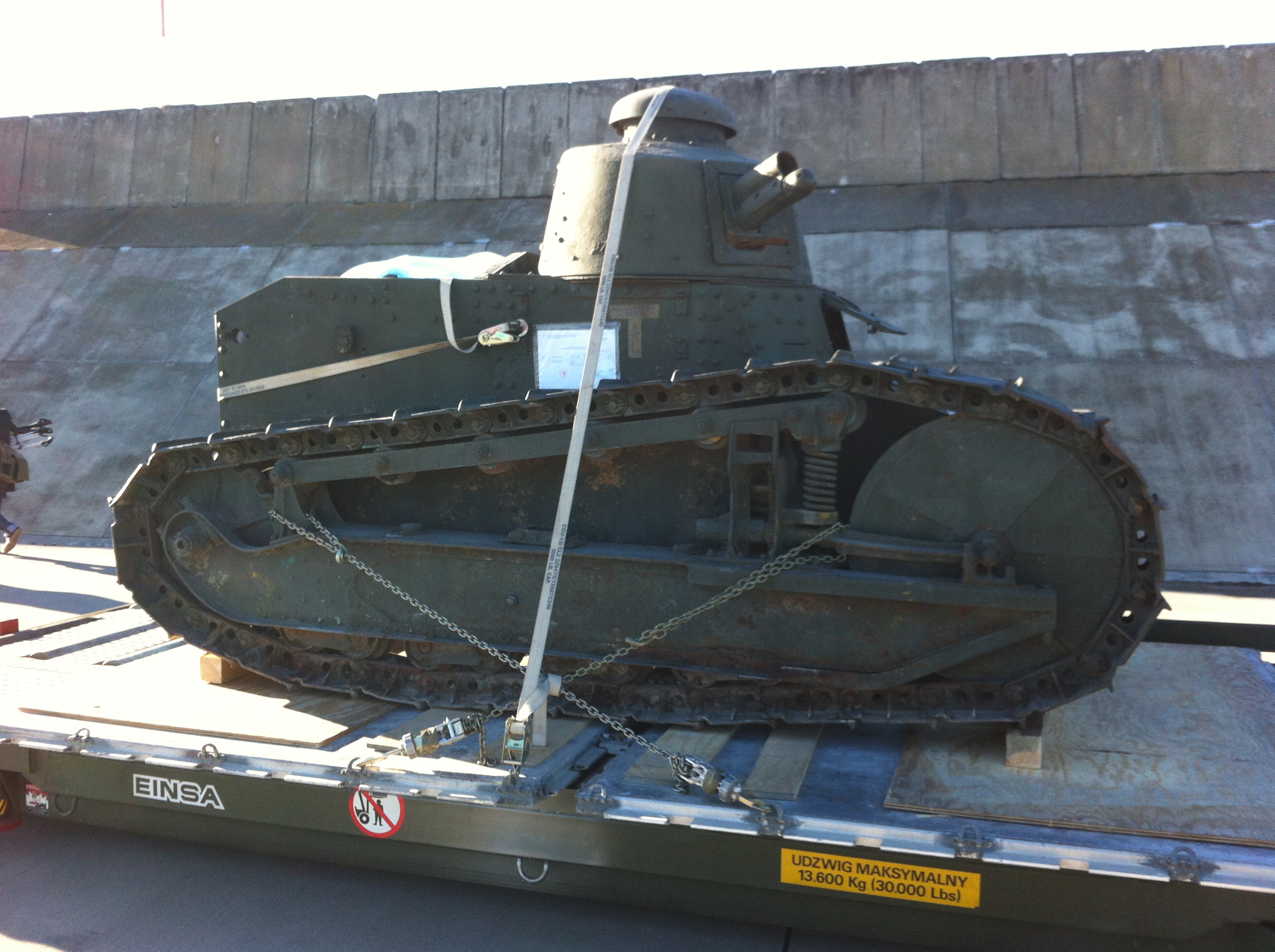
No trains, but this is quite interesting. The government of Afghanistan has given Poland a French-built WWI era Renault FT-17 tank which had survived in Kabul.

Renault FT-17 tank

FT-17 tanks were used by Polish forces in the Polish–Soviet War of 1919-21. Some were captured by Russian Bolshevik forces, and subsequently given to the Amir of Afghanistan in 1923 (that would have been King Amanullah).

In recent years westerners released a few of these tanks had survived in Afghanistan, and some went to the USA and France for preservation.

The Polish President asked the Afghan President for one, and at the end of October it was flown to Poland for restoration at the Land Forces Training Centre in Poznan, and eventual display in the Warsaw military museum, “a testament to the Polish-Afghan friendship and a recognition of Poland’s contribution to the reconstruction of Afghanistan”, according to Poland’s Ministry of Foreign Affairs.

Northern Distribution Network corruption

This is a fascinating if somewhat depressing read: The New Silk Road and the Northern Distribution Network: A Golden Road to Central Asian Trade Reform?

The New Silk Road and the Northern Distribution Network is a constructive assessment of the conditions and challenges facing this effort that asks and answers the following questions:

  1. Is the Northern Distribution network incentivizing regional cooperation and border reforms?
  2. Is the Northern Distribution Network helping to fight corruption in Central Asia?
  3. Has the Northern Distribution Network made transhipment through Central Asia more efficient?
  4. Are ordinary Central Asian citizens benefitting from Northern Distribution Network trade?

I suspect you can guess the answers… you know what they say about the answer to a headline phrased as a question always being “no”?

The New Silk Road: Where Will It Lead is an interview with the author, Graham Lee. The report itself has lots of numbers for freight transport volumes and costs, which might be of interest to some readers.

In summary, the money being spend on the Northern Distribution Network is all disappearing into a pit of corruption, with lots of people on the take.

The report suggests that the various state railways are doing nicely out of the NDN traffic. I guess that if the freight needs to be moved, railways are more efficient in technical terms. But where is all the money they are getting going – funding strategic infrastructure investments and shiny new trains, disappearing off into general government funds, or into someone’s back pocket?

Pakistan Railways CEO’s photos

Photos from an online album by retired Pakistani railwayman Kiskhan: “I joined the Pakistan Railway as a junior officer way back in 1968. I rose to become its General Manager and CEO in Jan. 2000 and finally retired in Jun. 2003 at the age of 60.”

The Khyber Pass line. Note the umbrella, and “Coupling to Khyber Pass” headboard:
Through the Khyber Pass

The Pakistan side of the Afghan border at Chaman in 2003:
Chaman - Afghan border 2003