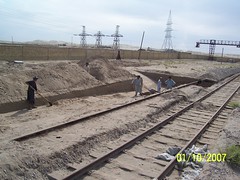
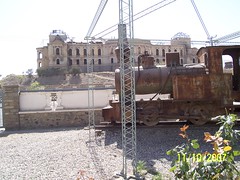
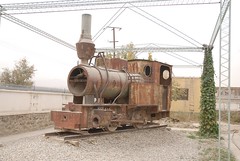
Towraghondi railway in action


Yard Engine

Originally uploaded by holdemhill

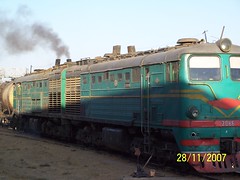
At last – photos of the railway at Towraghondi, Afghanistan’s border crossing with Turkmenistan. Donald Hill has various pictures of the terminal, including two shots of a Turkmenistan railway locomotive on 28 November 2007.

It is a 2TE10L twin-section loco, number 2086 (or is that just one half of it?). The loco is not a thing of beauty, but it is real rail action in Afghanistan.

Iran – Herat railway project

“Construction of a 191 km railway from Iran to Herat in Afghanistan, with the prospect of an extension across Afghan territory to Sher Khan Bandar, promises to stimulate trade with Central Asia.” reports Murray Hughes in the January 2008 issue of Railway Gazette International.

The current scheme was launched when a Memorandum of Understanding was signed in June 2002 between the Iranian Transport Ministry and the Ministry of Public Utility in Kabul. The project was costed at US$28m and construction was split into four lots, two in Iran, and two in Afghanistan; work officially began in Iran on July 29 2006.

It is from the penultimate loop at Khaf that the single-track line to Herat begins.

From Khaf the route heads slightly south and then east across the border through arid and rugged terrain. Total length of the new line is 191 km, of which 77 km is located in Iran and 114 km in Afghanistan. Of the 10 intermediate stations envisaged, Ghurian will be the largest intermediate town served by the section on Afghan territory.

Preliminary investigations have been made for an extension from Herat that would run for no less than 700 km across northwestern Afghanistan to Meymaneh, Sheberghan and Sher Khan Bandar on the border with Tadzhikistan. This route would also offer the opportunity to connect with the 1 524 mm gauge line that crosses the Uzbekistan frontier near Termez, penetrating as far as Hariatan. This line is now handling trains nearly every day, mainly carrying petroleum products, machinery, building materials and agricultural produce.

You can read the full article on the Railway Gazette International website.

Afghan locos found in works list

Simon Darvill has found some records of more industrial locomotives which were supplied to Afghanistan!

He is currently going through the works lists for German loco builders as part of some work for the Industrial Railway Society on industrial railways of Benelux, and found the Afghan machines in a Ruhrthaler works list.

German company Ruhrthaler Maschinenfabrik built four 600 mm gauge 4wDM locos, works numbers 3787-90/1964. According to Ruhrthaler’s works list they were delivered to “Working Group Mahipar”.

Simon’s theory is that they were supplied in conjunction with the constuction of the Mahipar power station, a hydro-electric power station on the Kabul River 40 km downstream from Kabul. The dates support this, as the locos were supplied to Hochtief, dispatched on 31 July 1964 and the power station opened in 1966.

Dr Paul E Waters’s 2002 book Afghanistan: A Railway History says (unfortunately without a reference):

On 15 March 1969 Wilfrid Simms noted four B-B diesel-hydraulic locomotives in a compound at the head of the Tang-i-Jharoo or Afghan Pass on the road from Kabul towards the Khyber Pass. They were numbered TIJ 1 to 4, were of about 60 cm gauge and appeared to be of East German or other Soviet Block origin. They had presumably been used on recently completed road improvements, whch included several tunnels. Armed guards inhibited attempts at close inspection or photography.

Could these be the same locos – actually West German and for a hydroelectric project? I’ve not pinned down the location of Tang-i-Jharoo on a map yet. Anyone know where it is?

Ruhrthaler background

Ruhrthaler Maschinenfabrik is now part of Bräutigam, who describe Ruhrthaler as follows:

In order to further strengthen our market position, we acquired the RUHRTHALER machine works in 1996. A prestigious company that established itself worldwide as a designer and manufacturer of locomotives and as the market leader in mining locomotives and monorail systems over the course of its 100-year history. From 1924 on, they supplied local and foreign sources with more than 4500 diesel locomotives.

Power station background

A PDF with details of the Mahipar & Sarobi Hydropower Plants:

The run-of-river hydroelectric power plant Mahipar is located on the Kabul river about 40 km downstream of the capital Kabul. The hydropower scheme was completed and the first two units commissioned in 1966 to provide mid and peak load electrical power to the grid for supplying the city of Kabul. A third unit was installed some years later.

The Afghan Energy Information Center has some more information.
Iran’s Torbat-e Heydariyeh to Khaf (and one day Herat) line on TV

YouTube has this video from 1 March 2007, “3 TV News Reports on New Iran Railroad to Afghanistan”, about the opening of the Torbat-e Heydariyeh – Khaf railway within Iran, and a 200 km extension now under construction towards Herat in Afghanistan.

For those of us who don’t speak Persian(?), there is a translation here. Mr Mohammadizadeh, governor-general of the Province of Khorasan-e Razavi, says:

Construction work began on this railroad in the year 2002. It is 148 kilometers long. It has eight stations and cost about 50 billion tomans, fortunately it went into operation today [1 March 2007].

The primary objective in creating this line is to haul iron ore, with an annual load of about .52 million tons.

More important is that the vital artery for the economic development of our nation with the friend and brother nation of Afghanistan will travel by way of this very railroad.

About 6 months ago inside Afghanistan the ground was broken for the Afghanistan railroad by our president of the republic’s first vice-president and today also the ground was broken for the line from Sangan to Harat inside Afghanistan.

The credits for ths project have been procured, and for the first time the culture of the railroad is coming into the friend and brother nation of Afghanistan and the nation of Afghanistan will have a train and a railroad.

It appears that the conditions that exist in Afghanistan in terms of reconstruction and the needed goods in the outside world, this railroad can be effective achieving economic development and the social welfare of the people of Afghanistan.

It can therefore be said in short that this project has great importance for the iron ore of Khaf, for the use of the people in several cities along the route and especially for establishing a railroad for government of the Islamic Republic of Iran for the people of Afghanistan.

The line that goes into operation today is 148 kilometers long, but the work is beginning on a line into Afghanistan with about 50 kilometers inside our country and about 150 kilometers inside Afghanistan. This year about 45 billion tomans have been allocated for the new line, and we are hoping that this task will be completed in the year 2007.

Afghan railway terminals from above

The two railway terminals in Afghanistan are now visible at a half-decent resolution in Google Earth.

Hayratan

Unfortunately the eastern-most part of the railway line is still low-resolution, including the Friendship Bridge from Uzbekistan. Some sidings are visible, but no trains.


View Larger Map

Towraghondi

There is more to see on the line from Turkmenistan, with lots of sidings and buildings, and various wagons.


View Larger Map

Freight operations in Afghanistan

Samuel Rachdi of Fahrplancenter has provided me with some information on train operations across Afghanistan’s northern borders.

The Turkmen government has rehabilitated earlier in 2007 the line to Towraghondi and about 20 to 25 wagon loads are brought over this rail line to Afghanistan per week. This line is operated by Turkmen Railways.

In contrast the Termez (Uzbekistan) – Hayratan line is very busy, nearly every day a train is entering Afghanistan, mainly with petroleum products, building material, machines, agricultural products. Every train consits of up to 30 wagons. In the opposite direction very little merchandise is transported, less than 10% against import, so most wagons are leaving the country empty. This line is operated by Uzbek Railways, but with some Afghan employees at Hayratan.

Balochistan Rail Link

A news report which is floating round the web

Plan Ready To Make Balochistan Rail Link For Central Asia

QUETTA, Oct 26 Asia Pulse – [Pakistan’s] federal government has prepared a blueprint for Balochistan to make it a rail bridge for Pakistan trade and a traffic corridor connecting it to Iran, Turkey, Europe and Central Asia.
According to official sources, Pakistan Railway’s blueprints provide for rail access from Gwadar, Pakistan’s third deep seaport along Arabian Sea, to Afghanistan and Central Asian Republics as well as Russia on one side.

On the other side, they said, Gwadar would have a rail link with Iran, Turkey, Europe and beyond. Both these vital rail links would go through southern, central and northern Balochistan. The blueprints show a link between Gwadar-Mastung-Taftan and Zahidan (Iran) on one hand, while on the other from Gwadar to Kandahar (southern Afghanistan) via Mastung-Quetta-Chaman-Spinboldak.

The sources added that at present Gwadar had no rail network, therefore, the government had decided to build 940-kilometer broad gauge from Gwadar (southern Balochistan) to Mastung (central Balochistan) at an estimated cost of Rs75 billion. Mastung is already connected with Quetta on the main line linking Pakistan with Iran via Taftan and Zahidan (Iran). The Quetta-Taftan-Zahidan section (612-km) though Mastung is in process of upgrading to international standard.

Such standard would be at par with Iranian railways, already catering for passengers and freight services to Turkey and the European countries, they added. They said the PR had already set aside a sum of Rs10billion for upgrading of Quetta-Taftan-Zahidan section.