Der Spiegel on King Amanullah’s visit to Berlin

Potentaten als Bittsteller (PDF) is a 2001 article about Afghanistan in Der Spiegel.

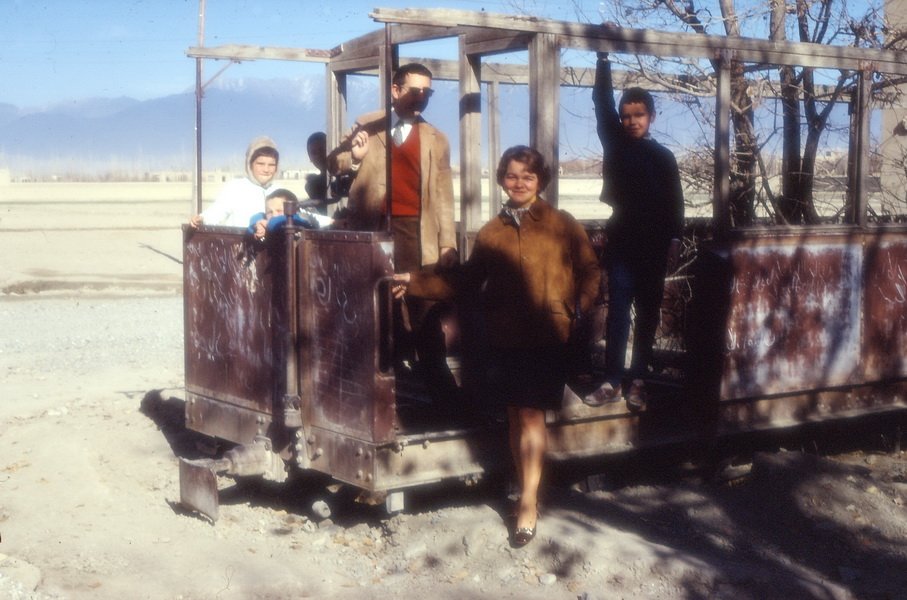
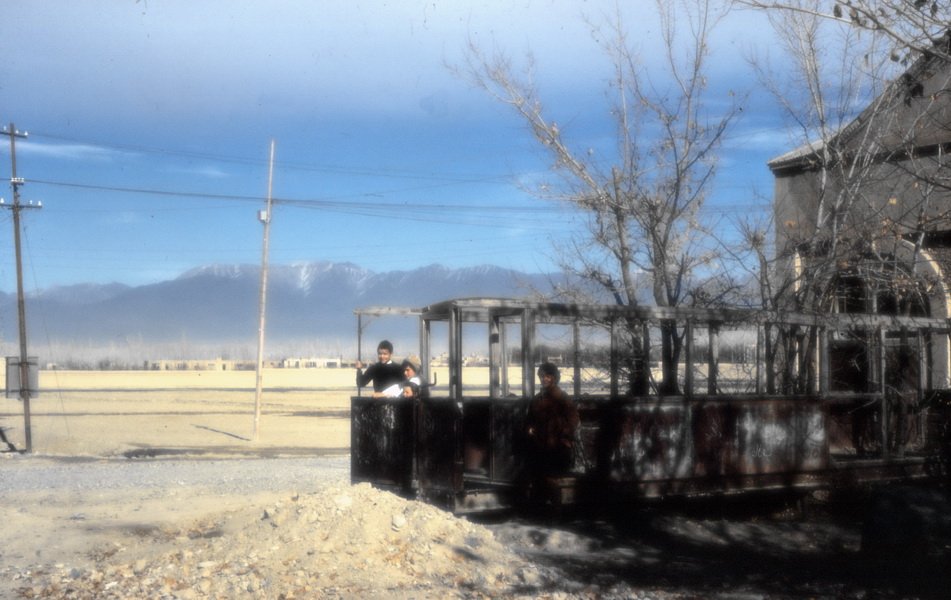
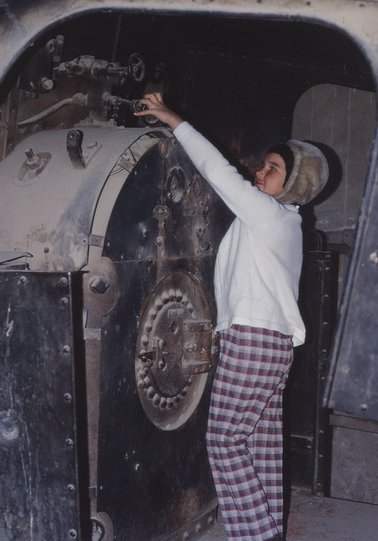
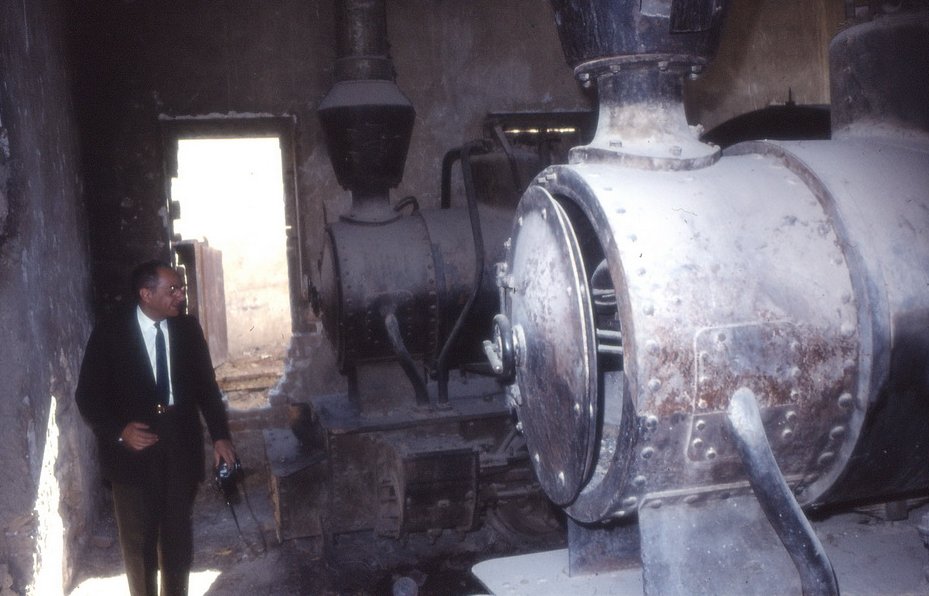
There is a 1989 photo of the steam engines at Darulaman. The text says:

Amanullah holte deutsche Firmen und Ingenieure ins Land. Sie errichteten Straßen, Brücken, Staudämme und eine königliche Residenz sowie Prachtbauten in Darulaman, einem Vorort von Kabul. Dort sollte auch eine deutsche Eisenbahn fahren, als Lieblingsspielzeug des Potentaten. Die mit dem Schiff nach Bombay transportierten Lokomotiven wurden von Elefanten über enge Passstraßen durch den Hindukusch geschleppt, ein paar hundert Meter Schienenwege verlegt. Noch nach über 20 Jahren Bürgerkriegswirren und der Zerstörung Kabuls standen dort auf einem von Disteln und Dornenbüschen überwucherten Anger drei verrostete Dampfloks und das Fahrgestell eines Reisewaggons „Made in Germany“.

Whch is something vaguely approximating to:

Amanullah sought German companies and engineers into the country. They built roads, bridges, dams
and royal palace in Darulaman, a suburb of Kabul. There should also be a German rail travel, a favourite toy of potentates. The locomtives were transported by ship to Mumbai and then pulled by elephant in passes through the Hindu Kush, where a couple of hundred metres of rail were laid [not sure I’ve got that translation quite right!]. Yet after more than 20 years of civil war turmoil and the destruction of Kabul, there overgrown by thistles and thorn bushes are three rusty steam engines and the carriage labelled “Made in Germany”.

There is a description (in German) of King Amanullah’s visit to Berlin in 1928.

Die politischen Konsultationen verliefen wenig ergiebig. Der Potentat trat als Bittsteller auf. Er brauche Geld, eröffnete der junge König sogleich dem greisen Reichspräsidenten, „Geld zur Entwicklung meines Landes“. Auch wolle er Eisenbahnen bauen. Bei den Eisenbahnen mahnte Hindenburg zur Vorsicht („wenig rentable Unternehmen“), und über besondere Geldmittel verfüge er leider nicht. Aber Deutschland sei gern bereit, Afghanistan „tüchtige Leute“ zur Verfügung zu stellen.

The political consultations were low yielding. The potentate appeared as a supplicant. He needed money, the young king immediately told the aged President [Hindenberg], ‘money to develop my country.” He even wanted to build railways. Hindenburg warned to be cautious about railways (“little profitable business”), and did not have funds. But Germany was happy to provide “capable people”.

(better translations gratefully accepted!)
Termez to Mazar-i-Sharif construction started?

A 26 February 2009 report in Pakistan’s Daily Times quotes Uzbekistan’s president Islam Karimov as having said the previous day that a railway is being built to Mazar-i-Sharif:

“Uzbekistan has agreed to allow non-military, I underline, non-military cargo to be transited through Uzbek territory to Afghanistan, in accordance with existing Uzbek legislation,” Karimov told reporters. “Uzbekistan is participating in the development of the communication and transport infrastructure of Afghanistan. We’ve started a construction project on a railway from the (Uzbek) city of Termez to (the northern Afghan city of) Mazar-e Sharif,” he said.
Source: Daily Times 2009-02-26

Termez is the nearest Uzbek city to the Friendship Bridge, and Uzbek Railways already operates to the freight terminal at Hayratan just inside Afghanistan. An extension of the line on to Mazar-i-Sharif has long been proposed, but is it really happening? I can’t spot anything (in English) on the presidential website, and the quote doesn’t seem to appear in other versions of essentially the same story.

Afghanistan’s development and functionality: Renewing a collapsed state

A paper in GeoJournal Volume 70, Numbers 2-3/October 2007 by John Shroder of the University of Nebraska at Omaha.

Afghanistan’s development and functionality: Renewing a collapsed state

Afghanistan has long been backward and underdeveloped where centuries of desertification, deforestation, overgrazing and environmental degradation have combined with successive invasions, violence, and terrorism to reduce the population to abject poverty. In the post 9/11 world, development of Afghanistan is seen as the only hope to revive the failed nation and reduce its threat to the external world. New assessments of natural resources offer many solutions to old problems of development and the potential economic functionality through renewal of the collapsed state. Oil, gas, copper, iron, gemstones, and a number of other resources, combined with a renewed transportation grid, offer a viable solution that is now underway to possibly produce a somewhat more promising future, providing that corruption, renewed violence, and environmental despoliation can be kept to a minimum.

Military transport routes to Afghanistan

An interesting 17 February 2009 article from Der Spiegel about the problems of supplying military forces in Afghanistan. This problem is nothing new of course – various armies over the centuries have faced it before.

Allies Struggle to Find Safer Supply Routes

By Dieter Bednarz, Rüdiger Falksohn and Alexander Szandar

The Taliban has staged repeated attacks on Afghanistan’s perilous Khyber Pass against trucks loaded with NATO supplies. The international security forces, including Germany’s Bundeswehr, are scrambling to find safer routes – and might even consider one through Iran.

Interesting bits

  • Three-quarters of all the military equipment and goods for Afghanistan goes through Karachi.
  • Germany is the only NATO country with permission to transport war materiel through Russia by rail. But other countries, including Kazakhstan and Uzbekistan, have refused permits so no trains have actually run.

The Bundeswehr has also looked into the feasibility of building additional stretches of track in Afghanistan. There are already 20-year-old plans from the days of the Soviet occupation. The railroad could connect the border town of Hairatan with Mazar-e-Sharif, 67 kilometers away. Thanks to a bridge built in 1982 across the Amu Darya River, which serves as the border between Afghanistan and Uzbekistan, Hairatan has a direct connection to the rail network in Termes.

The financing is still up in the air, though. But given that the project would both make it easier to bring supplies to NATO troops and promote the region’s economy, military officials hope to receive funds from the German Federal Ministry for Economic Cooperation and Development and international organizations. For example, the Asian Development Bank plans to prepare a feasibility study with the support of the Uzbek government.

In December, a privately owned Uzbek railroad company, which already operates in Afghanistan’s Herat Province, contacted the German Embassy in Kabul. According to a confidential report the embassy sent to the German Foreign Ministry in Berlin, the Uzbek company “would like to work with German companies” to implement projects sponsored by the development bank.
Source: Der Spiegel

Studies for two Pakistan Railways extensions

In November 2008 Hail Ghulam Ahmad Bilour, Pakistan’s Railways Minister, told the National Assembly that two studies for railways were being considered.

One plan is to revive the long-standing proposal to extend the Pakistan Railways network by about 10 miles from the current terminus at Chamman to reach Spin Boldak across the border in Afghanistan, providing a railhead for Kandahar.

The other plan is much more substantial, being a 662 km link from Havelian in Pakistan to China via the Khunjerab Pass, which reaches an altitude of 4700 m. However it had been said in September that this route was not commercially feasible.

Pak-China rail link pre-feasibility study completed, National Assembly told


Bilour told the house in response to a question raised by MNAs including Fauzia Wahab, Muhammad Asad Khan, Yasmeen Rehman and Shereen Arshad Khan, that the PC-I for Chaman Spinbuldak (Afghanistan bordering town) rail link was completed with the cost of Rs 417 million in June 2004 and the project was to be executed by M/s Railcop, however, work could not be started due to non-issuance of NOC by Afghanistan government. The revised cost of PC-l is now assessed Rs 943.00 million, he added.

He said that the Pak-China Rail link pre-feasibility study has been completed through two consulting firms M/s L.L.F of German-Austria and M/s Don fang Electric Corporation (DEC) of China and following route has been recommended for detailed feasibility. Havelian-AbbotAbad – Batagram – Thakot-Bridge-Bèsham-Pattan -Dassu-Chillas – Gilgit-Karimabad – Sost-Mintaka Pass. The length of this route is 662 km and tentative cost is US $10.237 billion to be completed in 15 years, he informed.

[More]

Source: Business Recorder, 2008-11-11

There are more details of the feasibility studies in the February 2007 Asia Times Online article China-Pakistan rail link on horizon, by Syed Fazl-e-Haider. This says:

As a part of its development plan for its transport and communications network, Pakistan Railways has completed a feasibility study of the Chaman-Kandahar section for laying railway tracks between Pakistan and Turkmenistan through Afghanistan.
Source: Asia Times Online, 2007-02-24

Iran to Afghanistan railway completed ‘in the next 5 years’

Afghan website Quqnoos reports on the Iran — Herat railway construction project. There is a photograph of some railway track, but it could be a stock picture rather than evidence of the work being underway.

Plans to extend the line from Herat to serve the existing railheads are mentioned.

Afghanistan’s railway project which will connect Shirkhan harbor with the western province of Herat will cost $2 billion.

The project which is planned to be completed in the next five years will connect Central Asia with Iran via Afghanistan.

Construction work on the project, from Herat to Iran, has already started. The design of the rest of the railway network from Herat to the Shirkhan commercial transit way is also in late planning stage.

The railway network which will be about 1200 km long will connect Afghanistan’s Shirkhan, Hairatan, Aqina and Torghondi commercial highways with the commercial harbors in the central Asian countries.

Meanwhile the media in Tajikistan have reported that work has begun on a railway network which will link Klokhabad with Panjpayan, on the border with Afghanistan.

Source: Quqnoos.com 2009-01-19

Iran building rail links to Iraq and Afghanistan

Network expansion is in full swing is an article about the Iranian rail network in the January 2009 issue of Railway Gazette International.

The author is railway consultant David Brice, who has worked on transport projects in Afghanistan, including at the Hayratan terminal.

Work is currently well in hand on extension of RAI’s Torbat – Sangan iron ore line across the border to Herat in Afghanistan (RG 1.08 p55). Whilst perhaps not a major development in terms of generating traffic, this line certainly has major political implications. Largely financed by the Iranian government, it will constitute the first major standard-gauge line in Afghanistan.

A further extension to Sher Khan Bandar serving the northeast of Afghanistan is currently under investigation, and on November 23 2008 the Asian Development Bank announced that a protocol had been signed highlighting the importance of developing rail links from Herat through Mazar-i-Sharif as far as the current Uzbekistan Railways railhead at Hayratan, reached by a 1 520 mm gauge line from Termez. The Afghan government has requested technical and financial assistance from ADB for a pre-feasibility study.

A proposed extension of this route beyond Sher Khan Bandar along the Wakhan Corridor, albeit through challenging terrain, could complete a direct connection from Iran to the rapidly expanding Chinese rail network, creating a standard-gauge through route between Europe and China.
[…]

Iran – Iraq. Two links to Iraq are in hand, one from Khorramshahr to the port of Basra, and the other from Arak via Kermanshah to the Iraqi border at Kosrayi. This will cater for substantial flows of pilgrimage traffic once the political situation has normalised.

Source: Railway Gazette International

Afghan and Turkey – Iran – Pakistan rail links discussed

The 2nd Meeting of Railway Committee of TTCC

(The ECO Secretariat, Tehran, 12 December, 2008)

The 2nd Meeting of Railway Committee of TTCC was held at the ECO Secretariat on 12 December, 2008. Delegations of Afghanistan, Azerbaijan, Iran, Pakistan, Tajikistan, Turkey and Uzbekistan participated in the Meeting. Delegations from the People’s Republic of China and the United Nations Economic Commission for Europe (UNECE) also attended the Meeting.

The Meeting discussed cooperation between the ECO and UNECE on implementation of railway-related articles of Transit Transport Framework Agreement (TTFA) and important UNECE agreements. Those included the European Agreement on Important International Transport Links and Related Installations (AGTC) and the European Agreement on the Main International Railway Links (AGC). Possibilities of participation of the ECO in Phase II of the Euro-Asian Transport Links (EATL) Project were also considered.

The meeting discussed three important projects for improving the regional railway network in the ECO region. These included upgrading the capacity of Sarakhs Station in Iran, improving the Quetta–Taftan Railway in Pakistan and constructing railway bypass around Van Lake in Turkey.

In order to materialize operation of the ECO Container Train on Istanbul-Tehran-Islamabad route, the Meeting requested Iran, Pakistan and Turkey to expedite holding a High Level Expert Group Meeting and a Meeting of the concerned Ministers to decide on technical, operational and other aspects of this important initiative. It was hoped that a demonstration train from Islamabad to Istanbul would be launched in 2009.

The Meeting considered ways to have the Kyrgyz Republic, Tajikistan and Afghanistan connected to the ECO regional railway routes. The said member states would prepare detailed reports on the proposed routes, technical requirement, and expected cargo volumes.

The Meeting worked out the procedures for publishing ECO Railway Transit Routes Maps and the updated Railway Network Map.
Source: Economic Cooperation Organization press release, 2008-12-12