Steam engine diplomacy

The politics behind “Pakistan’s gift of a steam engine to UK in 1981 and the interesting story of this loco’s arrival in Manchester” at All Things Pakistan.

The Museum of Science & Industry in Manchester has a page on the loco, Vulcan Foundry 4-4-0 works no. 3064 of 1911, while The Vulcan Foundry Newton-le-Willows “electronic museum” has information on other Vulcan Foundry survivors.

Russia’s March to the East

An April 1899 article form the Timaru Herald, based a journey through the Russian empire, and the railway from Merv to Kushka (Serhetabat in Turkmenistan).

RUSSIA’S MARCH TO THE EAST

Mr John W. Bookwalter, of Ohio, who has just returned to London from a two months’ journey through Russia, informed a press correspondent in an interview that he enjoyed unusual facilities for observing what is going on in that country. He travelled 17,000 miles to the terminus of the Trans-Siberian Railway, to the end of the line reaching the frontier of Afghanistan, and to the end of the one penetrating China through Manchuria. Mr Bookwalter says :—

“Russia in three years has done more to open the doors of China than Great Britian and all the rest of the world has done in 50 years. No one who has not seen it with his own eyes can have the faintest conception of what Russia has done and is still doing in Central Asia. I have travelled over twelve hundred miles of railway which she was built from the Caspian Sea to Tashkend. in Turkestan ; over a branch of this line which runs to the northern frontier of India, and over another branch which goes from Merv to the border of Afghanistan. This last branch was not completed when I was there, but it will be open to traffic shortly. There are also Russian lines all along the Persian frontier and penetrating into that country, either completed or rapidly approaching completion. All the work on these lines has been done by soldiers, who in this way are not in Russia, as elsewhere, non-producers.

“All this tremendous Asiatic railway system is owned and operated by the Government. All the lines are admirably built and splendidly equipped. Why, I saw a bridge across the Amu-Daria, in Central Asia, at a point where the river is three miles wide, that cost 20,000,000 roubles, and is the greatest piece of engineering work ever accomplished. There is nothing like it anywhere else m the world, the celebrated Forth Bridge, near Edinburgh, Scotland, not excepted.

“Wherever I went I saw cities and towns springing up – such as Askabad, in Turkomania, for example, which already has 25,000 inhabitants. Near Merv the Czar is building a magnificent palace. New Bokhara, twelve miles from Old Bokhara, has 12,000 inhabitants. The Russian policy in Central Asia is not to bring the new and the old in too close a contrast, and so she builds her railway stations a few miles away from the old centres of population, thus forming newand entirely modern centres. Where do the people come from to inhabit these towns? Why, from European Russia. The Government is turning her surplus European population into Central Asia, just as the United States turned the surplus population of her Atlantic States into her great Western territories. What I have just seen in Central Asia is almost an exact reproduction of what I witnessed years ago in Illinois, Indiana, and Missouri, when the emigrants from the East were pouring into the West. No human power can stay the onward march of the Slav through Russia, which will be the feature of the twentieth century, just as the the march of the Anglo-Saxon through America has been the feature of the nineteenth.”
Source: Timaru Herald, Volume LXII, Issue 2916, 4 April 1899, page 4, accessible at the National Library of New Zealand

The Pathan borderland in 1910

A glance at the network of road and railway communications, which forms an essential feature in the scheme for efficient control, shows how comprehensive are the detailed arrangements for the protection of the North-West Frontier.

The outbreak of 1897, and the consequent isolation of the Malakand, showed the necessity of a railway line from Nowshera to Dargai; though a broad gauge line would certainly help better to develop the trade which is yearly increasing. The road up the Khyber Pass has been so far improved that heavy guns can go with ease as far as Torkham, on the Afghan border. The broad gauge line extends now to Jamrud. Work on the still incomplete Loi Shilman railway came to a standstill during the late Mohmand expedition. It is finished and ready for use as far as Shahid Miana, about six miles up the Cabul River gorge, beyond Warsak.
The Pathan borderland; a consecutive account of the country and people on and beyond the Indian frontier from Chitral to Dera Ismail Khan, by CM Enriquez, 21st Punjabis (Thacker, Spink & Co, 1910)

Kandahar railway on War Office map

www.angloafghanwar.info is an online resource for anyone interested in knowing more about the Second Anglo-Afghan War of 1878-1880. It is also the home of the Second Afghan War database project, a collection of names, family histories and stories concerning those who participated in this lesser-known campaign from the days Queen Victoria’s British Empire.

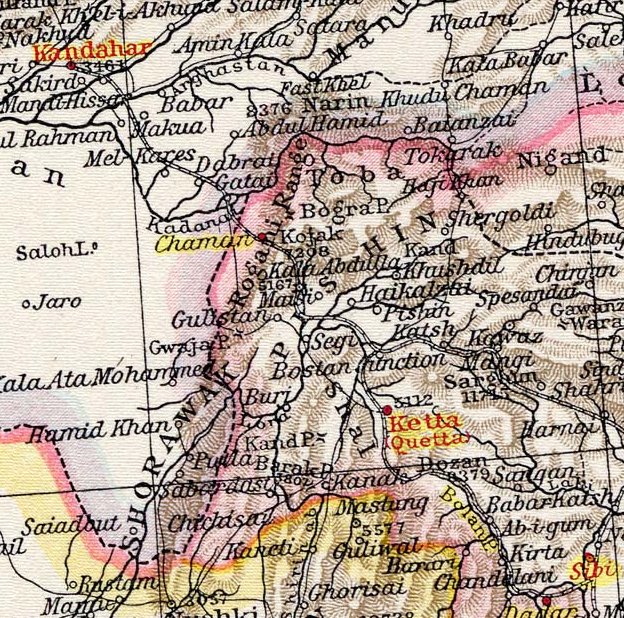
Map showing proposed Quetta - Kandahar railway, 1895

The website has this 1895 War Office map, which, interestingly, shows the never-built railway from the Indian (now Pakistani) border at Chaman to Kandahar.

British reconnaissance parties looking for a route for the proposed railway had reached Kandahar by December 1879, but they were in enemy country and so it was difficult to identify an optimal route. The British authorities realised it would not be possible for the railway to reach even as far as Quetta before the end of the war, and so the work was given a lower priority. When a new cabinet was formed under Gladstone in April 1880 they put the planned extension to Kandahar on hold.

Pakistan Railways still runs to Chaman, and plans for an extension as far as Spin Boldak resurface every so often – it even appears on some more recent maps, though it has never existed.

Are you there Moriarty?

And finally… while Sherlock Holmes’s sidekick Dr Watson may not really have been in the Second Afghan War, it seems a Moriarty was

Uzbekistan signs Mazar-i-Sharif contracts

Uzbek president resolves to adopt measures on construction of railroad Hairatan-Mazar-e-Sharif

28 November 2009 18:31:13 +5 GMT

Tashkent, Uzbekistan (UzDaily.com) — President of Uzbekistan Islam Karimov signed a resolution “On measures on realization of project “Designing, construction, establishment and commission to exploitation of railroad line between Hairatan and Mazar-e-Sharif” on 20 November.

The resolution was adopted for developing Trans-Afghan railway corridor, expanding transit transportation on railway line Tashguzar-Boisun-Kumkurgan, and broadening export potential of enterprises of Uzbekistan.

Board of Directors of the Asian Development Bank (ADB) adopted decision on 30 September 2009 to allocate grant to the Government of Afghanistan to finance project “Designing, construction, establishment and commission to exploitation of railroad line between Hairatan and Mazar-e-Sharif” and Uzbekistan Temir Yollari state joint stock railway company was selected as general contractor.

The resolution said Uzbekistan Temir Yollari and Ministry of Public Works of Afghanistan initialled contract on construction of railroad for US$129 million.

The document noted that Uzbekistan Temir Yollari will participate at the project as general contractor and Boshtransloyiha OJSC as general designer, as well as legal entities, realizing goods (works and services) to general contractor in line with the signed agreements.

The resolution entrusted Uzbekistan Temir Yollari to sign agreements with Uzbekinvest national export-import company on insurance of life and health of all workers, engaged in the project, during their stay in Afghanistan.

Uzbekistan Temir Yollari in cooperation with the Ministry of Interior Affairs, National Security Service, and Ministry of Foreign Affairs was entrusted to adopt measures on signing memorandum of mutual understanding on guaranteeing security of personal, attracted to the project, construction equipment and infrastructure in the territory of Afghanistan with the authorized body of Afghanistan and Collective Security Forces, deployed in Afghanistan.

The resolution set several preferences to Uzbekistan Temir Yollari and its employees, who will participate in the project. In particular, the sum of additional payments to travel allowances, paid to employees of the Uzbek railway company, traveling to Afghanistan to realize the project, and the expenses on providing three meals a day are not included to taxable base to income taxes of legal entities and individuals.

The document said income tax will not be obliged to property, received and handed over within the structures of Uzbekistan Temir Yollari within the framework of the realized project.

Uzbekistan Temir Yollari was also exempted from custom payments, except fees for customs registration, for equipment and materials, imported and exported from Uzbekistan within the project, in line with the list, approved by the Cabinet of Ministers of Uzbekistan. The document also allowed to export some items, which were banned in line with the legislation.

Ministry of Economy of Uzbekistan in cooperation with Uzbekneftegaz national holding company were entrusted to supply combustive-lubricating materials to Uzbekistan Temir Yollari without interruption.

The ministry will also ensure realization of metal products and cement to the Uzbekistan Temir Yollari on direct agreements on average exchange prices.

Source: UzDaily.com, 2009-11-28
Afghan fruit by rail

An article on the rail transport of Afghan fruit to markets in India.

Fresh Fruits from Afghanistan to India!

I fondly remember as a youngster – in late 1940’s and as late as early 50’s – the repeated shouts of burly, awesome Pathan vendors in our ‘mohalla’ in Lucknow: “Fresh luscious grapes from Chaman; red juicy pomegranates from Kandahar; “Buy them now, eat them now, lest you repent!”

But whatever the virtues of the vendors, their assertion about the quality of their products was never in doubt. So with this childhood experience when I read the following lines in P.S.A Berridge’s old classic, “Couplings to the Khyber: The Story of The North Western Railway” I became really nostalgic about the fruits which are certainly no more:

“Built primarily as a strategic line the Chaman Extension Railway served for many years hundreds of tons of luscious fruits — grapes, peaches, and nectarines in particular from Afghanistan found their way to the markets of far-away cities in India. Before 1947, in the summer months, there used to run every day a train with its ice-packaged refrigerator vans destined for places as far away as Calcutta and Madras.”

Let me now construct this interesting rail transportation story which has a human angle too.

More

Source: Arunachala Grace, Sacred Power Site of South India, 2009-10-18

The Railway Magazine, January 2010

There is a short report “Afghan railway progress” on page 91 of the January 2010 issue of The Railway Magazine.

This mentions the Asian Development Bank funding, and describes the Iran to Herat line as “stalled due to both lack of resources and border disturbances”. It reports there are 20 wagon loadings a week to Towraghondi, and 30 daily to Hayratan.

An old locomotive at the Kabul Museum

Found on Flickr.

Photo of the Day: 4 August 2009

Photo of the Day: 4 August 2009

An old locomotive at the Kabul Museum.

One of the first three locomotives in Afghanistan, imported by King Amanullah Khan in the 1920s, is now on display at the Kabul Museum.

A US$ 120 million grant from the Asian Development Bank is due to be used for railway development in Afghanistan.

A feasibility study will be conducted for a rail route connecting the northern town of Hairatan, which borders Uzbekistan, to the western province of Herat. Another route under study will be between Shirkhan Bandar in Kunduz province, which borders Tajikistan, and Mazar-i-Sharif in the north of the country.

Afghanistan is a landlocked country with no railways.

Photo: Fardin Waezi (UNAMA).

Railways of the Raj

A website which might be in interest to readers of this site is Railways of the Raj

WELCOME TO THE RAILWAYS OF IMPERIAL INDIA

This website sets out to capture the flavour of the Railways of the Raj, that giant colossus set up and equipped by the British and founded on the power of steam. We take a look at impressions, reminiscences and memoirs, pictures, extracts from diaries, even that odd letter Aunt Jane wrote telling how she was stranded at Bombay Victoria Terminus station back in the twenties.
More