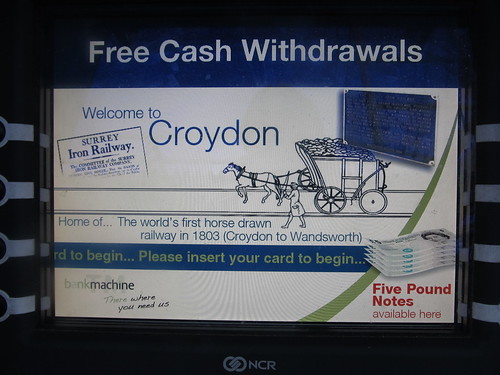
I recently spotted a cash machine outside East Croydon station with a message on the screen which says:
“Welcome to Croydon
Home of… The world’s first horse drawn
railway in 1803 (Croydon to Wandsworth)”.
A nice touch, however horse drawn railways were already long established by the time the Surrey Iron Railway opened in 1803. The first railway for which documentary evidence is currently known is apparently the Wollaton Wagonway, near Nottingham, which was referred to as a “passage now laide with railes” in a document dated 1 October 1604. This used horse power, as did many subsequent lines in mining areas of the northeast of England.
The claim to fame of the SIR is that it has long been widely described as the world’s first public railway; previous railways had been private lines for the use of the owners of a mine, quarry or similar. However there is now doubt as to the accuracy of this claim, as it appears that the SIR was in fact preceded by the Lake Lock Rail Road, near Wakefield, which opened in 1798 but doesn’t seem to have had as good PR.
In a moment of boredom I contacted the operators of the cash machine. Not only did I get a reply, it was longer and politer than I expected (or deserved?). Apparently they obtained the information from the Wikipedia article on the SIR, and “these screens are due to be changed and this information will then be removed”.
In January 2001 I went to London, Ontario (where the Class 66 locomotives are built), and also had chance to take a train ride to Windsor and visit a freight yard in Toronto. These pictures some pretty grotty old scans, first uploaded back when downloading an image over dial-up could involve a long wait.
I went back to Canada in June 2004, this time touring the country by train.
Looking across from Windsor in Canada to Detroit in rebel-controlled North America.
CN class K-3-b steam locomotive number 5588, formerly Grand Trunk Railway class P6 number 213. This pacific was built in 1911, and is now ‘stuffed and mounted’ in Riverside Drive, Windsor. It carries the name Spirit of Windsor. If you ever visit Windsor, it may be useful to know that the station is a long way from the city centre – I didn’t! It was about -7°C when I took this – maybe nothing special to the locals, but jolly cold for me.
GY-418e number 7260 alongside the river in Windsor, with Detroit in the background. Originally build by General Motors in 1956 this locomotive was remanufactured at Pointe St-Charles main shops in Montreal in 1990. It is approved for operation in the USA, and is equipped for remote control operation.
Behind the locomotive is GP9 slug 253. This was converted from a cut-down General Motors GP9 in 1990. It has no engine, instead taking power for its traction motors from the locomotive.
I caught the 09:55 departure from London to Windsor on 9 January. This set off from London about half an hour late, and was about an hour late into Windsor. A freight train in front of us was apparently having problems.
There is quite a difference in height between the loco and the three carriages.
Another view of the locomotive about to run round. 6424 is a 3000 hp B-B built by General Motors in 1987, and is one of ten examples of the GPA-30b class. There were three orders for these GPA-30 passenger locos between 1986 and 1989, totalling 59 locos
Compared to the UK, Canadian trains are big. 6426 departs London for Toronto at 15:48 on 8 January 2001
An Amtrak train bound for Chicago leaves London, 10am Tuesday 9 January 2001. The picture doesn’t really capture the size of the thing. The station doesn’t have raised platforms like the UK, just a tarmaced area next to the line, so the train really towers above passengers. There is a second platform, but that was under deep snow. The loco, number 519, is a GE B32-8WH of 1991.
A disused passenger station on the CP line in London. Freight still comes through here. 8 January 2001
This GP9 is one of three switchers (shunters) belonging to a private contractor that are used at the Canadian Pacific Railway’s Vaughan Intermodal Terminal near Toronto. Vaughan is the largest container freight yard in Canada, and sees trains up to 10 000 feet long! Seen here on 10 January 2001
GMD type SW1200RS B-B switcher of 1956. Formerly a CN loco, it now belongs to a contractor, and is also used at Vaughan. 10 January 2001.
GMD type SW9 of 1952, formerly belonging to Century Locomotive Parts, and previously a CN loco, but now belonging to a contractor and working at Vaughan yard. 10 January 2001.
EMD SD40 or SD40-2(?) 6046 of 1952 at MacMillan Locomotive Reliability Centre, near Toronto.
EM GY-418f 7276 at MacMillan Locomotive Reliability Centre, near Toronto. Originally build by General Motors this B-B locomotive was remanufactured by AMF Technotransport in 1993. 258
GP9 slug 258 was converted from a cut-down General Motors GP9 no 4411 (ex-1735) in 1990. It has no engine, and takes the power for its traction motors from the locomotive. It is equipped for remote control operation, and approved for use in the USA.
I found the details of the vehicles in the book Canadian Trackside Guide 1996, published by Bytown Railway Society Inc of Ottawa.
Crossing Canada on VIA Rail’s The Canadian Toronto – Vancouver train service in June 2004, and continuing on to Vancouver Island.
Lugagge for The Canadian service being loaded (or unloaded) at Jasper station, 21 June 2004.
The VIA Rail train from Victoria waits at Courtenay before heading back south. The railway on Vancouver Island is very scenic, but only had one daily passenger train each way. 23 June 2004.
Victoria station, at the south end of the Vancouver Island line. 23 June 2004.
The UAE is another country which might be thought to have had no railways before the metro and monorail were built in Dubai. However there were some lines.
Mushrif Park is the largest of the four parks and consists mainly of scrubland. There is a plinthed standard gauge train on a short section of track alongside a concrete platform, with a plaque saying OLD MUSHRIF PARK TRAIN (1975).
A four-wheel Baguley-Drewry diesel locomotive is accompanied by two wooden-bodied four-wheel coaches, all painted in blue. The coaches are built on the frames of goods wagons, are braked and have builder’s plates reading BUTTERLEY Co. Ltd. 1968, Builders Codnor Park, Nottingham.
History
Eljas Pölhö and the Halcrow website provide some details of the railway.
By the late 1960s Dubai’s growing trade meant a new and modern port was needed, as large ships could only approach to a mile from the shore. Work was underway in 1967, with Sir William Halcrow & Partners as consulting engineers and Costain Civil Engineering Ltd as contractor.
The breakwaters for the port were composed of rock brought by road from Bayadat Quarry, some 20 miles inland, and then transferred to a standard gauge railway at a large construction yard adjacent to the future port’s site. When the breakwaters were completed in 1971 the track was lifted and all rolling stock stored in an adjacent plant yard.
The port opened in 1972, named after Sheikh Rashid bin Saeed Al Maktoum, the ruler of Dubai.
Further extensions of the breakwaters were commenced in late 1975, but this time road vehicles were used for all transportation of materials.
Fleet
Costain International had five locomotives, Baguley-Drewry 3655-3657 of 1968 (numbered L1 to L3, new to Costain International) and RH 418595 of 1957 and 418599 of 1958 (L4 and L5, previously used in three other locations). They had also 18 flat wagons, built by Butterley Co Ltd, Codnor Park Works.
The preserved locomotive is the former L1. Before being plinthed it was used from December 1975 to 1981 in Musrif National Park, an irrigated oasis 12 km east along the main road from the international airport. The park was opened by the ruler of Dubai in December 1975, together with the half-mile long railway which was built by Costain International Ltd who presented one locomotive and two flat wagons converted to passenger coaches.
The line was to be extended to form a loop, but this never happened and it was abandoned by 1981.
L4 and L5 were scrapped in Dubai about September 1975.
L2 and L3 were stored in Costain’s plant yard in 1981. In 1983 they were dumped amongst other disused plant at Bayadat Quarry, in the desert about 30 km out of Dubai on the Al Ain road, shortly before the Jebel Ali-Hatta crossroads. They were disposed of along with other machinery sometime between March 1987 and 1991.
At Safa Park Thomas Kautzor found a 60 cm (see below) gauge railway loop with a station/shelter at one end and a tunnel at the other. Inside the tunnel was a derailed train consisting of one steam-outline diesel locomotive (2’B no.115) and two bogie open coaches (15 seats each).
Given the condition of the track, this railway seemed not to have operated for quite some time.
Another report says a 381 mm (15 in) gauge miniature railway was in operation in 1981 in a park in the western suburbs of Dubai – could this be the same thing?
The information on this page is mostly assembled from postings to the World Diesel Loco mailing list by Richard Bowen, Thomas Kautzor, Daniel Osborne and Eljas Pölhö. Their quoted sources are
Industrial Railway Record 72 (1977), p74-76: The Railways of Dubai by W.F. Simms (includes two photos)
In October 2003 I spent a week in the Czech Republic, touring the Czech rail network, and sampling the odd local beer or four.
Railbus 810 055-4 was part of the stock of the 12.36 from Marianske Lazne to Karlovy Vary dolni, where it is seen shortly after arriving at around 14.14 on 2003-10-05.
Electric multiple-unit 451 068-1 stands at Praha hlavni with service Os 9143, the 11.23 to Benesov u Prahy, on 2003-10-06. Despite the impressive front end the train was a bit grotty inside.
The 120th anniversary of the Krupa – Kolesovice line was celebrated on 4th and 5th October 2003. Steam loco 434.2186 hauled a Praha Masarykovo – Kladno – Luzna train, which connected with a Luzna – Krupa – Kolesovice special pulled by 434.1100, seen above running round the train at Kolesovice. Preserved railcar M131.1130 was also in operation. Details from Rinbad.
A very dead kettle in the railway museum at Luzna.
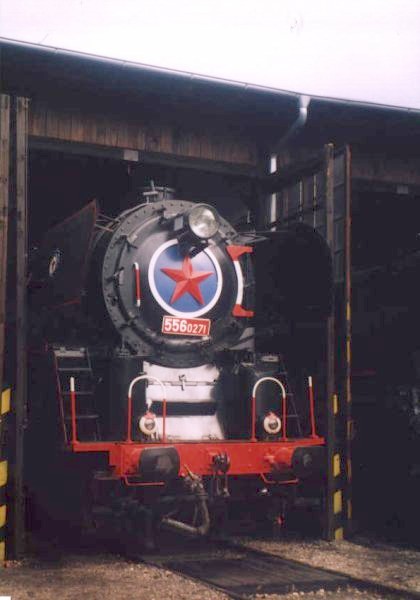
Preserved loco in the Luzna museum. Only the front of it has been restored – inside the shed, some of the wheels are missing!
A train for Tabor leaves Bechyne, over the impressive concrete viaduct which is shared with road traffic.
A Bechyne-bound train passing our train for Tabor. There are some more photos of this rather nice line on a 100th anniversary website.
Diesel loco leaving at Jindrichuv Hradec on the 760 mm gauge JHMD line to Obratan.

![[Preserved steam locomotive]](/images/rail/ca-5588.jpg)
![[7260 in Windsor]](/images/rail/ca-detroitloco.jpg)
![[6424 at Windsor]](/images/rail/ca-6424windsor1.jpg)
![[6424 at Windsor]](/images/rail/ca-6424windsor2.jpg)
![[6426 at London]](/images/rail/ca-6426london.jpg)
![[Amtrack train]](/images/rail/ca-amtrack1.jpg)
![[Disused station in London]](/images/rail/ca-london-station.jpg)
![[Switcher 12]](/images/rail/switcher1.jpg)
![[Switcher 1254]](/images/rail/switcher2.jpg)
![[Switcher 7703]](/images/rail/switcher3.jpg)
![[Loco 6046]](/images/rail/ca-cn6046.jpg)
![[Loco 7276]](/images/rail/ca-cn7276.jpg)
![[Lugagge at Jasper station]](/images/rail/ca-jasper-luggage.jpg)
![[Courtenay station]](/images/rail/ca-courtenay.jpg)
![[Victoria station]](/images/rail/ca-victoria.jpg)
![[Photo of train in Dubai. Thomas Kautzor]](/images/rail/ue-loco2.jpg)
![[Photo of train in Dubai. Thomas Kautzor]](/images/rail/ue-train1.jpg)
![[Photo of train in Dubai. Thomas Kautzor]](/images/rail/ue-train2.jpg)

![[Photo of train in Dubai. Thomas Kautzor]](/images/rail/ue-loco3.jpg)
![[Photo of train in Dubai. Thomas Kautzor]](/images/rail/ue-loco4.jpg)
![[Photo of train in Dubai. Thomas Kautzor]](/images/rail/ue-loco1.jpg)
![[Photo of train in Dubai. Thomas Kautzor]](/images/rail/ue-coach1.jpg)
![[Photo of train in Dubai. Thomas Kautzor]](/images/rail/ue-coach2.jpg)
![[Photo of train in Dubai. Thomas Kautzor]](/images/rail/ue-coach3.jpg)
![[Photo of train in Dubai. Thomas Kautzor]](/images/rail/ue-coach4.jpg)
![[Photo of train in Dubai. Thomas Kautzor]](/images/rail/ue-track1.jpg)
![[Photo of train in Dubai. Thomas Kautzor]](/images/rail/ue-ngloco.jpg)
![[Photo of train in Dubai. Thomas Kautzor]](/images/rail/ue-tunnel.jpg)
![[Photo of train in Dubai. Thomas Kautzor]](/images/rail/ue-ngtrain.jpg)
![[Photo of CD railbus 810 055-4]](/images/rail/cz-railbus.jpg)
![[Photo of EMU 451 068-1]](/images/rail/cz-emu-praha.jpg)
![[Steam loco on level crossing]](/images/rail/cz-steam1.jpg)
![[Derelict, rusting steam loco]](/images/rail/cz-steam2derelict.jpg)
![[Czech train]](/images/rail/cz-bechyne-bridge.jpg)
![[View out of train window]](/images/rail/cz-bechyneline1.jpg)
![[Diesel loco]](/images/rail/cz-jhmdloco.jpg)