A few badly-scanned pictures of railways in Poland, taken when I was touring the country with a PKP Polrail pass in August 2002.
![[Cast PKP emblem on a steam locomotive]](/images/rail/pl06-pkp.jpg)
PKP emblem on a steam loco at Wolsztyn.
![[Child looking up at steam locomotive cab]](/images/rail/pl03-wolsztyn.jpg)
I’m taking an early holiday ‘cos I know summer comes soonest in Wolsztyn.
![[Steam train]](/images/rail/pl09-wolsztyn.jpg)
A real steam-hauled freight train leaves Wolsztyn on a wet morning. 2002-08-05.
![[Driver of diesel locomotive waving for the camera]](/images/rail/pl10-leszno.jpg)
The driver of SU45-205 on the Wolsztyn to Leszno train says says hello. Leszno, 2002-08-05.
![[Loco at Hel]](/images/rail/pl11-hel.jpg)
A diesel-hauled train at Hel, waiting to depart for Gdynia. 2002-08-06.
![[Polish countryside]](/images/rail/pl05-window.jpg)
A view from the window of the overnight Gdansk – Krakow train, morning of 2002-08-07. Standing in the corridor and leaning out of the window seems a popular way to travel by train in Poland.
![['WARNING! Train' in Polish, German, English and Russian]](/images/rail/pl04-warning.jpg)
A quadlingual sign at Oswiecim. 2002-08-07.
![[Tram]](/images/rail/pl08-tram.jpg)
A tram in Krakow. 2002-08-08.
![[Us on a pump trolley]](/images/rail/pl-trolley.jpg)
Once on board the train, we began to suspect that buying the cheapest ticket might have been a mistake…
Chabowka, 2002-08-08.
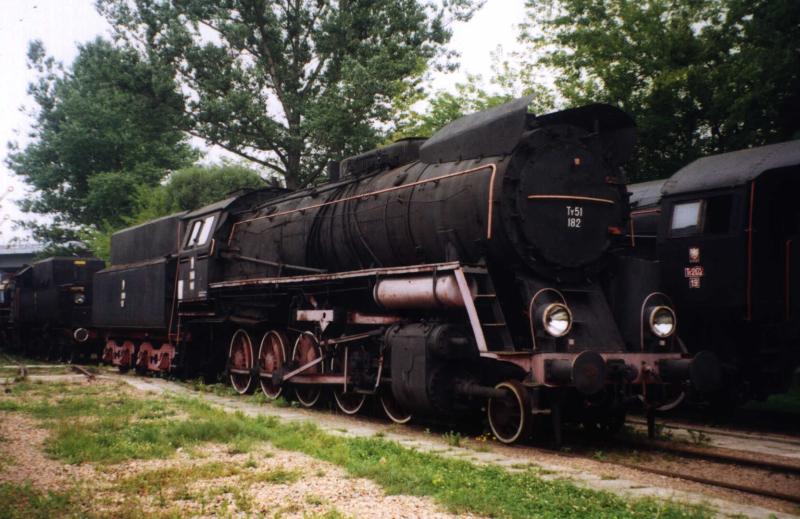
Steam loco Ty51 182 in the railway museum at Chabowka. They’ve got quite a variety of standard and narrow gauge locos there. Entrance to the museum cost PLZ 3, and permission to take photos PLZ 10. 2002-08-08.
![[Loco EU06-17]](/images/rail/pl13-wroclaw.jpg)
Our train from Krakow to Wroclaw, seen on arrival at Wroclaw. Electric locomotive EU06-17 was built in Britain.
2002-08-09.
![[Tram]](/images/rail/pl01-wroclaw.jpg)
A tram in Wroclaw. The city has an extensive tram network, and almost every street in the centre seemed to have tram tracks. 2002-08-10.
![[Tram]](/images/rail/pl02-krakow.jpg)
A tram in Poznan. Gdansk, Katowice and Wroclaw had very similar vehicles.
![[EP08]](/images/rail/pl12-ep08.jpg)
An EP08 at Poznan. Most electric locomotives we found seemed to be green, but this one wasn’t. 2002-08-10.
![[Tram]](/images/rail/be-antwerp1.jpg "Antwerpen")
![[Tram]](/images/rail/be-brus1.jpg "Brussels")
![[Tram]](/images/rail/be-brus2.jpg "Tram and Atomium")
![[Commonwealth military cemetery]](/images/rail/be-cem.jpg "Ramparts Cemetery, Ieper")
![[Tram]](/images/rail/be-coast1.jpg "Oostende")
![[Railcar at Dinant]](/images/rail/be-dinant1.jpg "Railcar")
![[Tram]](/images/rail/be-gent.jpg "Tram in Gent")
![[Tram]](/images/rail/be-gent2.jpg "Tram in Gent")
![[Tram]](/images/rail/be-gent3.jpg "Tram in Gent")
![[Train]](/images/rail/be-gent4.jpg "Train at Gent")
![[Train]](/images/rail/be-loco1.jpg "2131")
![[Belgian National Railways logo with nightcap]](/images/rail/be-logo.jpg "Belgian National Railways logo with nightcap")
![[People in Napoleonic costume heading for a bar]](/images/rail/be-waterloo2.jpg "...Oh yeah, and I have met my destiny, In quite a similar way")
![[Steam locomotive in Reykjavik]](/images/rail/icelandloco.jpg "Steam locomotive in Iceland")