Government railways department to be formed

According to the 17 October 2011 Ministry of Mines statement which said MCC is to commission a Chinese firm to undertake surveys for railways from Kabul to Torkham and the Hayratan line, Minister of Mines Wahidullah Shahrani “stressed that the creations of most of railways are related to mining projects therefore for the time being all of railways projects will be related to the Ministry of Mines“.1

However, on 19 October 2011 a US$222m grant agreement was signed in Kabul by Finance Minister Hazrat Omar Zakhilwal and the Asian Development Bank’s Country Director Robert Rinker.2 The Minister of Finance said $189m of this was for road projects, according to a news report, while the rest would be used “to establish an independent railways department”. This will be “within the framework of the Ministry of Public Works, which will supervise the construction of rail tracks.”3

The Deputy Public Works Minister, Eng Ahmad Shah Waheed, said a commission led by the presidential advisor on economics affairs and comprising representatives from the ministries of Public Works, Finance, Economy and Commerce has been set up “to evolve a mechanism for the railways department”.

So is there a risk of a turf war between the ministries of Mines and Public Works? I’ve been led to believe that the Minister of Mines is a powerful figure, as mining rights could potentially generate significant income for a country which lacks many source of revenue.

  1. Technical research for Kabul-Mazir and Kabul-Torkham railways begins soon, Ministry of Mines, dated 17 October 2011, published 18 October 2011
  2. ADB Provides $US 222 Million for Roads Construction in Afghanistan, Ministry of Finance, 19 October 2011
  3. ADB to give $222mn for roads, rail tracks to Afghanistan, News Network International, 20 October 2011

Mazar-i-Sharif to Andkhoy railway plans

Some more details are emerging about the plan for a east-west railway, which would start at the terminus of the recently-completed line to Naiababad east of Mazar-i-Sharif, and run across northern Afghanistan to Andkhoy.

The Asian Development Bank approved a US$754m multi-tranche financing facility “to rebuild Afghanistan’s shattered road and rail network” on 20 September 2011, and this includes funding for the project; unofficial sources say up to US$300m could be allocated to the railway project, and there is a hope that other sources of funding will be available.

Studies are still to be undertaken, however it is likely that 1520 mm (“Russian”) gauge will be adopted for compatibility with the existing line from Uzbekistan and the 126 (or possible 162) km line which the Turkmenistan’s President Gurbanguly Berdimuhamedov is proposing from Atamyrat across to the Aqina border crossing and Andkvoy; media reports say work on this line could begin in 2012.

Construction of the east-west line could begin in 2013. The contract to build the Hairatan to Mazar-i-Sharif line was awarded to Uzbek national railway UTY without a competition, because it was believed that given conditions in Afghanistan, the lack of a local rail industry and the reliance on a physical connection to Uzbekistan there was little prospect of anyone else with the right skills and experience bidding. However this second stage will put out to an open tender.

As with the existing line, the focus is again on the freight market.

In the longer term a further extension from Andkhoy to Herat is envisaged if/when Iran completes its line to Herat. This will presumably create a break-of-gauge at Herat, which is probably a sensible place to have one.

MCC to commission studies for north-south railway

The Minister of Mines Wahidullah Shahrani has said Chinese copper mining concessionaire MCC should award contracts for surveying railway lines from Kabul to Torkham (on the Khyber Pass border with Pakistan), and from Kabul to Kabul to Ghorband, Bamiyan and Naibabad (for Mazar-i-Sharif and Hayratan).

I think “China Railway(s) Company” is China Railway Group, who undertook work on the Kabul – Jalalabad road.1 However there are a number of Chinese organisations with similar names which can be hard to untangle.

Technical research for Kabul-Mazir and Kabul-Torkham railways begins soon

According to Aynak Copper Project contract, MCC are required to extend the railways sub projects for transportation of copper. Accordingly a meeting took place between the relevant organizations at the Ministry of Mines to discuss the coordination and regular implementation, and, identifying routes for the railway tracks.

The Minister of Mines Wahidullah Shahrani said at the meeting that the preliminary track – from Kabul to Torkham and from Kabul to Mazarisharif via Ghorband, Bamyan and Naybabad to Hairatan – of the railway was determined last year. Now it is necessary for MCC to sign a contract with a company for technical survey though a bidding process.

“The China Railway Company which is familiar with the territory of Afghanistan and have experience in constructing the Polikhomri-Shikhanbander and Kabul-Jalalabad roads, has been identified as being the winning company of the tender, and will begin the technical research for Kabul-Mazar and Kabul-Torkham railways” Said Mr. Shahrani

Mr. Shahrani believed that the creation of railways in Afghanistan is a complex undertaking and therefore there is need for an independent railways organization inside the government.

He stressed that the creations of most of railways are related to mining projects therefore for the time being all of railways projects will be related to the Ministry of Mines.

“These railways will not be limited to transportation of minerals, but will be used in different sectors like trading goods etc.” He said.

The exact expenditures of the project will be estimated after the technical research implemented by the China Railways Company.

Source: Ministry of Mines, dated 2011-10-17, published 2011-10-18

  1. Record results for China Railway IPO, China Economic Review, 10 January 2011

ADB funding for Andkhoy extension

The Asian Development Bank approved a US$754m multitranche financing facility “to rebuild Afghanistan’s shattered road and rail network” on 20 September 2011.

The money will be used to upgrade 578 km of roads and to fund “construction of new facilities to complement the recently completed train line connecting the northern hub of Mazar-e-Sharif and Uzbekistan.” The 75 km railway will be extended 225 km west, with “new tracks and stations between Mazar-e-Sharif and Andkhoy”.

There is a $33m cofinancing grant from the Afghanistan Infrastructure Trust Fund, while “contributions from Japan and the United Kingdom, will be administered by ADB.”

According to ADB, Afghanistan’s road network “is incomplete, mostly in bad shape, and the railway network is in its infancy”.1

“Infrastructure links the new mineral centers to markets, creates jobs, improves trade, and—perhaps most importantly—provides Afghans with a sense of hope for the future,” said Juan Miranda, ADB’s Director General for Central and West Asia. “With the development of modern road, rail and energy networks, Afghanistan is poised to reap the benefits of its strategic location and become a pivotal crossroads for trade and commerce in the region.”2

Updates will probably appear on ADB’s 44482: Transport Network Development Investment Program webpage.

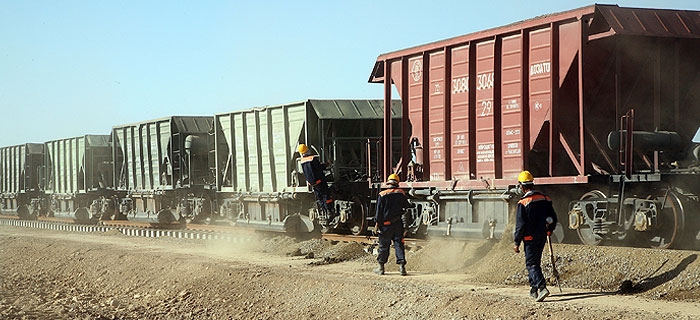
There is a photo on the ADB website showing some hopper wagons dropping ballast onto the tracks, presumably during construction of the Mazar-i-Sharif line.

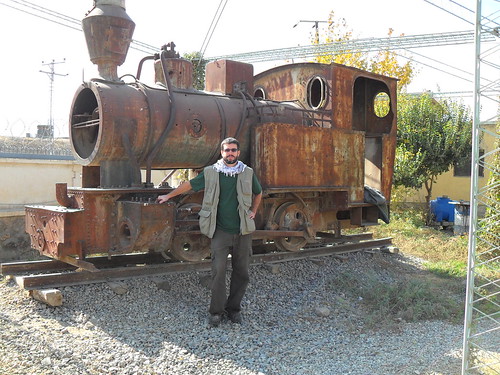
King Amanullah’s 1920’s Train

King Amanullah's 1920's Train

Amanullah sought German companies and engineers into the country to build roads, bridges, dams and royal palace in Darulaman, a suburb of Kabul. The locomtives were transported by ship to Mumbai and then pulled by elephant in passes through the Hindu Kush, where a couple of hundred metres of rail were laid. After 20+ years of civil war turmoil and the destruction of Kabul, they’re overgrown by thistles and thorn bushes are three rusty steam engines and the carriage labelled “Made in Germany”

Flickr photo by Tanya Murphy (username “turnip!”, © All Rights Reserved), taken on 2 November 2009.

Afghan funds for rail project approved

The Afghan government’s financial contribution to the Hayratan to Mazar-i-Sharif railway project was approved by a session of the Wolesi Jirga, the lower house of parliament, on 15 October 2011.

Wolesi Jirga approves paying of 51 million US$ to the central bank and 20 million US$, because of a railway construction from Hiratan to Mezari Sharif

Wolesi Jirga held session. The plenary session of the Wolesi Jirga was chaired by Abdul Raouf Ibraheemi the president of Wolesi Jirga. At the session, the MPs debated about paying of 51 Million US$ to the central bank and 20 Million US$ because of a railway construction from Hiratan to Mezari Sharif.

[…]

In conclusion, they approved paying of ‘51 Million US$ to the central bank and 20 Million US$ because of a railway construction from Hiratan to Mezari Sharif’ by the majority of all the members.
Source: Parliament of Afghanistan, Kabul, 2011-10-15

When the Asian Development Bank agreed to fund the Mazar-i-Sharif project in 2009 it said it would meet USD165m of the USD170m cost, leaving USD5m to come from the Afghan government. The Afghan parliament has now agreed to provide USD20m, so an extra USD15m has appeared somewhere.

UTY to build next section of railway?

Uzbekistan Railways To Help Build Afghan Railway System

Uzbekistan Railways is to construct a new railway from Mazar-e-Sharif to Andkhoy in western Afghanistan, according to the Uzbek company.

This railway section is part of the project to construct a railroad in Afghanistan with a total length of 2,000 kilometers from Mazar-e-Sharif through Kabul and Kandahar to Herat and back.

[…]

Minimum income of Uzbekistan Railways from the operation of the Hairatan Mazar-e-Sharif railroad section in Afghanistan during 2011-2013 will be $96 million.

Source: Uzbekistan Railways To Help Build Afghan Railway System, AsiaPulse News, 2011-09-30

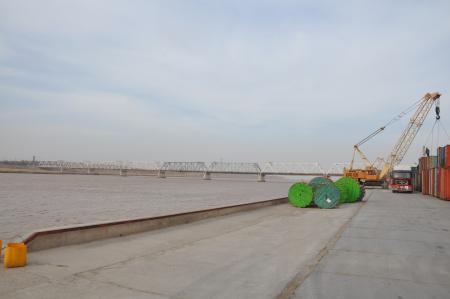
Hayratan port

DVIDS has three articles about the Hayratan port by Michael Vanpool.

Photo of riverside quay at Hayratan port

… more than half of everything arriving into country is from the trains in Hairatan.

“[International Security Assistance Force] cargo comes through trains, and also fuel comes through here as well,” said Maj. Jason Cole, tactical command post officer in charge, 101st Sus. Bde. Joint Combat Outpost Hairatan.

“Basically the train is a great mover. Take a look at the U.S. History; the train did a lot for the growth of our nation. Trains, it’s the way to go for the future of Afghanistan, and they have a lot of plans for trains.”

Railroads in Afghanistan are starting to be embraced more by the country, after decades of war halted the expansion of trains into the country. Now the rails are planned to grow from the north down to the other provinces.

Source: New line for coalition forces, new life for Afghanistan, Michael Vanpool, DVIDS, 2011-09-17