Kabul railway coach photo

Abandoned railway coach in Kabul

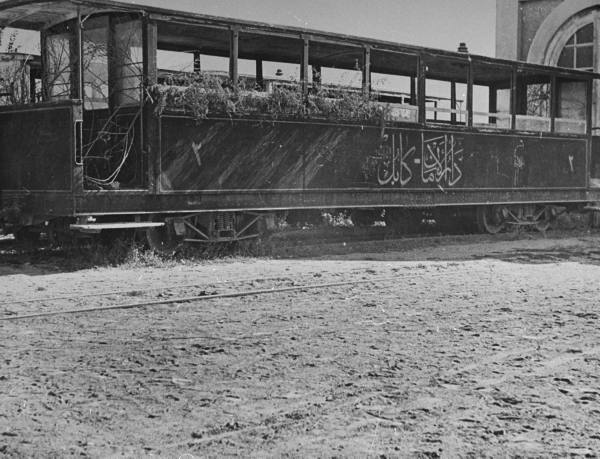
Google’s archive of photos from Life has this one (above) captioned “Deserted Afghan railway car after failure to begin rail system”.

Dated 1938 in the caption, the picture shows an overgrown bogie coach from the short-lived narrow gauge railway which ran for 7 km between Kabul and Darulaman.

The number painted at each end is “2” – a vehicle number, or a class number? The coach is noticeably longer than one in labeled “1” in this picture below, which was taken by Wilhelm Rieck in 1923 and is said to show the first train, so perhaps it is a class number, with the bigger coach being second class.
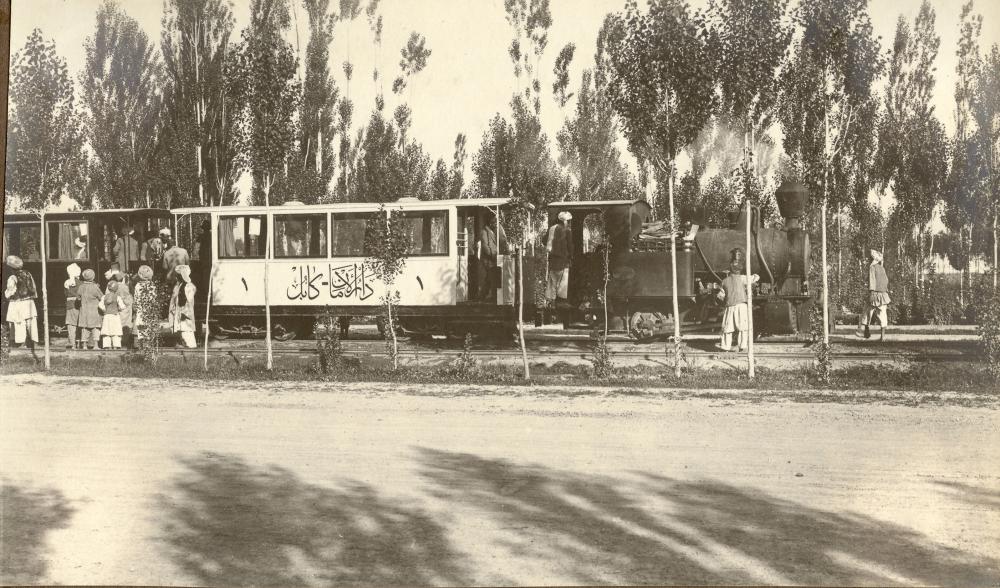
The Life photo shows another coach at the back, apparently a lighter colour, which is presumably the first class car. But is there a third vehicle as well, in front of that one?

This picture below appeared in the February 1930 issue of the German magazine UHU, and shows two coaches plus some wagons.
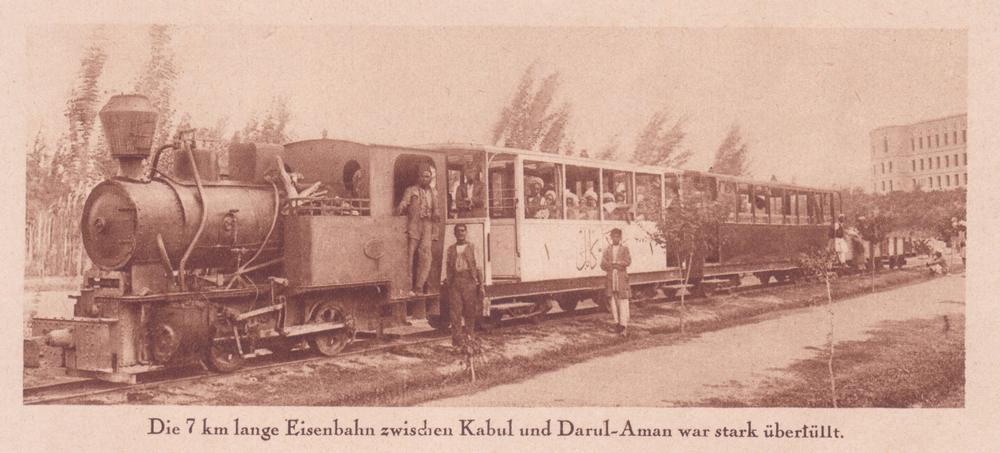
Train at Darulaman

Amazingly, the locomotives have survived, though only the underframes of the coaches remain.
“The tribes were very restive and hostile”

I’ve just been re-reading a fascinating book I found whilst browsing dusty shelves in a bookshop in Rawalpindi when I was last in Pakistan (1997). It is called “Adventure Through Khyber” by Victor Bayley … His task: to design and supervise the construction of a railway through the Khyber Pass, a railway which would eventually link far off Bombay to the Afghanistan Border at Landi Khana.

More…

Cost of road transport

Writing in Viewpoint: Measuring success in Afghanistan, Fotini Christia, a political scientist at the Massachusetts Institute of Technology who has recently spent time in Afghanistan researching conflict and development says:

The cost of transporting goods is increased by violence and the chances of being attacked on the roads. If transport costs on a route were to fall it would be a positive sign.

In 2007 Afghanistan’s lorry drivers’ union estimated that each vehicle pays more than $6,500 (£4,216) annually in taxes and bribes extorted on Afghanistan’s roads.

Such costs are an important measure of the security situation.

Visit of their Majesties the King and Queen of Afghanistan to Swindon Works

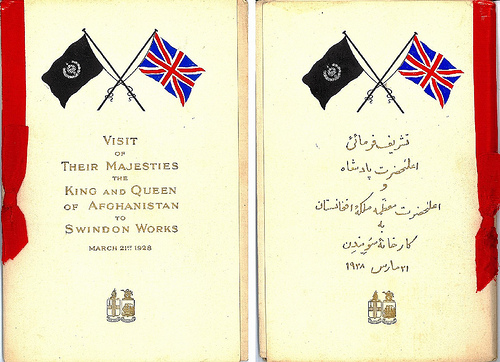
Swindon Local Studies Collection has an image of the commemorative booklet containing an illustrated history of Swindon works in Persian which was produced when King Amanullah visited the Great Western Railway‘s works on 21 March 1928.

The Queen did not attend as had been planned: “it was understood that the Royal lady was too fatigued to bear the journey” reported Railway Gazette on 23 March 1928.

The booklet included portraits of the GWR’s Chairman, Deputy Chairman, General Manager and Chief Mechanical Engineer.

British Pathe has some old film KING AMANULLAH IN SWINDON:

Royalty. Amir of Afghanistan Amanullah Khan visits England. The Amir and his entourage visit a railroad engine factory. Dark but interesting footage. The group watches a worker using a gun to spray paint or some sealant on a railroad freight car; the man wears a mask to protect himself from chemicals. The men walk by a locomotive rotating on a turntable outside factory. Interior: they walk through large space w/ many sets of train wheels lined up. Heavy machinery moving another set of wheels overhead. Next; they gather around a finished locomotive. Exterior again;the group walking along beside train. Entering train coach. This visit is probably from 1921 [sic]; when A.K. signed a treaty w/ Great Britain.

I suspect 1921 should say 1928, making it the same as the visit above and as listed by the British Film Institute.

There is also a photo The King of Afghanistan visits the Swindon railway works, Wiltshire, 1928 at the Science & Society Picture Library.

Mazar-i-Sharif line construction work

Uzbekistan to build railway line in Afghanistan

Uznews.net – A wage of $500 per month, poor living and working conditions and the lack of security – this is what Uzbek railway builders are offered to build the Hairaton-Mazar-e Sharif railway line in northern Afghanistan.

The salary of $500 per month is very good in Uzbekistan but many specialists will think twice before putting their lives at risk.

Railway builders told Uznews.net on condition of anonymity that the construction of the Termez-Hairaton line started last autumn and 20 Uzbek builders had been involved in it. “Builders were sent at the beginning of last autumn to lay rails and ballasts. They returned a month ago,” a railway builder said.

A brigade of 30 militarised guards was sent to Afghanistan on 24 January but they could not get there immediately because of military operations in the country’s north.

[more]

Source: Uznews 2010-02-07

Tajik rail link offered

Islamabad-Dushanbe flights will start by March: Tajik envoy

[…]
The ambassador [of Tajikistan to Pakistan, Zubaydullo N Zubaydov] said that he would like to acknowledge that at the London Conference held on January 28, 2010 on providing stability and security in Afghanistan, the Minister of Foreign Affairs of the Republic of Tajikistan announced that Tajik side has offered construction of railway and gas pipeline from Turkmenistan to Mazar-e-Sharif, Afghanistan and Tajikistan, as well as building of power transmission lines from Turkmenistan to North Afghanistan and Tajikistan, building Dashti Joom Hydropower Dam at the Tajik-Afghan border. “It will help the normalisation of the situation and restoration of the economic life in Afghanistan”, he added.
Source: Business Recorder, 2010-02-05

Russian discussion

Russian language-discussion of Afghan railways, via Google Translate

It looks like I need to find a copy of the book Выполняя Интернациональный Долг (and learn Russian).

Yes, the branch Kushka-Toragundi there a long time. I have personally seen covered freight wagons in the WCD Toragundi, when he served in Afghanistan, in 1986 and I have a small book (authorship, not mine) “In carrying out international duty”, where this branch is a little described. There an interview with a citizen of Afghanistan, a switchman employed on this road. There is in this book and excellent photo (h / b) TEM-2 diesel locomotive with a banner “Friendship with the Soviet and the Afghan people can not be undermined!

Павел Егерев 17.08.2009 01:31

Also a Ferghana article dated 4 December 2009 Why does Afghanistan need railroad?, looking at the background to the Uzbek – Afghan rail link.

Uzbek bottleneck on the Northern Distribution Network

AFGHANISTAN: WASHINGTON EXPLORING CHINESE RE-SUPPLY ROUTE

Deirdre Tynan 2/02/10

[…]
On land, the NDN also appears to be experiencing some problems. Although the US Department of Defense insists the NDN is running at top capacity, Dmitri Rogozin, Russia’s mischievous envoy to NATO, told the Russian news paper Izvestia on January 26 that “there are some technical problems associated with an overload on one of the railway routes.”

Experts caution that additional land routes, whether routed through China or eastern Russia, could ultimately face the same problem — a bottleneck in Uzbekistan. “The problem isn’t the route to Central Asia, it is getting across Uzbekistan [to Afghanistan]. So you can have 10 ways to get to Termez, but what’s the difference?” a well-placed source told EurasiaNet.

Until major upgrades are completed at the Termez-Hairaton border crossing, and action taken to contain corruption and red tape, Uzbekistan is likely to continue to act as a choke point for US and NATO supplies bound for Afghanistan, the source added.
Source: Eurasianet , 2010-02-20

NATO transit traffic

From Russian Transport Daily Report, 1 February 2010:

NATO Cargo Transit through Russia May Start within Days

Railway transit of non-lethal NATO freight through Russia and Central Asia to NATO forces in Afghanistan may start within days. This would seriously supplement transportation through the main transit route, which passes through Pakistan. Pakistan will most likely remain the main transit route for the foreseeable future. Cargo to be transported through Russia and Kazakhstan will not include weapons or ammunition. A transit deal with Russia signed in 2008 needed approval from Kazakhstan and other Central Asian countries to come into force.
Source: Interfax News Agency

Work starts on Mazar-i-Sharif line

Uzbek national railway UTY has begun construction of the Hayratan to Mazar-i-Sharif railway.

Construction of Afghan railway launched

AFGHANISTAN: A ceremony on January 22 marked the start of construction of a 75 km rail link from Uzbekistan to the city of Mazar-i-Sharif in northern Afghanistan. The line is being built by Uzbek national railway UTY, which said it will be ‘a vivid testimony to the friendly relations between the two countries.’
More
Source: Railway Gazette International, 2010-01-27