Hayratan freight terminal

Army Strong Stories has some comments from Major Chris LeCron on the “neat article from Bloomberg News” about the Hairaton – Mazar-i-Sharif railway project.

When we were there [at the Friendship Bridge], the rail line stopped about a mile down the road south into Hairiton. Containers were downloaded off the rail cars by forklift or RTCH (rough terrain container handler, pronounced rech like throw-up). Once downloaded, they are shipped by truck.

Military logistics in Afghanistan

Rerouting Logistics in Afghanistan

Recent events highlight both the possibilities and fragility of the International Security Assistance Force (ISAF) presence in Afghanistan nine years after Operation Enduring Freedom began, John CK Daly writes for ISN Security Watch.

By John CK Daly for ISN Security Watch

There were a number of items on the agenda for Afghan President Hamid Karzai’s four-day visit to Washington last week, from ongoing US support for NATO’s mission in Afghanistan to the political crisis in regional neighbor Kyrgyzstan, home to a major US airbase instrumental in supporting ISAF’s campaign.

Nine years into Operation Enduring Freedom, solidifying logistical support for the ISAF Afghan mission remains an issue of some concern in Washington. If the mantra of the preceding Bush administration toward developing the post-Soviet Caspian’s energy reserves was “happiness is multiple pipelines,” then a legacy of its Afghan campaign is an implicit “happiness is multiple logistical resupply routes.” Given the massive presence of ISAF forces, the value of these logistical transportation networks will only increase with time.

The scale of the problem

The logistical scope of resupplying western forces in Afghanistan is immense. According to ISAF spokesman Colonel Wayne Shanks, there are currently nearly 400 US and coalition bases in Afghanistan, ranging from the massive Bagram airbase down to camps, forward operating bases and combat outposts. According to the Pentagon, there are now 87,000 US troops in Afghanistan alongside 47,000 ISAF troops from 44 other countries. When the Obama administration surge is complete, by 2011 Afghanistan will host a total of 102,000 US troops.

Nor are these the only US personnel considerations: According to the Pentagon’s Central Command (CENTCOM), the number of contractors for the US military in Afghanistan is now 107,000. These forces are immensely costly; by the end of the 2010 fiscal year, Afghanistan will cost nearly $105 billion, which includes most of $33 billion in additional spending requested by the Obama administration and currently pending before Congress.

Logistical support

Virtually everything needed for these forces is brought into Afghanistan primarily through Pakistan. But the rising level of violence against the ‘traditional’ resupply routes through Pakistan has left the Pentagon seeking alternatives, most notably through Central Asia.

Currently, the Pentagon’s main logistical pipeline for supplying ISAF forces in Afghanistan remains Pakistan, where roughly three-quarters of supplies are shipped either through or via overflights. Ground supplies are shipped into Pakistan’s Karachi port on the Arabain Sea and offloaded onto trucks before being sent to one of five crossing points on the Afghan border, the most important being Torkham at the Khyber Pass and Baluchistan’s Chaman, both of which have been subjected to increasing militant attacks. Torkham is the shortest route for ISAF supplies to both Kabul and its adjacent Bagram Air Base, the largest US facility in Afghanistan, with about 4,000 Pakistani drivers delivering about 150 truckloads of supplies to Afghanistan each day.

The persistent vulnerability of the Pakistani logistical conduit and the attendant problems of supplying nearly a quarter of a million troops and ancillary personnel has led the Pentagon to develop options, most notably the Northern Distribution Network (NDN), a railway link running from Latvia’s Riga Baltic port through Russia and Kazakhstan terminating in Uzbekistan’s Termez on the Afghan border.

The Northern Distribution Network

The NDN is a joint initiative of multiple Department of Defense agencies, including the US Transportation Command, CENTCOM, the US European Command, the Defense Logistics Agency and the Department of State.

The NDN’s first shipment was sent on 20 February 2009 from Riga 3,212 miles to Termez, with US commanders stating that 100 containers daily would be transported via the NDN, nearly two-thirds of the 140 containers shipped through the Khyber Pass each day.

While CENTCOM, the US and Russian governments maintain that the NDN is designed to transit only ‘non-lethal’ cargoes, when last year ISN Security Watch asked Russian Foreign Minister Sergei Lavrov about the NDN he replied, “It’s only one year ago that we signed an agreement with NATO as an organization for non-lethal transit, but for many years lethal transit had been operating through Russia on the basis of our bilateral agreements with France, Germany, and recently the similar agreement with Spain was signed. They can move equipment, troops.” Despite the presence of major US and Russian media representatives, Lavrov’s comment was overlooked.

As Lavrov made his comments farther east, Uzbek President Islam Karimov announced that the airport in Navoi, Uzbekistan, was being used to transport non-lethal cargo into Afghanistan via South Korea’s Korean Air, officially handling Navoi’s logistics. Two months later, shortly before a visit by President Barack Obama to Moscow, Russian authorities announced that US troops and weapons could use the country’s airspace to reach Afghanistan.

Uzbekistan as a transit hub

Given the volatility of Pakistan, Pentagon logisticians are increasingly favoring Central Asian alternatives. Shifting from the high cost of airlifting cargo, several railway projects from Uzbekistan into northern Afghanistan are now underway. On 7 May, Afghan Finance Minister Omar Zakhelwal, while attending a meeting of the Asian Development Bank in Tashkent, announced that Japan had pledged $1 billion for railway building in Afghanistan for a line from Balkh to western Herat province.

The scope of the Japanese commitment is immense, as according to Zakhelwal, his Ministry’s revenue in 2009 was $1.3 billion. The Japanese commitment builds on earlier Uzbek efforts to assist its southern neighbor. Uzbekistan is helping upgrade Afghanistan’s only functioning railroad, the Termez-Hairatan line, linking Afghanistan’s northern provinces with the world and extending the Termez-Hairatan line to Mazar-e-Sharif.

Dr Fred Starr, chairman of Washington’s Central Asia-Caucasus Institute, told ISN Security Watch, “Afghanistan is the missing link in Eurasia’s rail network and Uzbekistan has taken a lead role in filling the gap. Everyone gains from this. No one loses.”

While the western military commitment in Afghanistan has led to infrastructure projects that languished for decades, roads, airports and railways are ‘dual-use’ technologies that will assist the post-war development of Afghanistan’s economy, decimated by decades of strife. An improved Afghan road and rail infrastructure will benefit all of Central Asia as well as provide cost-effective transport alternatives to aerial shipments. For all of the Taliban’s militancy, the rail and road upgrades are a Karzai administration economic ‘hearts and minds’ incentive for improving life in the countryside that the Taliban cannot counter, only attack.

Dr John CK Daly is a non-resident Fellow at John Hopkins Central Asia-Caucasus Institute in Washington, DC.
License Logo
Creative Commons – Attribution-Noncommercial-No Derivative Works 3.0 Unported

Source: International Relations & Security Network, 2010-05-17
ECO on rail corridors

Regional Summit Meeting of Afghanistan and Neighbors

The Secretary General’s statement
(Istanbul, 26th January, 2010)
[…]
In the field of transport and communication, the Secretariat is currently working on the launch of the ECO truck caravan to run from Turkey through Iran and Afghanistan to Central Asia. A wing of this truck caravan will run from Pakistan to Central Asia through Afghanistan. Such effort, if successful, will add value to Afghanistan’s competitiveness as a regional transit country with the estimated potential of 20 to 30 million tons of annual transit throughput to Central Asia, South Asia, Middle East and Europe. Similarly, in the field of railways, to enable Afghanistan’s effective exchange of goods and commodities with neighboring economies, the ECO is helping the country in connecting it to regional rail road system. Afghanistan’s railway lines are projected to run along the main regional transit routes stretching through Iran, Pakistan and Central Asia. Specifically, the rail segment en route Shirkhan-Bandar-Kondoz-Mezare Sharif-Herat is being considered for construction. It will connect Afghanistan’s rail system through that of Tajikistan with China’s railway network. A number of other projects/activities are also being worked out/planned for Afghanistan in the area of transport.
Source: Economic Cooperation Organization 2010-01-26

Kunduz cotton railway

There was once a narrow-gauge railway in the Consolidated Cotton Company factory at Kunduz in northern Afghanistan.

I can’t find any information about Consolidated Cotton online, but according to USAID: In the 1960s, Kunduz was the home of the Spinzar Cotton Company, which helped to make it one of the wealthiest provinces in Afghanistan. Although the factory is no longer in operation, Kunduz maintains steadily improving infrastructure, with a plentiful water supply and high level of literacy.1

Spinzar which means white gold when translated into English, was formed in 1936 by a group of traders. It was sold to the state-owned Miley Bank of Afghanistan in 1944, ultimately passing to the controlled of the Ministry of Light Industry and Foodstuffs.2 Spinzar would appear to still exist, and it seems possible that it might be the same thing as, or a successor to, Consolidated Cotton.

The Consolidated Cotton Company of Kunduz, 63 per cent of whose stock was acquired by the Ministry of Finance in 1955, is gradually adjusting to provide a larger ginned cotton base for Afghanistan’s textile industry and for exports. In 1957, it replaced the old gins at Kunduz with eight new British models each having a capacity of 1500 pounds per hour and capable of extracting up to 37 per cent by weight of lint from long-staple cotton. It has also replaced or increased the number of gins in the outlying towns and plans to add several new ginning centers to its operations. But the most spectacular improvements are those being carried out in Kunduz itself, a rapidly growing city with a present population of perhaps 30,000, where the Company has employed Unimac of Austria to build new warehouse and operating facilities including equipment for making cooking oil, margarine and soap from cottonseed oil. The old operations of the plant have largely been modernized with the installation of air-suction and blower systems to carry the raw cotton from the storage sheds directly to the ginning plant and to feed the ginned cotton automatically to the cleaners and the hydraulic baling press. A narrow gauge railway then transports the bales to either of two warehouses with an 8000-bale capacity each.
Data on plant and operations from interviews with Messrs. Fox and Meyer, Austrian and German engineers, at the Cotton Company plant in Kunduz, September 25-26, 1957.

Source: The Kabul, Kunduz, and Helmand Valleys and the national economy of Afghanistan 3

References

  1. Afghanistan’s Provinces Kunduz, USAID website
  2. Afghanistan Rebuilding Agricultural Markets in Afghanistan Cotton Production Assessment, Chemonics International Inc for US Agency for International Development, Kabul, July 2004
  3. Aloys Arthur Michel, The Kabul, Kunduz, and Helmand Valleys and the national economy of Afghanistan, (National Academy of Sciences, Washington DC, USA, 1959) p113

Railways to bring ‘economic revolution’

Afghan minister predicts “economic revolution” if railway project completed

Finance Minister Hazrat Omar Zakhelwal told journalists today that Afghanistan would experience unprecedented economic development by the implementation and the opening of these railway lines. The finance minister, who left for Tashkent to attend the annual meeting of the Asian Development Bank [ADB], said that during his meeting with bank officials he would also try to attract financial assistance to implement the railway project from Mazar-e Sharif [the capital of northern Balkh Province] to Herat [western Afghan Province].

[Finance minister speaking to camera] We are looking for a donor for the Mazar-e Sharif-Herat Province railway project and if the project is completed – and I am sure that the project will be completed over the next five years, God willing – it will make an economic revolution in Afghanistan and the region as a whole.

According to Ministry of Finance officials, besides the ADB, a Chinese company, which has been given the right to extract copper at the Ainak mine in Logar Province, has also promised to construct a railway line from Mazar-e Sharif to Jalalabad [the capital of eastern Nangarhar Province]. According to economists, the construction of railway lines in Afghanistan, which needs hundreds of millions of dollars, will play a key role in the economic development of the country.

Source: BBC Monitoring South Asia. Originally published by Arzu TV, Mazar-i-Sharif, in Dari 1 May 2010.

Bloomberg on Afghan railway projects

Afghan Railway to Draw Taliban Fire as It Boosts Economy, NATO

By Eltaf Najafizada and James Rupert

May 5 (Bloomberg) — Workers are laying track across north Afghanistan’s rolling grassland for the country’s first rail line, a project that will boost the economy, supply NATO troops and become a target for Taliban bombs.

“Railroads can reduce our isolation,” said Hamidullah Farooqi, a Kabul University economics professor and former transport minister, in a phone interview. “This is just the first line for a network that we hope can turn our country into a new trade route. That is what we need to create stability.”
[More…]

The Khojak rope inclines

There is an article about the Khojak Rope Inclines at the Funimag website, which covers funicular railways.

The Khojak tunnel is (now) in Pakistan, on the railway from Quetta to Chaman on the Afghan border.

The defense and the supply of Chaman could not wait for these three years of digging Khojak tunnel. The Indian government decided to build a temporary line of communication, quick and inexpensive to cross the mountains until the end of the work in the Khojak tunnel (1889-1891).

The temporary railway line was built in 1888 and crossed the summit chain Khwaja Amran mountains with the help of four inclined cable railways which allowed to move locomotives and carriages from one side to the other side of the mountain.
[more…]

Jabal Seraj cement works railway

In the late 1950s an industrial narrow gauge railway served a cement works at Jabal Saraj, about 60 km north of Kabul.

According to An Historical Guide to Kabul1 The little town of Jabal Seraj is built around Afghanistan’s first hydroelectric station which was installed during the reign of Amir Habibullah (r. 1901-1919) by the American engineer, A.C. Jewett. There is also a large textile mill and a cement plant at Jabal Seraj.

One final industrial installation must be mentioned here, however. This is the newly-completed cement plant at Jabal Seraj. The 100-metric ton per day mill, built under the $5 million loan extended by Czechoslovakia. in 1954, was located at Jabal Seraj after a good deal of discussion regarding the proper location of Afghanistan’s first cement plant. Surveys made by an industrial engineer on the United Nations Technical Assistance Mission had recommended that the mill be built at Pul-i-Khumri, near the Kar Kar coal mines and with abundant local supplies of good limestone and gypsum. A ready market for cement is also to be found in the Kunduz Valley. However, the Ministry of Mines and Industries decided that the Kabul market should take precedence even if it was necessary to bring coal from north of the Hindu Kush to supply the plant. A belt of semi-metamorphosed (crystalline) limestone had been located by the German firm of Kochs in the folded and faulted strata just north of Jabal Seraj where the Salang River cuts through the sedimentary formations. So the plant was assembled, a small-gauge railway constructed and a quarry opened. However, the initial supply of gypsum for the mill was brought all the way from Pul-i-Khumri, while the extremely friable coal of the Ishpushta mine, located just north of the main Hindu Kush range and near the Great North Road which follows the Bamian and Surkhab Rivers, was being trucked in over the 9800-foot Shibar Pass and over almost 125 miles of unimproved roads. At the end of February, 1958, the plant had built up a four-months supply, calculated on the basis of from 24 to 30 tons of coal per 100 tons of cement, and was just beginning to operate its limestone crushers preparatory to making the first batch of cement. Enough gypsum was on hand for six-months’ operation, calculated at three tons per 100 tons of cement. But it appeared highly desirable for the plant to develop a local source of gypsum as quickly as possible. Limestone and water are available in sufficient quantity, but the cement mill also runs the risk of a shortage of electric power since it will require 12,000 kwh per 100 tons of cement. The electricity and coal needs of the Jabal Seraj cement factory will be reconsidered under “Power Resources and Requirements” of Afghan industry in Chapter X and related to the hope of building a second Czech-financed cement mill, with a capacity of 200 metric tons per day, at Pul–i-Khumri.

lnformation on the cement plant is from an interview of February 8 1958 with Mr Puchek one of the Czechoslovakia engineers at Jabal Seraj

Source: The Kabul, Kunduz, and Helmand Valleys and the national economy of Afghanistan2

References

  1. Nancy Hatch, An Historical Guide to Kabul, (Dupree, Kabul, 2nd edition 1971), quoted at aisk.org
  2. Aloys Arthur Michel, The Kabul, Kunduz, and Helmand Valleys and the national economy of Afghanistan, (National Academy of Sciences, Washington DC, USA, 1959) pp70-1

Hayratan freight terminal pictures

The Army Strong Stories website has an article Hairaton, Afghanistan – On the Uzbekistan Border by Maj. Christopher Lecron. “Containers are off-loaded at the rail yard and put on trucks. We are hoping to expand the rail line further south to reduce costs and increase efficiency.” He also has a March 24 2010 photo of the border.

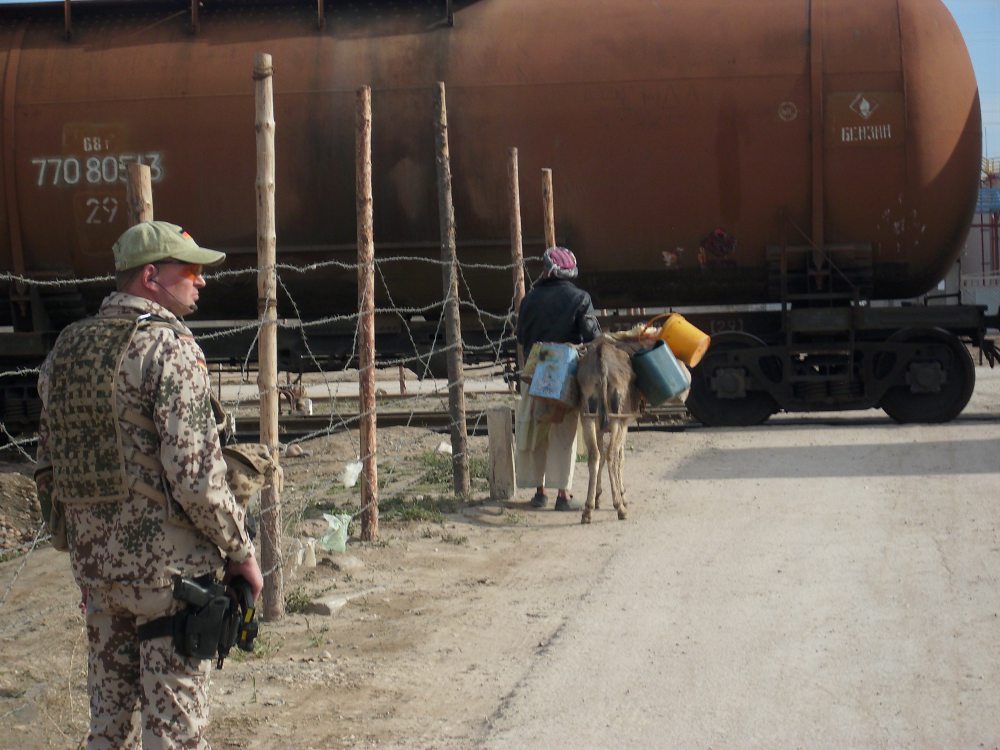
Tank wagon on level crossing at Hayratan

Hairaton, Afghanistan Hopes to Move More U.S. Military Cargo

Story by Maj. Christopher Lecron
Date: 03.24.2010
Posted: 03.27.2010 01:40

HAIRATAN, Afghanistan — The mayor of Hairaton, Afghanistan and several other town logistics officials met with U.S. Air Force Major General Robert McMahon and his staff to discuss potential improvements in the cargo supply chain from Uzbekistan into Afghanistan.

Hairaton is the border crossing for a high volume of truck, rail and river barge cargo transiting into Afghanistan.

“We are always looking for additional supply routes into Afghanistan and we hope to improve the route through Hairaton with a rail line that extends all the way to Masar-e Sharif,” said McMahon. Currently, the rail line ends at Hayraton and containers are trans-loaded onto trucks for onward movement.

McMahon is the director of the Central Command Deployment and Distribution Operations Center. The agency monitors and optimizes the flow of cargo into Afghanistan. After reading daily reports of U.S. forces cargo transiting Hairaton, the team wanted to survey the town and logistics center with their own eyes. The trip included a walking tour of the rail yard, truck border crossing, and river barge site. German soldiers from nearby Camp Marmal provided a security detail for the trip.

Hikmat Rahmetov, a representative from Hapag-Lloyd, served as the subject matter expert for Hairaton logistics. Rahmetov routinely works with U.S. military agencies to transport containers by truck and rail from Hayraton into Afghanistan. Hapag-Lloyd mostly moves U.S. military cargo through Hayraton, but hopes to expand shipping to include NATO cargo as well.

With very safe, secure areas, welcoming government and commercial partners, Hayraton is an ideal place to increase the flow of re-supply into Afghanistan. The potential completion of a rail line that runs south from Hairaton would only increase the volume and efficiency of cargo flow. In addition, increased transportation requirements would create more jobs and help to fuel the local economy.

Source: DVIDS, 2010-03-24

Herat railway still some way off

A Reuters report suggests that completion of the Iranian-backed railway to Herat may still be a long way off. If completion will take “another 10 years” as suggested, this could mean that little if any construction has been done so far, or that the political environment is not right.

There seems to be a general lack of hard evidence of what has been actually built for the project so far.

The new railway will not run directly from Herat to Mashhad, instead it will run from Herat to Khaf, on the existing Islamic Republic of Iran Railways branch line to Sangan. This line offers connections to Mashhad.

Iranian engineer brings roads, rail to Afghan west


[Ali Tavakoli Khomeini], an Iranian engineer, has built some 400 km (250 miles) of highway and railroad in western Afghanistan over the last six years, paving the ancient trade routes of the Silk Road.

His firm […] has just finished laying foundations for a railway that could one day link south and east Asia to the Middle East and Europe, reviving some of the most important ancient overland trade routes in the world.

It would reduce the cost of moving goods across the region to a fraction of that of highway transport, he said.

The project is still delayed. A final 58 km stretch to Herat province’s capital, Herat City, needs to be built by Afghanistan, according to the project’s terms, and has been held up.

Tavakoli predicts it could take up to another 10 years for the railroad to be completed, linking Herat to Iran’s northeastern city of Mashad and on to Turkey.

He won the tender to build the railroad from the Iranian government, after it pledged some $500 million of money for reconstruction projects in Afghanistan at a donor’s conference in Japan in 2002.
[more]
Source: Reuters, 2010-04-17