A Kyodo News photo showing police officers patrolling railway track in the suburbs of Mazar-i-Sharif in July 2011.
Afghanistan’s railways
Hayratan to Mazar-i-Sharif railway opens
Hairatan-to-Mazar-i-Sharif railway opens
TASHKENT – Service began last weekend on the long-awaited Hairatan-to-Mazar-i-Sharif railway.
Uzbekistan Railways (UTY) built the route, which was scheduled to open in July before contingencies forced a postponement.
“We have been working out the route’s status as well as who will run it and how (since early July),” said Rasul Holikov of UTY.
Uzbekistan and Afghanistan signed a three-year contract August 4 under which Uzbekistan will provide commercial services and operate the 75km railway. For now, the tracks carry only freight. Technical problems, such as reinforcement of sections of the trackbed and security on the Afghan portion, have also been addressed, Holikov said.
Original plans called for both countries to operate the railway, but a lack of Afghan equipment required UTY to take over full operation.
“We hope that while our company is operating the railway, Afghanistan will be able to train its personnel, acquire the necessary rail equipment and take over the route … for its own use,” Holikov said.
Afghanistan conceded a current lack of workers and equipment.
“We also do not have enough rolling stock – locomotives, which cost approximately $300,000 each, and freight cars – to ensure uninterrupted freight transport,” said Walid Obaidi, an Afghan locomotive engineer from Mazar-i-Sharif. “It is better in this case to rely on a company with considerable material resources and a good reputation in the rail sector.”
But Afghanistan must increase its efforts to develop rail transport for economic reasons, said Mohammad Daud of the Moscow Centre for the Study of Modern Afghanistan.
“The Afghan market is attractive to all of Central Asia’s countries. For example, Uzbekistan exports electricity and clothing and provides transport services,” said Daud. Now, freight deliveries can be conducted routinely, he said.
“The railway has unquestionably stimulated development of the entire northern region,” said political analyst Valerii Han. “New jobs were created, and local enterprises started operating. The railway will affect the development of agriculture, industry and mining … in these regions. In the future … it will help the Central Asian countries access the sea … (at) the Karachi seaport.”
Uzbek and Afghan security agencies are working together to ensure the lines are safe. The railway’s security will be further strengthened in the future, UTY said.
“We plan to amend the Law on Railways to further ensure the security of rail transport, prevent possible emergencies and eliminate threats to people’s lives,” said Damir Siddikov, an Uzbek senator. “We will be introducing the National Railway Transport Safety System.”
“I drove a locomotive through all of the stations up to Mazar-i-Sharif,” said Umid Hursandov, a UTY engineer. “Like all other the new railways built by our company, (it) is reliable and meets all standards. Many railway workers in our country are worried about their safety if they work this route. Of course, it would be foolish not to recognise that tension in the region persists, but I saw sound security along the entire railway and soldiers were guarding every crossing and important railway yard.”
Source: Hairatan-to-Mazar-i-Sharif railway opens, Maksim Yeniseyev, CentralAsiaOnline.com, 2011-08-23
The photo captioned “An Uzbekistan Railways train departs from Hairatan, Uzbekistan, to Mazar-i-Sharif, Afghanistan, August 21” appears to show a VL80 electric locomotive. UTY operates the type, however the Afghan line is not electrified.
TCDD hosts Afghan delegation
On 20-22 June 2011 Turkish national railway TCDD hosted a visit by Afghan officials, who saw a traffic control centre as well as locomotive and wagon maintenance and repair workshops in Ankara.
Aqina – Andkhoy study to be completed this year
Construction of Aqina-Andkhoi Railway to Begin Next Year, writes Tamim Shaheer at Tolo News on 7 August 2011: According to the Ministry, the railway has a length of six kilometers [sic – previously reported as 36] and will be constructed with financial aid from Turkmenistan … construction of third railway will begin next year in Jowzjan province, and currently the study phase is underway … “I think the study phase of this project will be completed by the end of this year, and if there is no problem the practical phase will start next year,” Ahmad Shah Wahid, Deputy Minister for Public Works Ministry said.
New book on Financing India’s Imperial Railways
A book to be published in September 2011 looks potentially very interesting: Financing India’s Imperial Railways, 1875–1914, by Stuart Sweeney.
The Indian railway network began as a liberal experiment to promote trade and commerce, the distribution of food and military mobility. Sweeney’s study focuses on Britain’s largest overseas investment project during the nineteenth century, offering a new perspective on the Anglo-Indian experience.
Chapter 3 is entitled “Military Railways in India, 1875–1914: Russophobia, Technology and the Indian Taxpayer”. The book’s index is available at publisher Pickering & Chatto’s website, and there are a number of mentions of Afghanistan, the Kandahar Railway and related matters.
By the looks of it, this will be a serious academic study. Unfortunately, and probably not unrelated to this, it will also be sixty quid…
(other forthcoming books from the publisher include “The Unpublished Letters of Henry St John, 1st Viscount Bolingbroke”. Will the very existence of such a book trigger some kind of publishing grandfather paradox?)
Turkmenistan-Afghanistan agreement ratified
A resolution “On the ratification of a Friendship and Cooperation Agreement between Turkmenistan and the Islamic Republic of Afghanistan” was unanimously adopted at a regular meeting of the Turkmen Parliament during the fourth assembly, an official Turkmen source said.
[…]
Also, Ashgabat’s initiative to construct a new railway line Atamurat-Ymamnazar (Turkmenistan)-Akina-Andkhoy (Islamic Republic of Afghanistan) is an example of two neighboring countries eventually becoming an important link in the Eurasian continent’s international transit system.
Source: Turkmenistan ratifies Friendship and Cooperation Agreement with Afghanistan, Trend News agency, Ashgabat, Turkmenistan, 2011-08-05
Railway opening delayed
Opening of the Hayratan to Mazar-i-Sharif line had been planned for July, but has been delayed “indefinitely”, Central Asia Online reported on 28 July 2011.
The delay is blamed on “legal and technical issues” including “the incompatibility of the railway’s track width with that of Afghan railways” – which seems a little odd – and the lack of Afghan locomotives, rolling stock and trained workers. There have also been problems with unstable ground.
More at “Afghan railway launch delayed” by Maksim Yeniseyev at Central Asia Online.
Paris conference discusses Afghan railways
A Ministry of Mines statement on the 4 July 2011 conference in Paris.
Conference on Afghan Railways development held in Paris
A comprehensive plan for building railways in Afghanistan based on economic criteria was welcomed at a special conference in Paris.
The Conference, organized by the Afghan and French governments, was attended by representative of the G8 group, international organizations such as the Asian Development Bank, World Bank, European Union, Pakistan, Uzbekistan, Tajikistan, Kazakhstan, India.
The inaugural speech of French Minister of Transport Thierry Mariani, was followed by His Excellency Wahidullah Shahrani, the Afghan Minister of Mines, who presented the plan, designed to facilitate transport of goods between South Asia and Central Asia and revive the historic role of Afghanistan as the transport hub of the region.
Mr. Shahrani clarified National and Regional Resource Corridors Program drafted by the Ministries of Mines, Transport and Civil Aviation, and Public Works. The Program was warmly received by the French Minister of Transport and the participants.
Representative of G8 and international organizations expressed their willingness to consider giving financial and technical support to the proposals for the Mazar-i-sharif-Andkhoi, Kandahar-Chaman, Kabul-Torkham and Kabul-Mazar-i-sharif railways projects financially and technically, and emphasized the need for a clear organizational structure and railway management regime.
Railways are vital for Afghanistan’s development and the exploitation of Afghan mineral resources. Accordingly the comprehensive railway plan has emerged from coordination by the Ministry of Mines with other relevant organizations.
Mr Shahrani, in his dual role as the Minister of Mines and Head of the Infrastructure Cluster, was accompanied by Engineer Abdul Quddus Hamidi the Minister of Public Works, Dr. Daud Ali Najafi Acting Minister for Transport and Civil Aviation, and Mustafa Mastoor Deputy Minister of Finance.
Source: Ministry of Mines, 2011-07-09
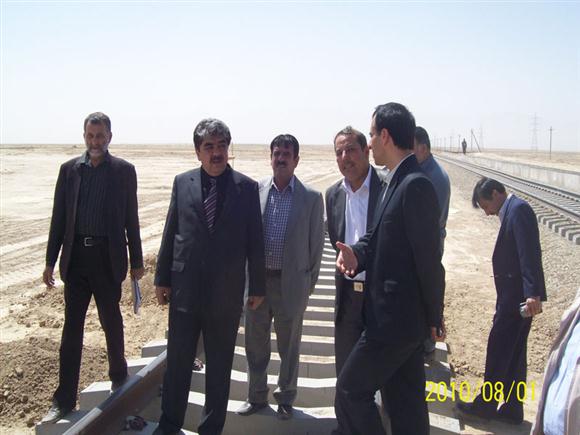
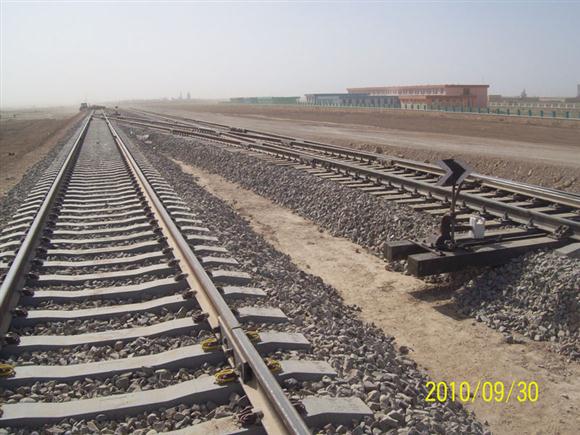
Minister of Public Works visits railway project
A photo from the Ministry of Public Works website showing an official visit to the Hayratan to Mazar-i-Sharif railway project, dated 1 August 2010, plus a view of some track dated 30 September 2010.
“The visit of minister of public works to the project of railways Heyratan-Mazar sharif”
View from the museum
The view from the Archaeology Museum. In the foreground are early trains, a form of transportation first brought to Afghanistan by the British. Unfortunately there is no train service in Afghanistan today.
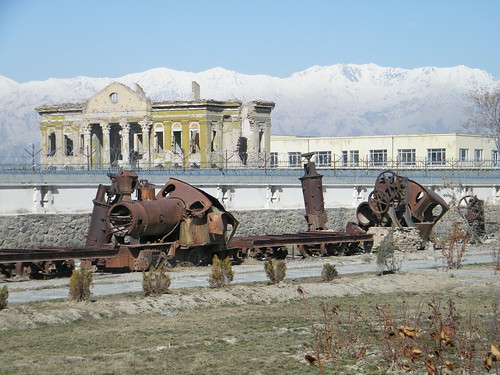
Flickr photo taken on 14 January 2009 by Lauras Eye (CC BY-ND 2.0). The locos were supplied from Germany.