Iran’s Spending Spree in Afghanistan

A 20 May 2009 article from Time looks at Iran’s role in Afghanistan, including the Herat railway.

Some locals jokingly call Herat the “Dubai of Afghanistan.” The nickname is a stretch, but the mini-boom taking place in this commercial capital is borne out by 24-hour electricity and pothole-free streets where people wander without fear of the random violence that afflicts other urban centers in the country. Who gets the credit? Much of it goes to Iran, which lies less than a hundred miles to the west and is moving closer.

After completing a highway from its desert border, the Islamic Republic next door bankrolled an extension linking Herat city to Afghanistan’s remote northern provinces. Later this year, a host of Iranian-built schools, clinics and industrial parks around the city will be connected to the Iranian interior thanks to an $80 million railroad spur currently under construction. Homayoun Azizi, the head of Herat’s provincial council, says he’s grateful for the “huge impact” Iran has had in accelerating economic growth in the region, “But,” he asks, raising an eyebrow, “what are they doing beneath it all?”
More at Time

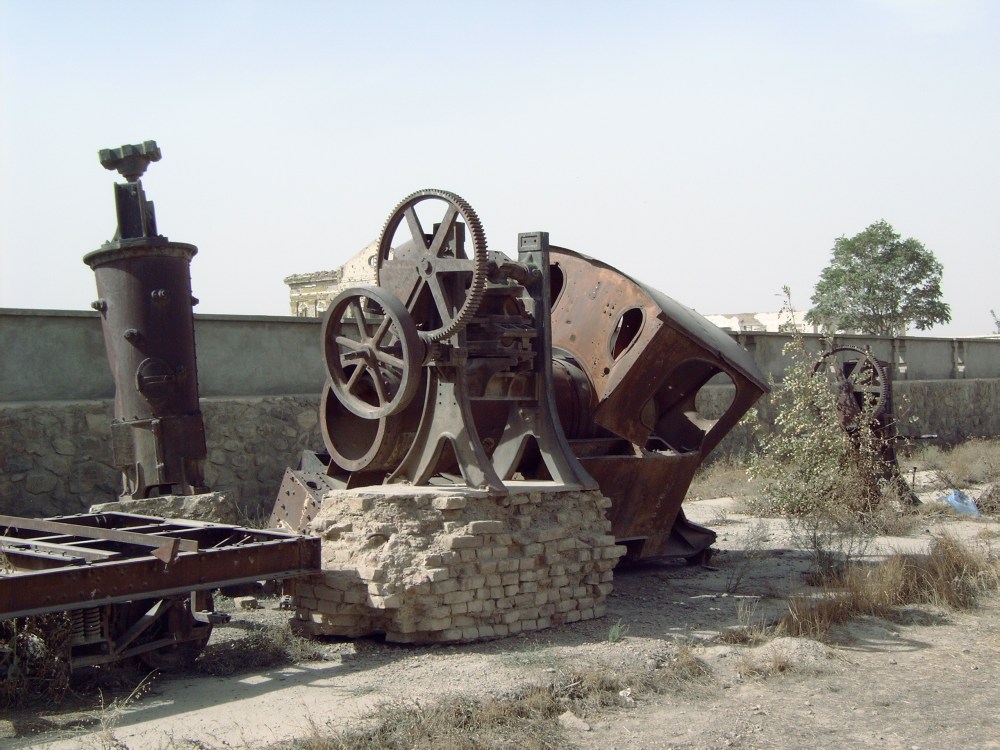
Photo of displayed Kabul loco

“Not something you would expect!” says wandering photographer Bob McIntosh, who took a nice photograph of the plinthed Henschel steam locomotive in Darulaman, near Kabul.

He also has a picture of a grain silo, which shows part of the defunct trolley bus route in Kabul.

A correpsondent called Ramon writes that The engine put on display must be engine no. 19680 or 19681. These two were reported to be kept in the shed for a long time. The 3rd engine has no. 19691, it is the last one in the row outside the museum.

Third Regional Economic Cooperation Conference on Afghanistan

Islamabad Declaration

The delegates participating in the Third Regional Economic Cooperation Conference on Afghanistan having met in Islamabad on 13 – 14 May 2009:

NOTE THAT
Transport, Trade, Energy Cooperation, Agricultural Cooperation, Capacity Building and Education, Border Management, Health, Counter Narcotics and Refugee Return and Reintegration are areas with considerable scope for mutually beneficial regional cooperation.

Connectivity: Increased trade in the region will be facilitated by affording Afghanistan easy accessibility to the Sea, developing east-west and north-south corridors on the basis of mutual agreement, and further developing infrastructure links with Afghanistan and its neighbours.

Railway connection between Iran and Herat is already on going on the basis of a grant from the Government of Islamic Republic of Iran.

An 80 km railway link from Hairatan (on the Uzbekistan border) to Mazar-e-Sharif is considered a priority route for development. The planned link forms part of CAREC’s Transport and Trade Facilitation Strategy, and is in accordance with Afghanistan’s Railways Development Programme. The project will be developed with Asian Development Bank grant support.

HAVE DECIDED THAT


4. High priority will be accorded, in terms of resource allocation and political commitment to the following set of practical short-term projects of benefit to Afghanistan and the region:
a. Concluding negotiations of the Afghanistan Pakistan Trade and Transit Agreement before the end of 2009, as agreed earlier this month in Washington, DC.
b. Extension of rail link from Chaman to Kandahar.
c. In addition, the European Commission will conduct a pre-feasibility study of railways across Afghanistan linking major destinations within Afghanistan and its neigbours.

Read in full on the Ministry of Foreign Affairswebsite.

(thanks to Michael G Erickson for sending me a link)

ADB supports railway study

A news release from the Asian Development Bank, dated 28 April 2009. ADB has also published Islamic Republic of Afghanistan: Railway Development Study (PDF), with some background and a handy map.

Boost for Afghan Plan to Develop Railway System

MANILA, PHILIPPINES – Afghanistan’s push to develop a railway system that will spur economic growth and make the country a key transit and trade route within Asia is to receive support from the Asian Development Bank (ADB).

ADB has approved a technical assistance grant of US$1.2 million to fund a feasibility study for two key railway routes in the north of the country. The focus will be on railway lines linking northern Afghanistan with neighboring Uzbekistan and Tajikistan.

Land-locked Afghanistan has seen major improvements in its road network in recent years, with support from ADB. However, only half the roads that connect 24 provinces in the country are serviceable throughout the year and the system remains inadequate, inefficient and, in some places, unsafe. Rail provides a more reliable and cost-effective option for moving people and goods, and can help Afghanistan unlock its significant mineral, industrial and agricultural wealth.

An expanded rail system will also help Afghanistan realize its strategic potential as a gateway linking Central, South Asia and the Middle East, and supports the Central Asia Regional Economic Cooperation (CAREC) group of countries’ transport corridors program.

“The technical assistance support for an expanded rail system will help boost sustainable economic growth and poverty reduction in the country, as well as fostering regional cooperation by boosting intra and interregional trade along the CAREC transport corridors,” says Manzoor Rehman, Senior Transport Specialist in ADB’s Central and West Asia Department. “It will enhance Afghanistan’s economic competitiveness and provide all-year accessibility to its neighbors.”

Feasibility studies will be carried out on two proposed railway lines linking Hairatan, on the border with Uzbekistan, to Herat, in west Afghanistan, and another starting at Shirkhan Bendar, on the border with Tajikistan, and traveling via Kunduz and Mazar-e-Sharif to Herat. ADB will assess long-term traffic demand, and the rail sector’s potential capacity, before making recommendations to the Government on the two routes.

The total project cost is estimated at $1.26 million with the government making an in-kind contribution equivalent to $60,000. The Ministry of Public Works will be the Executing Agency.

Since 2002, ADB has approved financial support of over $600 million for Afghanistan’s transport and communications sector, mostly for roads. This is over 40% of ADB’s overall assistance to the country and around 25% of all donor financing for Afghanistan’s roads. The new technical assistance grant is included in the ADB’s 2009 pipeline for nonlending products and services for Afghanistan, as set out in the ADB’s Country Partnership Strategy: Afghanistan, 2009-2013.
Source: Asian Development Bank 2009-04-28

Railways of Afghanistan website relaunched

The Railways of Afghanistan website has been relaunched with a new, more permanent and easier to use home at
https://www.andrewgrantham.co.uk/afghanistan/

This will bring all the news, updates and historical articles about Afghanistan together in one place, without being mixed up with the sound mirrors news as well.

There is a dedicated Railways of Afghanistan RSS feed, if you want to be alerted when the website is updated.

Meanwhile, it has been drawn to my attention that someone is nicking my text and republishing it on a web forum in HMP Australia. Sometimes he isn’t even crediting the source, and sometimes he is making it look like I’ve actually written it for them.

Obviously I’m all in favour of quotation, fair use and being linked to, but please don’t pinch my text without first asking.

I’ve been a bit sensitive about copyright since someone “borrowed” my Afghan railway history for a rather dubious political website which I really didn’t want to be associated with (though they did take it down when I sent the webmaster a nastygram)…

Tajikistan building railway to Afghanistan

A 20 March 2009 article from the Open Society Institute’s EurasiaNet website.

Tajikistan: rail link to Afghanistan under construction

Tajikistan has begun construction on a railway line to connect the capital Dushanbe with the southern city of Khorgan-Tepe near the Afghan border. Once completed, the link could be used by US and NATO forces transporting goods to Afghanistan through the newly opened Northern Distribution Network.

President Imomali Rahmon officially launched the Vakhdat-Yavan section of the line, the Interfax news agency reported March 20. Construction on the $130 million project is drawing on funds from the Tajik state rail company, but the government hopes to attract foreign investors, the report added.

In January Tajikistan received $14.79 million grant to complete a highway running from Khorgan-Teppe to Nizhny Pyanzh at the Afghan border. The nearly 24-kilometer stretch of road will link into a $37-million, US-funded bridge across the Pyanzh River to Shir Khan Bandar in Afghanistan. The bridge was completed in 2007. In August 2008, a border post at Nizhny Pyanzh, built at a cost of $6.5-million by the US Army Corps of Engineers, was given to the Tajik Customs Service.

Source: Copyright 2009 Open Society Institute. Reprinted with the permission of the Open Society Institute, 400 West 59th Street, New York, NY 10019 USA, www.EurasiaNet.org

German firms to use Herat railway?

A German firm is reported to be negotiating to use the future railway from Iran to Herat to suply NATO.

German Army spokesman confirms negotiations with Iranian Pvt Firms

Berlin, April 2, IRNA – A spokesman of German Army here Wednesday confirmed in an interview with IRNA representatives of Iranian private firms negotiated with Germans regarding transferring some non-military facilities for German forces situated in Afghanistan.

The spokesman who spoke on condition of anonymity said, “The German sides negotiating with Iran are representatives of private firms that provide foodstuff and fuel for the German forces serving at NATO units in Afghanistan.

He added, “These companies are after finding alternative routs for Pakistan to forward those goods to Afghanistan thorough it.”


According to him, those companies have considered using the Chabahar-Zaranj road, or the Tehran-Harat railroad to transfer their logistical, non-military facilities to Afghanistan.
Source: IRNA 2009-04-02

Goods handling on the Chaman Extension Railway

At a model railway show I picked up a copy of Soldier with Railways, the autobiography of Tony Mains, a British railway enthusiast and army officer who travelled extensively in India. Mains was an intelligence officer in Iraq during World War II, and his book also describes various trips by rail from Basra to Turkey, Syria and Beruit.

The chapter describing his time in Baluchistan in 1944-46 gives a history of the railways to the Afghan border at Chaman in (what is now) Pakistan, and this description of traffic:

The station at Chaman was literally on the frontier, and near by were a number of sheds, which, rumour had it, contained the material to extend the line to Kandahar in the even of a fourth Afghan War. There was a heavy traffic in fruit brought by by lorry from Kandahar, and dispatched onward in ice bunkered wagons, necessitating a daily special good train. The supply of wagons was never adequate for the traffic offering, and the hubbub created by the arguments this engendered could be heard all over the cantonment. There is no doubt that the railway staff benefited greatly from this, and the story was current that the North Western Railway administration used to post a very senior Station Master to Chaman to enrich himself in his last year of service.
Soldier with Railways, by Lt Col A A Mains (Picton Publishing, 1994) pp101-102
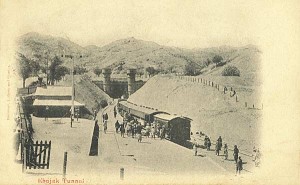
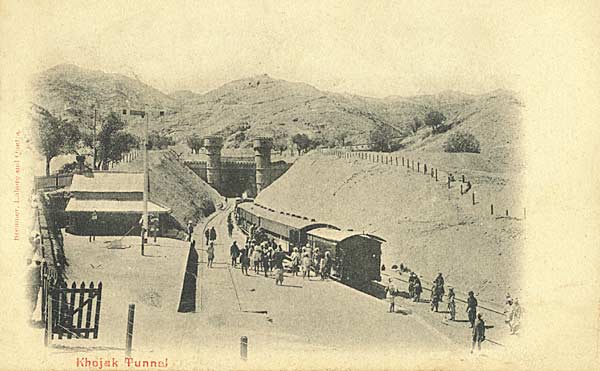
Khojak tunnel circa 1905

The Chaman Extension Railway from Bostan Junction on the line through the Chapar Rift to Chaman on the Afghan frontier was opened 30 September 1891. The broad gauge line’s summit is at over 6000 ft, and the route passes through the Khojak tunnel through the Khwaja Amran range. The rails stopped 5 km beyond Chaman fort, and just 200 m short of the border with Afghanistan as fixed by Sir Mortimer Durand in 1893.

A supply depot at Chaman contained the rails, sleepers and bridge parts which would be needed to extend the line the remaining 108 km to Kandahar in the event of a military emergency. Meanwhile the Russians were thought to be storing similar materials at Kushka to allow the rapid construction of a line to Herat if they thought there was an emergency!

I met with unbounded civility and hospitality from everybody in Quetta as well as at Chaman, our most north-westerly point on the Afghan boundary. For those who believe in the unpreparedness of England, it may be stated that, from this point, we could with ease lay a railroad to Kandahar in less than three weeks.
Across Coveted Lands, Or a Journey from Flushing (Holland) to Calcutta, Overland by A Henry Savage Landor (Macmillan & Co Ltd, 1902)

An extension of the Chaman line at least as far as Spin Boldak has often been proposed in subsequent years, but doesn’t seem to have made much progress.

Pakistan and Afghanistan are expected to enter in to a new trade and economic cooperation mechanism during the President of Pakistan first official visit to Afghanistan on January 7, 2009, official sources told Daily Times on Friday.

Extension of railway link between Chaman-Spin Boldak is expected to be deliberated in the visit as this issue was discussed in 2006 for establishing better communication and development of physical infrastructure, which will help in enhancing trade facilities between the two countries.
Source: President’s first official visit: Pakistan, Afghanistan to ink new trade agreements, Daily Times, 2008-12-27.
Aynak copper mine railway

There have been some slighly vague news reports suggesting that the railway from Iran to Herat may open during March. I’ve not seen anything definite yet though, and still haven’t seen any pictures of construction works.

Meanwhile, China’s thirst for copper could hold key to Afghanistan’s future is a March 8 2009 report from the South Asian News Agency about the Aynak copper mine project: China must complete an ambitious set of infrastructure projects, including Afghanistan’s first national railway, as part of the deal.

Moreover, China must deliver the infrastructure projects that helped it snag the deal over six rivals, including Phelps Dodge Corp., which was acquired by Phoenix-based Freeport-McMoRan Copper & Gold Inc. in 2007.

These include an onsite copper smelter, a $500 million generating station to power the project and augment Kabul’s electricity supply, a coal mine to fuel the power station, a groundwater system, roads, new homes, hospitals and schools for mine workers and their families, and a railway line from the country’s northern border with Uzbekistan to its southeastern border with Pakistan.

The deal, Ashraf said, is structured so that by the seventh year, the entire work force will be Afghan. Beginning in 2010, 60 Afghan engineering students a year will study in China, he said, adding that Chinese language courses have begun at Kabul University.

Employment projections vary, but there’s general agreement that as many as 10,000 workers could be hired at Aynak and the coal mine in central Afghanistan, which the Jalrez Valley road project will link to the copper field. The railway will need thousands more.
Source: South Asian News Agency 2009-03-08