“Quite a sight to see a train in operation”

A 12 October 2008 posting on Free Range International, a blog with some fascinating on-the-ground reports and thoughts from Afghanistan:

Two days ago, I traveled to Hairatan which is located approximately 65km north of Mazar-e-Sharif. It is also located on the Amu Darya river (formerly know as the Oxus River) which is the longest river in Central Asia. For someone like myself who has never operated any where else other than the southern or eastern parts of the country, it sure came across as a bit of a surprise.

One of the most striking impressions that I got was seeing an operating freight rail system. After being to most corners of Afghanistan, and only witnessing ‘Jingle’ trucks and semi-trailers it was quite a sight to see a train in operation. The main purpose of the train is transporting fuel, which is imported from Uzbekistan.
Source: Free Range International

There are a couple of big pictures showing the Friendship Bridge and (presumably Uzbek Railways) locomotive TEM2-3315 in operation at Hayratan.

Problems with the Northern Supply Network

EurasiaNet has an interesting report by Deirdre Tynan, a freelance journalist specialising in Central Asian affairs, which discusses problems with the US plan to supply military forces in Afghanistan by rail from the north. I’ve highlighted some key bits.

The report includes a quote from David Brice, a international railway consultant who was in Afghanistan in 2005 working on a capacity increase and re-equipment study for freight lines.

One puzzling thing is the reference by a Russian Railways spokesman to the widening [of the narrow gauge tracks] at Galaba-Hairaton on the Uzbek-Afghan border. As the Soviet-built railway tracks at Hayratan in Afghanistan are only connected to wider world via the bridge with Uzbekistan, it seems pretty unlikely that the tracks are anything other than the 1520 mm broad gauge used across the former USSR and into some neighbouring countries. There would be little point in having built just the terminal to standard (1435 mm) or even a true narrow gauge.

CENTRAL ASIA: NORTHERN SUPPLY NETWORK FOR AFGHANISTAN HITS SNAGS


Deirdre Tynan 7/23/09

The Northern Distribution Network, an American-assembled logistical pipeline designed to ease and expand the flow of supplies to coalition forces in Afghanistan, is off to a lackluster start.

The land routes for the delivery of non-military goods from Europe to Afghanistan via Central Asia provided just over 250 containers between June 5 and July 14. That total is far short of the number originally envisioned by military planners. During a Senate hearing in March, Gen. Duncan McNabb, the head of TRANSCOM, the military’s transport wing, predicted that the NDN would transport “hundreds of containers” per day.

The existing rail route, which begins in Riga, Latvia, and ends at border points in Uzbekistan and Tajikistan, appears to be experiencing bottlenecks and other problems. On June 5, TRANSCOM officials told EurasiaNet, “We have shipped roughly 750 containers of construction material and other general supplies for US forces in Afghanistan through the NDN, which includes the original ’proof of concept’ shipment of about 200 containers. ”

“With the appropriate transit agreements in place, the US Transportation Command began using existing rail and road infrastructure in mid-May,” the Transcom statement added. “It is important to note that no additional construction was necessary and the NDN utilizes commercial companies from origination to destination.”

On July 14, TRANSCOM said, “For obvious operational security reasons, we cannot provide geographic and time-sensitive specifics of moving military cargo. But to update information previously provided, the US has shipped more than 1,000 containers of non-lethal cargo, such as construction materials and other general supplies, along the Northern Distribution Network.”

In June and July, according to publicly available data, only seven containers a day on average were arriving in Afghanistan via the NDN. A commercial source, speaking on condition of anonymity, characterized the performance as “ridiculous.” Railway experts have also questioned whether the Uzbek rail route, which crosses the Afghan border at Termez-Hairaton, is capable of handling the amount of traffic envisioned by the US military and its allies.

David Brice, an international rail consultant who made recommendations on upgrading the capacity of Hairatan two years ago, said the depot remains under-equipped to deal with a large volume of traffic. “There will certainly be a capacity problem in the Termez-Hairatan section, which two years ago was handling its full capacity of three or four trains daily without the US traffic,” Brice said.

“Three-quarters of the terminal area was disused and the working area very badly equipped for its task,” he told EurasiaNet in an interview. “The ideal route for this traffic would be deep sea via Bandar Abbas and the new Iranian rail line being built from Sangan to Herat. It’s a massive problem, though, due to the current political tension between the United States and Iran.”

Given the complexities of overland operations, an air-transit deal for arms and military equipment, struck by Presidents Barack Obama and Dmitry Medvedev in Moscow in early July, appears to be an important breakthrough. However, America’s partners in the region say similar arrangements with the United States have not been negotiated.

Daniyar Mukataev, a spokesman for the Kazakh Ministry of Transport and Communications said, “There are no agreements or talks between Kazakhstan and the United States on the transit of military cargoes through the territory of Kazakhstan. After reaching agreement with Russia, they now have to talk with Kazakhstan and then with Uzbekistan on the transit of military cargoes. But for the moment the agreement with Russia is just empty words.”

When EurasiaNet asked the US State Department if attempts were being made to secure military transit agreements with the Central Asian states, the press office did not respond directly to the question, referring instead to Under Secretary of State William Burn’s remarks publicized during his early July trip to Central Asia. Burns told reporters in Ashgabat, Astana, Bishkek and Tashkent, that Washington looked forward to “new ways of working together.”

Some regional observers suggest the United States may have underestimated the complexities, both political and logistical, of establishing the NDN. “We have to realize that this network implies crossing of the borders of several states and every transit country is looking out for its own material interests,” said Andrei Grozin, the director of the Central Asia Department at the CIS Institute in Moscow.

“Frankly speaking, this is one of the main reasons why the system is not set up properly and not working well,” Grozin continued. “There are of course objective reasons such as the complexity of the system itself. But, mostly it’s all about the borders, the financial interests of the transit countries, and corruption in these countries.”

Central Asian leaders publicly express concern about the security threats originating from Afghanistan, but, although they don’t say so openly, the NDN is also seen as a lucrative opportunity, Grozin said. “The United States understands that for solving its geopolitical and other problems, it has to pay,” he added.

But many experts are asking: is Washington overpaying? Several indicators would seem to suggest that the Pentagon’s tendency to throw money at the problem is not producing desired results. Not only is the rail network not delivering as expected, financially speaking it’s shaping up as something of a boondoggle.

Russian and Uzbek companies are reorganizing their structures to take maximum advantage of the Pentagon’s commercial approach to the NDN. In a move designed to get the network up and running quickly, defense officials eased tender rules to allow for lucrative contracts to be granted with no competitive oversight. That has seemed to stimulate a feeding frenzy among regional transport entities.

Russian Railways, for example, has confirmed to EurasiaNet that it is seeking a grant from the US government to upgrade the Termez-Galaba-Hairaton border crossing between Uzbekistan and Afghanistan.

A spokesperson for Russian Railways said on July 9, “We can confirm that Russian Railways seriously addresses the issue of modernization at Galaba-Hairaton on the Uzbek-Afghan border to transit American goods from Riga [Latvia] to the border with Afghanistan. Also, a proposal was sent to Ministry of Foreign Affairs of Russia on the need to involve US participation in the financing of the widening [of the narrow gauge tracks] at Galaba-Hairaton on the Uzbek-Afghan border.”

Neither the Russian Ministry of Foreign Affairs nor the US State Department would elaborate on the information provided by Russian Railways.

Source:Eurasia Insight 2009-07-23

[Copyright © 2009 Open Society Institute. Reprinted with the permission of the Open Society Institute, 400 West 59th Street, New York, NY 10019 USA, www.EurasiaNet.org]
Nasrullah Khan and the Dockers Umbrella

The Workington-based Times & Star describes an 1895 visit to weapons ranges at Silloth in the UK by The Shahzada Nasrullah Khan, second son of the Amir of Afghanistan. It also says he was impressed by the Liverpool Overhead Railway.

When a Silloth weapons range welcomed Afghanistan royalty


It has to be remembered that the Shahzada, who reportedly didn’t speak English too well, was undertaking a long and arduous state visit, was only 20 years of age. He’d travelled all over the country, albeit in his personal train, having to endure innumerable long and boring addresses from assorted “very important people.”

What did interest him were examples of technological development, he was much taken with Liverpool’s Overhead Railway.

Source: Times & Star 2009-07-02

Russia allows lethal goods transit to Afghanistan

Among the agreements announced by Presidents Obama and Medvedev on 6 July is one for the transit through Russia of “lethal” military supplies bound for the armed forces in Afghanistan.

Could this be a breakthough in rail transport? “Non lethal” military freight has reportedly been sent by train via Russia and Uzbekistan to Hayratan this year. Germany already has an agreement to ship lethal materials by rail through Russia – though Uzbekistan and Kazakhstan were less keen on allowing transit, and it is unclear if any has actually been transported.

JOINT STATEMENT BY PRESIDENT OF THE UNITED STATES OF AMERICA BARACK OBAMA AND PRESIDENT OF THE RUSSIAN FEDERATION D. A. MEDVEDEV CONCERNING AFGHANISTAN

…we intend to make active use of the transit route through the territory of the Russian Federation for deliveries of property and equipment for the needs of the international forces operating in Afghanistan

We express our willingness to explore issues related to Russian-U.S. interaction and cooperation in restoring the transportation, energy, and industrial infrastructure of Afghanistan.
Source: Whitehouse.gov press release 2009-07-06

PRESS CONFERENCE BY PRESIDENT OBAMA AND PRESIDENT MEDVEDEV OF RUSSIA

PRESIDENT MEDVEDEV: The subject of U.S.-Russian cooperation in Afghanistan is extremely important. It is for this reason we paid so much attention to the discussion of this problem, and we have just signed an agreement that concerns transit. It’s an important subject and we will of course continue cooperation with our American counterparts.

As concerns the current situation, it is — really is not simple. I am not trying to say that it is being worsens, but in many aspects the progress is not available or is insignificant. But we value the efforts that are being made by the United States together with the other countries in order to prevent the terrorist threat that was emanating and still coming from the Afghan soil.

We are prepared in this sense to a full-scale cooperation with our U.S. and other partners, including in transit areas. We are prepared to help in the various aspects. I don’t know to what extent — how quickly the situation will improve. It depends to a large extent to the development of the political system in Afghanistan, to what extent the Afghan government will achieve successes in the economy — and it’s not a simple task.

PRESIDENT OBAMA:

And we’re going to have to think regionally in terms of how we approach these problems. Obviously there are countries along the border of Afghanistan and Central Asia that are of deep strategic importance, and it’s very important that we also include them in these conversations about how we can move forward.

But I just want to thank again the Russian government for the agreement for military transit. That will save U.S. troops both time and money. And it’s I think a gesture that indicates the degree to which, in the future, Russian-U.S. cooperation can be extraordinarily important in solving a whole host of these very important international issues.
Source: Whitehouse.gov press conference transcript 2009-07-06

‘Preliminary work’ started on Kandahar and Jalalabad lines

An official government of Pakistan press release dated 19 May 2009 claims preliminary work is underway for the long-planned Chaman – Spin Boldak – Kandahar extension of Pakistan’s rail network into Afghanistan.

The press release also says similar work is underway on a line from Peshawar to Jalalabad; presumably the rehabilitation of the famous Khyber Pass line combined with an extension over the frontier.

PR No. 206
PRESS RELEASE

UKRAINian ambassador calls on minister for railways

Islamabad; May 19, 2009

Ukrainian Ambassador, Mr. Ihar Pasko called on Federal Minister for Railways Ghulam Ahmad Bilour here today.

The matters of mutual interests in the backdrop of extending cooperation and business in Railway sector between the two countries came under discussion.

The Federal Minister for Railways briefed the Ambassador about on-going development in Railways Sector and told that preliminary work has been started on Chaman-Qandhar section and Peshawar-Jalalabad section.

The Minister said that establishment of rail link with Afghanistan, Pakistan may provide an easy access to Central Asia Russia and rest of Europe.

The Ukrainian Ambassador briefed the Minister about the achievement and development of Ukrainian Railways and expressed his eagerness to extend cooperation in railway sector with Pakistan.

The Ambassador highlighted the characteristics of Ukrane locomotives, Tracks and other technicalities.

The Secretary and Chairman Railways welcomed the offer made by Ambassador and said that Ukraine might also participate in Tender Process by following the rules and procedures laid down by the Railways Ministry regarding procurement.

The Secretary Railways further said that the exchange of Railway experts from both sides will benefit each other in professional backdrop.
SA/Ahmad
Source: Press Information Department, Government of Pakistan 2009-05-19

Unfortunately it does not specifiy what “preliminary work” means.

Reduction in deficit of Pakistan Railway witness in current financial year: Bilour.

ISLAMABAD, 13 May, 2009 (Frontier Star) — Federal Minister for Railways, Ghulam Ahmad Bilour has said […] while talking to media on the occasion of inauguration of “Islamabad Express” […] the under-construction Railway project from Chaman to Afghanistan would be completed very soon, reducing not only the travelling difficulties of passengers but also save their time.
Source: The Free Library/Asia Pulse/Frontier Star

The idea of a line to Kandahar has been discussed for many years – it was one of the first proposals for an Afghan railway way back in the 19th century.

On 1 October 2004 the Pakistan Times reported:

Quetta-Kandhar Bus Service to begin Shortly

[A meeting between] Governor Balochistan Owais Ahmed Ghani and Governor Kandhar Engineer Mohammed Yousuf Pashtoon […] decided to start construction of Railway line between Pakistani border town Chaman and Afghan city Kandhar for which survey has already been conducted. […] The 100 km Railway track would be completed at an estimated cost of US dollar 110 million with the coorporation of Pakistan Railways.
Source: Pakistan Times 2004-10-01

Gap in Britain to India rail route closed?

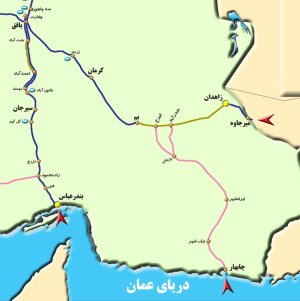
Various news reports suggest that the Bam – Zahedan railway line in Iran is now physically complete. While there is no direct connection to any of the Afghan rail projects, this railway is important for “joining the dots” on the global railway map, as it is the missing link between the Iranian railway network and Zahedan, terminus of the 5’6″ gauge line which runs into Iran from Pakistan.

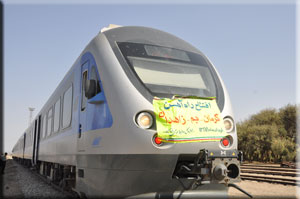
Iranian DMU

It seems there has been some kind of opening ceremony for the Bam – Zahedan line, but other articles suggest this might only have been held so that it was nominally finished before the recent Iranian elections were held.

Some reports suggest regular services might start on August 14 – which, whether by accident or design, is Pakistan’s Independence Day.

Map of Bam - Zahedan railway

Until now Zahedan has been joined to the Indian subcontinent’s rail network, but not to the Iranian network. IRFCA has some history, and Dr John Stubbs wrote about the construction of the new line in the January 2007 issue of Railway Gazette International.

Via Google’s new Persian machine translation, I found this press release from Islamic Republic of Iran Railways. It gets a bit mangled in the translation (I don’t speak Persian), but is more or less understandable after some tidying up:

First passenger and goods trains to Zahedan station on the Kerman – Zahedan railroad

With the opening of the Kerman – Bam – Zahedan railway on 19/03/1388 [9 June 2009] southeast Asia was connected to Europe via Iran.

M. Hajian, Supervisor General at the Office of Public Relations of Islamic Republic of Iran Railways, said: The first cargo and passenger trains were welcomed into Zahedan station in the presence of the Deputy Managing Director of Islamic Republic of Iran Railway, [list of bigwigs which hasn’t quite survived translation], the Governor of Sistan & Baluchestan province and a group of regional VIPs.

Hajian added that the railway links Kerman – Bam – Zahedan and Sistan & Baluchestan province.

He said: This rail route will save energy, reduce road traffic, create employment in the east and south-east of the country and through economic development will reduce the causes of deprivation in the province of Sistan & Baluchestan and Kerman, and offer the possibility of bypassing the port to connect the port of Chabahar with north – south transit routes.

He added: “The railway has 11 bridges, the largest bridge 400 meters long, and 20 tunnels totalling 5320 meters.

Seat61 is probably the place to start if you are planning a journey from Britain to India by train (and two ferries – shortly to be one ferry when the Marmaray project in Istanbul is completed).

Hayratan – Mazar-i-Sharif railway plan

Text of report by privately-owned Afghan Arzu TV on 18 June, reported by BBC Monitoring South Asia, 2009-06-19.

Rail Road Project to Link North Afghanistan to Uzbekistan

[Presenter] After a short time, new rail road will be built from Uzbekistan to Hayratan border town and from Hayratan to Mazar-e Sharif city, says Minister of Commerce and Industries Wahidullah Shahrani in a meeting with Uzbek railway minister in Hayratan border town. Mr Shahrani said rail road’s designing and technical procedure had been started and will be completed in nine months. He added Asian Development Bank will donate 100m dollars for building the rail road and a logistic station in Mazar-e Sharif city and Uzbekistan will cooperate in its technical procedure.

[Correspondent] Minister of Commerce and Industries Wahidullah Shahrani visited Hayratan border town of Balkh Province to meet Uzbek minister of railway and speak about building a rail road between Uzbekistan and Mazar-e Sharif city. The minister said building a railway from Hayratan border town to Mazar-e Sharif city costs 80-120m dollars, its technical and designing procedure costing 1.2m dollars will be completed after nine months. The project is funded by Asian Development Bank.

[More]

Maps of planned Afghan rail projects

Asian Development Bank’s documentation on the 7th Ministerial Conference on Central Asia Regional Economic Cooperation held in Baku on 19–21 November 2008 includes a PDF with maps of the various railway proposals currently active in Afghanistan.

Railway Development Plans in Afghanistan (2.2 MB PDF), was a presentation by Dr Wali Mohammad Rasooli, Technical Deputy Minister, Ministry of Public Works, Islamic Republic of Afghanistan.

The role of Pakistan’s railways

Shahid Javed Burki considers how the role of railways in (what is now) Pakistan has changed over the years in a 12 May 2009 Dawn article For a new transport policy

It is always useful to reflect on history before planning for the future. I will illustrate this point today by using the case of the transport infrastructure. Three legacies must be recognised to deal with the situation as it exists today and for the adoption of a strategy that would serve the future.
Source: Dawn 2009-05-12

Khyber Pass railway revival discussed

The achievements and embarrassments of Zardari visit

By Shaheen Sehbai

WASHINGTON: Three major outcomes of the bilateral and trilateral summit talks between Presidents Zardari, Obama and Karzai are now becoming visible as officials of the three countries hammer out details of how much money would be poured in, how it would be spent and how it would be monitored.

One solid suggestion made by a Pakistani official, got immense attention and generated an intense discussion in one of these meetings. It was to build a railway track from the port of Gwadar to Peshawar, passing through the mainland of Balochistan and along the western side of Pakistan, then going into Afghanistan through the dormant Peshawar-Torkham rail link and to Kabul onwards through Jalalabad.

This idea was also presented to President Zardari by an American expert, the Pakistan Embassy sources revealed. Zardari was excited about it as the project could involve billions of dollars that the US was ready to invest, it would revive Pakistan’s industry and economy, it could bring Balochistan into the mainstream by generating jobs and providing them goodies coming out of the project, it could spur construction industry by building hundreds of railway stations and other facilities needed and it could provide Pakistan an alternate route from Karachi to Peshawar.

For Afghanistan, as well it could be a booster as the rail link could enter Afghanistan at the south-eastern border with Pakistan and could be carried to any place inside Afghanistan by US dollars, lessening the dependence on transit trade through troubled Fata and Taliban-infested areas. It also fits the US goal of joint Af-Pak development, serving the US as well as Pak-Afghan interests.

Source: The News International 2009-05-10