MCC to build Kunduz – Jalalabad railway

“75km Railway to be Completed in Afghanistan”, reported TOLOnews on 2 August 2010. Work is “50 percent completed”, and there is a new opening date: “I hope the construction of this rail-road will be completed by the end of March, 2011,” said the Minister of Public Works, Abdul Qudoos Hamidi.

There is also this hint at something much bigger in the pipeline:

The ministry also adds that the Afghan government is planning to build 700km rail-road that will connect the capital Kabul with the northern province of Kunduz and the eastern city of Jalalabad.

The railway will be built by the MCC Chinese Company.

“The primary studies of this rail-road have already started, and its contract will be signed soon,” said Deputy Minister of Public Works, Ahmad Shah Wahid.

Source: TOLOnews, 2010-08-02

MCC is presumably China Metallurgical Group Corporation (rather than the other MCC). The Chinese group was selected for a concession to develop the Aynak copper deposits in 2007, with a railway proposed as part of the project.

The plan which seems to be firming up is to build a new north-south railway starting from Tajikistan. There would be a new line from the Tajik capital, Dushanbe, to the Tajik-Afghan border near Kunduz. The route would then run through Afghanistan from Kunduz to Kabul and the Aynak mining area, continuing on to Jalalabad. There would then be an onward link to the Pakistan Railways network, joining the line through the Khyber Pass to access to Pakistan’s coast.

Pakistan keeps talking about reinstating the out-of-action Khyber Pass line and extending it to Torkham (the Afghan border town) and possibly Jalalabad (the first major town in Afghanistan). However Pakistan Railways is reported to be facing serious financial and structural problems at present.

And as a correspondent points out, “railroads are built with money, not signed agreements to build railroads”.

Problems with transport in Uzbekistan

A EurasiaNet article by Deirdre Tynan discussing “a morass of inefficiency, arbitrariness and “informal” payments” in Uzbekistan.

Documents Highlight Problems with Uzbek Corridor of Afghan Supply Route

June 28, 2010

Responses to a Pentagon-issued request for information about sourcing fuel in Uzbekistan appear to suggest that the Uzbek-Afghan corridor of the Northern Distribution Network (NDN) is a morass of inefficiency, arbitrariness and “informal” payments.

In documents obtained under the Freedom of Information Act (FOIA), respondents to the Pentagon query made stark comments about severe delays at the Uzbek-Afghan border, and one – a major partner to USAID in Afghanistan – said corrupt payments “might be required to keep business moving.”

The NDN is a supply line for troops serving in Afghanistan spanning Europe, Russia and Central Asia. It was developed by US Transportation Command, US Central Command, Defense Logistics Agency, and the State Department, in conjunction with a variety of regional commercial and governmental actors. [For background see EurasiaNet’s archive [1]].

In August of 2009, the Defense Energy Support Center (DESC) solicited preliminary procurement evaluations from commercial companies in a query titled “Sources sought within the Republic of Uzbekistan for Products and Services in Support of Operation Enduring Freedom (OEF).” The query specifically sought information covering possible diesel, motor fuel and aviation fuel supplies.

According to the FOIA request submitted by EurasiaNet.org, eight companies responded to the DESC query. But only six responses were made available to EurasiaNet.org under the FOIA. Two responses, one from FMN International, the parent company of FMN Logistics, a firm that has strenuously denied any financial connections with the disgraced Uzbek conglomerate Zeromax, and another from NCS Fuels, were deemed “un-releasable.” [For background see EurasiaNet’s archive [2]].

One response – from Milio International Ltd, a company working in the fuel business in the former Soviet Union since 1997 – contended that “Uzbek Railways frequently (often for some period of time each month) bans all rail traffic going to the destination of Hairaton, Afghanistan. This is due to the thousands of rail cars both empty and full of all types of goods that have congested the rail stations for the past year while waiting to get to Afghanistan […] this is especially the case around the Termez and Karshi areas.”

Rail cars from the Baltic states and Russia also get “blocked from time-to-time,” the Milio response noted.

Meanwhile, Afghan Management Group (AMG) said rail transport from Bukhara, Uzbekistan, to Hairaton “with no ‘speed up fee’ takes up to 35 days.” But with “payment of informal fees, the time can be reduced to 7 to 18 days, (depending on amount of money paid).”

When asked to describe “the known impacts related to fuel specifications, taxes, transit leases/approvals, other local laws and challenges you may expect to face,” AMG outlined the payment of “informal fees” as a major challenge in Uzbekistan.

“Apart from refinery fees and transport costs, there are no taxes to be paid in Uzbekistan. However, payment of informal fees to authorities and individuals might be required to keep business moving,” the AMG response said.

“One of the biggest problems in both countries involved is the fact that rules are changing overnight and very frequently. To cope with this issue requires good contacts to authorities and flexibility to adapt own processes to a new situation,” the AMG response added. “AMG/Partner is very reluctant to pay bribes, but manages issues through established good relationship to authorities involved.”

AMG is listed as an “implementing partner” to USAID in Afghanistan. According to both USAID and AMG’s websites, “AMG is a leading firm supporting the reconstruction of developing nations, like Afghanistan, while promoting economic growth and higher living standards among the people of those nations.”

In another DESC response, Agility, one of Defense Logistics Agency’s top-100 contractors, said fuel trucks could be used as an alternative to the “normal delays” experienced at the Termez-Hairaton railway crossing.

“Government taxes and leases will always present challenges,” the Agility response added. However, initial talks with “government and commercial officials” signal that “they are willing to work with the United States to find suitable business arrangements.”

FMN, a firm that did not have its response to the Pentagon query released, reportedly maintained a strong relationship with Zeromax. According to a document available from the American-Uzbekistan Chamber of Commerce’s website, FMN Logistics purported to be capable of carrying out “rail cargo operations coordinated out of Tashkent using Zeromax Rail Code.” [For background click here [3]].

“Based on local presence, FMN Logistics and Zeromax Logistics transit times into and through Uzbekistan are half those of major shippers […] FMN Customs brokerage clearance services can cut Uzbek transit times in half,” the company asserted.

According to FMN’s website, “FMN was formed on 8 September 1999 as a domestic US corporation. The shareholders were, and remain its founder, Harry F. Eustace, Sr. and members of his family.”

“In 2009, FMN formed a subsidiary, FMN Logistics, with Harry F. Eustace, Jr. as its CEO and whose shareholders are the Eustace family plus David O’Connor, a Canadian citizen. FMN Logistics’ prime mission is to serve the US war fighter in Afghanistan by providing effective logistics solutions throughout the Central Asian Theater,” the website added.

The NDN carries 30 percent of goods delivered to US troops in Afghanistan, according to a White House statement on June 24.

Copyright (c) 2010 Open Society Institute. Reprinted with the permission of the Open Society Institute, 400 West 59th Street, New York, NY 10019 USA, wwwEurasiaNet.org
ECO train returns

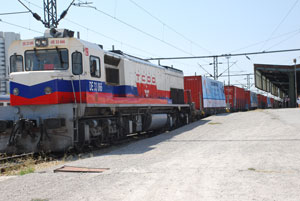
The Istanbul – Tehran – Islamabad eastbound return working of last year’s westbound Economic Cooperation Organization train left Istanbul on August 2, running via Iran’s Bam – Zahedan line.

The eastbound train of vans and container wagons – seen here in Turkey – was due to arrive in Islamabad on August 13, a faster transit time than last year’s train.

Does anyone know if it successfully made it to Iran and Pakistan?

Iran offered to fund 1970s rail project

Although relations between Iran and the Soviet Union are at present friendly […] the opportunities for the Russians to make difficulties through Kabul are thus abundant, though Kabul’s rulers would have to forego the $2,00m (£1,111m) which the Shah has offered for the building of Afghanistan’s first railway line.

Hostile neighbours fuel Shah’s defence fears, David Watts, The Times, 22 May 1978, p5 (Issue 60307; col D)
.

Photos of the Friendship Bridge

Some photos on Flickr. Some of the captions refer to the “Freedom Bridge”, though the road-rail crossing of the Amu Darya between Hayratan and a point east of Termez is usually called the “Friendship Bridge”.

100527-N-1928O-064

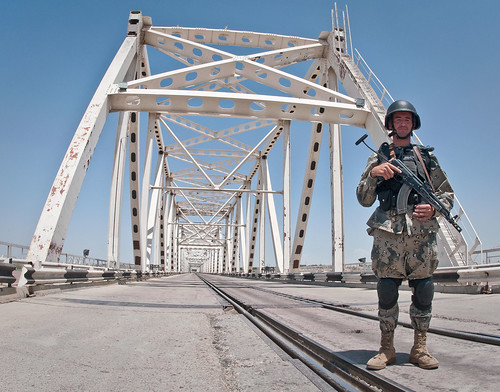
BALKH PROVINCE, Afghanistan (May 27, 2010) —An Afghan Border Policeman stands watch on the Freedom Bridge crossing the Amu Darya River. On 15th February, 1989 the last Soviet troops to withdraw from Afghanistan crossed the bridge into the, then, Uzbek Soviet Socialist Republic. The bridge now carries rail and vehicular traffic and is the only border crossing between Afghanistan and Uzbekistan. (U.S. Navy photo by Petty Officer 1st Class Mark O’Donald)

Balkh Province in Afghanistan
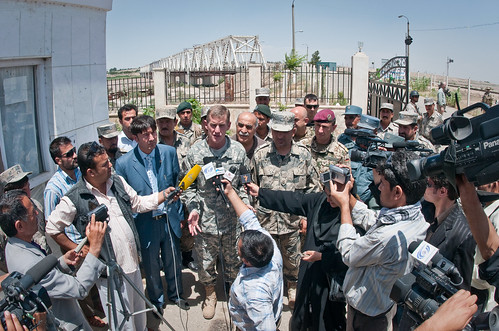
BALKH PROVINCE, Afghanistan (May 27, 2010) — General Stanley McChrystal, commander of NATO’s International Security Assistance Force, speaks to Afghan media during a visit to the Freedom Bridge in the town of Hairatan. The bridge, which crosses the Amu Darya River between Afghanistan and Uzbekistan, carries both rail and vehicular traffic. (U.S. Navy photo by Petty Officer 1st Class Mark O’Donald/Released)

Visiting with Afghan Border Police
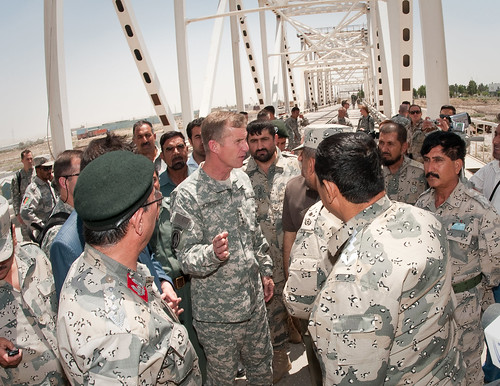
BALKH PROVINCE, Afghanistan (May 27, 2010) — General Stanley McChrystal, commander of NATO’s International Security Assistance Force, speaks with Afghan Border Police officials on the Freedom Bridge crossing the Amu Darya River. On 15th February, 1989 the last Soviet troops to withdraw from Afghanistan crossed the bridge into the, then Uzbek Soviet Socialist Republic. (U.S. Navy photo by Petty Officer 1st Class Mark O’Donald/Released)

5th Zone ABP border crossing point to Uzbekistan
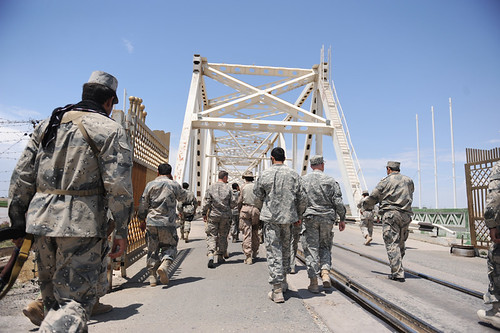
Heryatan – Afghan Border Police(ABP) and coalition forces tour the bridge seperating borders at 5th Zone ABP border crossing point to Uzbekistan June 8, 2010. The 5th Zone ABP guard all provinces of Regional Command North, being responsible for defending all borders against enemy threats and counter narcotics. (U.S. Air Force photo/ Staff Sergeant Matt Davis)

History of aviation in Afghanistan

It was decided to move the aircraft to Kabul by elephant and to try to repair it.

Lennart Andersson has written a history of the first 30 years of aviation in Afghanistan.

The history of aviation in Afghanistan is more or less a “white spot”. The reason is undoubtedly the county’s inaccessibility, both geographically and politically. Old photos of aircraft in Afghanistan are extremely rare, finding detailed information is difficult, and consequently few publications have dealt with aviation in that country. As always, there are sources for research, however, although they may be difficult to find, and with unearthed information it is possible to outline the early history of aviation in the recently so war-torn and devastated country.
More

Italian engineers and electrification plan

FIRST AFGHAN RAILWAY
(from our own correspondent)
SIMLA, Sept.20.

Italian engineers in Kabul are reported to be collecting engines and rolling stock for the first railway to be opened in Afghanistan between Kabul and Darulaman, six miles from the capital. The construction of the line is expected to begin shortly. The possibility of making it an electric tramway is discussed in certain Afghan papers.

The Times, 30 September 1922, p9 (Issue 43150; col G)

The reference to Italian engineers is interesting – one might have expected the people involved to be German.