Oberweißbacher Bergbahn

A piggy-back ride up the hill

One of Germany’s oddest railways is a piggy-back funicular, part of a three-line network of rural railways. In the hot summer of 2003 I went for a ride, and wrote another article for Eagle, the journal of the Cambridge University Railway Club.
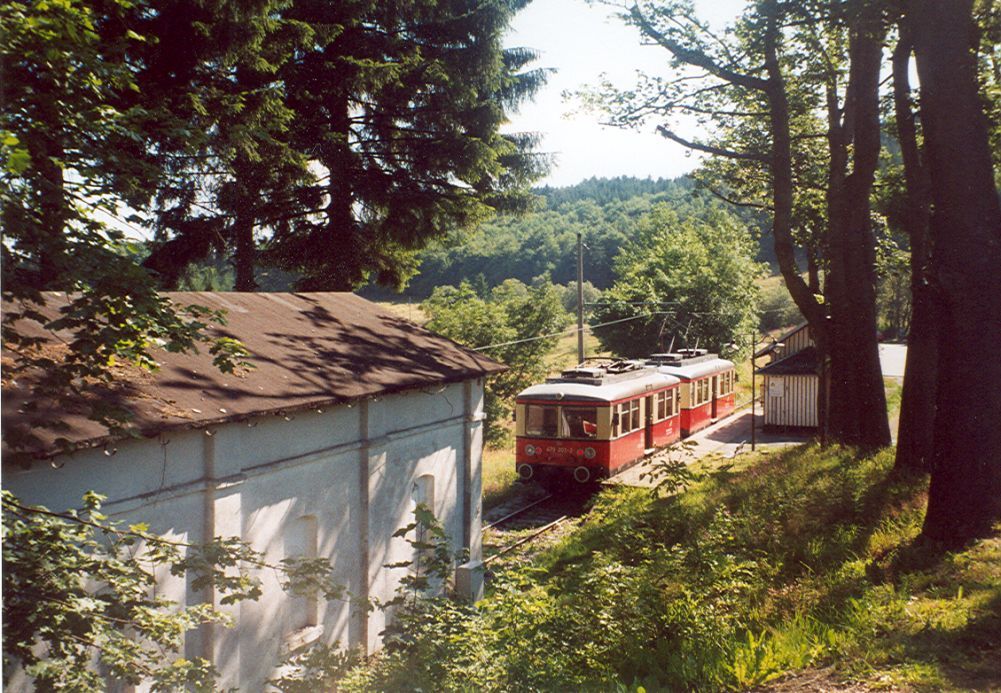
An electric train at Cursdorf, the end of the electrified branch from the top of the Oberweissbacher Bergbahn.

In Britain we tend to think of funicular railways in terms of the Edwardian cliff lifts gracing our seaside towns, but deep in the forests of Thüringen is something rather different. One of the strangest lines operated by Deutsche Bahn, the Oberweißbacher Bergbahn is a 1.4 km broad-gauge funicular which climbs 323m up a wooded hillside. Inland funiculars are not usual in the more vertiginous parts of the Continent, but what makes the Oberweißbacher line special its very unusual (though I dare not suggest unique!), piggy-back design. Seemingly little known outside Germany, the Bergbahn deserves wider fame, both for its unusual arrangement and the short electric railway at the summit.

I first came across the Bergbahn in 2003 while flicking through a copy of Eisenbahn Magazin, a German monthly publication for railway enthusiasts. There was short report about the reopening of the Bergbahn on 15th December 2002 following a major refurbishment, with a photo of the piggy-back car. Thinking it might be some kind of spoof, I looked up the line in Cook’s European Timetable and then on the internet – there is a comprehensive website about the Bergbahn in German and English – and soon decided it would be on my itinerary for a visit to Germany planned for July 2003.

Going there

Located in the Free State of Thüringen, one of the Länder in what was once East Germany, the Bergbahn is somewhat remote, and while it is not difficult to get there by train, some forward planning ensures that one can end up somewhere sensible afterwards.

Leaving the Nürnberg to Berlin ICE train at Saalfeld, there is time for a quick look across the tracks to a small loco depot, where one of the bays of the roundhouse appears to have the front end of a diesel loco built into a blanking wall! From Saalfeld a cross-country branch runs to Erfurt, and our train was formed of 621 024-5, a single car DMU built by De Dietrich and LHB (now part of Alstom) for use in Germany and France (where it is Class X73500). Another change is necessary 16 minutes later at Rottenbach, where we boarded 641 019-5, one of two 120 km/h De Dietrich/Alstom class 641 railcars which are dedicated to the 25 km Schwarzatal branch.

The branch, the funicular and the electric railway at the top of the hill together form the Oberweißbacher Berg- und Schwarzatalbahn, one of four self-contained regional networks created by DB AG on 1st January 2002. The infrastructure and operation are integrated, the rolling stock is dedicated to the route, and OBS has 28 staff providing a degree of local control and management. The 42 minute journey along the Schwarzatalbahn passes up the heavily wooded valley of the river Schwarza to the terminus at Katzhütte. Sections of the permanent way had been recently relaid, with disused goods yards which had once served now derelict factories losing their connection to the rail network. There are eight stations on the route, including Obstfelderschmeide, the lower station of the Bergbahn. Plandampf ays are held each year, when steam locomotives work service trains along the line, which opened in 1900.

Katzhütte is a small place, spread out along the valley by the river and road. The youth hostel was almost empty, with just a handful of Germans and the obligatory Japanese visitor, intently studying his guidebook (which no doubt listed every detail of the Bergbahn). Unusually, the hostel warden spoke no English, so the rusty remains of GCSE German were dusted off. Across the road from the hostel was a pub, serving the usual chunks of pig atop a mountain of cabbage. The occupants of the village’s second pub were intently playing cards, but we received a more vigorous welcome from the local midges.

Going up

The next morning we caught 641 020-3 down the branch for the 16 minute ride to Obstfelderschmeide, the lower end of the funicular. The Bergbahn was originally built to provide a rail link from the valley bottom to the villages on the plain above. Access via a twisting road up the valley sides had been difficult until the funicular provided a link to the outside world, opening for goods traffic on 15th January 1922 and to passengers on 15th March the following year. The 1 387.8 m long Bergbahn has the common funicular layout of two cars running on a single track line with a passing loop in the middle. More unusually the tracks split again at the bottom station, the left-hand route when seen from the valley bottom having a roof over it. On this track is a conventional, if wide, funicular vehicle which we rode up the hill. It has banked seating for 100 passengers, and an empty weight of 26 tonnes.

The most distinctive feature of the Bergbahn is the other car, which travels on the right hand track at Obstfelderschmeide and through the passing loop. This 25 tonne vehicle has a triangular wedged-shape, providing a level platform on top of which sits, piggyback style, a 9.2 tonne four wheel carriage which 72 passengers can travel in. This carriage was formerly used on a light railway between Schleiz and Saalburg, and it was adapted for dedicated use on the funicular in 1972. It can be rolled off the transporter vehicle, leaving the platform free to carry other stock up the funicular. A siding from the Katzhütte line leads to a small turntable, where single wagons or small carriages of up to 27 tonnes can be rotated 90 degrees and manoeuvred onto the piggyback
car.

The Bergbahn operates every 30 minutes, more frequently than the two trains each way every two hours (it isn’t simply hourly) on the branch line, and, being in Germany, the funicular departures are timed to connect with the trains. In March 2004 the funicular was adapted to provide wheelchair accessibility. A conductor travels on board, and can give a talk on the history of the line, well rehearsed to fit the 18 minute duration of the trip. The descending vehicle is passed in the middle, with the inevitable waving between passengers. To avoid the need for moving points the vehicles have double flanged wheels on their outer wheels but no flanges on the inner wheels, the inner rails through the loop providing support but not guidance. The gradient varies between 24% and 25%, and the track curves to the left as it climbs. The top station at Lichtenhain is 323 m above Obstfelderschmeide, and houses the electrically-powered winding gear for the funicular. Inside the station is a small display of old photos.

Going along

Outside the funcular’s fine trainshed is the platform used by trains on a standard gauge line which runs for a further 2.5 km to Cursdorf. The only rail link from this line to the outside world is via the piggy-back wagon to the valley bottom. Stock can be rolled onto the piggy back vehicle via another turntable, this time situated on the standard gauge running line rather than a siding. The turntable and also gives access to a small workshop. The line to Cursdorf is electrified at 600 V DC, and the half-hourly service is worked by three electric railcars dating from 1923, assembled from parts used on Berlin S-Bahn trains. Six minutes after the funicular had arrived we set off on board 479 205-7, with the 24 seats in each of the two cars of the train to ourselves. The 10 minute ride to Cursdorf passes through a rural landscape of fields, trees and the ubiquitous wind turbines, with one intermediate station at Oberweißbach. There didn’t seem to be much to see at the terminus, and not having time to explore the country walks signposted with the usual Teutonic thoroughness, we simply caught the train back for a look at the top station, travelling in the other car, 479 203-2. At Lichtenhain a few passengers were waiting for the trip down in the piggyback car.

Going back

We caught 641 020-3 from Obstfelderschmeide back to Rottenbach. The DMU had a first class area with eight, empty, seats, the only difference from the 55 in standard class seemingly being a partition. The driver was responsible for checking tickets, leaving the cab at some stations to walk through the trains. Many of the passengers were children.

In 2003 the Bergbahn received around 200 000 visitors, making it the second most popular attraction in Thüringen.

More information

Trams in Debrecen, Hungary

Some notes complied after a visit in summer 2005, and published in Eagle, the journal of the Cambridge University Railway Club, of which I’m a life member.

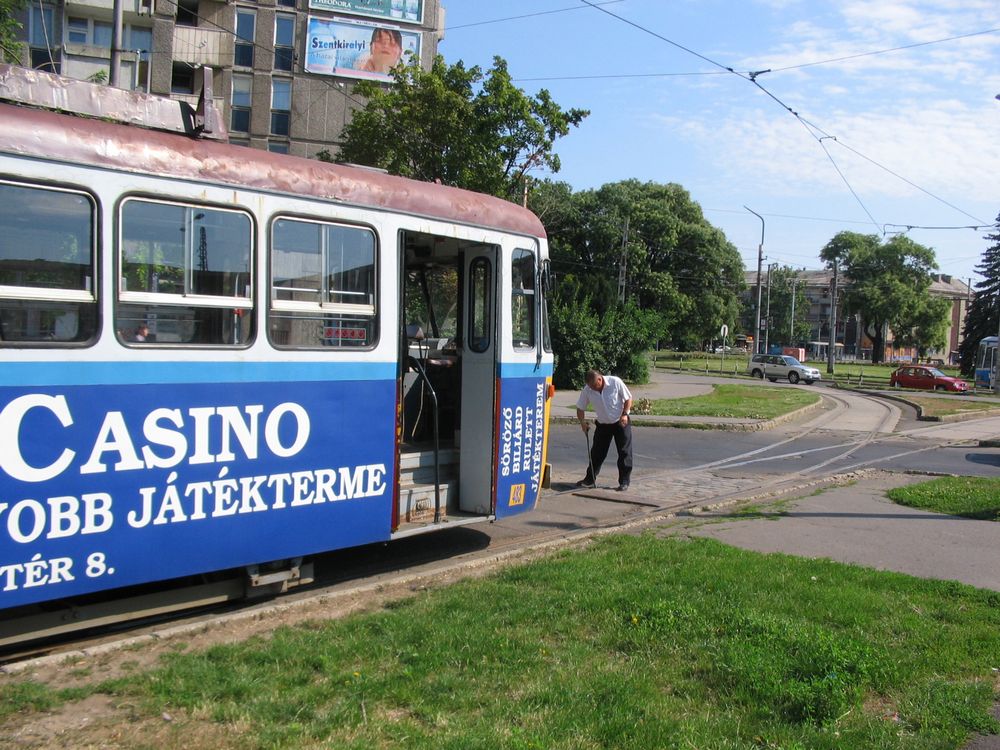
Tram driver changes the points

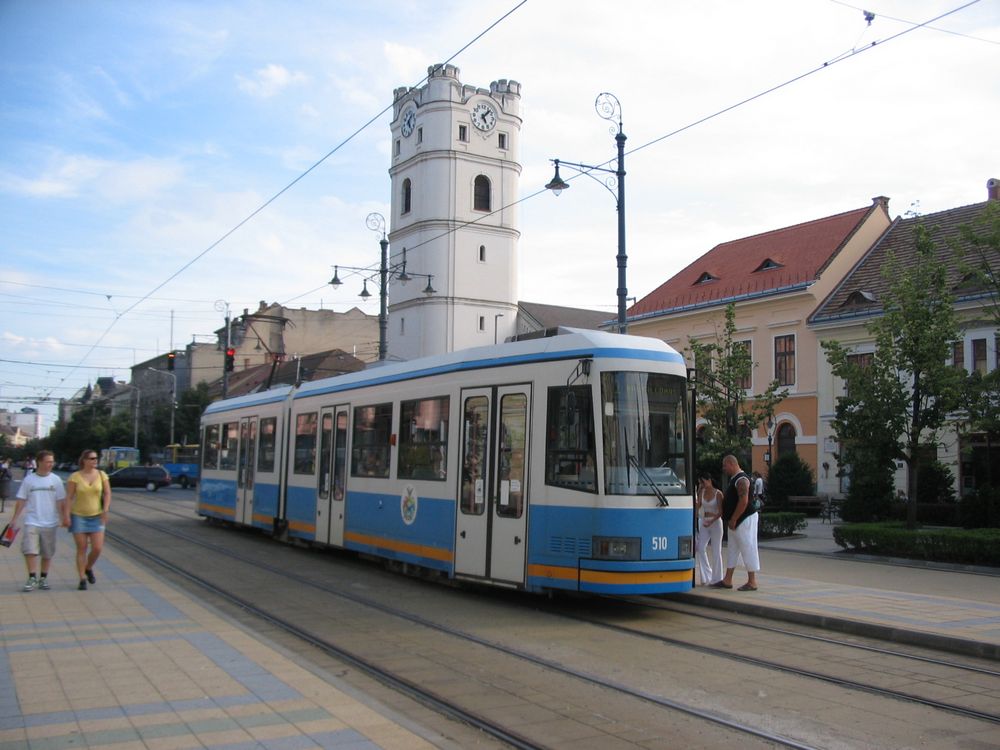
Tram and the small church, Debrecen

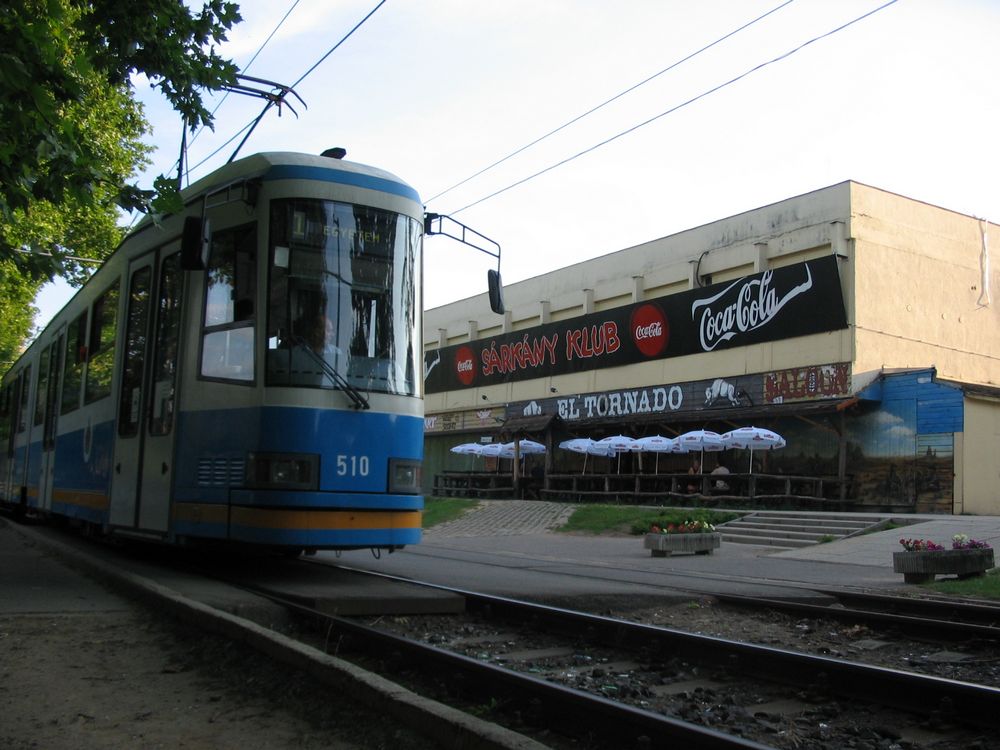
Tram 510 is one of the 11 Ganz-Hunslet cars built for Debrecen. The Small Church was once crowned with an onion-shaped dome, but it was badly damaged by a storm in 1907. Two years later a further storm wrecked the repairs, so the locals took the hint from above and stuck with the truncated stone tower instead.

If the council is to be believed, Debrecen’s population of around 210 000 makes it Hungary’s second largest city, after Budapest. On the other hand, proud residents of the northern city of Miskolc have other ideas, as they will tell tourists on their narrow gauge railway who let slip that Debrecen is next on the itinerary.

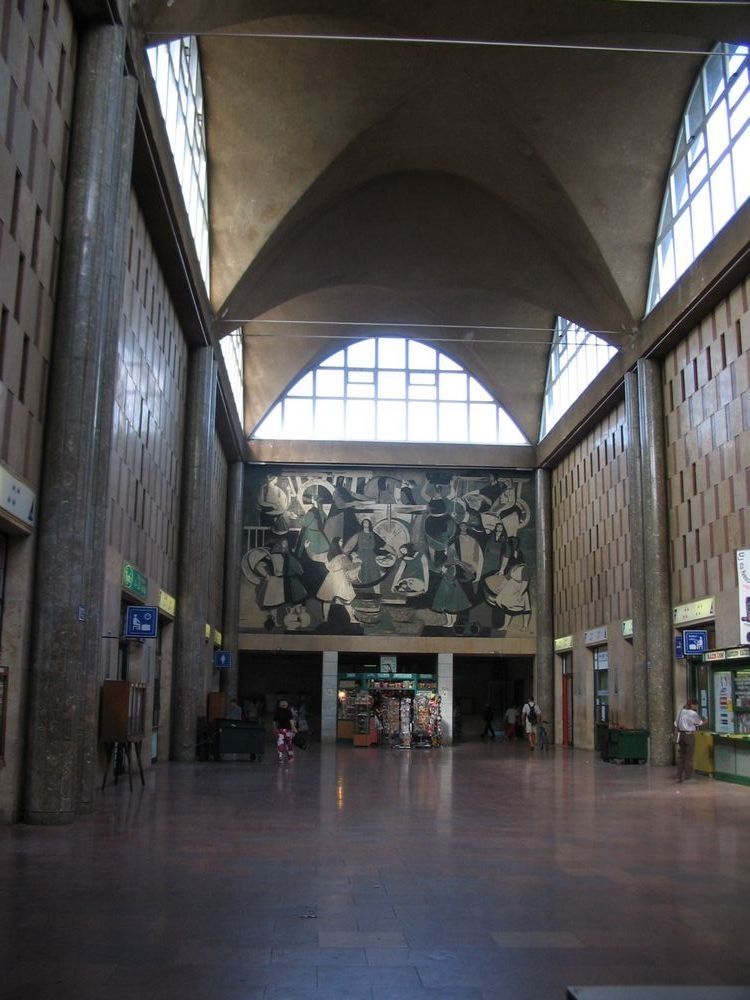
Railways first arrived in Debrecen in 1857 with a link from Pest (now one half of Budapest). Today visitors arrive at a large 1961 replacement for an ornate building which was built in 1900 but destroyed by bombing in 1944. The current station’s main hall contains two vast frescos by Endre Domanovszki, showing happy peasants working in the fields of the Great Plain which stretches for mile after mile across the south and east of the country.

Debrecen station concourse, Hungary

Mural on the wall on Debrecen station concourse.

Stepping outside the station and crossing the road brings the passenger to the conveniently-located the terminal loop of the city’s single tram line. Unimaginatively branded Line 1, the standard-gauge route run by city transport company DKV is the sole survivor of six which once crossed Debrecen. The first steam tramway opened in October 1884, electric trams arrived in 1911, but by 1975 all but the one of the lines had been supplanted by buses of the diesel or electric persuasion (and some which are both, merrily carrying on beyond the wires). The remaining line is well used, providing a frequent and useful link along an axis running from the station, through the main square, to the university, park and hospital.

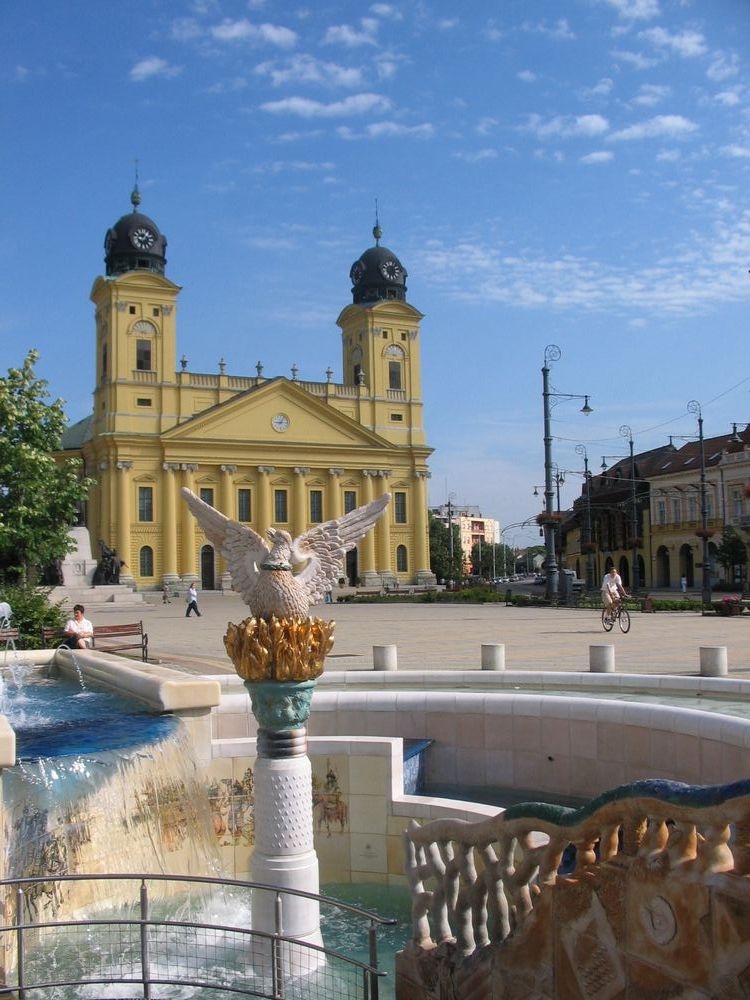
Fountain in the main square, Debrecen

Efforts to beautify the city centre include the construction of this rather distinctive fountain.

In recent years the local authority has undertaken a major regeneration of the town centre in an effort to raise the city’s national and international profile and to attract the tourist forint. Perhaps as a result of this, each of the 13 tram stops has information in Hungarian, German and English, complete with a route map, details of the service frequencies and the vital information – so often forgotten on even the best-run light rail systems – on how people who aren’t familiar with the system can buy a ticket. These were available from the driver for HUF160, or in advance from various kiosks at a slightly lower price. Few people seemed to need to buy tickets from the driver, and trams are boarded through all doors. There are two DKV offices, one helpfully located within the station loop, which are the only outlets able to sell a HUF500 day pass valid on all the city’s trams and buses.

The stops have passenger information screens on them, built into ‘heritage-style’ signs, which is unusual for a long-established Eastern European tramway. Following the pattern of the Budapest metro, these screens tell you how long ago the last service left, not when the next will depart. This isn’t the most useful way of doing things, but it can be used in conjunction with the frequency information to estimate waiting times, which were short anyway. Services run from 04:30 to 23:00, with frequencies ranging from a peak of 2-4 min down to to 8-10 min at the extremities of the day.

Trams

Ticket office in turning loop at Debrecen station

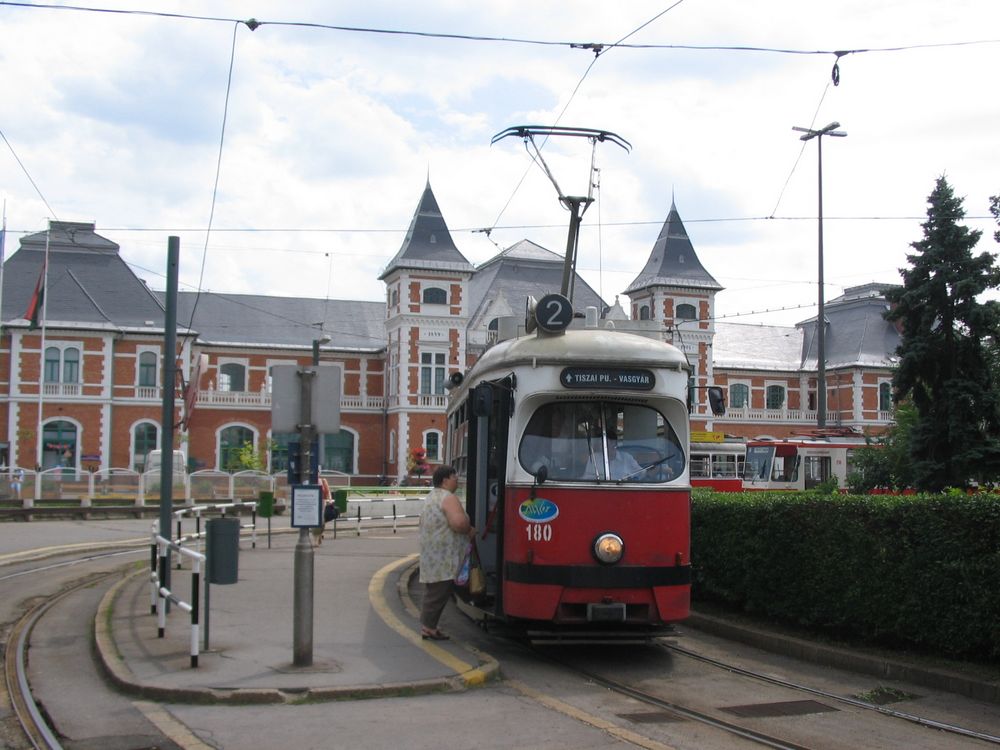
The high frequency of the service means there were always trams waiting in the station loop when we passed. The Bauhaus-style tramway ticket office is in the centre of the loop, the MÁV railway station across the road on the right. The city of Miskolc has a very similar loop outside its main station, and also has a single tram line serving the main street.

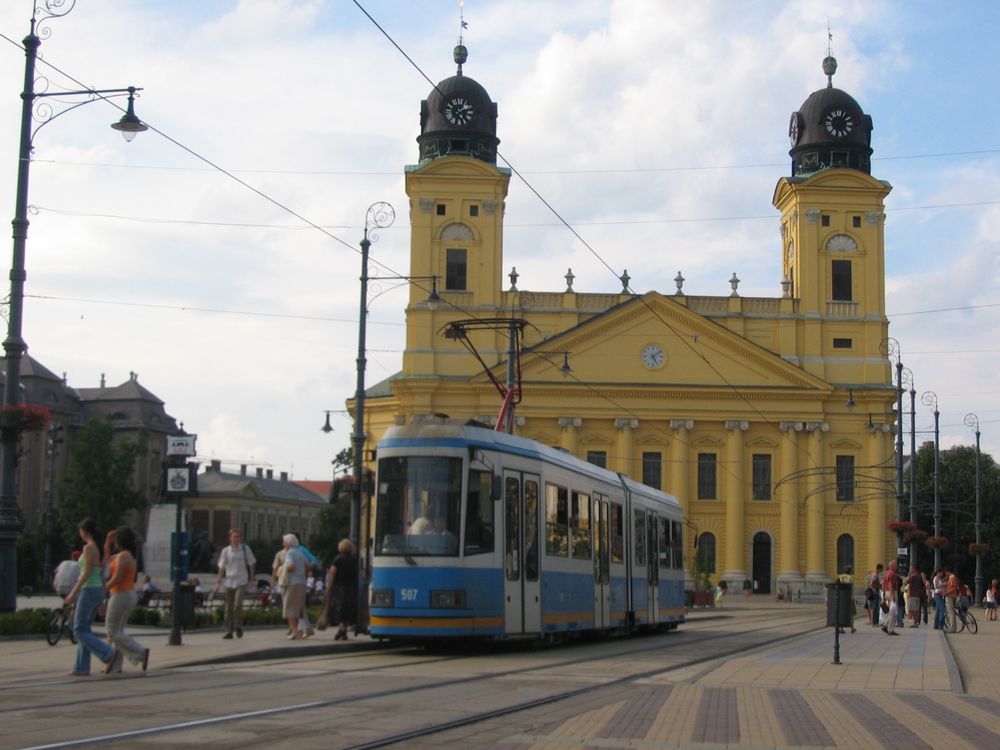
We noticed an interesting modern-looking tram, so decided to let the first service go so we could take a look. It was one of ten six-axle KCSV6 series vehicles supplied by Ganz-Hunslet of Budapest in 1997, after the production of a prototype car (now no. 500) in 1993. Though it felt narrow, the KCSV6 is 2 500mm wide, falling between the 2 300 mm common on many older European systems and the 2 650 mm generally adopted for modern trams and new lines. The Debrecen tram’s interior is designed for standing passengers, having 28 single seats either side of a wide aisle. On-board passenger information displays show the name of the next stop.

Nagytemplom, Debrecen

One of the Ganz-Hunslet trams in Kossuth Square passes the Calvinist Great Church, Debrecen’s signature building.

The tram was designed in an attempt to produce a cheaper vehicle than the big western suppliers can offer to the Eastern European market, but no further orders materialised. Traditional tramways have so far survived in many Eastern European cities, but they are often in a poor state. There is no money available to purchase new “western” trams from the likes of Alstom, Bombardier or Siemens, but existing vehicles are often life-expired and offer a poor travelling environment as access to private transport increases.

The problem is widespread, and in the former East Germany the Leipzig tram company has developed a tram it calls Leoliner, which keeps costs down by using Tatra-designed tram bogies under a new body. Leipzig is now hoping to sell its Leoliners across eastern Europe, in competition with the big suppliers (Halberstadt in eastern Germany was the first external customer, putting five metre-gauge Leoliners into service in October 2006).

A tram arrives from the depot

A tram on the branch from the depot.

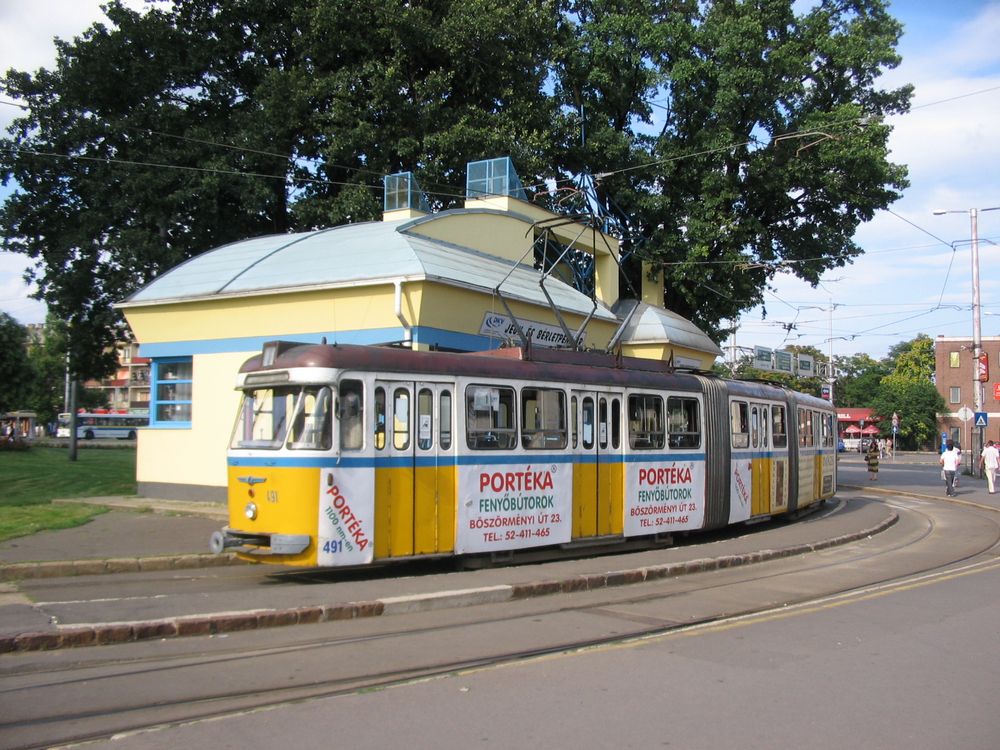
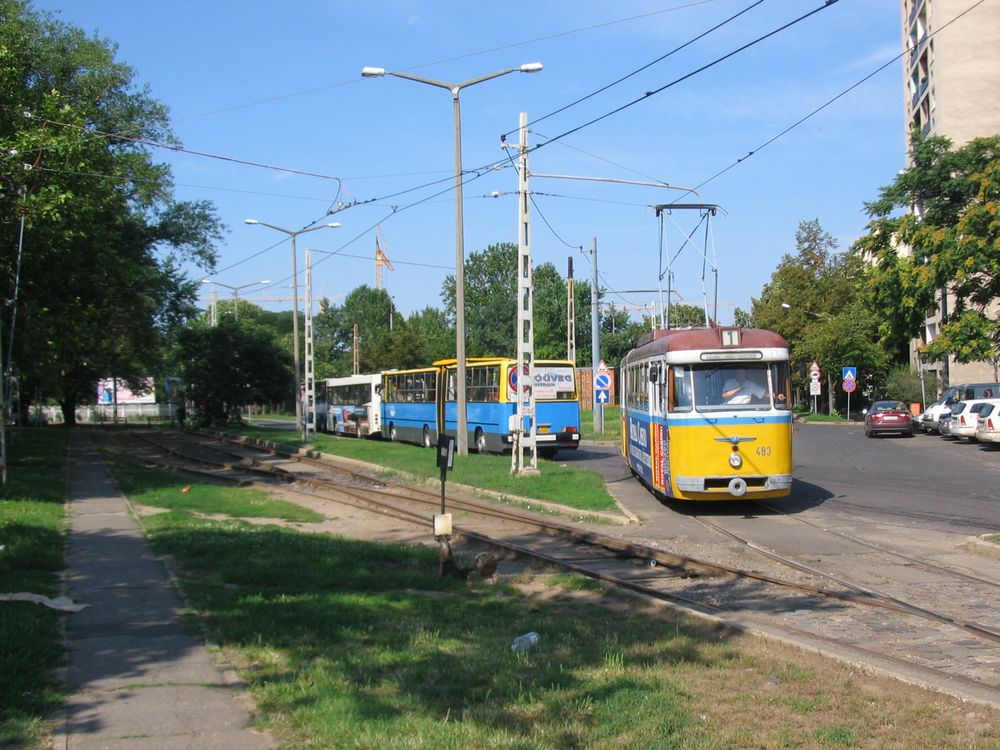
In Debrecen ten older FFV “two-rooms-and-a-bath” trams also remain in use, the surviving examples dating from the 1970s. Nicknamed “Bengálik”, these were developed in the 1960s by Budapest’s tram maintenance depot for use in the capital. The design was then adopted by Debrecen, which also built similar vehicles for Miskolc and Szeged, the two other Hungarian cities where tramways remain. These very dated vehicles are rather noisy, quite worryingly so in one case. Electrification is at 600 V DC, and all DKV’s tram are double-ended, though as the line has turning loops and outside platforms it would seem possible to use single-sided vehicles, as ran in the city in the past.

Along the line

Changing the points

The driver changes the points as a tram comes off the branch from the depot to join the main route.

A couple of sidings trail into the turning loop outside the station, while a single track branch from the depot runs in from an adjacent street, linked to the running line by a triangle giving access in and out.

Departures are very frequent, with three or four trams waiting in the loop to load up in a turn-up-and-go service. The line is double track throughout, except a short section round the park, and has 13 stops.

Tram and trolley bus wires cross in the centre of Debrecen

In the city centre the tramway crosses a trolleybus route at a busy junction, where the extra electrical equipment needed for rubber-tyred vehicles stands out. The locally-built trams with two four-wheel cars linked by an articulated section are showing their age, and can be rather noisy inside.

After the turning loop, the line follows reserved track through Petofi Square, which is named after a poet who lived in a house on the site now occupied by the station in 1843-44. The trams continue along Piac Utca, a road shared with other traffic. By the Small Church the trams make a right angled crossing with the city’s trolleybuses, which are also covered by the day ticket. As well as conventional electric trolleybuses, DKV has some Solaris/Ganz-Transelektro dual mode vehicles with diesel engines, and despite the presence of overhead at least one trolleybus went past in diesel mode.

The trams then continue through Kossuth Ter, the city’s main square, which has been modernised and pedestrianised to produce a pleasant car-free area. Money has been spent on public art and generally tidying the city centre up, which produces a pleasant environment which other cities could learn from.

Buildings in Debrecen

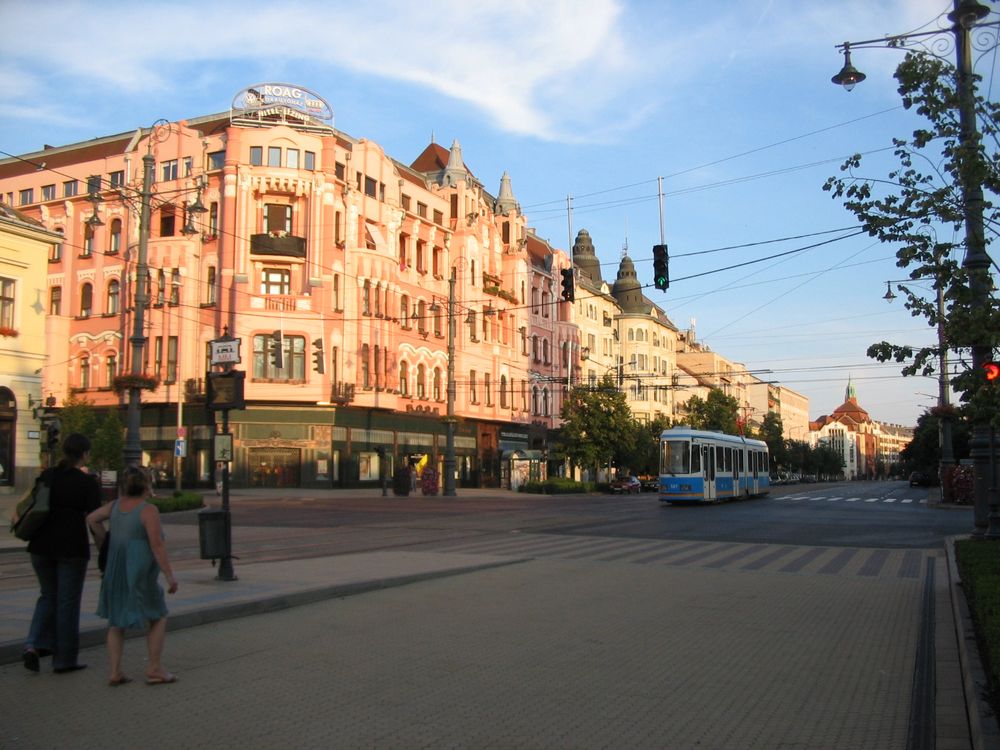
There is some interesting architecture in Debrecen, including this rather pink building.

The line then passes to the right of Debrecen’s signature building, the Calvinist Nagytemplom, or Great Church. In 1849 Kossuth declared Hungary independent of Austria in the church. The revolution was defeated by Russian military intervention, but now it is difficult to walk more than a short distance in Hungary without passing a Kossuth street, square, statue or monument.

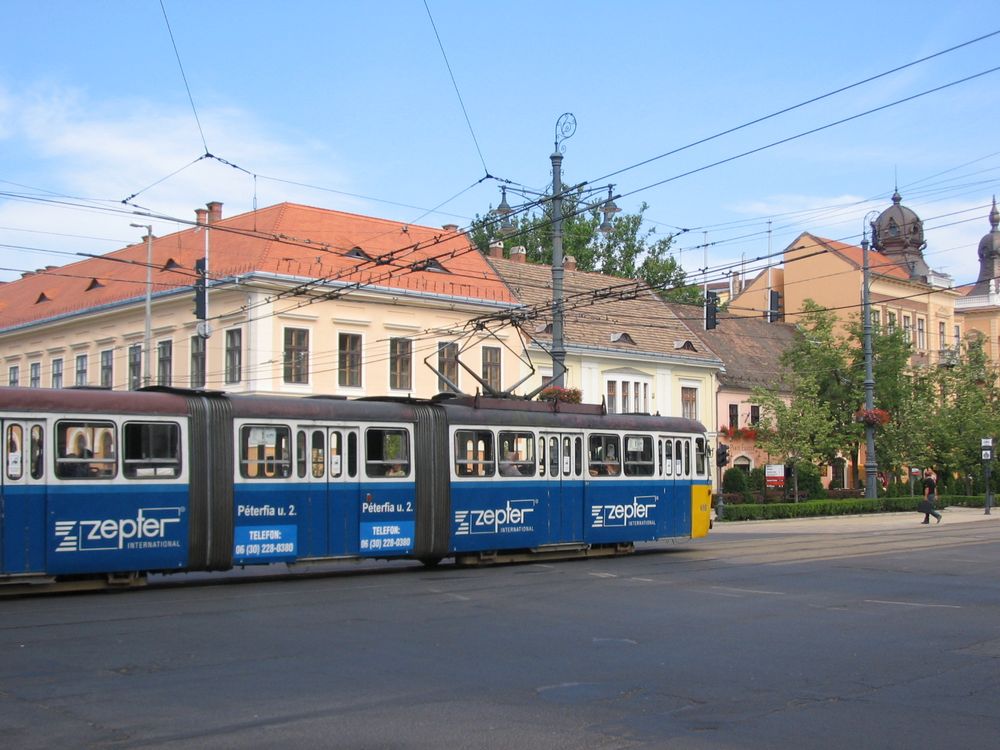
Trams then continue down the middle of Peterfia Utca and Simonyi Utca to the Nagyerdei park, which the line enters and bisects. The reserved track through the park is double track, but only one line is used, the stops being served in one direction only as all trams travel anti-clockwise.

Tram passing the Spa, Debrecen

Tram passing the spa in the park. The double track cuts across the middle of the park, then circumnavigates one side of the tree-lined grounds along the perimeter road. Only the outermost track appeared to be in use on the section outside the thermal baths.

The route passes thermal baths fed by sulphurous springs, then at the far side of the park it swings left, completing a circuit of the western half of the park on a single track line along the perimeter road. Single platform stops serve the surrounding Kossuth Lajos university and hospital district. With potential traffic generators at either end of the line, and the city centre in the middle, the tramway is an extremely useful way of getting about, providing an excellent way to see the city.

On arriving in the park we went in search of the zoo and its narrow gauge railway. Unfortunately the zoo was closed. Peering over the fence some zebras were spotted [no, any fule kno they were striped] but no trains, so we boarded another tram for the city centre. A return trip, from the station, round the park and back to the station, takes 36 min for the journey of about 9 km.

More information

Tram at Miskolc station

Miskolc also has a single tram line. A tram stands outside the station.

  • There is a impressive amount of bilingual information on Hungarian trams for enthusiasts at Hamster‘s Trams of Hungarywebsite.
  • City transport company DKV has a surprising amount of data, including fleet lists and vehicle specifications (in Hungarian).
  • Online tramspotting is possible using a controllable webcam in Kossuth Square.
  • Plus of course the Rough Guide to Hungary and Lonely Planet Hungary are handy for planning a visit. If I could remember its name, I’d recommend a hotel where a one-armed man served us ham and eggs for breakfast, as their German names were the only food which he and us could all name in a common language.