Iran – Afghanistan – Uzbekistan discussions

Iran’s Fars news agency reports

Iran, Uzbekistan to Expand Railway Cooperation

News number: 8708080931 14:39 | 2008-10-29

TEHRAN (FNA)- Managing Director of the Islamic Republic Railways Hassan Ziari said in a meeting with his Uzbek counterpart that cooperation between the two countries will further expand in the field.

According to a report by the Public Relations Department of the entity, he referred to the significance of railway link between the two states and said that development of railway network between Iran, Afghanistan and Uzbekistan will facilitate Uzbekistan’s access to the Persian Gulf waters.

Rahmatov, for his part said that his country is keen to promote cooperation with Iran in the field, the Islamic republic news agency reported.

The two officials met on Tuesday to review development of railway cooperation.
Source: Fars

Uzbek-Afghan rail co-operation discussed

Uzbek news agency УзА (UZA) has a report about a recent official visit which discussed Afghan railway projects. Google’s automatic translation and a bit of tidying up gives something like this, although I don’t speak Russian so it might not be quite right!

Visiting Afghan delegation

On 27 August a delegation from Afghanistan headed by Ali Safari Sohrobom, Minister of Public Works, met Akbar Shukurovym, Deputy Chairman of state railway company Uzbekiston Temir Yullari.

During the meeting they stressed the importance of the promotion of mutual cooperation in such spheres as trade, the economy, energy, transport and communications, the legal basis for which agreements [were, will be?] reached during meetings of the heads of state of Uzbekistan and Afghanistan.

Links between Uzbekistan and Afghanistan in the field of transport and communications are important. During the meeting the sides exchanged views on expanding co-operation between the two countries in the field of railway transport.

No more details are given, unfortunately.

Afghan president mentions through rail route

Speaking to the South Asian Association for Regional Cooperation’s Heads of State Summit in Colombo last week, Afghan President Hamid Karzai said

As part of the contract with a Chinese consortium for the exploration of the Aynak copper deposit, a railway line will be constructed which will connect Central Asia to South Asia, thereby expediting the transport of people and goods within the region and beyond.

The suggestions of passenger transport, and a through north-south link, are interesting.

The project was announced last November. A consortim of China Metallurgical Group Corporation and Jiangxi Copper Co would build a railway line from the town of Hairatan on the Amu Darya bordering Uzbekistan, through Logar and to Torkham on the Pakistan border to export the minerals.

Georgian conflict a threat to Afghan transit plan?

The potential implications of the current Georgian situation for proposed NATO rail transit traffic to Afghanistan via Uzbekistan are considered at Ghosts of Alexander. The initial Central Asian transit route agreement that was reached earlier this year had the approval of Russia says Russia, Georgia, NATO and Afghanistan, asking Is it doomed? Is it just one of several bargaining chips that Russia has (the big one being energy)?

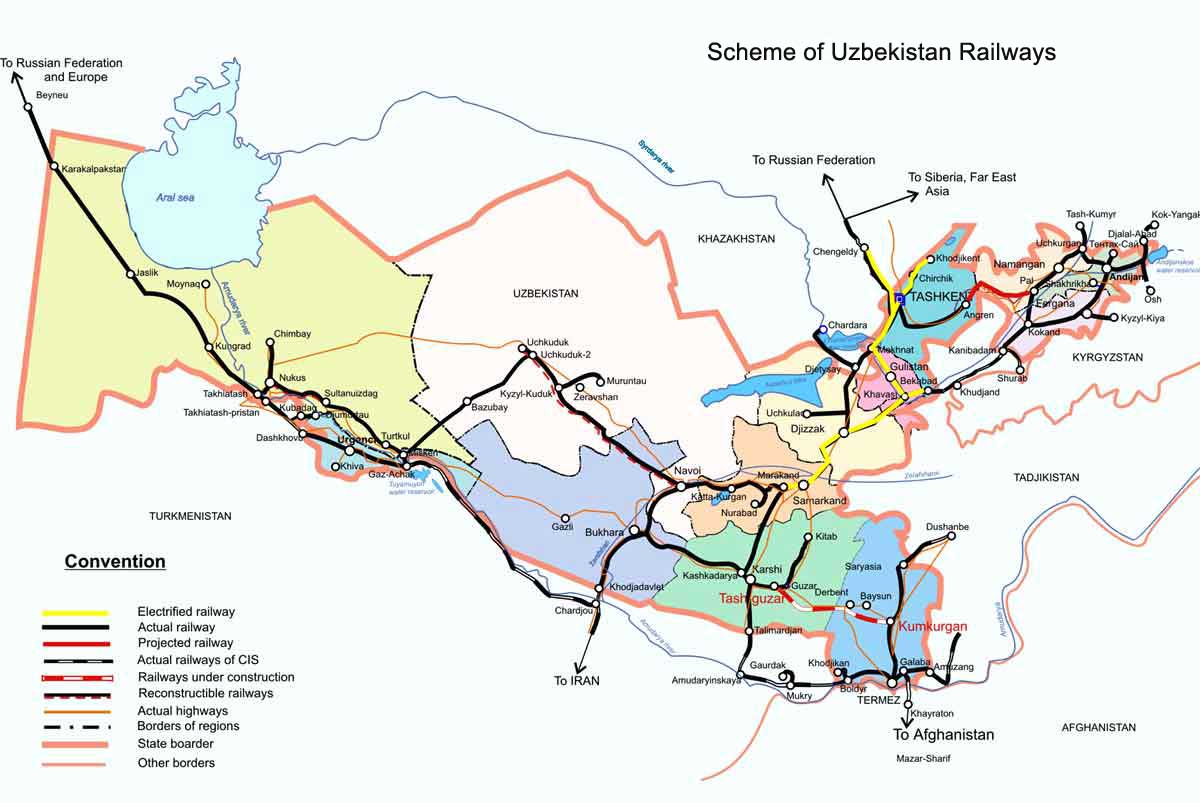
There is a link to a handy map of Uzbekistan’s railways.

An earlier posting on Registan.net, Termez, Where the “T” Is for “Transit”, considers the problems of supplying NATO in Afghanistan. The few rails that operate along the Amu Darya have major rail break problems, in that they operate at a different gauge than their neighbors. This tells me freight can make it only as far as Termez, and from there is must be either shipped or flown to its final destination.

This is not quite right – the break-of-gauge is between the former USSR and elsewhere (except Finland and Mongolia, which use “Russian” gauge). There are transhipment and dual-gauge facilities around the various borders, so a wagon could in theory run from (say) Poland to Afghanistan without the gauge being an issue.

The two existing lines in Afghanistan are to the 1520 mm Russian gauge, though the line from Iran to Herat will be standard gauge.

NATO’s Europe to Afghanistan rail plan under discussion

NATO is “Making progress on Afghanistan rail route”, according to a Eurasia Insight report dated May 5. It seems NATO is hoping to move freight between Europe and Afghanistan via the rail connection from Uzbekistan to Hayratan, across the Friendship Bridge.

NATO is striving to rapidly conclude a deal with Central Asian states on an inter-continental rail link that would ease the supply of non-lethal equipment and assistance for both military and reconstruction operations in Afghanistan.

The rail project is an outgrowth of NATO’s efforts to reinvigorate its Afghan operations. Discussions on how to improve Afghan reconstruction efforts featured prominently at the alliance’s early April summit in Bucharest. [see previous posting] …

At present, the cost of supplying NATO operations in Afghanistan is astronomical, due mainly to the fact that most supplies must be brought in by air. According to NATO estimates, airlifting supplies to Afghanistan costs a whopping $14,000 per ton, or roughly $7 per pound. In addition to the high cost, the air option may not be able to handle the requirements necessitated by an expansion of NATO forces in Afghanistan.

A Europe-Afghan rail link could cut supply costs to roughly $300-$500 per ton, allowing the bloc to both save tremendously on transportation and increase supply for its Afghanistan operations. The optimal route envisioned at this time would traverse Ukraine, Belarus, Russia, Kazakhstan and Uzbekistan. By all appearances, NATO has secured approval in principle from all the potential transit states.

… no new railroads are expected to be built at this point; the route will follow existing Soviet-era high-capacity tracks. … NATO indicated that if route proves reliable and efficient, the alliance will seek the permission of transit states to allow military equipment to travel over the railway. This option would necessitate closer cooperation between NATO and the Russia-led Collective Security Treaty Organization (CSTO), of which several transit states are members.

The full article has a lot of background to the political implications of allowing such traffic through the surrounding countries.

Other than the Europe-Afghan railway, there would seem to be no other viable options for the overland supply of Afghan reconstruction efforts.