15th ministerial conference of non-aligned countries in Tehran

News dated August 6 2008 from the Ministry of Foreign Affairs of Afghanistan, regarding the 15th ministerial conference of non-aligned countries.

Minister Spantas Press conference in Kabul

In the sidelines of this conference the Foreign Ministers of Afghanistan and Turkmenistan had a bilateral meeting they talked about the cementing of the bilateral ties between the countries, construction of a railway track from the border areas of Turkmenistan to Afghanistan and various issues of interests came under discussion.

Afghan president mentions through rail route

Speaking to the South Asian Association for Regional Cooperation’s Heads of State Summit in Colombo last week, Afghan President Hamid Karzai said

As part of the contract with a Chinese consortium for the exploration of the Aynak copper deposit, a railway line will be constructed which will connect Central Asia to South Asia, thereby expediting the transport of people and goods within the region and beyond.

The suggestions of passenger transport, and a through north-south link, are interesting.

The project was announced last November. A consortim of China Metallurgical Group Corporation and Jiangxi Copper Co would build a railway line from the town of Hairatan on the Amu Darya bordering Uzbekistan, through Logar and to Torkham on the Pakistan border to export the minerals.

Georgian conflict a threat to Afghan transit plan?

The potential implications of the current Georgian situation for proposed NATO rail transit traffic to Afghanistan via Uzbekistan are considered at Ghosts of Alexander. The initial Central Asian transit route agreement that was reached earlier this year had the approval of Russia says Russia, Georgia, NATO and Afghanistan, asking Is it doomed? Is it just one of several bargaining chips that Russia has (the big one being energy)?

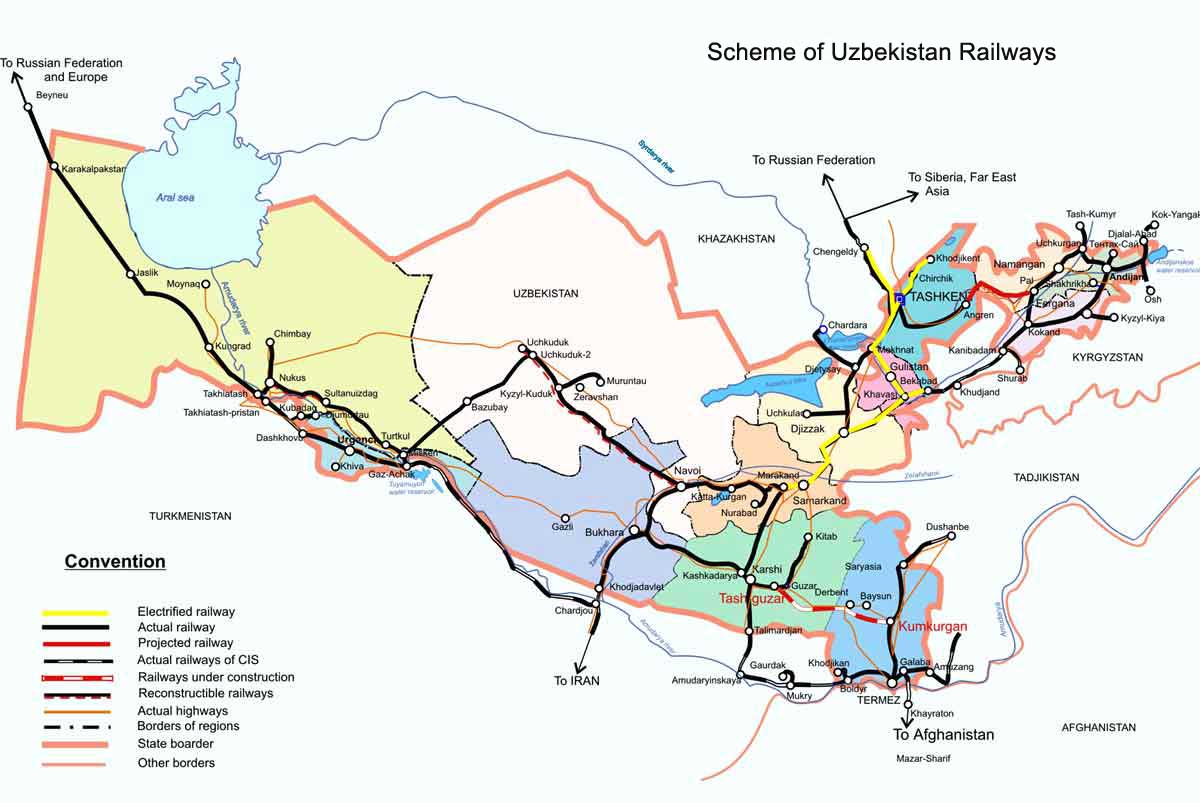
There is a link to a handy map of Uzbekistan’s railways.

An earlier posting on Registan.net, Termez, Where the “T” Is for “Transit”, considers the problems of supplying NATO in Afghanistan. The few rails that operate along the Amu Darya have major rail break problems, in that they operate at a different gauge than their neighbors. This tells me freight can make it only as far as Termez, and from there is must be either shipped or flown to its final destination.

This is not quite right – the break-of-gauge is between the former USSR and elsewhere (except Finland and Mongolia, which use “Russian” gauge). There are transhipment and dual-gauge facilities around the various borders, so a wagon could in theory run from (say) Poland to Afghanistan without the gauge being an issue.

The two existing lines in Afghanistan are to the 1520 mm Russian gauge, though the line from Iran to Herat will be standard gauge.

Tajikistan – Afghanistan – Iran railway to be discussed in Kabul

The project is to be discussed in Kabul next week, according to the first deputy head of the Tajik Railways, quoted in a story from Asia-Plus. There is currently no rail link between Tajikistan and Afghanistan.

Construction of railroad linking Tajikistan, Afghanistan and Iran to be discussed in Kabul next week
Author: Daler Ghufronov

DUSHANBE, July 15, 2008, Asia-Plus — Issues related to construction of a railway that will link Tajikistan, Afghanistan and Iran will be discussed at a meeting of officials of the three countries that is expected to take part in Kabul next week, Vladimir Sobkalov, the first deputy head of the Tajik Railways, announced at press conference in Dushanbe on July 14.

Sobkalov noted that a joint communiqué pledging tripartite cooperation in the energy and transport sectors was signed by foreign ministers of Tajikistan, Afghanistan and Iran in Dushanbe last March. A railway link connecting Tajikistan, Afghanistan and Iran is part of the project for construction of Tajikistan-Afghanistan-Iran highway.

The Tajik side has already prepared its proposals on the construction of the mentioned railroad, the Tajik Railways official said.

We will recall that the trilateral summit that is scheduled to take part in Dushanbe next month on sidelines of the summit of the Shanghai Cooperation Organization (SCO) will consider this issue.

Atamyrat to Afghanistan railway plan

On July 12 the State News Agency of Turkmenistan reported a plan for the construction of a new railway to Afghanistan, starting from Atamurat (formerly Kerki) in eastern Turkmenistan.

The project was discussed at the first meeting of the snappily-titled intergovernmental Turkmen-Afghani commission for trade and economic and technical co-operation, which was held in Ashgabat this month.

Intergovernmental Turkmen-Afghani commission meets in Ashgabat

The opportunities for further co-operation in energy industry and the sphere of transport and communication including railway and motor transport were a focus of the talks. It was noted that by concerting efforts Turkmenistan and Afghanistan occupying the favourable geographical position could ensure transit freight traffic across their territories to the north-south and the east-west. In this regard the Turkmen partners expressed the willingness to connect the national railway networks of Turkmenistan and Afghanistan. In particular, Turkmenistan intended to finance the construction of a branch line from Turkmen town of Atamurat to the Turkmen-Afghan border that would give Afghanistan an outlet to other countries of the region.

Atamurat/Atamyrat was formerly called Kerki, until the previous president (of personality cult fame) renamed it in honour of his father, who had been born there. While Afghanistan doesn’t really have a “national railway network” yet, the 1520 mm gauge Turkmen line from Turkmenabat to Atamyrat opened in 1999, providing a link between two parts of the Turkmen network to eliminate the need to go round through Boukhara in Uzbekistan.

Turkmentel – 2007 explains:

Owing to the thought over, far-sighted and steady decisions of the First President of Turkmenistan Saparmurat Turkmenbashy the Great for years of independence the railway branch became one of priority directions in the field of communications and has achieved the new high level of development.

In the end of 1999 construction of railway Turkmenabat-Atamyrat by extention of 203 km is completed. This branch line, having connected five regional centers of Lebap area with the city of Turkmenabat, and also with capital Ashgabat, passes on the left coast of Amu Darya river.

Supermap might help explain the arrangement of railways in Turkmenistan.

Searching Google Earth, this could well be the station at Atamyrat, with a line heading off south then looping round towards the construction site for a bridge over the Amu Darya (which seems to have run into political complications during construction).

View Larger Map

The railway appears to carry some Afghan traffic at present, presumably transhipped to or from road transport (or maybe barge?):
Text of report by Turkmen newspaper Neytralnyy Turkmenistan on 26 January 2007.

A [railway] loading station for cargo transported via the Turkmenabat-Atamyrat railway line [in eastern Turkmenistan] has been put into operation. Weighing facilities and a set of loading and unloading equipment are located on the station’s territory, which measures 80,500 sq m.

A network of storage facilities is being installed at the station as well. Some of them are designed for short-term storage of cargo from neighbouring Afghanistan. The others will be used for goods from economic entities in the Gulustan newly-developed desert area and along the Garagum canal.

Turkmenistan already has a short cross-border railway link to Towraghondi in Afghanistan.

Crossing the Friendship Bridge

Here are some links to various articles on the Friendship Bridge, which carries the railway from Termiz/Termez in Uzbekistan, over the Amu Darya river to a freight terminal at Hairaton/Hayraton/(and various other transliterations) in Afghanistan. The nearest town to the Uzbek end is Mangusar.
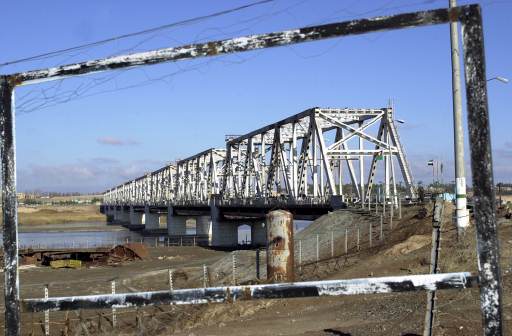
Friendship BridgeU.S. Army Civil Affairs personnel visit the Termez bridge to assess its usability for supporting the transport of humanitarian aid from Uzbekistan, to the northern provinces of Afghanistan, in support of Operation Enduring Freedom, Dec. 18, 2001. (U.S. Air Force photo by Staff Sgt. Cecilio Ricardo)

War Zones for Idiots describes American Tom Bissell’s journey into Afghanistan over the Friendship bridge: A trim two-lane span with shallow train tracks running down the center, the bridge was splendid, solid, clean – until we came to its indisputably Afghan side. Suddenly graffiti streaked along the girders, all of it scrawled in indecipherable Arabic-alphabet Persian.

Travelling from Termez, he found

A converse silhouette of crosshatched white girders, the bridge was perhaps five hundred yards from where we stood. Before us a grassy bay of thigh-high vegetation swung back and forth in the breeze. A quarter-mile away, on the other side of the motionless Amu Darya River—as unremarkable as I imagined the view of North Dakota might appear from South Dakota—was Afghanistan.

Some cows, looking legless in the tall grass, drank from pools of swampy standing water near the river, which was itself blocked off with electrified fence and cyclonic coils of barbed wire. Michael thought that some great photos of the Friendship Bridge could be snapped from deeper in the field, and convinced me to follow him.

“Nyet, nyet!” our driver Sobir yelled. We turned, already up to our knees in the grass. He began calling out a single word in Russian while performing an ominous-looking hand motion. I asked Michael what this word meant. He said nothing, his mouth squirming thoughtfully within his blond goatee. He looked at his feet, and then around them.

“He’s saying,” Michael began, “that there are landmines here.”

In this travel blog tourists leave Afghanistan in 2007. Includes a photo of the deck showing the railway.

There is photo of the Russians leaving in 1989 (here is a news report from the Guardian archive), and also a rug design possibly inspired by the bridge, on an Australian website which has almost everything you could possibly need to know about Afghan War Rugs [now there is something which conjures up a strange image – coming next, the Doormats of Mass Destruction?].

A news article on reopening of the bridge in 2001.

Photo, collection of five pictures of the bridge area. I think the armoured vehicles in the river could be BTR-70s, but identification of drowned military kit isn’t exactly my speciality.
Kabul to China railway via Dushanbe?

Railway Gazette International June 2008 reports:

At a meeting with his Iranian and Afghan counterparts, the Foreign Minister of Tajikistan proposed that a railway which is planned to serve a Chinese copper mining concession at Aynak, east of Kabul, be routed through Kunduz, Panj and then to the Tajik capital Dushanbe. A line would be built up the Vakhsh River valley and onwards to Kashi in China. This route avoids the difficult Wakhan corridor.

“A dismal place with a railway yard”

An article in Dawn dated May 14, 2006 quotes M H A Beg visiting Central Asia to follow Babar‘s passage from the Amu Darya to Nilab:

Babar must have crossed the river Amu somewhere near Termiz. This is the famous crossing site of men and armies. The most famous in recent history being the Russian army of 1979 through the Bridge of Friendship, named in contrast to the act of invasion.

The bridge still stands. It is used by the trade traffic. Not only does it have a road but also a railway crossing from Uzbekistan to Afghanistan. To establish a station for unloading goods, they built a town named Hayratan, a dismal place with a railway yard and some houses belonging to the railway workers and army personnel. The town is so recent that it doesn’t even show on some of the older maps of Afghanistan. These days you cannot go on the bridge directly, but a guard will direct you to a place from where the bridge and Amu Darya are within sight.

The bridge is a steel construction, painted pale yellow on the top. Amu is a big river in the region, made famous in Arabic historical writings as the “Nehar”. Arab historians have given the area beyond a name so beautiful and descriptive, “Mavara-un-nehar”. The railway does not go beyond Hayratan. This is the only part of Afghanistan where there is a railway built by the invading Russians. It is their legacy.

Babar writes in his book that after crossing the Amu on a raft, he landed in Afghan Turkistan where he was greeted by vast flat grasslands.

Fuel Line Vol. 3, 2006 from Defense Energy Support has an article “Voruz Earns Bronze Star Thanks to Many Logistics Professionals”. This describes removing a vast quantity of fuel from a US base in Uzbekistan to one in Afghanistan in a hurry during 2005, by rail and lorry. There is a small photo of railway tracks at Hayratan.

Iran – Herat railway 40% finished

The railway line under construction to provide a link between the Iranian network and Herat in Afghanistan is progressing, according to Hamid Behbahani, Iran’s Deputy Minister of Roads & Transportation, in a report by the Fars news agency:

Railroad to Link Pakistan to Europe via Iran
15:14 | 2008-05-14

[…The Bam-Zahedan line is to be completed by March 2009, …]

The construction of the railroad between Khaf in northeastern Iran and Herrat in western Afghanistan is making progress, he said, adding 60 percent of the Iranian side and 40 percent of the Afghan’s side are completed.

Upon completion of the project, Afghanistan will have a railroad link to Europe via Iran, Behbahani said.

This line starts at Khaf in Iran, then heads slightly south and then east across the border through arid and rugged terrain., reported the January 2008 issue of Railway Gazette International. The new line will be 191 km long, of which 77 km is on the Iranian side of the border and 114 km within Afghanistan.

NATO’s Europe to Afghanistan rail plan under discussion

NATO is “Making progress on Afghanistan rail route”, according to a Eurasia Insight report dated May 5. It seems NATO is hoping to move freight between Europe and Afghanistan via the rail connection from Uzbekistan to Hayratan, across the Friendship Bridge.

NATO is striving to rapidly conclude a deal with Central Asian states on an inter-continental rail link that would ease the supply of non-lethal equipment and assistance for both military and reconstruction operations in Afghanistan.

The rail project is an outgrowth of NATO’s efforts to reinvigorate its Afghan operations. Discussions on how to improve Afghan reconstruction efforts featured prominently at the alliance’s early April summit in Bucharest. [see previous posting] …

At present, the cost of supplying NATO operations in Afghanistan is astronomical, due mainly to the fact that most supplies must be brought in by air. According to NATO estimates, airlifting supplies to Afghanistan costs a whopping $14,000 per ton, or roughly $7 per pound. In addition to the high cost, the air option may not be able to handle the requirements necessitated by an expansion of NATO forces in Afghanistan.

A Europe-Afghan rail link could cut supply costs to roughly $300-$500 per ton, allowing the bloc to both save tremendously on transportation and increase supply for its Afghanistan operations. The optimal route envisioned at this time would traverse Ukraine, Belarus, Russia, Kazakhstan and Uzbekistan. By all appearances, NATO has secured approval in principle from all the potential transit states.

… no new railroads are expected to be built at this point; the route will follow existing Soviet-era high-capacity tracks. … NATO indicated that if route proves reliable and efficient, the alliance will seek the permission of transit states to allow military equipment to travel over the railway. This option would necessitate closer cooperation between NATO and the Russia-led Collective Security Treaty Organization (CSTO), of which several transit states are members.

The full article has a lot of background to the political implications of allowing such traffic through the surrounding countries.

Other than the Europe-Afghan railway, there would seem to be no other viable options for the overland supply of Afghan reconstruction efforts.