Khyber Pass railway history, and Bostan – Zhob revival?

The Doodh Patti – My Cup of Tea blog has an illustrated article on the history of the Khyber Pass railway, which almost – but not quite – ran to Afghanistan, stopping just short of the border.

The July 2007 issue of Railway Gazette International reports that Pakistan’s government has authorised the acquisition of 584 acres of land required to rebuild to 1 676 mm gauge the 295 km mothballed 762 mm gauge railway between Bostan and Zhob, and construct a 150 km extension to Dera Ismail Khan. This would cut 400 km from the distance from Quetta to Peshawar by rail.

If it ever happens, and who knows how likely that it, this line would be broadly parallel(-ish) to the Afghan border. Pakistan Railways has previously costed the project at Rs 6bn.

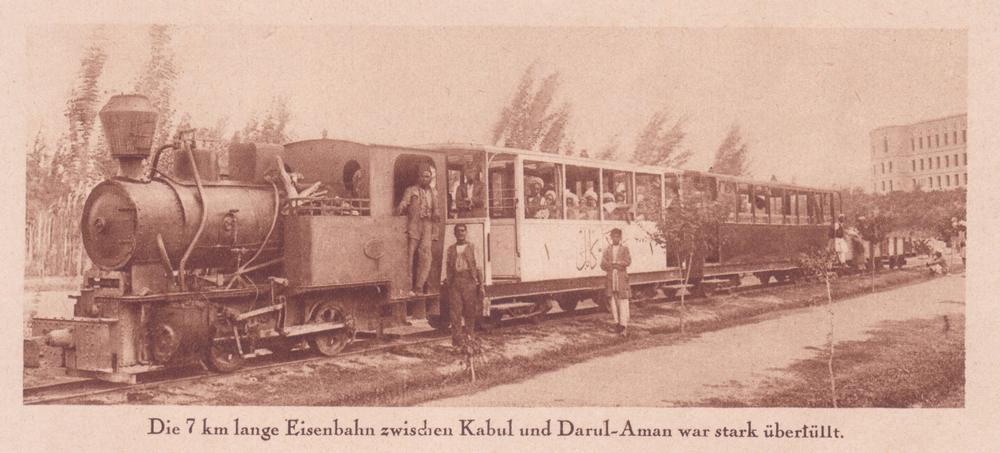
Photograph of the Kabul – Darulaman railway

Karlheinz Rohrwild has found this wonderful picture in the February 1930 issue of the German magazine “UHU”. The caption says The 7 km long railway between Kabul and Darul-Aman was very over-filled..

Train at Darulaman

I guess the building in the background is the palace at Darulaman. Werner Müller has put on-line some fascinating old photos of Afghanistan and Darulaman taken by his ancestor Wilhem Rieck in the 1920s, which are well worth a browse, even if you can’t read German.

The Kabul locos

Two photos of an Old loco in Afghanistan taken by Major Rob Fraser of the Oregon Army National Guard were posted on Trainorders on 6 December 2006 (thumbnails only – full pics requires a subscription). Accoring to the report, The builders plate says: Henschel & Sohn, G.m.b.H., Cassel, 1929, 12 ATM, Kessel No. 1968.. The two locos previously in the shed have previously been reported as 19680 and 19681 of 1923, so this could be the mysterious third loco (and perhaps the last digit of the number has become illegible)?

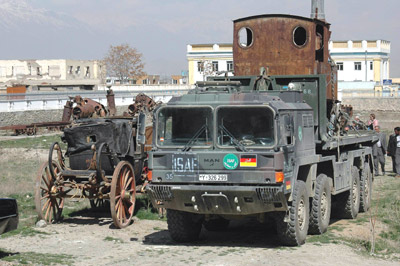
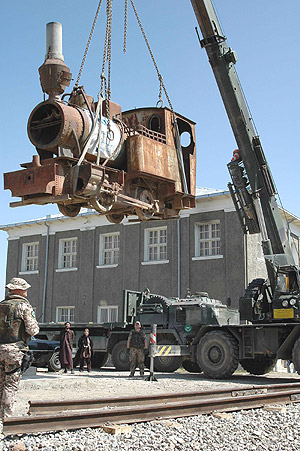
Crane lifts Afghan loco Afghan loco on truck The May 2007 Rail Passion magazine article is broadly similar to this April 2006 article from NATO: German ISAF Personnel relocate historical railway engine. I’ve borrowed ISAF’s photos of the loco being moved, and from the un-bent cab it looks to be the one in Major Fraser’s photos (above). Other reports suggest that one of the three locos is actually 2′ gauge, rather than the 2’6″ of the other two engines, so all three are unlikely to have worked on the same line (if anyone happens to be passing Darulaman and has a tape measure, it would be interesting if the gauges could be confirmed). Quite where it did work is still a bit of mystery, as until recently all reports only mentioned two locos at the museum site.

The locos can (just) be seen on this photo at Kabul guide.

Une vapeur Henschel

Steam locos in Darulaman, October 13 2004 (Photo: Wim Brummelman)

The May 2007 issue of French magazine Rail Passion (issue no.115, page 86) has a one-page article by Dimitri Beck about the plinthed steam locomotive at Kabul museum.

“Une vapeur Henschel devant le musée de Kaboul” has two photos, including a rather nice view showing German NATO soldiers putting one of the locos on a four-axle military lorry; moving the loco 200m to the museum for safe-keeping took about 3 hours.

There is a mention of Wim Brummelman, who sent me some photos of the three locomotives in the past.

Thanks to Thomas Kautzor for alerting me to it.

Khwaf to Herat rail link

IRNA reports Khwaf-Herat Railway To Connect Afghanistan To Pakistan

Afghan Foreign Minister Rangin Dadfar Spanta said on Sunday [=15 April 2007?] that the executive operations of Khwaf-Herat railway project, which is highly important to his country, started last year.

He made the remark at a press conference in Kabul during which he briefed the media on his last week’s three-day visit to Iran.

“Once this railway project is implemented, northern and southern parts of Afghanistan will be connected to Pakistan. Besides railway lines inside the country will also expand,” he said.

A press release of 27 May 2006 mentioned Iran’s President Ahmadinejad meeting wih Afghanistan’s President Karzai, when “seven agreements and memoranda of understanding on transfer of prisoners, extradition of criminals, promotion of investment, construction of the Khwaf-Herat railway as well as cooperation in cultural, judicial and economic fields are expected to be signed.”

Iran Daily had more details on 27 February 2007, and claims work has started:

Rail Link With Herat

KHWAF, Khorasan Razavi, Feb. 26. Construction of a railway line to link national railway network to the Afghan city of Herat began in a special ceremony here on Sunday.
Deputy head of Construction and Development Department of Railway, Airports and Ports at the Roads and Transportation Ministry told the Persian daily Qods that the railway line will extend a total length of 202 kilometers, adding that 77 kilometers of the route will be in Iran.
He said that in the year to March 2008, a plan will be undertaken to lay 125 kilometers of railway lines from the Iranian border to Herat. The railway line will start from Torbat Heidarieh Station and will be linked to the national railway via Mashhad-Bafq route. The Torbat Heidarieh-Bafq railway line which is around 12 kilometers was made operational with an average cost of four billion rials per kilometer.
The official further said the construction project of Iran-Afghanistan railway line within Iranian borders will be implemented by Nasr Institute, an affiliate to Khatamol Anbia Base, and the remaining section within Afghanistan will also be undertaken by an Iranian contractor.
The Iranian railway network stretches a total length of 8 300 km. The government has decided to modernize 5 600 km of the lines and also plans to lay out another 3 500 km of electrified railway lines. The objective is to transport 3.5 percent of the country’s total passenger and 8.5 percent of the total freight by rail. The government is interested in developing the East-West corridor.[More]
Light Railways magazine on Kabul line

I’ve just stumbled across a mention of a letter about the Kabul tramway in the April 2007 issue (no 194) of an Australian publication called Light Railways, which is produced by the Light Railway Research Society of Australia Inc. I’ve not seen a copy of this magazine – anyone know if it says anything interesting, and if it might be worth me ordering a copy?

Letters – […] Kabul tramway, Afghanistan

Maglev to Kandahar?

Well, maybe not. That would just be silly. But today’s Pakistan Times reports that President General Pervez Musharraf on Saturday [2007-03-03] called for fast development of the Pakistan Railways on modern lines to provide economical travel to the people, swift movement of goods and to create linkages with neighbouring countries.

He said the current target of increasing speed of trains up to 140 km/hour was not enough. “Today the world is moving on to magnetic levitation trains and monorails for mass transport, we need to go for these,” he added.

The President referring to his vision for the Pakistan Railways spoke of plans to link Chamman to Kandahar in Afghanistan and to build an ambitious rail track from Havelian to the Khunjerab Pass to connect with the Chinese mainline.

“Both the governments of Kyrgyzstan and Kazakhstan have expressed desire to join this rail link as it will provide them an access to the Gwadar Port,” he said.

Railway to Spin Boldak

Club-Feroviar reported at the end of January:

Pakistan Railways (PR) are ready for expanding and improving railway links with neighbours countries, Iran and Afghanistan, linking Chaman to Spin Boldak and Quetta to Taftan, according to the Minister of Railways, Sheikh Rashid Ahmed. The Minister said PR has made all necessary preparations for linking Chaman to Spin Boldak in Afghanistan and added it is waiting for the approval of Afghanistan’s President, Hamid Karzai. Railway links between Quetta and Taftan are also taken in consideration, the Minister going to leave next month in Iran for to discuss this project with Afghan officials.

Secret report

Dr Jack Schroder writes to me regarding “a secret British report had a planned RR from Jalalabad going up the Kabul River to Sarobi and then north up the Panshir River before crossing it near Baghram and then back south to Kabul.”

I think there might be copy in the British Library, a document which I didn’t get round to reading.  Unfotunately Dr Schroder forgot to include his e-mail address – so if he is reading, please can he get in touch again?

German ISAF Personnel relocate historical railway engine

Gag Halfrunt has spotted that NATO’s International Security Assistance Force website has an article dated 22 May 2006 about moving the steam loco. There are a couple of photos of the loco being moved, and three more in a PDF newsletter.

KABUL – Afghanistan. A joint venture between the Deutscher Entwicklungsdienst and the German Supply Company 2, has led to the staging of a major attraction at, or to be more precise, in front of, the Kabul National Museum. A major operation was conducted in order to assist soldiers from the recovery unit lift a historical locomotive from its resting place with the help of their crane and a heavy multi-purpose truck. The engine, which had been neglected in the museum’s backyard, is one of just three historical railway engines left in Afghanistan. Now, after 80 years, it has been granted a place of honour in front of the National Museum, directly opposite the Darulaman Palace.

For five years only, between 1923 and 1929, Afghanistan had its own railway. Three steam engines manufactured by Henschel, a German enterprise, travelled on a test track running from Kabul, southwest to the Darulaman Palace, located 7 km from Kabul, at that the time, the fare for a one-way ticket was one Afghani or 0.02 Euros. The project, however, was short-lived, As long as Afghanistan does not have enough weapons to ward off acts of aggression by the big powers (British Empire and the Tsar) it would be crazy to allow the construction of a railroad track leading into his country, Emir Abdul Rahman (1880 – 1901) stated. Still today, Afghanistan remains one of the few countries in the world without a railroad system.

The idea to put the best preserved locomotive on display in front of the museum’s entrance came from the Deutscher Entwicklungsdienst and with the help of the German supply company the 10-ton engine was moved 200 meters and placed on a track bed which had previously been raised by the recovery unit. In view of the considerable age of the engine, this procedure had to be executed with great care and the utmost precision by the crane specialists. Finally, after almost three hours of nail-biting work, First Lieutenant Boris Barchanski reported, “Locomotive in place, mission accomplished!”