“A dismal place with a railway yard”

An article in Dawn dated May 14, 2006 quotes M H A Beg visiting Central Asia to follow Babar‘s passage from the Amu Darya to Nilab:

Babar must have crossed the river Amu somewhere near Termiz. This is the famous crossing site of men and armies. The most famous in recent history being the Russian army of 1979 through the Bridge of Friendship, named in contrast to the act of invasion.

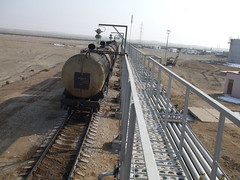
The bridge still stands. It is used by the trade traffic. Not only does it have a road but also a railway crossing from Uzbekistan to Afghanistan. To establish a station for unloading goods, they built a town named Hayratan, a dismal place with a railway yard and some houses belonging to the railway workers and army personnel. The town is so recent that it doesn’t even show on some of the older maps of Afghanistan. These days you cannot go on the bridge directly, but a guard will direct you to a place from where the bridge and Amu Darya are within sight.

The bridge is a steel construction, painted pale yellow on the top. Amu is a big river in the region, made famous in Arabic historical writings as the “Nehar”. Arab historians have given the area beyond a name so beautiful and descriptive, “Mavara-un-nehar”. The railway does not go beyond Hayratan. This is the only part of Afghanistan where there is a railway built by the invading Russians. It is their legacy.

Babar writes in his book that after crossing the Amu on a raft, he landed in Afghan Turkistan where he was greeted by vast flat grasslands.

Fuel Line Vol. 3, 2006 from Defense Energy Support has an article “Voruz Earns Bronze Star Thanks to Many Logistics Professionals”. This describes removing a vast quantity of fuel from a US base in Uzbekistan to one in Afghanistan in a hurry during 2005, by rail and lorry. There is a small photo of railway tracks at Hayratan.
Iran – Herat railway 40% finished

The railway line under construction to provide a link between the Iranian network and Herat in Afghanistan is progressing, according to Hamid Behbahani, Iran’s Deputy Minister of Roads & Transportation, in a report by the Fars news agency:

Railroad to Link Pakistan to Europe via Iran
15:14 | 2008-05-14

[…The Bam-Zahedan line is to be completed by March 2009, …]

The construction of the railroad between Khaf in northeastern Iran and Herrat in western Afghanistan is making progress, he said, adding 60 percent of the Iranian side and 40 percent of the Afghan’s side are completed.

Upon completion of the project, Afghanistan will have a railroad link to Europe via Iran, Behbahani said.

This line starts at Khaf in Iran, then heads slightly south and then east across the border through arid and rugged terrain., reported the January 2008 issue of Railway Gazette International. The new line will be 191 km long, of which 77 km is on the Iranian side of the border and 114 km within Afghanistan.

NATO’s Europe to Afghanistan rail plan under discussion

NATO is “Making progress on Afghanistan rail route”, according to a Eurasia Insight report dated May 5. It seems NATO is hoping to move freight between Europe and Afghanistan via the rail connection from Uzbekistan to Hayratan, across the Friendship Bridge.

NATO is striving to rapidly conclude a deal with Central Asian states on an inter-continental rail link that would ease the supply of non-lethal equipment and assistance for both military and reconstruction operations in Afghanistan.

The rail project is an outgrowth of NATO’s efforts to reinvigorate its Afghan operations. Discussions on how to improve Afghan reconstruction efforts featured prominently at the alliance’s early April summit in Bucharest. [see previous posting] …

At present, the cost of supplying NATO operations in Afghanistan is astronomical, due mainly to the fact that most supplies must be brought in by air. According to NATO estimates, airlifting supplies to Afghanistan costs a whopping $14,000 per ton, or roughly $7 per pound. In addition to the high cost, the air option may not be able to handle the requirements necessitated by an expansion of NATO forces in Afghanistan.

A Europe-Afghan rail link could cut supply costs to roughly $300-$500 per ton, allowing the bloc to both save tremendously on transportation and increase supply for its Afghanistan operations. The optimal route envisioned at this time would traverse Ukraine, Belarus, Russia, Kazakhstan and Uzbekistan. By all appearances, NATO has secured approval in principle from all the potential transit states.

… no new railroads are expected to be built at this point; the route will follow existing Soviet-era high-capacity tracks. … NATO indicated that if route proves reliable and efficient, the alliance will seek the permission of transit states to allow military equipment to travel over the railway. This option would necessitate closer cooperation between NATO and the Russia-led Collective Security Treaty Organization (CSTO), of which several transit states are members.

The full article has a lot of background to the political implications of allowing such traffic through the surrounding countries.

Other than the Europe-Afghan railway, there would seem to be no other viable options for the overland supply of Afghan reconstruction efforts.

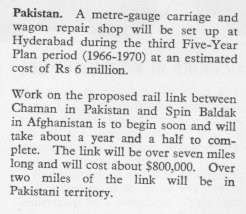
Chaman – Spin Boldak railway plans in the 1960s

Some old articles from Railway Gazette regarding a unrealised 1960s scheme for a rail link from the Pakistan Railways railhead at Chaman to Spin Boldak, a short distance across the border in Afghanistan.

Spin Boldak is a major border crossing point, and it seems that railway extension plans have been talked about every so often.

20 May 1966
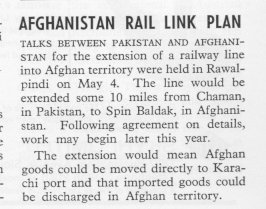
Talks between Afghanistan and Pakistan were held on May 4 1966 regarding building a railway to Spin Baldak. Short

2 September 1966
Construction to Spin Baldak “is to begin soon”.
Short

17 May 1968
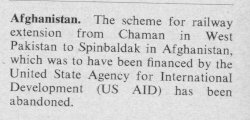
Bad news: the Spinbaldak scheme, which was to have been financed by the US Agency for International Development, has been abandoned.
Short

(clippings © Railway Gazette International)

NATO rail access to Afghanistan

The address by Uzbekistan’s President at the NATO Summit in Bucharest on April 3 2008 mentions rail access on the Uzbek Railways line to Afghanistan.

Islam Karimov, President of Uzbekistan Taking this opportunity, I would like to state that Uzbekistan stands ready to discuss and sign with NATO the Agreement on providing for corridor and transit through its territory to deliver the non-military cargos through the border junction Termez-Khayraton, practically the sole railway connection with Afghanistan.

At the same time, the sovereign interests on maintaining the security and legislation of our country must be observed.

The agreement on railway transit of Bundeswehr cargos through the territory of Uzbekistan signed by Uzbekistan with the German side on March 4 this year could be taken as basis for the future Agreement.

An agreement has also been reached “to allow the alliance to ship non-lethal freight across Russian territory to military forces in Afghanistan”

Afghan locos found in Austria

Simon Darvill has found four more industrial locos which were supplied to Afghanistan – and two of them survive in Europe.

Ruhrtaler seem to have delivered more locos to the same Mahipar project as the other Ruhrtalers. However these were delivered to Siemens-Bauunion GmbH, München. They were 3800 and 3812-4 of 1965. They were of the same G 60 O/V type, and 600 mm gauge.

The Siemens website describes Siemens-Bauunion.

Siemens-Bauunion GmbH was founded in 1921 as a subsidiary of Siemens & Halske AG and Siemens-Schuckertwerke GmbH. Previously the Siemens parent companies had contracted out the civil engineering works necessary for the building of power plants, tramways and subways to external companies, but because they worked with these companies they had their own experienced staff of civil engineers and building workers. In order to make better use of this potential and to be in a position to offer large-scale building projects from a single source, it was clear that the parent companies would have to have their own construction company. In the 1920s, Siemens-Bauunion was responsible for the building of numerous hydroelectric power plants and subways (Athens, Buenos Aires). Much of the motorway construction in the 1930s was also carried out by the Bauunion. In 1972 Siemens sold the company to Dyckerhoff & Widmann AG.

Loco 3800 went back to Austria and was used by a company called Bauhof AKB in Bludenz. It then went to Kärntner Museumsbahn as their number 284. It is now at the Montan- und Werksbahnmuseum in Graz, Austria.

Number 3814 also came back for use by Hochtief Bauunternehmung, on Frankfurt/Main’s U-Bahnbaustelle Bf Westend project [lines U6/U7?]. It was in use here by 1987, then went to the same two preservation sites, numbered 285.

There are details of the locos at Werkbahn.de (in German), which also mentions the Kabul steam locos. It seems the Montan- und Werksbahnmuseum (Mountain and Industrial Railway Museum) in Graz is not currently open to the public.

Anyone got an pictures of these locos?

The third loco identified

Simon Darvill has identified the “third” steam locomotive in Kabul. It is Henschel 19691 of 1923. The entry for it (and for 19680-1) is “Ferrostaal for Kabul-Darulaman, Afghanistan, British India”.

Meanwhile, a blogger in Kabul called Liz went to visit the Kabul museum last month, and provides links describing the revival of the museum. There is also a big photo of the plinthed loco in the snow.