Iran – Afghanistan – Uzbekistan discussions

Iran’s Fars news agency reports

Iran, Uzbekistan to Expand Railway Cooperation

News number: 8708080931 14:39 | 2008-10-29

TEHRAN (FNA)- Managing Director of the Islamic Republic Railways Hassan Ziari said in a meeting with his Uzbek counterpart that cooperation between the two countries will further expand in the field.

According to a report by the Public Relations Department of the entity, he referred to the significance of railway link between the two states and said that development of railway network between Iran, Afghanistan and Uzbekistan will facilitate Uzbekistan’s access to the Persian Gulf waters.

Rahmatov, for his part said that his country is keen to promote cooperation with Iran in the field, the Islamic republic news agency reported.

The two officials met on Tuesday to review development of railway cooperation.
Source: Fars
Afghan-Turkmenistan border photos

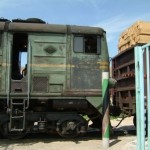
Train at the Afghanistan - Turkmenistan border

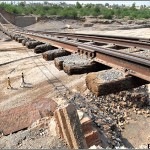
There are photographs of the railway across the Turkmenistan-Afghanistan border at www.wuestenfuchs.com, the website of Norbert Ratzke of Köln who was in Herat from January to April 2004.

The pictures show a 1520 mm gauge diesel loco (half of a 2ТЭ10Л?) crossing the border, and the freight yard at Towraghondi.

There is no railway transport in the country. At the Turkmen-Afghan border a Russian train runs about 500 meters on Afghan territory. There it is unloaded and returns to Turkmenistan.

In 2007 Turkmenistan launched a USD 550 000 programme to upgrade the line.

Herat line 60% complete, more railways planned

Quqnoos reports on the construction of the line from Iran to Herat.

Railway to Iran nears end of the tracks

Written by Zabiullah Jhanmal
Sunday, 19 October 2008 10:32

Ministry hopes to have the railway finished by the end of the year

A new railway linking Iran with the western Afghan city of Herat is 60% complete, the Ministry of Public Affairs said.

The Khawaf-Herat railway, built by the government of Iran, is expected to be completed by the end of the year.

The ministry said it planned to build more railway lines to meet the demand for transportation links between Afghanistan and its neighbours, who use Afghanistan as a transit route for goods travelling to other parts of the region.

The ministry says rail transport is five times cheaper than transporting goods by road.

But one kilometer of railway built in Afghanistan costs about $2 million, the ministry said, and a planned railway between Herat and Tajikistan will cost about $4 billion.

Deputy minister for public affaris, Ahmad Wali Rasooli, said: “After the completion of road constructions throughout the country, and with the increase of transported goods, we are now turning our attention to railroads.

“Now there is a real need for the construction of rail-roads in the country. We plan to connect our borders with our neighboring countries via rail.”

The ministry said the construction of railways between Afghansitan and its neighbours would speed up the flow of goods across the country’s borders.
Source: Quqnoos

China – Kabul rail plan in the Daily Telegraph

China extends influence into Central Asia, says a report about railway building in China by Malcolm Moore in the Daily Telegraph of 18 October 2008.

The move will connect Xinjiang to railway lines as far off as Moscow and Tehran and a direct route is also being planned through the Hindu Kush to Kabul. The lines will open Central Asia to Chinese goods and companies, and will serve as conduits for oil and petrol to be brought back. Source: Daily Telegraph 2008-10-18 (from the printed version – the online version has minor differences)

This Afghan line is presumbly related to the copper mine project. A schematic map in the printed version of the newspaper shows a railway continuing onwards from Kabul to Tehran. Other plans have suggested a line from the existing railhead at Hayratan to Herat, then to Iran over the line which is now under construction.

Routes from Afghanistan to China

There is a a letter in the August 2008 issue of Railway Gazette International from railway consultant David Brice, who has worked in Afghanistan providing advice on transport.

He considers the options for the railway planned to run from the Aynak copper mine to China via Dushanbe and Kashgar, concluding that standard gauge would be the best choice, and “the opportunity to avoid tedious gauge changes must not be passed up.”

Industrial Locomotives of South Asia website launched

Simon Darvill has undertaken extensive research into industrial locomotives in south Asia, and the results have been compiled into a new website, www.ilsa.org.in which is now live.

There are detailed records of industrial locos which have been used in India, Pakistan, Bangladesh, Afghanistan, Nepal, Sri Lanka, Burma and Bhutan (yes, really!) since the early 1850s.

Included in the section on railways used for military purposes in India up to 1947 are details of railways used for British overseas campaigns up until the end of World War I. This includes the campaign in Mespotamia (now Iraq).

Simon has supplied this site with details of locomotives in Afghanistan; his site also has an Afghan section.

China’s role in Afghan copper project

In ‘Just World News’, journalist Helena Cobban writes about China’s role in the Aynak copper mine project. The plans include a rail link to China.

China buys in to Iraqi, Afghan end-games

Posted by Helena Cobban at August 30, 2008 01:35 PM

If the Chinese really are also going to build a rail line that comes from western China, through Tajikstan, down through Afghanistan (including Aynak,) and through Pakistan to Karachi, then that is extremely significant.

I think the China-Tajikstan connector is already underway…

But the whole project, when completed, will have huge benefits:

  • for China, in its continuing drive to bring economic development to its far-west regions,
  • for Tajikstan and the other landlocked former-Soviet Stans, who have pretty good Soviet-era railway systems– but so far, most of them connect to the outside world only through Russia. This new connector would give them new outlets, to both China and the Arabian Sea.
  • for Pakistan, which gets access to a whole new hinterland and trading bloc there in Stanistan, and finally–
  • for Afghanistan, which gets its first ever long distance rail line– and one that connects, moreover, to such a lot of other interesting and potentially lucrative places. It also thereby gets a way to start exporting not just the massive amounts of copper said to exist in Aynak but all the rest of its currently barely scratched-at wealth of mineral resources.

Win-win-win all round, I’d say. And not just because I’m a committed ferrophile.

Read the full article at ‘Just World News’

Tajikistan to Iran via Afghanistan

According to Afghanistan’s Ministry of Foreign Affairs, an agreement is finalised this year for the construction of rail link from Tajikistan to Iran through Afghanistan, presumably using the Herat – Iran railway on which work is now underway.

Minister Spantas press conference in Kabul

30/08/2008 Dr. Rangin Dadfar Spanta the Minister of Foreign Affairs of the Islamic Republic of Afghanistan in a press conference here in Kabul […] talked about the recent trip of a high level Afghan delegation under the chairmanship of president Karzai to Tajikistan to take part in the summit of the shanghai cooperation group there.
[…]
In the sidelines of this summit the heads of states of Afghanistan, Iran and Tajikistan met to discus in details the issues of transit, and trade between the their countries.

In this meeting its was decided that till the end of the current year the text of the agreement in the bases of which the transfer of water and energy to Iran via Afghanistan, and also construction of a railway track from Tajikistan via Afghanistan to Iran that will link Tajikistan and Afghanistan to the Persian gulf will be completed, also the work between the experts of the these countries will soon start to establish a TV station, also honoring the birth anniversary of the famous Dari poet Abu Abdullah Rodake in Herat, and also celebrating the Nawroz festival in Mazar-i-sharif in the month of Hamal were discussed.

In a respond to a question that how Afghanistan can benefit from its transit role in this region? Dr. Spanta said, Afghanistan is a landlocked country we must search proper ways to find a solution for our problems and based on the principles of our government we don’t want to be limited in our ties in the region.