Afghan railways talk at Cambridge


On Friday 13 February 2009 I’m giving a talk to the Cambridge University Railway Club with the title A knife in the vitals: railways and the Great Game.

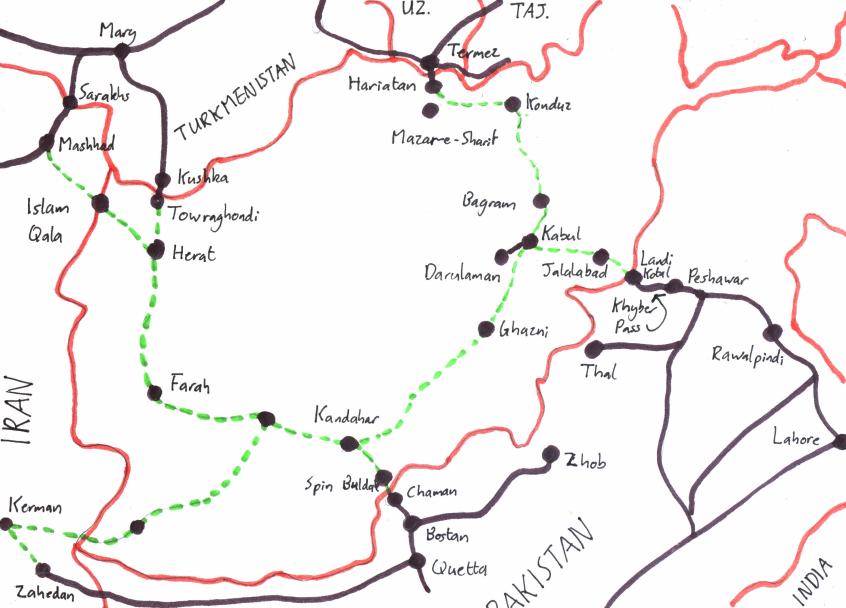
I’ll be looking at a general history of Afghanistan’s railways, and the various current projects for links to Iran, Pakistan and China.

Apparently it will be in the William Thatcher room at Fitzwilliam College, at 20:30. Non-members are welcome; the CURC attracts some big name speakers (and, erm, me), and you don’t have to be linked to the university to go along.

I guess I’d better start writing my script…

Andrew Grantham MA (Cantab)

Consultants wanted for ABD study of northern Afghan rail plan

Asian Development Bank is seeking consultants to look into the development of a freight and passenger rail network in northern Afghanistan. The route would link the existing line from Uzbekistan with Herat.

The Japan Special Fund is providing USD1.2 million for the eight-month study, with a tentative start date of 1 May 2009.

Afghanistan: Railway Development Program / Package T1: A team of experts is envisaged to be recruited

Closing date: 24-1-2009
Notice number: 42533-01
Abstract:Railway Development Program

The objective of the study is to respond to the Government of Afghanistan’s request to carry out studies of the possible railway linkage in the northern part of the country within approximately 1250 km corridor.
More specifically between the borders with Uzbekistan (at Hairatn) and Tajikstan (at Shirkhan Bendar) connecting with Herat in the West via Kunduz and Mazar e Sharif.

A team of experts is envisaged to be recruited to carry out issues-oriented studies and develop a commercial scenario for effective freight and passenger railway transport and provide the required output in a timely fashion.

The respective consultants will review the available studies undertaken in the respective areas, meet with the stakeholders and business people the requirements and discuss the prospects of the railway system for the transportation of passengers and freight operations in that part of the country.

The consultants will collect necessary data, carry out required field surveys and produce development program and plans.

Source: EVD

Kandahar rail plan revived Victorian idea

Afghanistan Railways: a dream coming true is an October 2004 article by S Azam Ali for the Pakistani newspaper Dawn. Availing of the second Afghan-British War, Russians stitched the great deserts of Central Asia with rail tracks. When the British came to know of the Russian success in the occupation of Marv in 1883, they reviewed and revived the Kandhar State Railway extension from Sibi to Quetta and Chaman.

A dream of the Kandhar Railway in the middle of the 19th century seems to be realized in the 21st century with the change of political scenario from the conflict to cooperation in this most sensitive region. This has become possible with practical move for the regional connectivity project to be undertaken jointly by Afghanistan and Pakistan for railway from Chaman (Pakistan) to Kandhar (Afghanistan) as one of the components of a compact and comprehensive rail road mega programme for 10-member countries in the ECO region.

Announcing a Rs3 billion package for Balochistan, through which the Pakistan Railways would penetrate into Afghanistan via Chaman-Kandhar rail route, Prime Minister Shaukat Aziz added that paper work on the track had been completed. Work on it would begin soon. It would usher in, a new era for economic cooperation between Pakistan, Afghanistan and eight other ECO-member countries in the field of train traffic for the region sprawling over an area of more than seven million sq kms.
[more]
Source: Dawn

NATO to Afghanistan through Kazakhstan

Following on from the recent Russian agreement to let Germany ship military equipment to Afghanistan by rail, other countries are reported to be getting in on the act.

Kazakhstan: US continues to probe rail route via central Asia to Afghanistan

American military officials are continuing to press for alternative transport routes to Afghanistan, with senior commanders exploring the feasibility of a rail route through the Caucasus and Central Asia.

According to a press release issued by Kazakhstan’s Ministry of Defense [here], Deputy Defense Minister Bulat Sembinov met with the commander of the US Transportation Command, Duncan McNabb, to look into “opportunities for organizing transit and providing material and technical assistance to the process of reconstruction and backing forces in Afghanistan.” Earlier in November, McNabb met with Azeri President Ilham Aliyev.

Separately, Kazakhstan’s transport minister, Serik Akhmetov, met Richard Hoagland, the US envoy in Astana, to discuss various transit ideas involving Afghanistan. The high level meetings in Astana follow on Russian permission to Germany to use the country’s extensive railway network to transit military goods bound for Afghanistan. It is the first time Russia has permitted a NATO ally to transit military supplies via an overland route.

A spokeswoman for NATO said the alliance was now actively pursuing agreements with Azerbaijan, Kazakhstan and Uzbekistan to gain access to Afghanistan.

Meanwhile, Uzbekistan, Afghanistan, and the Asian Development Bank (ADB) have signed a Memorandum of Understanding to expand trade and economic opportunities through railway transport. Zhao Xiaoyu, ADB Vice-President, said the agreement “will be taking a major step toward realizing the dream of expanded trade and economic opportunities for larger Central Asia.”

Source: Eurasianet, posted 27 November 2008
© Open Society Institute.

The Kazak Ministry of Defense’s website says:

Developing military cooperation

Today deputy minister of defense of the Republic of Kazakhstan general–lieutenant Bulat Sembinov met commander of Transport Command Staff of the USA (TRANSCOM USA) general Dunkan McNab in the defense office. During the meeting there were discussed perspectives of bilateral cooperation possibilities of transit organization, rendering material and technical assistance to the process of reconstruction and support of forces and means in Afghanistan in particularly.

USA TRANSCOM – is the one detachment which manages all the aviation, land and sea transport of the Ministry of defense of the USA. And Kazakhstan is the one state in the region which has 5 year cooperation Plan with the USA between defense offices which includes such important directions of cooperation as development f peacekeeping potential of the Armed Forces RK, improvement of Kazakhstan military education system and mutual participation in exercises.

[more]
Source: Ministry of Defense, Kazakhstan, 21 November 2008

Russia allows arms to Afghanistan by rail

The Russian government has decided to permit the German military to ship arms and military hardware by rail through Russia to the International Security Assistance Force in Afghanistan. Previous transit agreements only covered non-lethal cargo.

20-11-2008
Response by Russian MFA Spokesman Andrei Nesterenko to a Media Question Relating to Ground Transit through Russian Territory of Bundeswehr Military Cargoes to Afghanistan

Question: Has the present crisis in Russian-NATO relations affected the agreements concluded by Russia with individual member countries of the alliance regarding transit through Russian territory of military cargoes for the needs of the NATO-led International Security Assistance Force (ISAF) in Afghanistan?

Answer: The Russian side, including at the highest political level, has reaffirmed its interest in continuing and increasing cooperation with the alliance in the Afghan sector. This also concerns the fulfillment of the obligations under the transit agreements concluded with Germany, France and other partner countries acting as suppliers of troops for the International Security Assistance Force in Afghanistan.

During the 10th round of Russian-German Interstate Consultations at summit level (St. Petersburg, October 2, 2008), the President of Russia and the FRG Chancellor gave a high assessment of the practical interaction experience accumulated in a bilateral format with regard to Afghanistan, and spoke for expanding it. In particular, it was about launching in addition to the functioning air bridge of supply for the German ISAF contingent the railway transit of Bundeswehr military cargoes to Afghanistan, which is also provided for in the 2003-2004 bilateral intergovernmental agreements currently in force.

By way of the realization of the political decision adopted at the summit, the Federal Customs Service on November 10 issued a general permit to carry out in accordance with a request from the FRG Government railway transit through Russian territory of Bundeswehr arms and military hardware and equipment to Afghanistan. This will be the first experiment of this kind in Russian relations with foreign states, taking into account close cooperation with Germany in the field of combating the common security challenges and threats.
Source Ministry of Foreign Affairs of Russia website

Hayratan – Herat railway memorandum signed

Uzbek Railways TEM2 loco at Hayratan (photo: David Brice)

Asian Development Bank announces that a memorandum has been signed highlighting the importance of developing a railway line to Mazar-i-Sharif and Herat from the current Uzbekistan railways railhead at Hairatan. The Afghan government has requested technical and financial assistance from ADB for a pre-feasibility study.

It was recently reported by Der Spiegel that the German military is allegedly interested in building a long-planned railway extension from Hayratan to Mazar-i-Sharif. Meanwhile, Herat will be the terminus of a line currently being built from Iran, offering the possibility of an Uzbekistan to Iran route; Uzbekistan and Iran also recently signed co-operation agreements.

In the past railway proposals for Afghanistan seem to have focused on the south of the country, with international lines to Pakistan, but current plans seem to be oriented north and west.

The gauge question will presumably rear its head with any Uzbekistan – Iran link, as the Iranian line will be standard gauge (1435 mm), but the existing line from Uzbekistan to Hayratan is 1520 mm broad gauge. Putting the break-of-gauge in Herat could be the obvious answer?

Uzbekistan and Afghanistan have also agreed Rules for Passenger Transport & Freight Accounts for the Uzbekistan-Afghanistan Railway. The reference to passengers is interesting, as I’ve not heard of Afghanistan having a passenger service since the demise of the Kabul to Darulaman steam line. Perhaps cross-border passenger services are planned – or maybe it is just a formallity, and they thought they may as well include passengers when working out the details of freight transport?

Afghanistan, Uzbekistan and ADB Sign Memorandum of Understanding for Railway Transport Cooperation

BAKU, AZERBAIJAN – Uzbekistan, Afghanistan, and the Asian Development Bank (ADB) have signed a Memorandum of Understanding (MOU) to expand trade and economic opportunities through railway transport.

The MOU, signed on the eve of the Seventh annual Central Asia Regional Economic Cooperation (CAREC) Ministers’ Conference in the Azerbaijan capital, recognizes the potential for growth in railway freight traffic, including transit freight traffic, between Uzbekistan and Afghanistan.

“With the MOU, we will be taking a major step toward realizing the dream of expanded trade and economic opportunities for larger Central Asia,” said Mr Zhao Xiaoyu, ADB Vice-President (Operations 2). Afghanistan Minister of Finance, Dr Anwar-Ul-Haq Ahady and Uzbekistan Minister for Foreign Economic Relations, Investment and Trade, Mr Elyor Ganiev signed on behalf of their governments.

With the MOU, the Afghanistan Government underlined the importance of developing a railway line between the Afghan cities of Hairatan which borders Uzbekistan through Mazar-e-Sharif and Herat. The Afghanistan Government has requested technical and financial assistance from ADB in order to prepare a pre-feasibility study for the proposed railway project. Uzbekistan will give its full cooperation in the conduct of the study.

A Project Working Group, comprising representatives from both countries will supervise the study and explore other regional cooperation initiatives between Uzbekistan and Afghanistan in the field of transport and trade facilitation.

Transport sector development is vital for sustained growth and poverty reduction in this landlocked region and railways are a critical part of the transport sector in the region.

In support of the initiative, Uzbekistan and Afghanistan recently signed the Uzbekistan-Afghanistan Boundary Railway Agreement; the Freight Transportation Rules for the Uzbekistan-Afghanistan Railway; and Rules for Passenger Transport and Freight Accounts for the Uzbekistan-Afghanistan Railway.

The Asian Development Bank is a multilateral development bank, owned by 67 member countries. ADB’s main instruments for developing its member countries are policy dialogue, loans, equity investments, guarantees, grants and technical assistance. This year ADB adopted Strategy 2020, a long-term strategic framework that follows three complementary strategic agendas: inclusive growth, environmentally sustainable growth, and regional integration.

Further information about the ADB and CAREC can be found at http://www.adb.org/carec

Source: Asian Development Bank news release 20 November 2008

Developing Afghanistan – Uzbekistan transport links

A press release from Uzbekistan’s Ministry of Foreign Affairs detailing reconstruction efforts in Afghanistan, including the development of rail and other transport links via the Friendship Bridge and Hayratan.

At the end it gives a few more details of the official visit to Uzbekistan by an Afghan delegation back in August.

On participation of the Republic of Uzbekistan in post-war reconstruction of Afghanistan

27.10.2008 19:46 Press-Release

On participation of the Republic of Uzbekistan in post-war reconstruction of Afghanistan

Uzbekistan is taking an active part in efforts of international community aimed at enhancing stability and thorough development of Afghanistan, and attaches a significant importance to friendly and good neighborly relations with this country. It is conditioned not only by common borders but also by mutual interest of cooperation in the name of ensuring peace, stability and progress in the region.

In December 2002, the Government of Uzbekistan with a view to ensure effective provision of aid rendered by the world community to Afghanistan, adopted a resolution on opening the Hayraton bridge at the Uzbek-Afghan border. In November 2003, Ayritom customs complex started operating in Termez city.

On the outcomes of 2007, the volume of humanitarian cargo going via Ayritom check-point accounted for 1.2 million tons.

Upon the request of Afghan Government, Uzbekistan constructed 11 bridges between the cities of Mazari-Sharif and Kabul. These communication facilities have ensured uninterrupted link between the North and East of the country at the initial stage of economic reconstruction of Islamic Republic of Afghanistan.

Power supply to Afghanistan was restored at the beginning of 2002. In 2007 Uzbekistan exported 20 megawatt of electricity to Afghanistan. Following commissioning of Hayraton – Puli Humri– Kabul power line the volume of power supply to Afghanistan can be increased at the initial stage up to 150 megawatt and eventually up to 300 megawatt.

In June last year the Protocol of Negotiations between Uzbekenergo State Joint-Stock Company and the Ministry for Energy and Water Resources of Afghanistan was signed. The document has defined concrete directions of cooperation for increasing the volumes of power supply to Afghanistan up to 300 megawatt.

In June 2007, the first session of Uzbek-Afghan Intergovernmental commission for trade and economic cooperation was held as a part of the efforts of both sides aimed at extending the scope of bilateral cooperation.

Uzbekistan is rendering all possible assistance to Afghanistan in restoring its national economic system. Particularly, Uzbekistan has been supplying to Afghanistan fuel, construction materials, metal-roll, fertilizers, foodstuff, etc.

The volume of trade between countries is steadily increasing. In 2006 it accounted for USD 163.7 million, including exports – USD 161.7 million and imports – USD 2.0 million.

In 2007 the trade totaled USD 332.3 million, including exports – USD 331.4 million and imports USD 0.9 million.

Currently, 122 companies with participation of Afghan business people are operating in Uzbekistan, of them 39 have been established at the expense of 100% foreign capital.

Uzbekistan and Afghanistan have established quite active political dialogue. For over the last two years the first Vice-President of Afghanistan, Chairman of Senate, Minister of Foreign Affairs, Minister of Energy, Minister of Trade, as well as the Adviser to President of Afghanistan for national security visited Uzbekistan.

In 2008 the Afghan delegation led by Minister of Energy and Water Economy of Afghanistan visited Uzbekistan twice.

The sides have discussed construction of 200 kilovolt-capacity, 43-km-long power line starting from Surkhan (Surkhandarya Province) substation to Hayraton (Afghanistan).

Construction works shall be carried out by the Uzbek side.

On August 26-27 this year the first round of talks between the delegations of two countries was held in Tashkent. The prospects of Uzbek-Afghan cooperation on constructing Hayraton-Mazari-Sharif railroad have been discussed in the course of the meeting.
Source: Ministry of Foreign Affairs, Uzbekistan

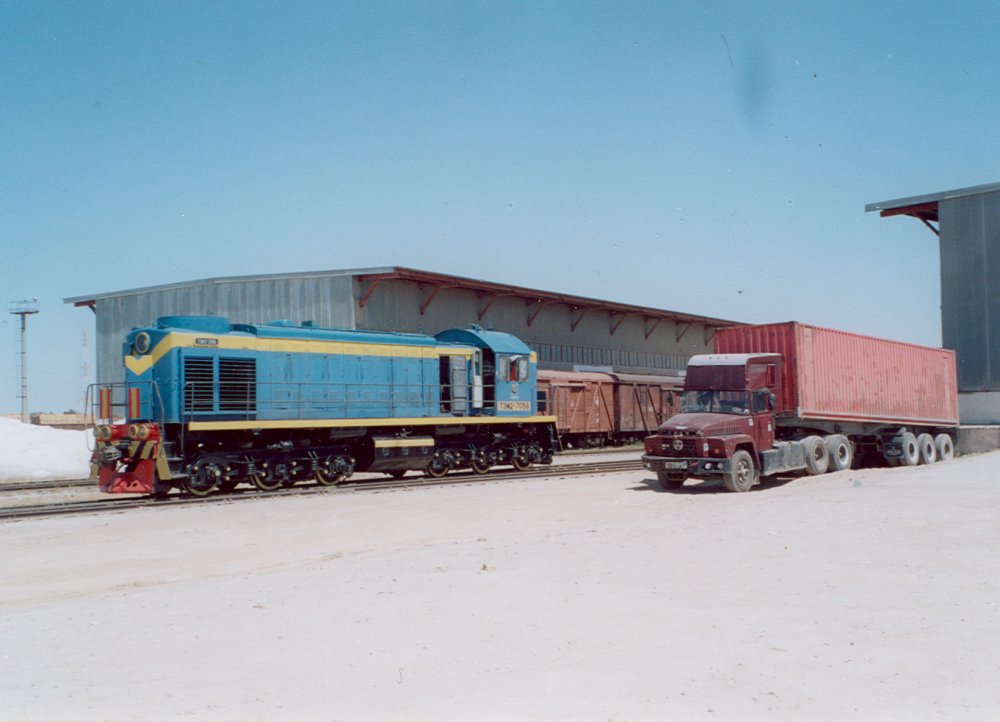
Locomotive at Towraghondi

A photograph captioned Rail Port in Turghundai Border with Turkmenistan from the Afghanistan Customs Department.

The diesel locomotive – a TEM2? – presumably belongs to Turkmen Railways.

The cross-border line from Serhetabat (Серхетабат, and formerly known as Gushgy) was built in the early 1980s – does anyone know more precisely when? It was rehabilitated in 2007 at a cost of USD550 000.

Uzbek and Iranian railways’ Afghanistan plans

The website of Uzbek national railway UTY has a news story about the recent agreement with Islamic Republic of Iran Railways. Google’s translation from Russian gives:

30-10-2008 October 28, TG

Tehran had a meeting and talks executive director of Iranian railways, Hassan Ziyari with the chairman of the board GAZHK Uzbekistan Temir YULLARI Achilbaem Ramatovym.

At the meeting the parties focused on specific issues expand bilateral cooperation in rail transport. In particular, the parties agreed on the establishment of private transport companies, which will transit rail transport, and joint investments in rail transport corridor project, which will link the railways of Iran and Uzbekistan through Afghanistan.
Source: UTY

Iran’s Press TV gives more details:

Iran, Uzbekistan sign railway pact

Thu, 30 Oct 2008 23:30:25 GMT

Iran and Uzbekistan have signed a nine-article cooperation pact on railway cooperation after holding a two-day meeting in Tehran.

The agreement was finalized between the managing directors of the national railway companies of Iran and Uzbekistan Thursday.

The pact includes initiating a container train transit route between Almaty, Tashkent, and Istanbul, launching a container train route between Tashkent and Bandar Abbas, a 25 percent discount to be granted to Iran for using Uzbek carriages, the passage of Iranian railroad cars through the Uzbek network and settling outstanding accounts between Iran-Uzbekistan railways

[…]

“Establishing private transit transportation companies and joint investments in launching railway networks among Iran, Afghanistan, and Uzbekistan will allow Uzbekistan access to the Persian Gulf waterway,” Ziyari added.

[…]

Read in full at Press TV

While looking for more information, I came across Helmut Uttenthaler’s Trains in Uzbekistan blog.