China’s interest in Pakistan rail links

In an article at Asia Times Online, Syed Fazl-e-Haider writes about co-operation between China and Pakistan, including plans to extend the Khyber Pass line and build the Spin Boldak line. There is also discussion of a direct China – Pakistan railway.

Chinese shun Pakistan exodus


China has also shown interest in early laying a track between the Pakistan border town of Torkham and Jalalabad in Afghanistan, as the Chinese want to use the Pakistan Railways network to transport their goods and equipment for the development of copper mines and various other projects in Afghanistan. Separately, Pakistan Railways has completed a feasibility study for a rail section between Chaman, in Balochistan, and Kandahar in Afghanistan that is part of a proposed link across Afghanistan to Turkmenistan.
Source: Asia Times Online, 2009-09-11

€3bn needed for Herat – Mazar-i-Sharif railway

ECO Urged to Invest in Iran-Afghanistan Railway Project

TEHRAN (FNA)- Iranian Minister of Road and Transportation Hamid Behbahani called on the Economic Cooperation Organization (ECO) to provide Afghanistan with 3 billion Euros in credit to accomplish a railway project linking the country to Iran.

“To finish Iran-Afghanistan railway project, ECO is needed to provide 3 billion Euros in credit for the construction of a 1,250 km-long railway segment between Herat and Mazar-e-Sharif (in Afghanistan),” Behbahani said in a ceremony to mark the arrival in Tehran of the first freight train ferrying cargo from Islamabad to Istanbul via Tehran.
[more]

Source: Fars News Agency 2009-08-23

Pakistan – Iran – Turkey container train

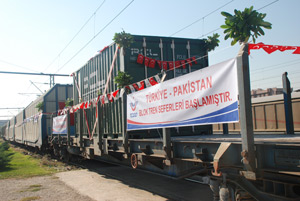
The demonstration Islamabad – Zahedan – Istanbul train started its journey from Pakistan on 14 August 2009.

ECO train

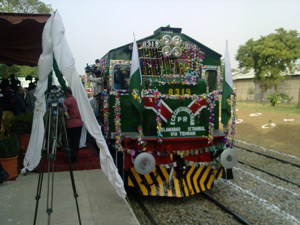
There are more details of the service (in Turkish) on the TCDD website. The photo is of a Pakistan Railways broad-gauge train. The containers are transhipped between gauges at Zahedan in Iran.

TCDD says the journey is 6566 km – other sources say about 6500 km with 1 900 km in Pakistan, 2 570 km in Iran and 2 036 km in Turkey – and the plan is to carry textile products, cotton, medical hand tools(?), toys, games and sporting goods westbound, with machinery and parts, chemical products, paper and paper products, cars spares and agricultural tools going eastbound.

According to PakTribune the journey “will take 15 days from Pakistan’s federal capital to the Turkish capital”, compared to “40-45 days from Karachi to a Turkish port” (do they really mean the Turkish capital, which is Ankara, or do they actually mean Istanbul, which people often mistakenly think is the capital?).

There is also a suggestion that Pakistan may join OTIF, which provides a common legal framework for international rail operations.

According to Iran’s Islamic Republic News Agency, regular services are expected to begin next year.

There are details of the background to the train in an article by Mohammad Mirzaei Kahagh, Director Transport & Communications at ECO, in the May 2009 issue of ECO Times. Despite the photos used in ECO Times, I don’t think Norfolk Southern or Norway’s Flåm railway are involved in the project!

Update: Barrie Hughes of the Welsh Highland Railway construction website has spotted that the tracklaying picture in the ECO Times article shows Cae Pawb mixed gauge crossing on the WHR/Cambrian Coast line in Porthmadog, Wales!

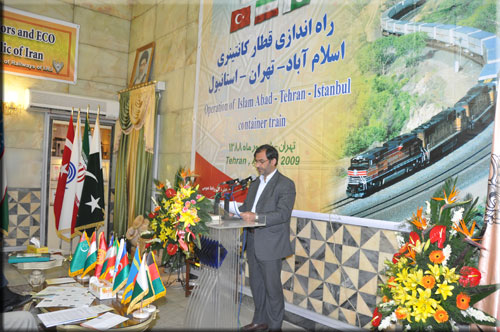
Update: The train reached Tehran on 23 AugustIran Daily has a photo of it. Director of Iran’s Railway Company Hassan Ziyari said the railroad is safer and more environmental friendly compared to the roadways and other transport modes. The duration of the entire journey can be reduced to 12 days in the future, he added, and voiced Iran’s preparedness for cooperating in new plans to expand rail networks of ECO members. ECO train event in Tehran

Update: It got to Turkey on 25 AugustFirst train on Islamabad-Tehran-Istanbul railway arrives in Turkey

Update: It arrived at Haydarpasa station, Istanbul’s Asian station, on 28 August.

Medvedev backs rail projects

A Reuters report saying Russia’s President Medvedev backs Afghan railway projects.

Russia aims to spur Afghan region economy, win aid

By Roman Kozhevnikov and Anastasia Onegina

DUSHANBE, July 30 (Reuters) – Russian President Dmitry Medvedev on Thursday brought together the leaders of Afghanistan, Pakistan and their neighbour Tajikistan to try and spur regional economic recovery and attract huge aid flows.

“We have a common space, which should be filled with all sorts of projects,” Medvedev said in the Tajik capital after meeting with Afghan President Hamid Karzai and Pakistani President Asif Ali Zardari.

“We were talking about energy projects, railway projects,” he told a news conference after talks also attended by Tajik President Imomali Rakhmon.

Source: Reuters 2009-07-30

Good railways but lousy boundaries

This is a border with no boundaries, boasting a frontier town with no frontier, said Jason Burke in describing the Pakistan-Afghanistan border at Chaman in an article in The Independent published on 21 January 1999: Frontline: Chaman, Pakistan-Afghan frontier – Legacy of the Raj: fine railways and lousy borders.

Even the home secretary in Quetta – the second-most senior civil servant in the province – admits the frontier, effectively created as the western boundary of British India, is a farce: “It is an imaginary border. You Britishers built us good railways but gave us some lousy boundaries.”

An Agenda Beyond the Elections

UN envoy: Afghanistan in 2009 – A turning point? is an article By Kai Eide, Special Representative of the UN Secretary-General for Afghanistan, which appeared in the Estonian newspaper “Postimees” and was republished at ReliefWeb.

An Agenda Beyond the Elections


Over the coming months, we will also have to build on initial progress achieved in the areas of regional cooperation and infrastructure development. The potential for regional cooperation goes way beyond the security sector. Trade, natural resources, energy and water management can bring Afghanistan and its neighbors together in a mutually beneficial way. Investment in key infrastructure programmes, including electricity lines and railway networks, could turn Afghanistan into a corridor for regional economic activities and provide the critical elements for Afghanistan’s own economic development. In those areas, we must be much more ambitious and broaden our perspective beyond the immediate geographical boundaries of Afghanistan itself.
Source: ReliefWeb 2009-08-01

Mazar-i-Sharif railway work to start by end of year

A report from a Chinese news agency saying work is to start imminently on extending the Uzbekistan – Hayratan railway line by 60 km to Mazar-i-Sharif.

Unfortunately the website of the Ministry for Commerce and Industries is “under maintenance” so I can’t check the source. The Rah-e-Nejat also has a website, but I can’t find the story using Google translate.

In the past there have been reports claiming that the German military is keen to see this line built, for bringing in supplies to German forces in Afghanistan. Presumably the line would be built to 1520 mm gauge, for compatability with the Uzbek rail network.

Construction of first railway in Afghanistan to begin within 4 months

KABUL, Aug. 13 (Xinhua) — Work for the construction of first Afghan railway to begin within the next four months, a local newspaper reported Thursday.

The essential project, costing 120 million U.S. dollars, would connect Uzbekistan to Mazar-e-Sharif city in north Afghanistan, the daily Rah-e-Nejat quoted a press release of Ministry for Commerce and Industries as reporting.

Afghanistan’s border town Hairatan is connected with Uzbekistan and the work for 60 km railway would begin from Hairatan possibly in this December, the newspaper further said.

A technical team from Uzbekistan would soon visit Afghanistan in connection with the project which is financed by the Asian Development Bank, the newspaper added.
Source: Xinhua 2009-08-14

(thanks to Michael G Erickson for spotting this)

Planning a Chaman – Kandahar route

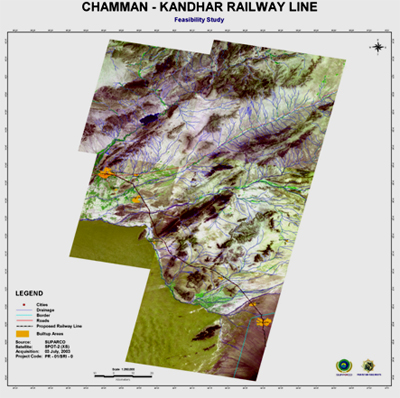
Pakistan Space & Upper Atmosphere Research Commission has used satellite images for Route Selection for Chaman Kandhar Railway Line. The client was Pakistan Railways, but unfortunately there is no date.

Satellite image of proposed route for Chaman to Kandahar railway

Scope of Work:

  • To locate feasible route from Chamman, Pakistan to Kandhar, Afghanistan. The route had been marked on the satellite image
  • Processing of satellite data. Geo-referencing. Digitization of SRS data for Chamman-Kandhar Railways Route Location and alignment

Chaman – Spin Boldak railway progress at last?

Various recent news reports, when taken together, imply that there could be some progress with the plans for a rail link from Pakistan to Spin Boldak.

This would be a 10-15 km extension of the Pakistan Railways line which currently terminates at Chaman, just short of the Afghan border.

On the other hand, it might just be talk. Does anyone know anything hard about what might be happening?

Building this long-proposed extension would seem to make sense. A line from Chaman to Spin Boldak would just be a cross-border extension of Pakistan Railways’ 1676 mm gauge rail network to the first settlement on the Afghan side of the border.

It would be comparable to the lines to Hayratan and Towraghondi in the north of Afghanistan, which are simply cross-border extensions of the Uzbek and Turkmen railway networks. Customs formalities and the like could be completed with Afghanistan, rather than Pakistan.


View Chaman – Spin Boldak railway in a larger map

Pakistan has helped Kabul to construct Chaman-Kandahar Rail Link claims a 1 August 2009 report by NN Khattak in The Frontier Post.

Blame game must end


Pakistan is doing its best within its resources to help Afghanistan in its rebuilding efforts. Both countries agreed to cooperate on a pipeline project that would transport energy from Central Asia via Afghanistan into Pakistan. There is also talk of running a railroad through Afghanistan that would connect the republics of Central Asia with Pakistan and, through Pakistan’s ports, to overseas markets. Similarly, there are ongoing discussions about bus links between Afghanistan and Pakistan.

Pakistan has constructed 75km long Torkham-Jalalabad Road and internal roads in Jalalabad to promote Afghanistan’s economy and trade. To bring the people of both countries closer, Pakistan has helped Kabul to construct Chaman-Kandahar Rail Link. This will help the people of Afghanistan to enter a new phase of industrialisation and development. Pakistan has provided 100 buses to Afghanistan to promote people-to-people contacts. The bus service between the cities of Pakistan and Afghanistan would enhance the cooperation between the people of both countries.

Source: The Frontier Post, 2009-08-01

Then there is this:

Pakistan turns to China to modernise railways

ISLAMABAD: Pakistan and China have agreed to cooperate for modernization of Pakistan Railways network, DawnNews quoted Railways Minister Haji Ghulam Ahmed Bilour as saying.

Bilour said that Pakistan Railways wanted to strengthen and expand the Torkham railway line [Khyber Pass] to meet the international standard, Quetta-Chaman-Kandahar section [Chaman – Kandahar doesn’t yet exist], Quetta-Iran [presumably the Zahedan route], and Quetta-Peshawar railway link via Zhob- D I Khan-Bakhar.

The railways minister said that Chinese side emphasized the need for early laying of Torkham-Jalalabad railway track [an extension of the Khyber Pass line] as they wanted to connect this section with Afghanistan so that they could use the Pakistan Railways network to transport their goods and equipment for the development of copper mines and various other projects launched in Afghanistan.

Source: Dawn, 2009-07-28

A line from Chaman across the border to Spin Boldak has been discussed for a very long time, with Britain contemplating building a line on to Kandahar in the nineteenth century. A line from Quetta to New Chaman opened by 1891, running 5 km beyond Chaman fort to terminate within 200 m of the frontier. This railway did not enter Afghanistan as such – the 1893 Durrand line was drawn around it – but rumour had it that track materials were stockpiled in case a military emergency required the rapid construction of a line over the border.

Proposals for the extension have resurfaced every so often, including in 1966, when Railway Gazette reported “Work on the proposed rail link between Chaman in Pakistan and Spin Baldak in Afghanistan is to begin soon and will take about a year and a half to complete. The link will be over seven miles long and will cost about $800 000. Over two miles of the link will be in Pakistani territory.”

This was to have been funded by the US Agency for International Development, but was canceled in 1968. Despite this, the line is actually shown on some maps.

The scheme has been discussed many times since, with studies in 2004 and 2007. In May 2009 the government of Pakistan said preliminary work had begun.

Maybe something is finally happening? ISAF is in need of a reliable transport route to Afghanistan, and perhaps has been the spur to action which has been needed?

In the longer term and given a suitable political climate, a Chaman – Spin Boldak line could be extended onwards a further 80-100 km from Spin Boldak to the city of Kandahar. This would be a significant destination in its own right, rather than just a border town. And from Kandahar, we can look at the map and dream of taking the permanent way onwards towards Herat, and thus Iran. And maybe one day Central Asia…
ISAF transit cargo

From the July 2009 Russian Railways e-mail newsletter, sent out on 5 August 2009.

RZD specialists took part in the interdepartmental meeting concerning the issues of transit of cargos meant for International Security Assistance Forces in Afghanistan. An exchange of opinions on the procedure of the cargo transit to Afghanistan took place.