Bulgarian narrow gauge

The Septemvri – Dobrinishte railway

Bulgaria’s last remaining narrow gauge line takes passengers on a five-hour journey through an highly atmospheric corner of the Balkans. In June 2006 I went for the ride.
Bulgarian narrow-gauge train

Lineside mosque

THE HOLY GRAIL of European travel seems to be the ‘new Prague’, as short break travellers seek the next ‘undiscovered’ city before Eire O’flot fills its streets with stag nights and the sort of Britons who inspire the rest of us to let people think we are from somewhere, anywhere, else.

Sofia isn’t it. However ancient a church is, once it is submerged in a roundabout it loses its appeal. Moving the national museum from the city centre to somewhere on the far side of the local equivalent of the M25 was a brave move, equalled only by the bravery of the people who try to cross the road to reach it.

In the woods

A much better reason to visit Bulgaria is the country’s last surviving narrow gauge railway, a 125 km line between Septemvri and Dobrinishte in the southwest of the country which take passengers on an attractive 5½ hour journey through the Rhodope and Pirin mountain ranges.

The obvious place to start a visit to the line is Plovdiv, a city which was already old when it was trashed by Alexander the Great’s dad in 342 BC, before he modestly re-named it after himself. You can still clamber over ancient ruins in the UNESCO-listed old town to get a fine view over the city’s Ottoman mosques and communist concrete, and six of its original seven hills (one was getting in the way, so they removed it).
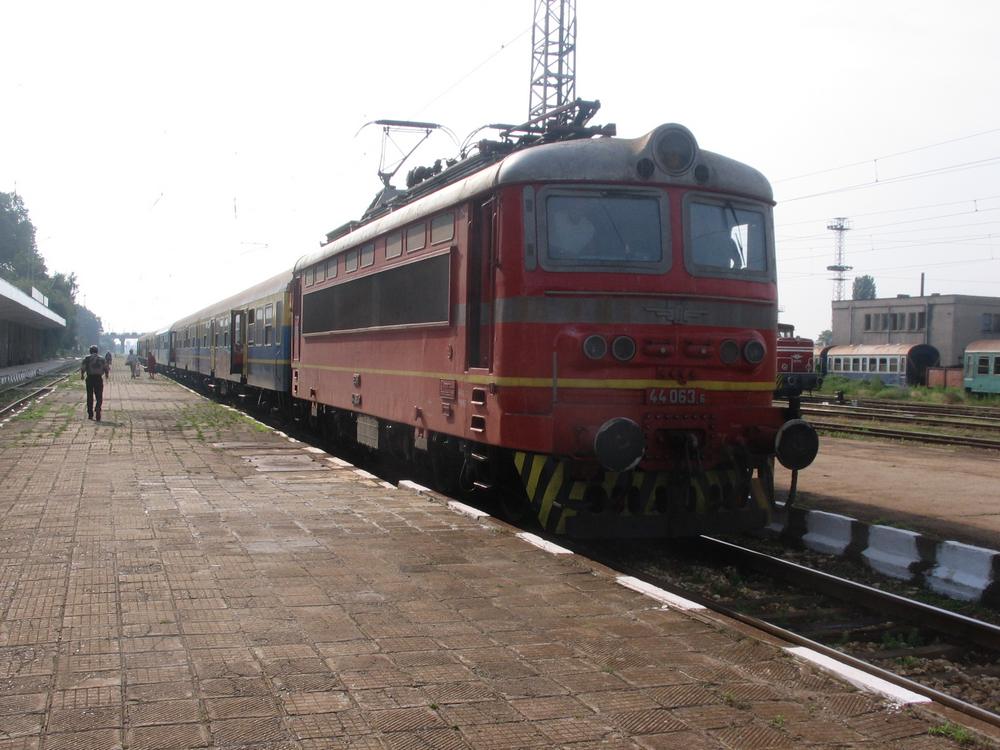
Plovdiv to Sofia train

Bulgaria seems to be where German trains go to die, and the 08:15 departure from Plovdiv was no exception, still adorned with signs still telling us what was Verboten while the train was stopped in the Bahnhof.

Ties to Germany stretch back to the construction of the railway, which was undertaken by German financier Baron Hirsch under a concession agreement with the Ottoman empire. The line between Plovidiv and Septemvri opened in 1872, as part of a railway from Constantinople to Belovo built under a scheme to link the capitals of the Ottoman and Austro-Hungarian empires “not only in support of their imperialistic strivings, but also a factor for political consolidation against Russia”i. It was subsequently extended to Sofia and on to the Austro-Hungarian empire at Tsaribrod (now Dimitrovgrad in Serbia) from 12 August 1888, with the opening of this first line built after Bulgaria’s liberation from the Turks been seen as the birth of Bulgarian State Railways.

Septemvri boasts a large station building, and a café selling substantial spicy sausages with bread and dark beer which proved useful on our return the next day. Narrow gauge trains leave from an island platform, and, as ever, the tourists are easy to identify as they are to only people who bother to penetrate the Stygian depths of the subway to cross the main line. The narrow gauge station is pretty basic, with some staff accommodation and a dark room which passed as the loo – completely unlit, but that’s probably for the best.
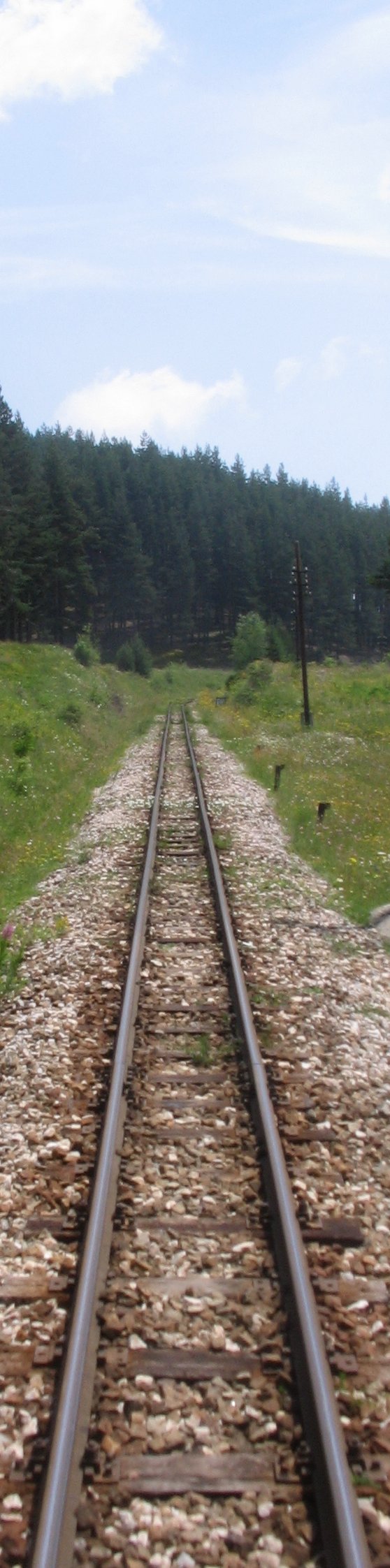
Tracks

Railways had come late to Bulgaria, and the initial 39 km of the narrow gauge line from Septemvri as far as Velingrad has just completed its 80th year, having opened in 1926. Construction began five years before, the relatively late construction start reflecting the historic lack of development in Bulgaria, a shortage of funds and the difficult terrain. Further complications came from the convoluted conflicts and border changes that the Balkans are infamous for, with the full area of the line only brought into the country during the First Balkan War in 1912, and further adjustments following the financially-damaging defeat in World War I. During the global conflict various 600 mm gauge lines had been built with German equipment to support the campaignsii, demonstrating the potential for reaching the parts other railways couldn’t, at a price which Bulgaria could afford. After some discussion as to whether sufficiently powerful locomotives could be produced to anything less than metre gauge, the government opted for developing narrow gauge lines using the 760 mm (2ft 6in) gauge which had proved successful in Bosnia and elsewhere.

Two substantial 760 mm gauge lines were built in Bulgaria, but the 105 km Cerven Briag – Oriahovo route closed in December 2002, leaving Septemvri – Dobrinishte as the last narrow gauge route operated by state railway operator BDZ. A greater loss from a tourist’s point of view is the 600 mm line which once linked the Sofia to Greece line at Kocherinovo with Rila and its famous monastery, which is Bulgaria’s foremost tourist attraction but rather difficult to reach without transport. A loco and coach from the line are preserved on the concourse of Sofia Tsentralna station, but I can’t help thinking that had the line survived beyond the 1960s until recent times, it would now be a very popular route.

Into the mountains
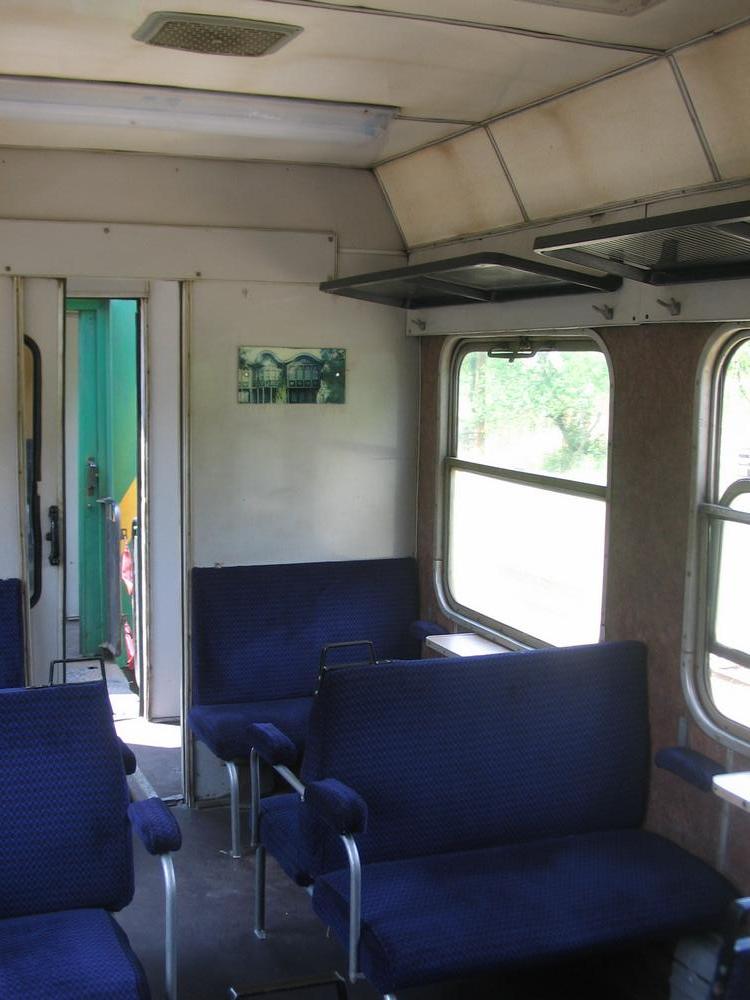
Inside a carriage

Along with a reasonable number of other passengers we hopped on the five-carriage train, and waited for departure at 09:12. The bogie coaches are second-class only and somewhat spartan, but do at least boast padded seats.

Behind the passenger platform are lines of derelict wagons, left over from the extensive freight traffic which unfortunately has now ceased. The route was built for 12 tonne axle loads, relatively high for a 760 mm gauge line, and the 1100 horsepower locos are said to be the most powerful of their gauge in the world. Timber from the forests along the line was a major source of traffic outwards, and construction materials and general goods were brought in from the rest of the countryiii.

Class 81 shunter

The depot is visible on the right as the train departs, with a Soviet-built Class 81 shunter, and a rake of slightly more luxurious passenger stock sat above an inspection pit. There is also a standard gauge rolling stock works.

Approaching the mountains

Turning southwest away from the main line to Sofia, 120 km away, the narrow gauge route follows the side of a road across the open plain between the Rhodope mountains to the south and the Balkan range to the north. The mountains were formed when Thracian bigwig Haemus unwisely compared himself and his wife the nymph Rhodope to Zeus and Hera, which annoyed the gods so much that they transformed the couple into the two mountain chains, forever separated by the River Maritsa.

Our train’s first significant stop is Varvara, which from 27 October 1928 until October 2002 was the junction for a 16 km branch which interchanged with the Septemvri – Plovdiv line further east at Pazardjik.
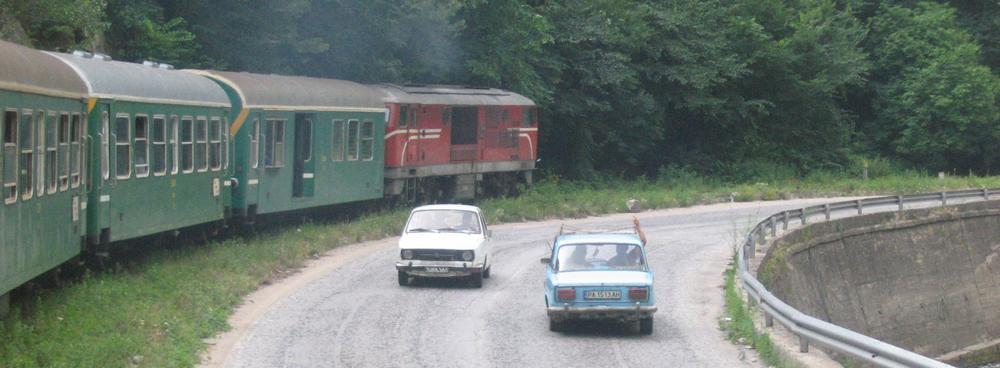
River Chepinska

The railway then plunges into a rocky gorge marking the start of the Rhodopes, twisting alongside a road and the tumbling River Chepinska, nipping in and out of a series of short tunnels, some of which are replacements for an original alignment which was destroyed by earth movements in 1928. The Ladas and battered old buses on the parallel road have to give way at a barriered level crossing, then the railway jumps across to the other side of the river.

My friend’s FIP [an international scheme for reciprocal railway staff travel] pass flummoxed the guard when she came to check tickets, but it looked convincing enough to be accepted. She seemed excited at the sight of my EuroDomino pass, and then decided to walk off with it. To my relief she returned with a second member of staff, and we established that she had never actually seen a real EuroDomino before, so wanted to show it to a new employee who was also onboard.

EuroDominos make little financial sense in Bulgaria. The fares are as cheap as the trains are slow, and even travelling from one end of the country to the other every day is unlikely to cost as much as the pass. However it does remove the need to queue up to buy tickets, and means you don’t need to know where you are going (not surprisingly, booking clerks can get confused with requests for a ticket to wherever that big throbby diesel loco is going, please). In theory most inter-city trains in Bulgaria require reservations, but on our first day in the country we’d visited three ticket windows at (the misleadingly named) Sofia Tsentralna station to get a slip of paper which no-one ever asked to see, and after that we didn’t bother, with no objections from anyone. The booking we did get specified a coach and seat, but as far as we could tell the coaches weren’t numbered anyway, so it was all a bit academic.

Dolene interlude
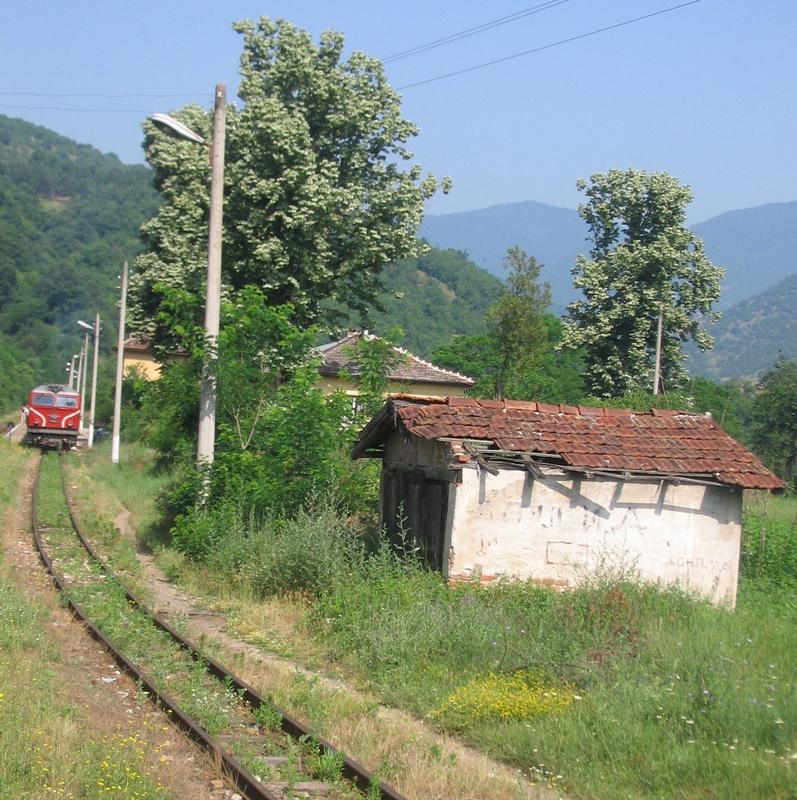
Dolene station

Road and rail eventually part company, the the gradient steepening as the railway heads off into a wooded valley. A sharp horseshoe curve brings the train to Dolene, a small station amid the trees about 21 km from Septemvri. The passengers spilled out for a wander outside or a cigarette, even though on many Bulgarian trains ‘no smoking’ simply means ‘open a window first’.
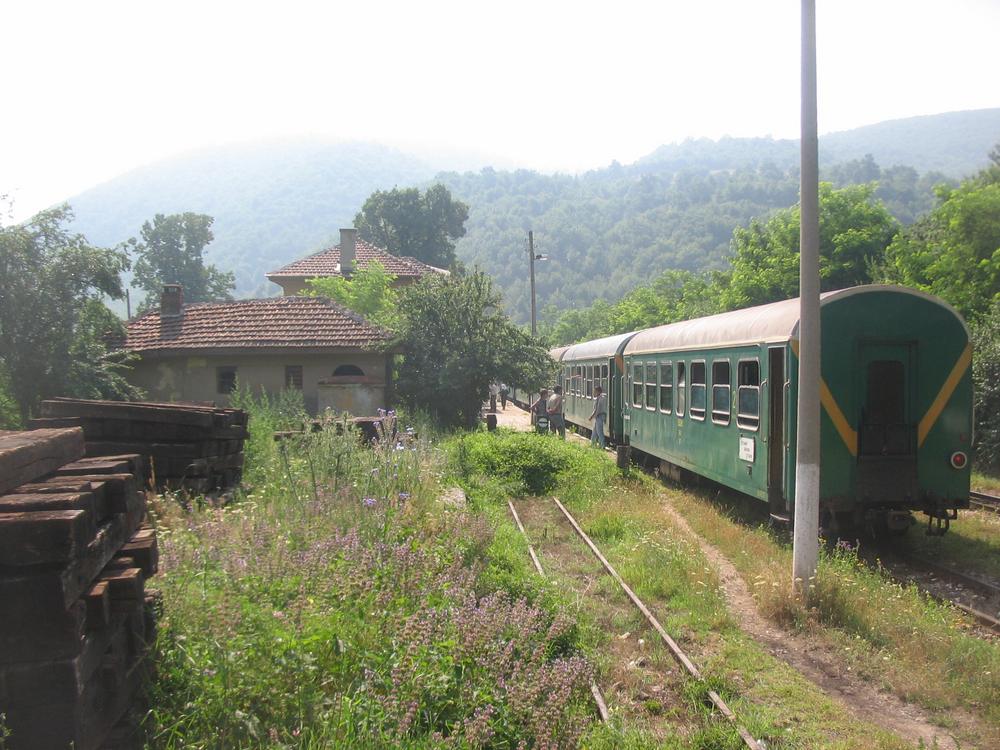
Dolene

Lacking confidence in my ability to decode the dusty timetable on the station wall, I went to ask the guard if there was time for me to take some photos. She made train noises and waived her hands past each other to symbolise that we were waiting to cross another train, and when I waved my camera she said “da while shaking her head, so I knew I had time to wander off up the line to gets some shots. Bulgarians shake their heads for yes and nod for no, something which I’d suspected was either a travel book myth or a tradition which had fallen to globalisation, but I was happy to discover is true. The trick is to always say da or ne as often as possible, and try very hard not to move your head as you speak!
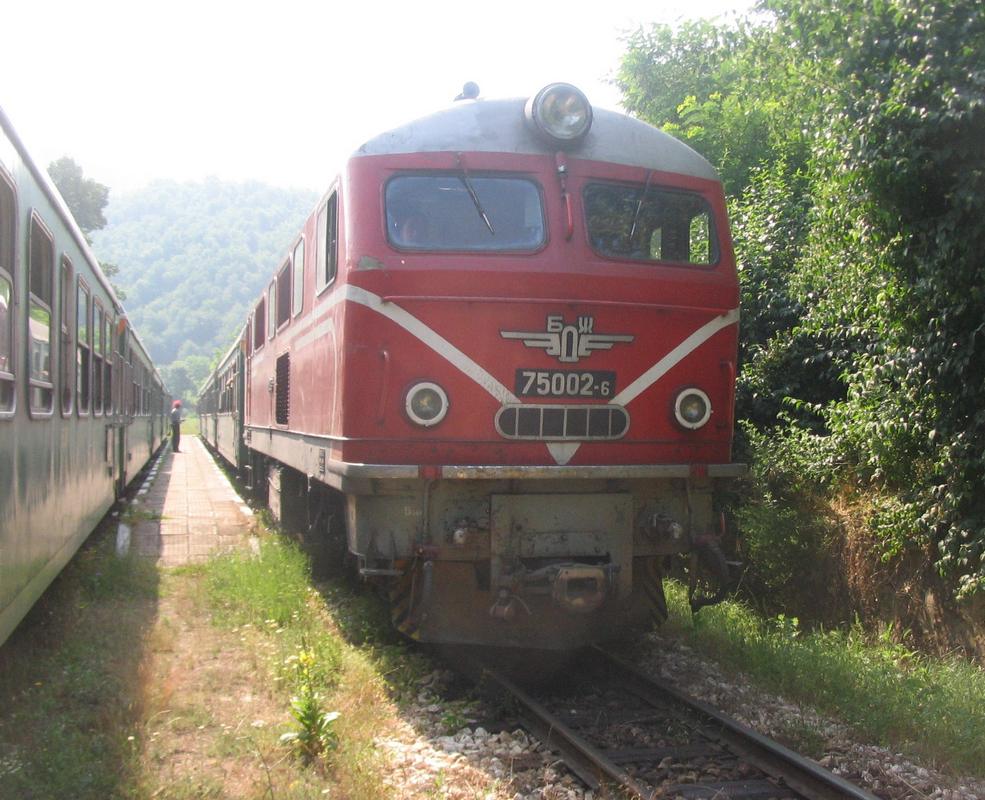
Class 75 loco

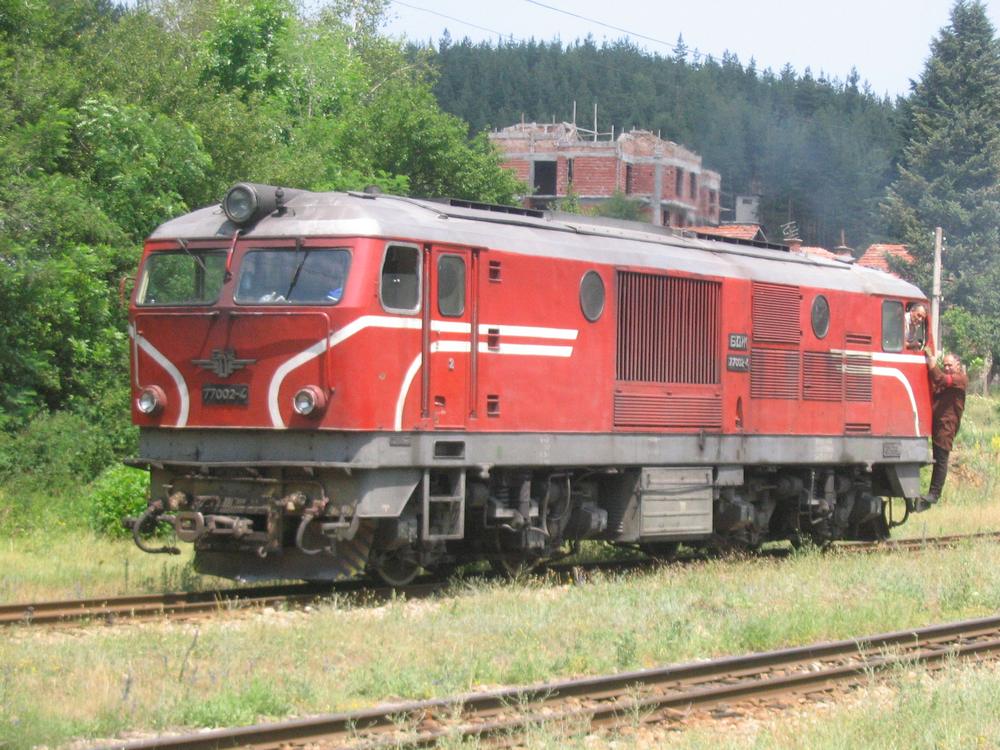
While the uphill train sits at Dolene for about 11 minutes, the downhill makes brief 2 minute stop, and the passengers waved to each other as they passed, a group of kids being particularly keen to ensure they were included in our photos. The other train was hauled by one of the 10 B-B diesel-hydraulic locomotives which were ordered from Henschel in Germany to replace steam in 1965. Attractive machines, they are based on a metre gauge design supplied to Spain, Thailand and Togo.

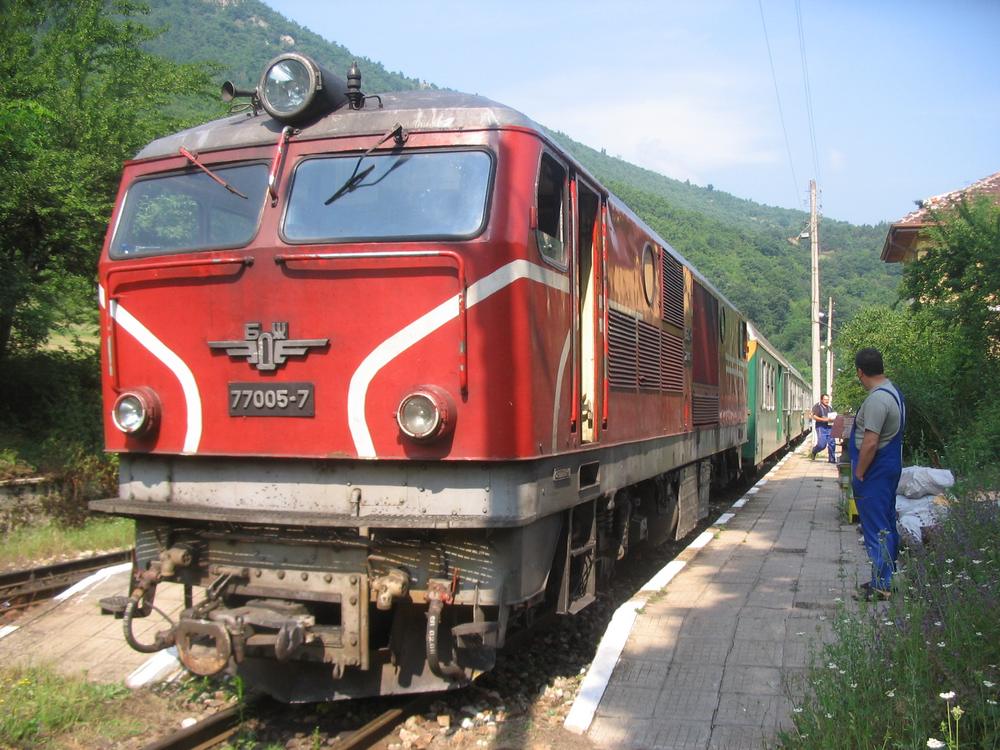
Loco 77005-7

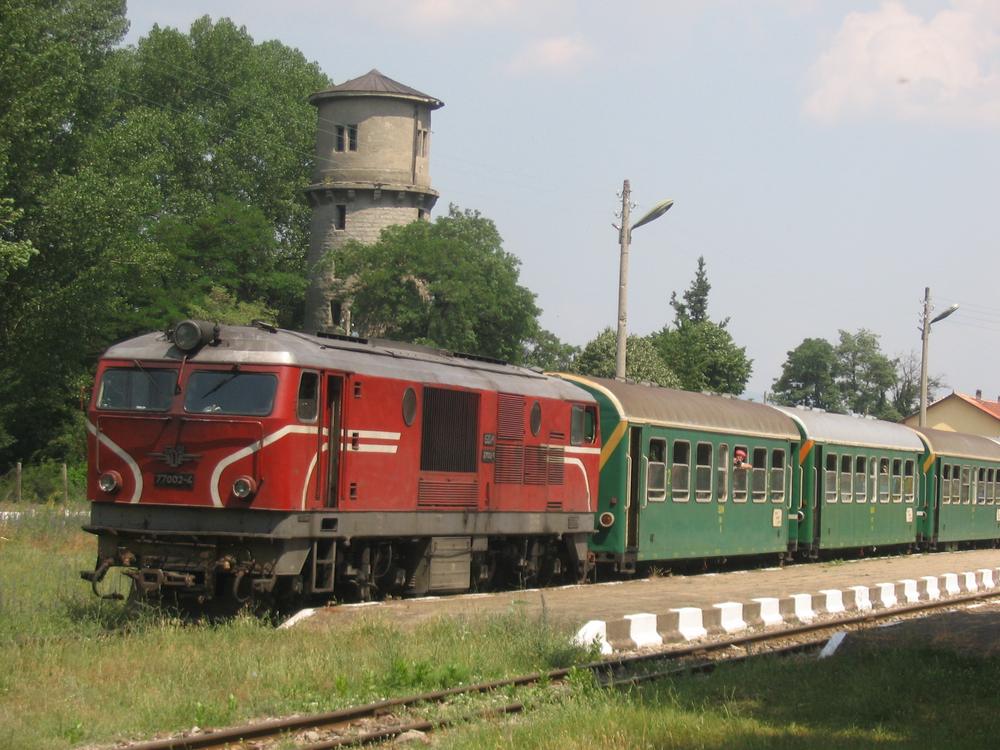
Our train was pulled by a similar but Romanian-built Class 77 loco. These were built by the 23 August factory in Bucharest in 1988 as an improved version of its Class 76 locos, which had suffered from various problems and are now all withdrawn. Following a drop in freight traffic five of the Class 77 locos were sold to the Rio Turbio Railway in Argentinaix

Climbing the side of the valley, the Septemvri-bound train is occasionally visible between the trees in the valley below.

The spa town of Velingrad boasts 80 hot springs with waters to cure all kinds of ailments, as well as a large station where many passengers got on or off. The abandoned goods yard has an assortment of derelict open, van and flat wagons cluttering the sidings, along with an almost comic-looking 760mm gauge Plasser tramper.

One of the passengers boarding at Velingrad was a retired teacher of German, who gave us a commentary on the next stretch of the line, opened from Velingrad over the Rhodope ridge to Jakoruda in 1937. He’d hoped we were German so he could chat to us, but unfortunately my German is much too limited, and all we really understood was that there was a chance of seeing some eagles on the cliffs high above the line.
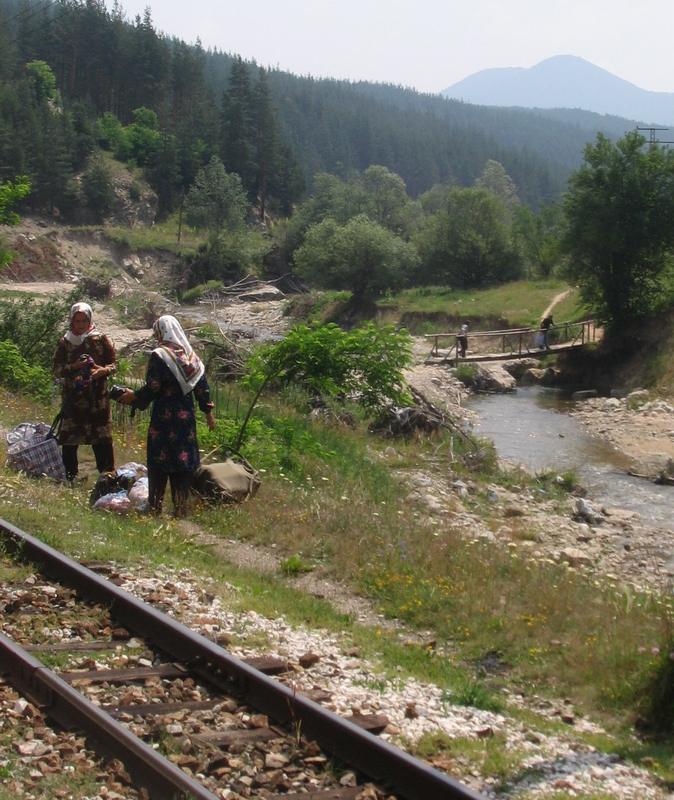
Alighting at Cvetino

Many of the stations are excessively substantial for today’s traffic, and the train almost emptied at Cvetino, where we passed another downhill train. The diminutive guard clambered up on a radiator to be able to lean out the window and wave her flag, and then we left for a further section of river gorge, passing between the Rhodope and Rila mountains though countryside once frequented by Orpheus, of underworld fame.

With the departure of the teacher at Cvetino, we raided the food supplies we’d acquired from a kiosk outside Plovdiv station. The station stops on the line are fairly short, and some are rather remote, so there is little chance of acquiring food en route. Bulgarian kiosks offer a wide variety of banitsa, pastries in a range of different shapes and sizes, all tasting like cardboard smeared with grease and marinaded with cling film. There is also a mysterious and foul-smelling brown cereal drink, which we both found undrinkable but is strangely popular with the locals.
Running round

I’d started keeping a close eye on my bottles of water after someone sharing our compartment on a train to Varna used my drink it to jam the train window open and try to get some ventilation. A much cleverer trick which is widely employed is to keep your worldly goods in a carrier bag tied to the window handle, with the weight holding the window open against the invariably broken mechanism.

After the deluge

On August 4 2005 Bulgaria was hit by severe flooding, Railway Transport Magazine describing a ‘crisis was so overwhelming that previous floods seemed as innocent as a children’s game in a swimming pool’. The Sofia – Plovidv main line was out of action for a month, and it took four days to restore a partial service on the narrow gauge line after the ‘most devastating disaster’ in the 117-year history of Bulgarian railways.

Flood repairs

The waters carried with them inevitable talk of abandoning the line, but on September 15 through services resumed following work to shore up embankments and install concrete flood defences between Cvetino, Avramovo and Cherna Mesta.iv The low running speeds were further cut by temporary speed restrictions throughout the damaged areas, trains crawling across some precarious- looking track over what must have been quite spectacular wash-outs.

The scenery gets increasingly impressive as the line zig-zags up the hills on gradients which reach 1 in 33, and the fragrances of the pine forests and carpets of local purple, yellow and sometimes white flowers fill the train. At one point three short tunnels in quick succession give an interesting view out the back of the train and through all three bores at once, and plunging into one of the longer chasms highlighted that the lighting in our carriage was defunct.

The train pauses briefly at Avramovo, 68 km from Septemvri and proudly announced as the highest station in the Balkans. Our friend the teacher had told us to watch for this, and the guard came along to ensure we saw the notice declaring that we were 1267 m above sea level. Much of the station signage along the route is bilingual, in Bulgarian and, strangely, French. The station appears to have little else to commend it, and the journey continues.
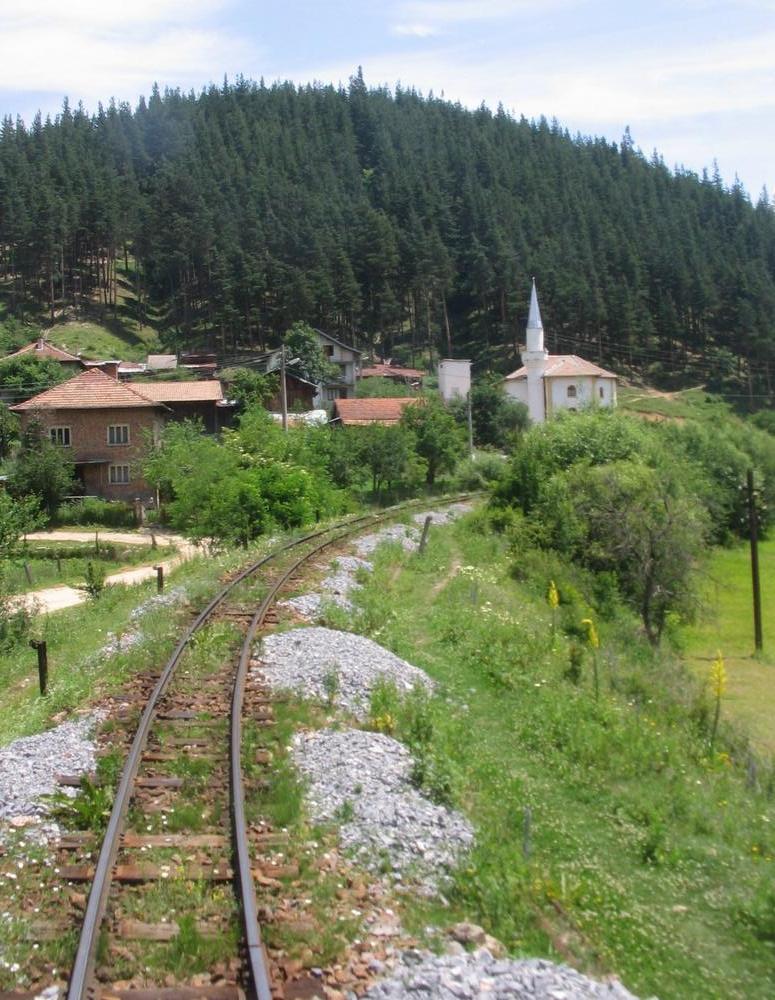
Mosque seen from the railway

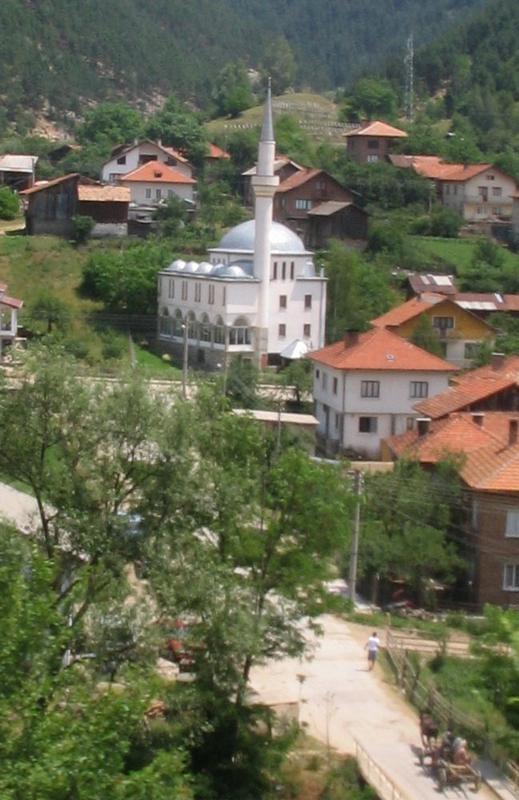
The Rhodopes remained outside Bulgaria when she gained her independence in 1878, but were added to the territory in the First Balkan War of 1912-13, and the railway helped to ensure the area would look north towards Sofia and Plovidv, rather than south to the Aegean ports. There is still posses an exotic feel, as headscarfed women in brightly-patterned dresses board the train, which threads past gleaming white mosques and minarets in the villages inhabited by ‘Pomaks’, ethnic Slav Muslims.
Horse and cart

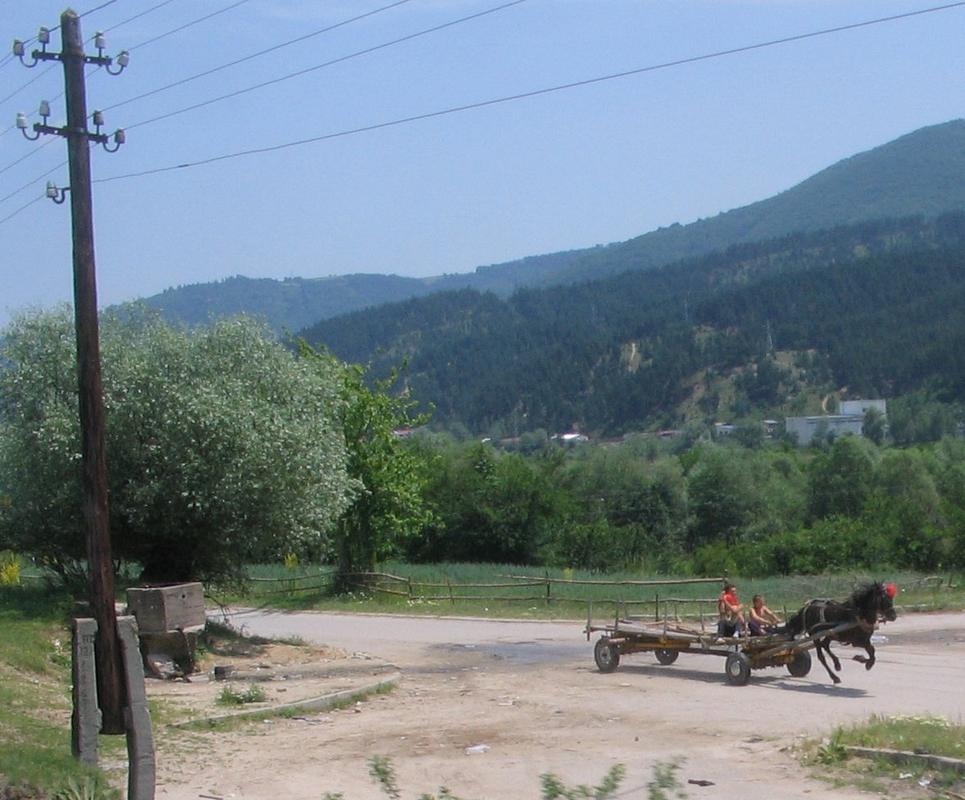
Horse-drawn traffic is quite common, the wagons drawn by horses decorated with red pom-poms on their heads. One cart driver decided to race the train, keeping up with us for a minute or two before we got ahead.
Pirin mountains

The line flattens as it reaches the Mesta valley, and the Pirin mountains come into view, still capped with snow in June. 114 km from Septemvri is Razlog, an industrial town with a paper factory which was once a major source of traffic for the line, employing three diesel locos until 2003v.
Bansko station

The loco is swapped for a replacement at Bansko, which is 118 km from the start of the trip, 936 m above sea level, and the main target of the line. However we stayed on-board to complete the route, having the train almost to ourselves for a further 13 min as far as the terminus at Dobrinishte, 125 km and 5½ hours from Septemvri. This final 7 km section of the line opened in December 1945 and is worth doing if you want to colour it on on your map, but offers little excitement in itself.
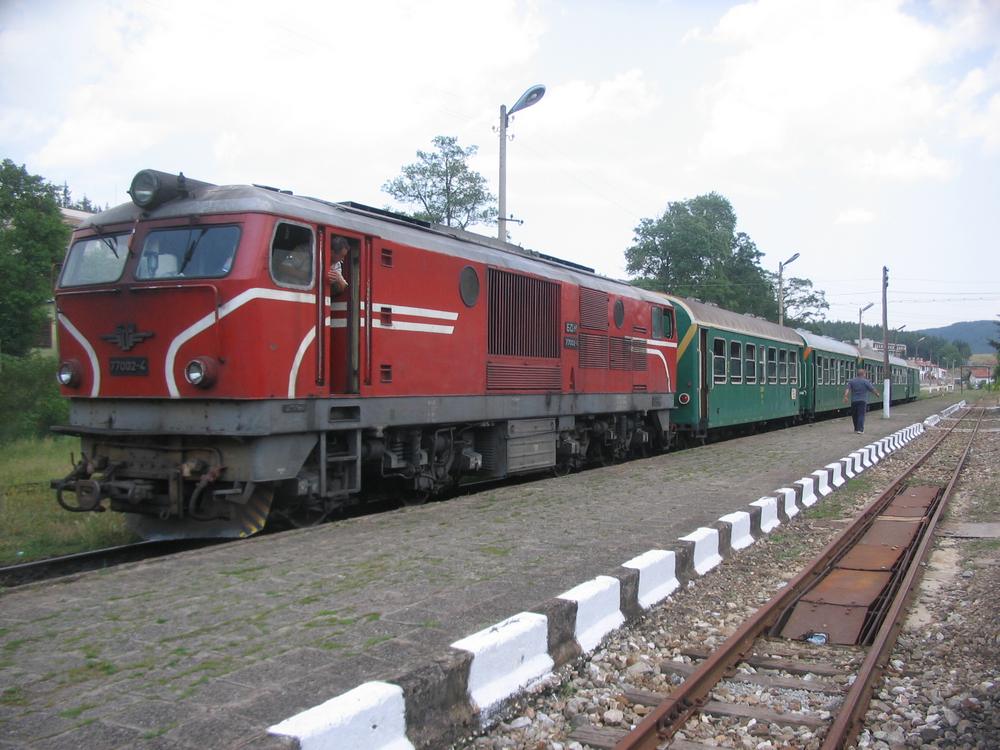
Dobrinishte

The timetable gives the option of not quite long enough or far too long in Dobrinishte, and as nothing exciting was visible from the station forecourt we contented ourselves with a few photos. Two more passengers appeared for the 15:00 return journey, equipped for serious hiking with military style gear but also photographing the train from all sides. We couldn’t identify their language, but they were using another railways staff passes, so of the four passengers on the return leg, I was the only one with a paid-for ticket – and even that was a pass, which can’t be too good for the traffic statistics.
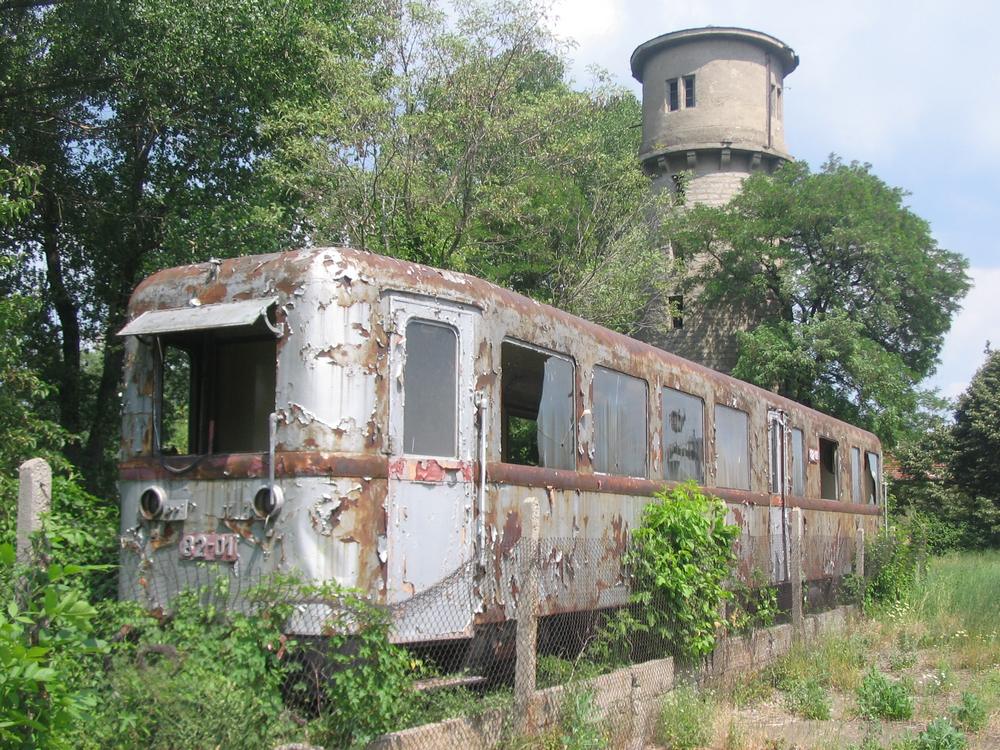
Railcar at Bansko

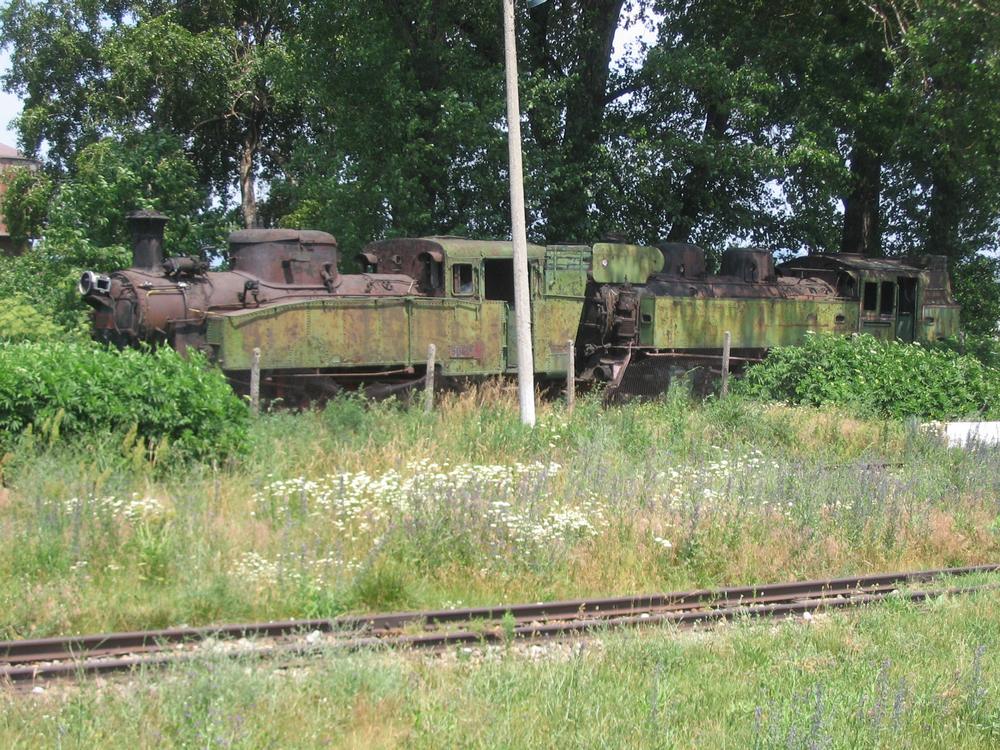
Steam locos at Bansko

Bansko has a small locomotive shed, and dumped (or preserved?) outside are two steam locos which we cabbed, plus a derelict diesel multiple-unit, all displaced by the arrival of the powerful Henschel diesel locos in 1965. We double-checked the next day’s departures on the timetable board, a slightly cryptic listing which includes the time times the various service leave their initial stating point, as well as the station in question. The Cyrillic alphabet initially looks a bit scary to someone with my lack of linguistic ability, but once you get the hang of transliterating a few letters it is fairly easy to spot what you are looking for. It is usefully phonetic, and the locals could generally understand what we were trying to say, as long as we remembered to not to shake or nod our heads!

Time for tourism
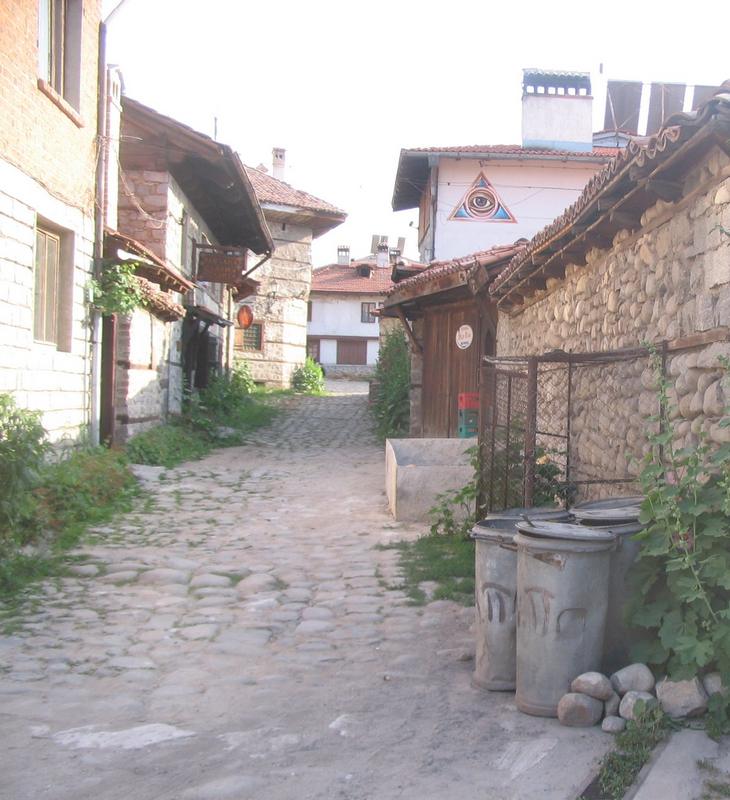
A street in Bansko

Bansko is a pretty place of cobbled streets and wooden houses, if a little over-modernised in parts. Property investors are hoping it will overtake places like Poland’s Zakopane as the eastern European ski resort of choice, and signs for estate agents’ offices line the streets, just as adverts for Bansko fill the windows of London estate agents. The winter sports areas are some way from the town, and new developments are sprouting up to serve the pistes.
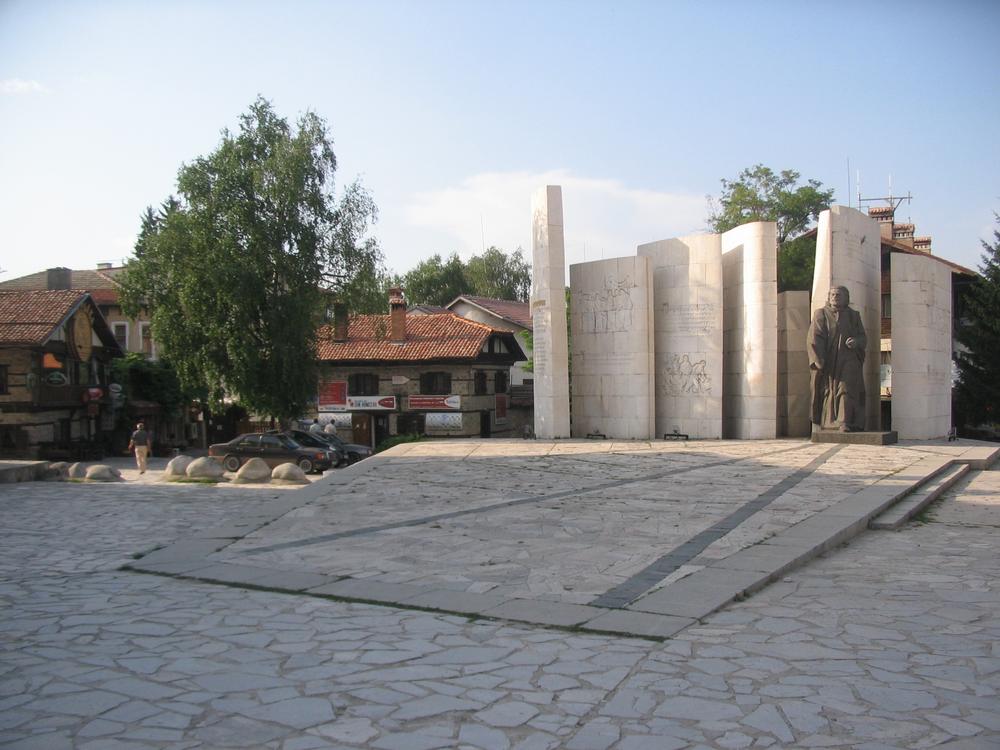
Monument in Bansko

Tourism has firmly arrivedvi, with a selection of restaurants offering alleged local colour and menus available in multiple languages (after a fashion – I opted for a Tickle of the Boss, having decided against Chicken Levers or Cock appetizer). Roadside stalls sell ice cream by weight, and a quid’s worth makes a fine site in the blazing heat.

The accommodation was less of a success, with Hotel Alpin believing that the addition of a sofa-bed was enough to declare the room as a twin, and breakfast seemed to be advertised in purely for decorative purposes.
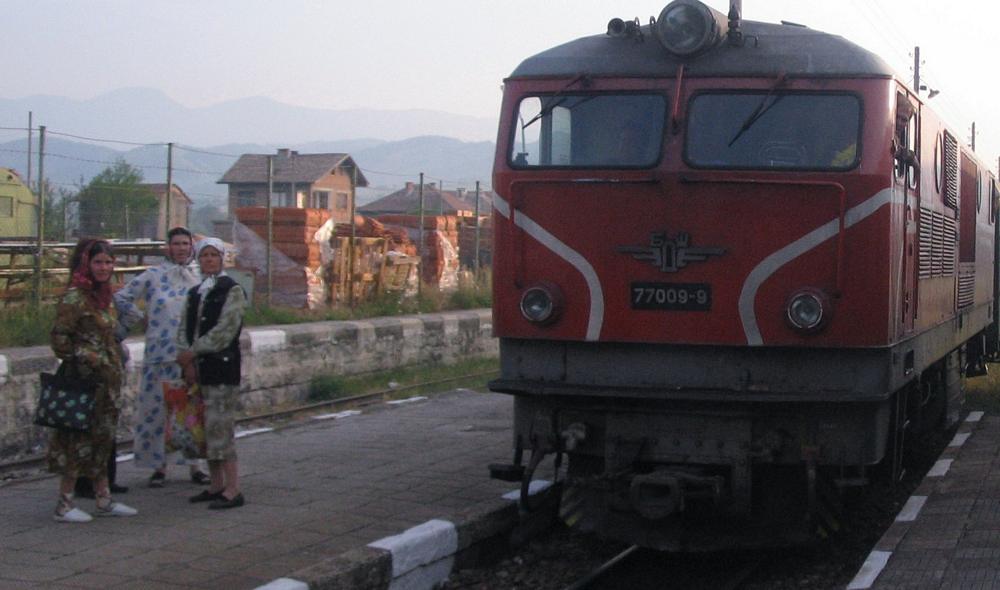
Belica station

A ski resort in summer is never going to the most exciting place, so we called it a night early and decided to forgo another bland Bulgarian lager in favour of catching the 06:13 train the next morning, which had the advantage of getting us to Septemvri by 11:10, from where we caught the 12:39 departure for Sofia, arriving at 14:34.

Two elderly couples got on for the last stretch of the trip down to Septemvri, and the men launched into an impromptu performance of Bulgarian songs. There was more enthusiasm than harmony, but all the passengers listened intently to what must be well-known tunes.

Worth a ride
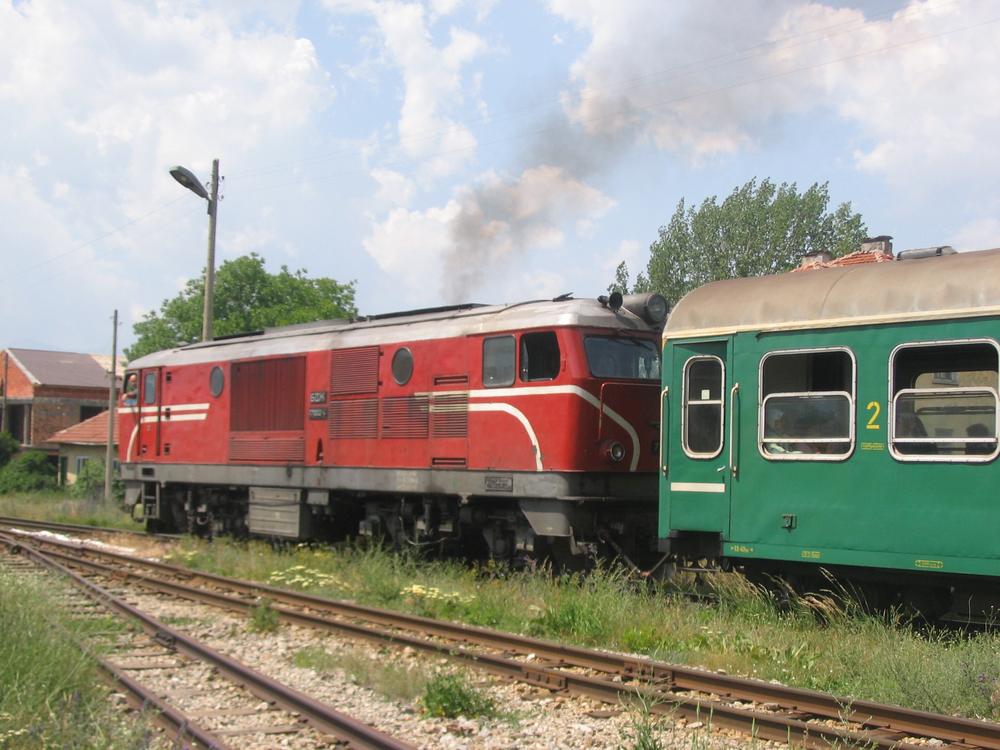
Leaving Bansko

The narrow gauge line is well worth the ride, though with just two or three through trains a day taking 5½ hours uphill and 5 back down there is a risk of too much of a good thing. In theory a day trip could be possible from Sofia, but I doubt even the most committed railfan would find the necessary early start and late return would constitute much of a pleasure by the time he was back in Sofia. A two day trip is a more realistic option, with both Bansko and Plovdiv being pleasant places to stay.

The times of the trains aren’t ideal for tourists, but in summer the early morning train does avoid the worst of the heat. The future of the line has been in doubt in recent years, and upgrades to the roads won’t help, but the repairs after the flooding suggest that the railway could still have a role; it was certainty well used. In December 2005 the local councils of the towns served by the line put forward a proposal for it to be operated under a concession, and negotiations have been held with British and German tour operators in the hope of capitalising on the scenic attractions of the line to develop tourist traffic.

Bulgaria’s trains are slow, infrequent and grubby, but there is still a sense of occasion to travelling. Racing horse drawn carts on 2’6″ gauge trains which wind between mosques is well worth doing before things change, whether for better or worse.

Opening datesvii
  Parliamentary approval 25 September 1920
  Construction starts 1921
39 km Septemvri (then called Sarambey) – Varvara – Velingrad (at the time three separate villages) 1 August 1926
16 km Varvara – Pazardjik branch 27 October 1928
closed October 2002
  Velingrad – Velingrad YG 1 July 1927
47 km Velingrad YG – Jakoruda 12 December 1937
15 km Jakoruda – Belica 30 July 1939
18 km Belica – Bansko 30 March 1943
7 km Bansko – Dobrinshte 9 December 1945

A branch from Kostandovo to Batak and a continuation of the main route beyond Dobrinishte to Gotse Deltchev (then called Nevrokop) were approved but not built.viii

The names of settlements along the route have varied with growth, politics, and the chosen scheme of transliteration from Cyrillic. For the sake of simplicity, I’ve used the spellings adopted by the Deutsche Bahn journey planner which we all know and love.

References

So you don’t have to take my word for it!

i 100 Years Bulgarian State Railways, BDZ, 1988 [A commemorative book produced just before changes swept eastern Europe. A typical excerpt: the revolutionary traditions of the railwaymen are best manifested during the armed struggle against the Hitlerite invaders and the Bulgarian fascist bourgeoisie]

ii The Bulgarian State Railways, S H Beaver, The Railway Gazette, 26 June 1936 pp1204-1207

iii Narrow gauge locomotives of great hauling capacity, The Railway Gazette, 1 July 1966 pp524-526

iv Flooded again! T Stefanova, Railway Transport Magazine, September 2005

v Bulgarian railways today, C Bailey, Today’s Railways Europe No.132, December 2006

vi The Rough Guide to Bulgaria, J Bousfield, D Richardson

vii 80th anniversary of the narrow-gauge line Septemvri-Veingrad, D Deianov, Railway Transport Magazine No.7/8 2006 [in Bulgarian]

viii Chemins de fer en Bulgarie, bulgaria-france.net [In French]. This site also has a map.

Links

Gmunden trams, Austria

Another old article written for the journal of the Cambridge University Railway Club, this time looking at a small tramway in Austria which I visited in January 2003.

Franz-Josef Platz tram terminus.

Gmunden, 4 January 2003

The accuracy of claims to the title of “the world’s smallest tramway” could doubtless form the basis of lengthy debate. One claimant to the title is is the 2·3 km line in the small Austrian town of Gmunden. The single route system is also one of the world’s steepest tramways, with gradients of up to 9·6%.

Gmunden stands on the shore of the Traunsee lake in Upper Austria, and has around 13 000 residents. The town has two railway stations, the dual-gauge Seebahnhof terminus by the lake, and the Hauptbahnhof on the Austrian Federal Railways (ÖBB) Attanag-Puchheim to Stainanch Irding line. This is some distance from the town centre, and 60 m higher than the lake. Linking the town centre with Hauptbahnhof is a metre-gauge tramway operated by Stern & Hafferl.

The line opened August 13 1894, with four trams. It is electrified at 600 V DC, and it was the company’s steady demand for power which brought an electricity supply to the town.

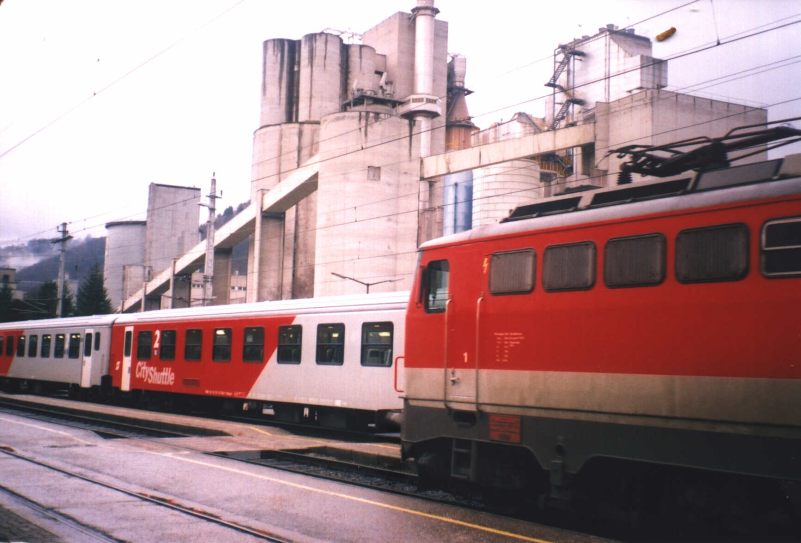
ÖBB trains at Gmunden station
ÖBB trains at Gmunden station. The town centre is a lot prettier than this!

Stepping off the train at Hauptbahnhof, the tram stop is found straight opposite the station entrance, a common arrangement in Continental towns. Crossing the road, visitors will find the tram waiting under a line of tall trees. The line to the town heads off to the left, and to the right some disused track extends over a level crossing, stopping amid the weeds in a disused railway goods yard area.


[Tram]

The tram stop opposite the entrance to Gmunden station, looking towards the town centre.

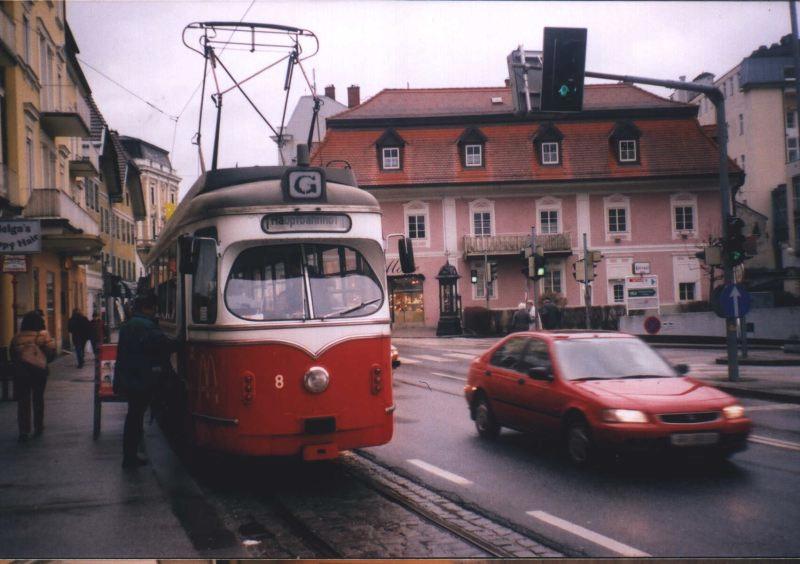
A half-hourly serve was running when we visited, and the red and white liveried tram was waiting to meet passengers from the train. Services were being operated by car number 8, a typical European double-ended single car. Despite the somewhat incongruous advertising livery promoting a well-know hamburger chain, next to the doors are symbols telling passengers not to eat or drink on-board.


[Tram]

Tram 8 about to depart from the town centre.

Tickets are bought from the driver on boarding the tram. There were two of us travelling together, and we were sold a €2·60 family day ticket. By the driver was a pile of leaflets advertising a model railway exhibition at Seebahnhof, but unfortunately we were too early in the day to visit. There are 32 seats, and including us there were six passengers on board. The return trip had more custom, and not everyone was travelling all the way between the termini.

Leaving Hauptbahnhof the tram runs on segregated ballasted track alongside the road. The line is single track, with two passing places, and forms a rough Z-shape as it descends to the lakeside. The maximum gradient is an impressive 9·6%, and quite noticeable.


[Tram stop]

Waiting for a tram from Franz-Josef Platz to the main station.

There are six intermediate stops along the route, marked by ornate metal signposts. All are on the left going downhill, allowing the use of trams with doors on only one side.

The depot stands alongside the line to the right, and part of the rest of the fleet of trams was visible inside as we passed. All the vehicles except number 8 were obtained second hand from other tramways. Tram number 5 was built in Graz in 1911. Our vehicle, number 8, was built by Lohner in 1962. Numbers 9 and 10 were built by Duewag in 1952 for the Vestische tramway in Germany, where they were numbers 347 and 341. The two cars were moved to Gmunden in 1974, and entered service in 1977 and 1983. Open-sided vehicle number 100 was built in 1898. There are also some works cars. The line’s five staff both drive and maintain the vehicles.

[Tram]
At Franz-Josef Platz tram terminus.

The line twists and turns alongside the main road, then disappears down a back street. There is a mix of reserved track and on-street running, and at some points the tram is on the wrong side of the road. On the return trip an on-coming car pulled onto the pavement to let us pass.

Trams from the station terminate in Franz-Josef Platz, opposite a lakeside promenade. The line originally continued a further 200 metres to the main square by the town hall, opposite a pier served by steamers on the lake. Unfortunately this required negotiation of an increasingly busy road junction, and so the line was cut back in 1975; a local campaign prevented complete closure. Beyond Franz-Josef Platz the overhead wires are still in place, and the route of the rails can clearly be seen under the road surface. There is some talk of re-instating the line, but negotiating the junction could be tricky. In the past there were proposals to extend the line over the bridge to the Traunseebahn station, a few minutes walk away. A line to the nearby town of Altmünster was also planned.

The line is one of the more attractive tramways I’ve visited (you can tell you aren’t in Croydon!), and would have been a great place for photography if we had had more time.

References

Tramways & Light Railways of Switzerland & Austria (RJ Buckley 1984)
Light Rail in Europe (Taplin, 1995)

Mariazellerbahn, 6 January 2003

[Train]
An electric loco on the 760mm-gauge Mariazellerbahn.

[Steam train]
A steam special on the Mariazellerbahn.

Oberweißbacher Bergbahn

A piggy-back ride up the hill

One of Germany’s oddest railways is a piggy-back funicular, part of a three-line network of rural railways. In the hot summer of 2003 I went for a ride, and wrote another article for Eagle, the journal of the Cambridge University Railway Club.

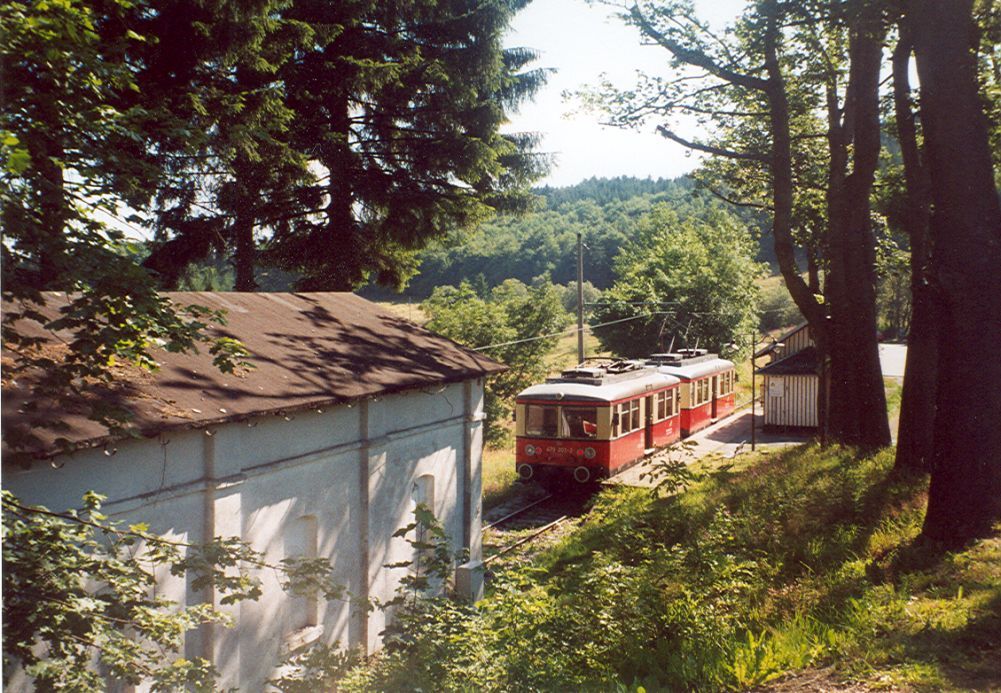
An electric train at Cursdorf, the end of the electrified branch from the top of the Oberweissbacher Bergbahn.

In Britain we tend to think of funicular railways in terms of the Edwardian cliff lifts gracing our seaside towns, but deep in the forests of Thüringen is something rather different. One of the strangest lines operated by Deutsche Bahn, the Oberweißbacher Bergbahn is a 1.4 km broad-gauge funicular which climbs 323m up a wooded hillside. Inland funiculars are not usual in the more vertiginous parts of the Continent, but what makes the Oberweißbacher line special its very unusual (though I dare not suggest unique!), piggy-back design. Seemingly little known outside Germany, the Bergbahn deserves wider fame, both for its unusual arrangement and the short electric railway at the summit.

I first came across the Bergbahn in 2003 while flicking through a copy of Eisenbahn Magazin, a German monthly publication for railway enthusiasts. There was short report about the reopening of the Bergbahn on 15th December 2002 following a major refurbishment, with a photo of the piggy-back car. Thinking it might be some kind of spoof, I looked up the line in Cook’s European Timetable and then on the internet – there is a comprehensive website about the Bergbahn in German and English – and soon decided it would be on my itinerary for a visit to Germany planned for July 2003.

Going there

Located in the Free State of Thüringen, one of the Länder in what was once East Germany, the Bergbahn is somewhat remote, and while it is not difficult to get there by train, some forward planning ensures that one can end up somewhere sensible afterwards.

Leaving the Nürnberg to Berlin ICE train at Saalfeld, there is time for a quick look across the tracks to a small loco depot, where one of the bays of the roundhouse appears to have the front end of a diesel loco built into a blanking wall! From Saalfeld a cross-country branch runs to Erfurt, and our train was formed of 621 024-5, a single car DMU built by De Dietrich and LHB (now part of Alstom) for use in Germany and France (where it is Class X73500). Another change is necessary 16 minutes later at Rottenbach, where we boarded 641 019-5, one of two 120 km/h De Dietrich/Alstom class 641 railcars which are dedicated to the 25 km Schwarzatal branch.

The branch, the funicular and the electric railway at the top of the hill together form the Oberweißbacher Berg- und Schwarzatalbahn, one of four self-contained regional networks created by DB AG on 1st January 2002. The infrastructure and operation are integrated, the rolling stock is dedicated to the route, and OBS has 28 staff providing a degree of local control and management. The 42 minute journey along the Schwarzatalbahn passes up the heavily wooded valley of the river Schwarza to the terminus at Katzhütte. Sections of the permanent way had been recently relaid, with disused goods yards which had once served now derelict factories losing their connection to the rail network. There are eight stations on the route, including Obstfelderschmeide, the lower station of the Bergbahn. Plandampf ays are held each year, when steam locomotives work service trains along the line, which opened in 1900.

Katzhütte is a small place, spread out along the valley by the river and road. The youth hostel was almost empty, with just a handful of Germans and the obligatory Japanese visitor, intently studying his guidebook (which no doubt listed every detail of the Bergbahn). Unusually, the hostel warden spoke no English, so the rusty remains of GCSE German were dusted off. Across the road from the hostel was a pub, serving the usual chunks of pig atop a mountain of cabbage. The occupants of the village’s second pub were intently playing cards, but we received a more vigorous welcome from the local midges.

Going up

The next morning we caught 641 020-3 down the branch for the 16 minute ride to Obstfelderschmeide, the lower end of the funicular. The Bergbahn was originally built to provide a rail link from the valley bottom to the villages on the plain above. Access via a twisting road up the valley sides had been difficult until the funicular provided a link to the outside world, opening for goods traffic on 15th January 1922 and to passengers on 15th March the following year. The 1 387.8 m long Bergbahn has the common funicular layout of two cars running on a single track line with a passing loop in the middle. More unusually the tracks split again at the bottom station, the left-hand route when seen from the valley bottom having a roof over it. On this track is a conventional, if wide, funicular vehicle which we rode up the hill. It has banked seating for 100 passengers, and an empty weight of 26 tonnes.

The most distinctive feature of the Bergbahn is the other car, which travels on the right hand track at Obstfelderschmeide and through the passing loop. This 25 tonne vehicle has a triangular wedged-shape, providing a level platform on top of which sits, piggyback style, a 9.2 tonne four wheel carriage which 72 passengers can travel in. This carriage was formerly used on a light railway between Schleiz and Saalburg, and it was adapted for dedicated use on the funicular in 1972. It can be rolled off the transporter vehicle, leaving the platform free to carry other stock up the funicular. A siding from the Katzhütte line leads to a small turntable, where single wagons or small carriages of up to 27 tonnes can be rotated 90 degrees and manoeuvred onto the piggyback
car.

The Bergbahn operates every 30 minutes, more frequently than the two trains each way every two hours (it isn’t simply hourly) on the branch line, and, being in Germany, the funicular departures are timed to connect with the trains. In March 2004 the funicular was adapted to provide wheelchair accessibility. A conductor travels on board, and can give a talk on the history of the line, well rehearsed to fit the 18 minute duration of the trip. The descending vehicle is passed in the middle, with the inevitable waving between passengers. To avoid the need for moving points the vehicles have double flanged wheels on their outer wheels but no flanges on the inner wheels, the inner rails through the loop providing support but not guidance. The gradient varies between 24% and 25%, and the track curves to the left as it climbs. The top station at Lichtenhain is 323 m above Obstfelderschmeide, and houses the electrically-powered winding gear for the funicular. Inside the station is a small display of old photos.

Going along

Outside the funcular’s fine trainshed is the platform used by trains on a standard gauge line which runs for a further 2.5 km to Cursdorf. The only rail link from this line to the outside world is via the piggy-back wagon to the valley bottom. Stock can be rolled onto the piggy back vehicle via another turntable, this time situated on the standard gauge running line rather than a siding. The turntable and also gives access to a small workshop. The line to Cursdorf is electrified at 600 V DC, and the half-hourly service is worked by three electric railcars dating from 1923, assembled from parts used on Berlin S-Bahn trains. Six minutes after the funicular had arrived we set off on board 479 205-7, with the 24 seats in each of the two cars of the train to ourselves. The 10 minute ride to Cursdorf passes through a rural landscape of fields, trees and the ubiquitous wind turbines, with one intermediate station at Oberweißbach. There didn’t seem to be much to see at the terminus, and not having time to explore the country walks signposted with the usual Teutonic thoroughness, we simply caught the train back for a look at the top station, travelling in the other car, 479 203-2. At Lichtenhain a few passengers were waiting for the trip down in the piggyback car.

Going back

We caught 641 020-3 from Obstfelderschmeide back to Rottenbach. The DMU had a first class area with eight, empty, seats, the only difference from the 55 in standard class seemingly being a partition. The driver was responsible for checking tickets, leaving the cab at some stations to walk through the trains. Many of the passengers were children.

In 2003 the Bergbahn received around 200 000 visitors, making it the second most popular attraction in Thüringen.

More information

Trams in Debrecen, Hungary

Some notes complied after a visit in summer 2005, and published in Eagle, the journal of the Cambridge University Railway Club, of which I’m a life member.

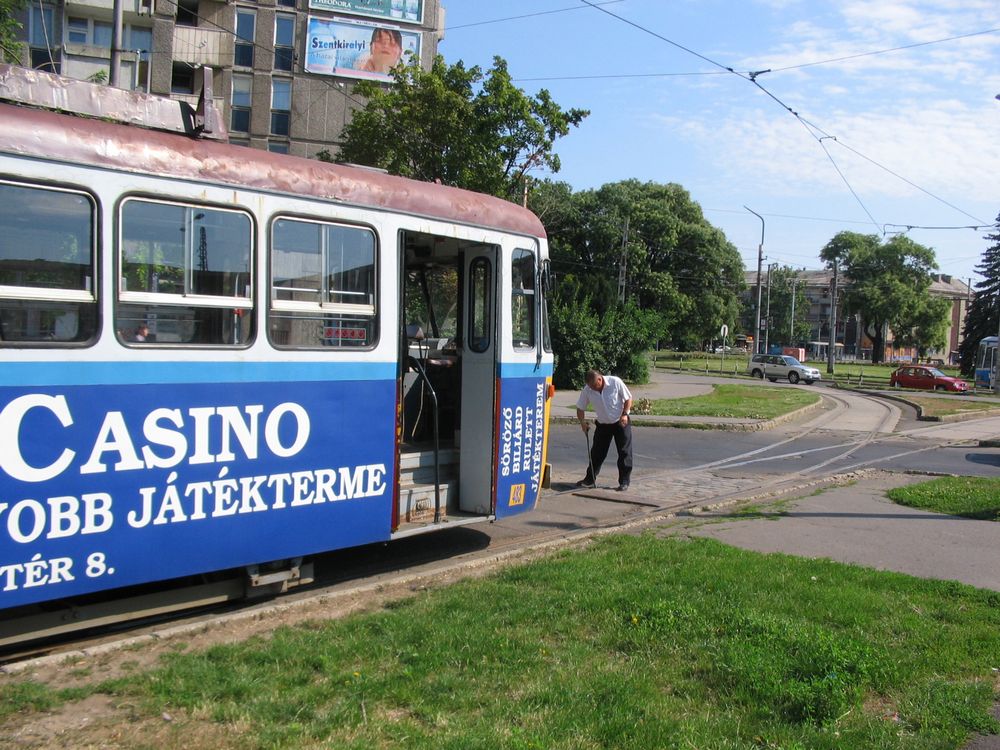
Tram driver changes the points

Tram and the small church, Debrecen

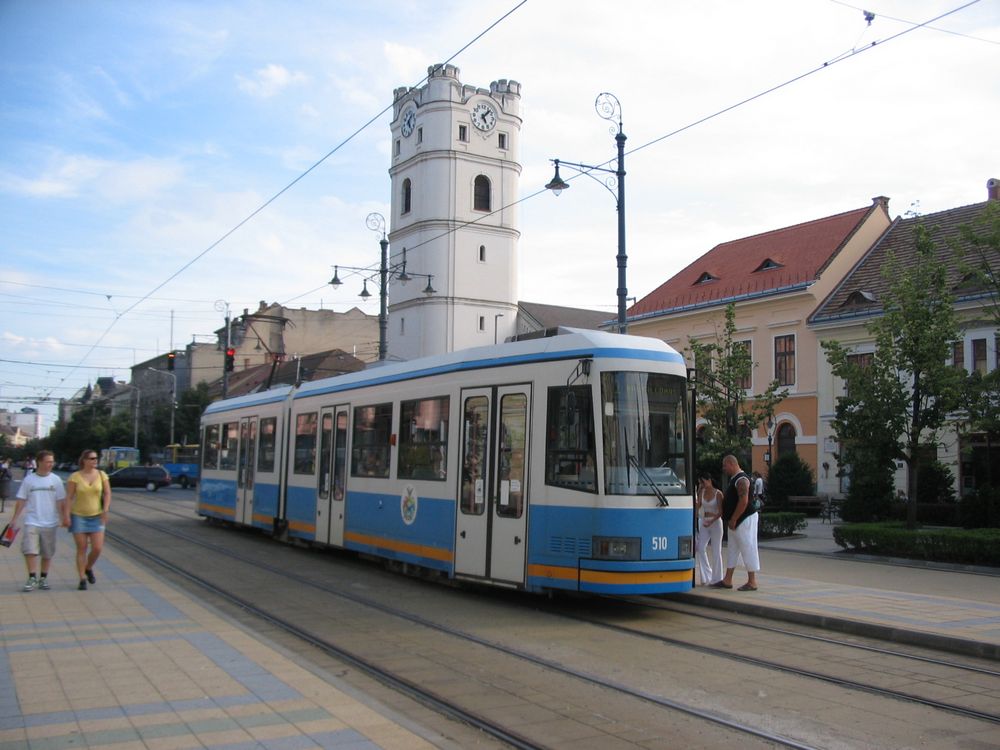
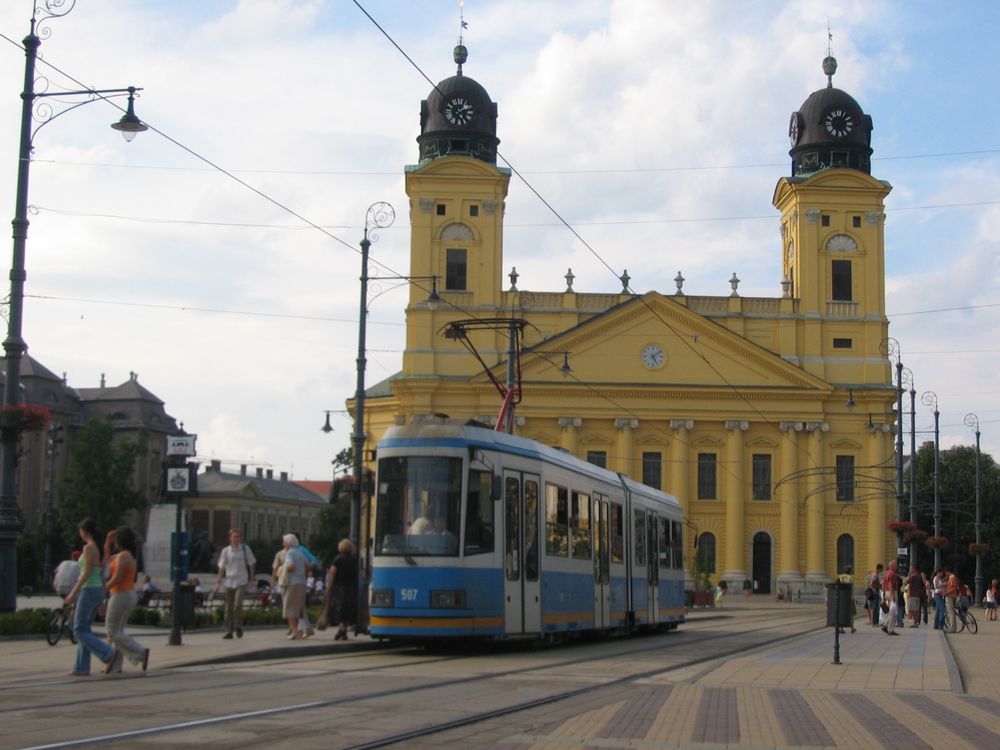
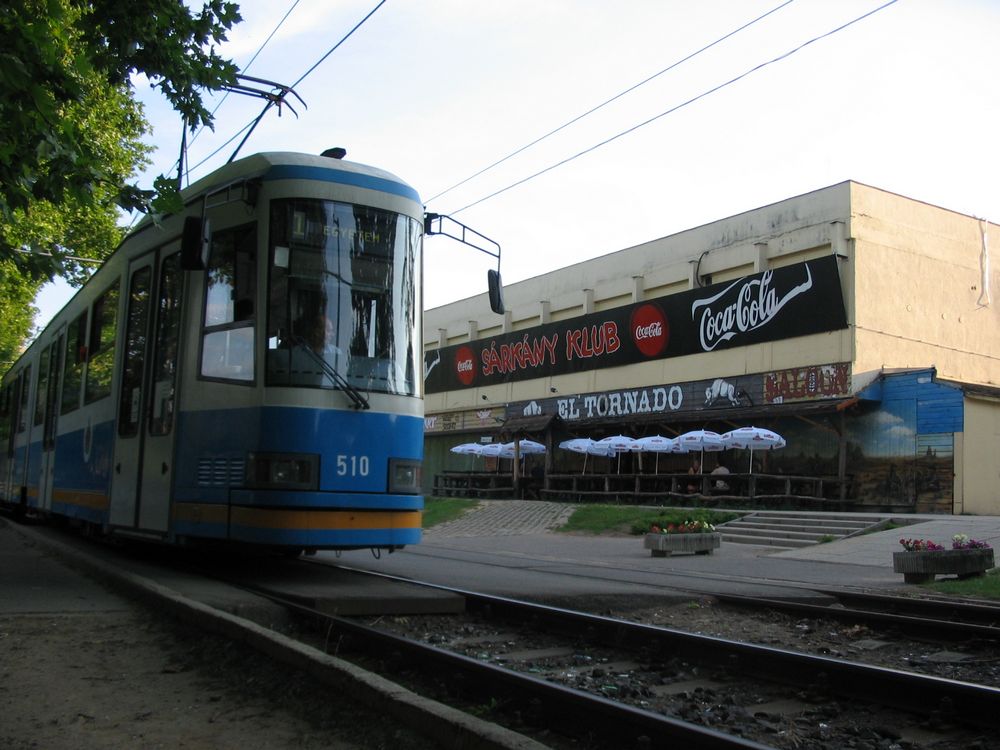
Tram 510 is one of the 11 Ganz-Hunslet cars built for Debrecen. The Small Church was once crowned with an onion-shaped dome, but it was badly damaged by a storm in 1907. Two years later a further storm wrecked the repairs, so the locals took the hint from above and stuck with the truncated stone tower instead.

If the council is to be believed, Debrecen’s population of around 210 000 makes it Hungary’s second largest city, after Budapest. On the other hand, proud residents of the northern city of Miskolc have other ideas, as they will tell tourists on their narrow gauge railway who let slip that Debrecen is next on the itinerary.

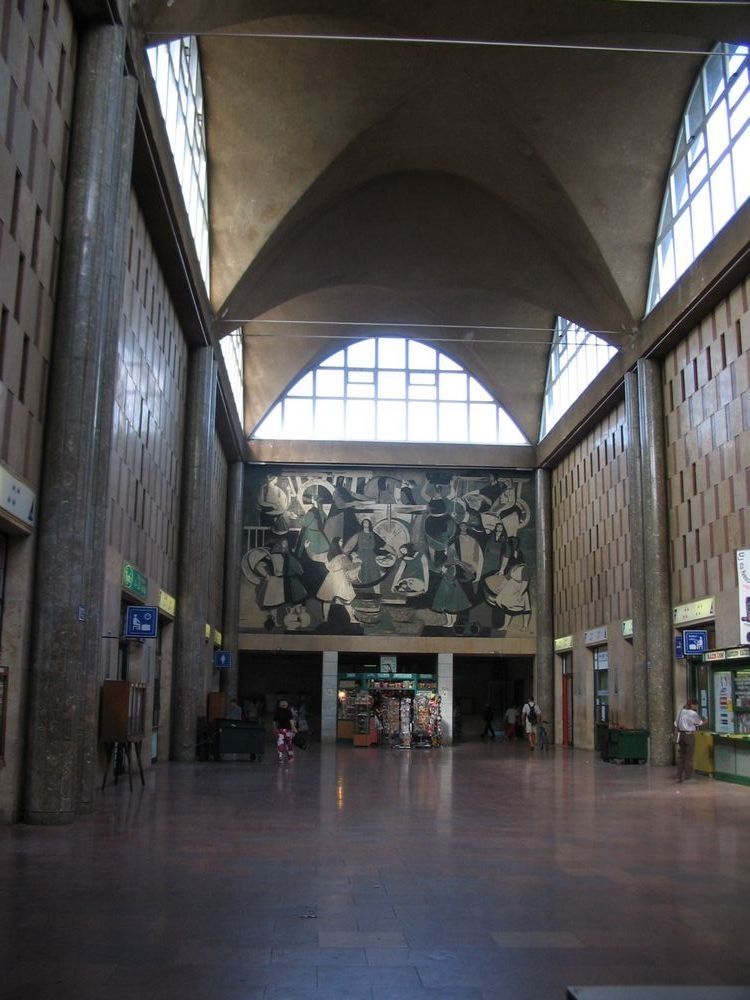
Railways first arrived in Debrecen in 1857 with a link from Pest (now one half of Budapest). Today visitors arrive at a large 1961 replacement for an ornate building which was built in 1900 but destroyed by bombing in 1944. The current station’s main hall contains two vast frescos by Endre Domanovszki, showing happy peasants working in the fields of the Great Plain which stretches for mile after mile across the south and east of the country.

Debrecen station concourse, Hungary

Mural on the wall on Debrecen station concourse.

Stepping outside the station and crossing the road brings the passenger to the conveniently-located the terminal loop of the city’s single tram line. Unimaginatively branded Line 1, the standard-gauge route run by city transport company DKV is the sole survivor of six which once crossed Debrecen. The first steam tramway opened in October 1884, electric trams arrived in 1911, but by 1975 all but the one of the lines had been supplanted by buses of the diesel or electric persuasion (and some which are both, merrily carrying on beyond the wires). The remaining line is well used, providing a frequent and useful link along an axis running from the station, through the main square, to the university, park and hospital.

Fountain in the main square, Debrecen

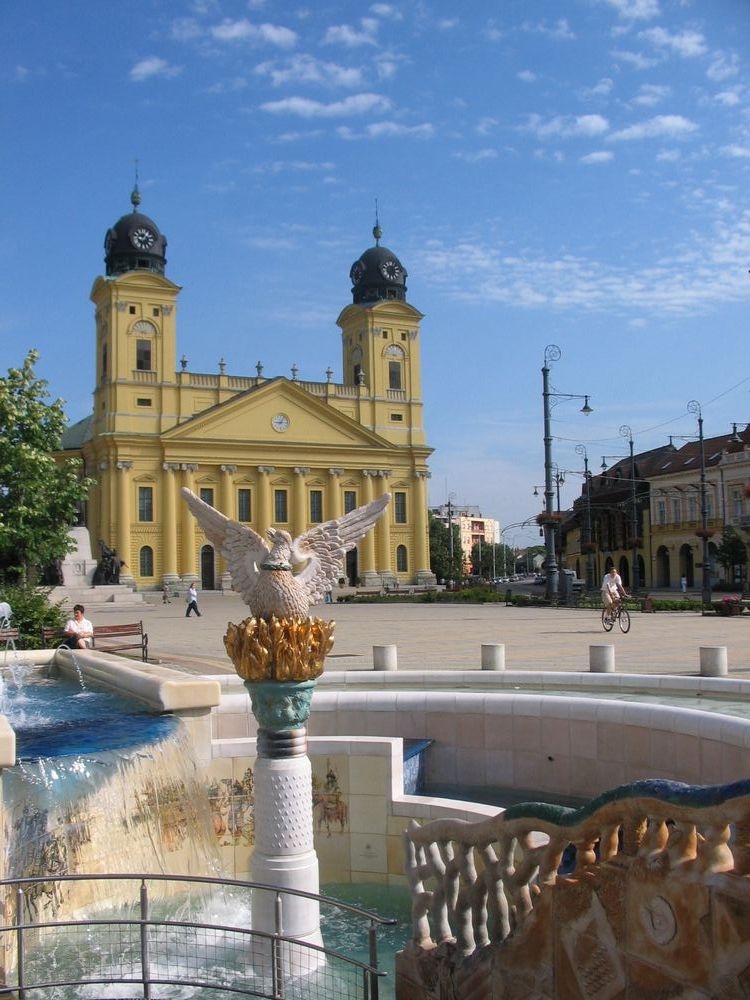
Efforts to beautify the city centre include the construction of this rather distinctive fountain.

In recent years the local authority has undertaken a major regeneration of the town centre in an effort to raise the city’s national and international profile and to attract the tourist forint. Perhaps as a result of this, each of the 13 tram stops has information in Hungarian, German and English, complete with a route map, details of the service frequencies and the vital information – so often forgotten on even the best-run light rail systems – on how people who aren’t familiar with the system can buy a ticket. These were available from the driver for HUF160, or in advance from various kiosks at a slightly lower price. Few people seemed to need to buy tickets from the driver, and trams are boarded through all doors. There are two DKV offices, one helpfully located within the station loop, which are the only outlets able to sell a HUF500 day pass valid on all the city’s trams and buses.

The stops have passenger information screens on them, built into ‘heritage-style’ signs, which is unusual for a long-established Eastern European tramway. Following the pattern of the Budapest metro, these screens tell you how long ago the last service left, not when the next will depart. This isn’t the most useful way of doing things, but it can be used in conjunction with the frequency information to estimate waiting times, which were short anyway. Services run from 04:30 to 23:00, with frequencies ranging from a peak of 2-4 min down to to 8-10 min at the extremities of the day.

Trams

Ticket office in turning loop at Debrecen station

The high frequency of the service means there were always trams waiting in the station loop when we passed. The Bauhaus-style tramway ticket office is in the centre of the loop, the MÁV railway station across the road on the right. The city of Miskolc has a very similar loop outside its main station, and also has a single tram line serving the main street.

We noticed an interesting modern-looking tram, so decided to let the first service go so we could take a look. It was one of ten six-axle KCSV6 series vehicles supplied by Ganz-Hunslet of Budapest in 1997, after the production of a prototype car (now no. 500) in 1993. Though it felt narrow, the KCSV6 is 2 500mm wide, falling between the 2 300 mm common on many older European systems and the 2 650 mm generally adopted for modern trams and new lines. The Debrecen tram’s interior is designed for standing passengers, having 28 single seats either side of a wide aisle. On-board passenger information displays show the name of the next stop.

Nagytemplom, Debrecen

One of the Ganz-Hunslet trams in Kossuth Square passes the Calvinist Great Church, Debrecen’s signature building.

The tram was designed in an attempt to produce a cheaper vehicle than the big western suppliers can offer to the Eastern European market, but no further orders materialised. Traditional tramways have so far survived in many Eastern European cities, but they are often in a poor state. There is no money available to purchase new “western” trams from the likes of Alstom, Bombardier or Siemens, but existing vehicles are often life-expired and offer a poor travelling environment as access to private transport increases.

The problem is widespread, and in the former East Germany the Leipzig tram company has developed a tram it calls Leoliner, which keeps costs down by using Tatra-designed tram bogies under a new body. Leipzig is now hoping to sell its Leoliners across eastern Europe, in competition with the big suppliers (Halberstadt in eastern Germany was the first external customer, putting five metre-gauge Leoliners into service in October 2006).

A tram arrives from the depot

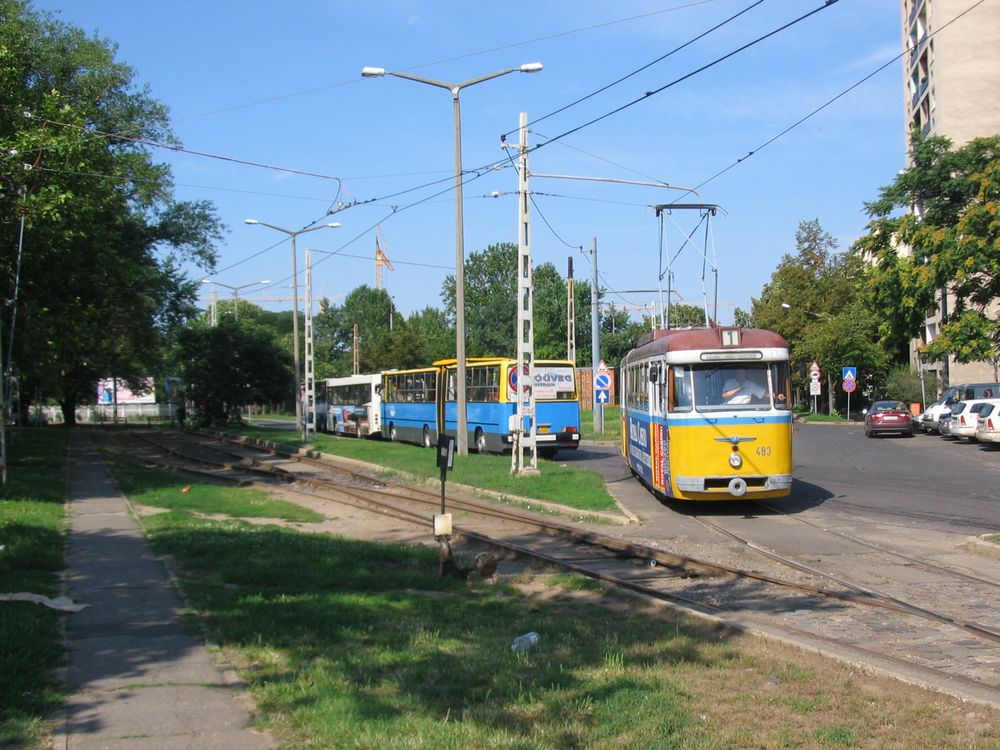
A tram on the branch from the depot.

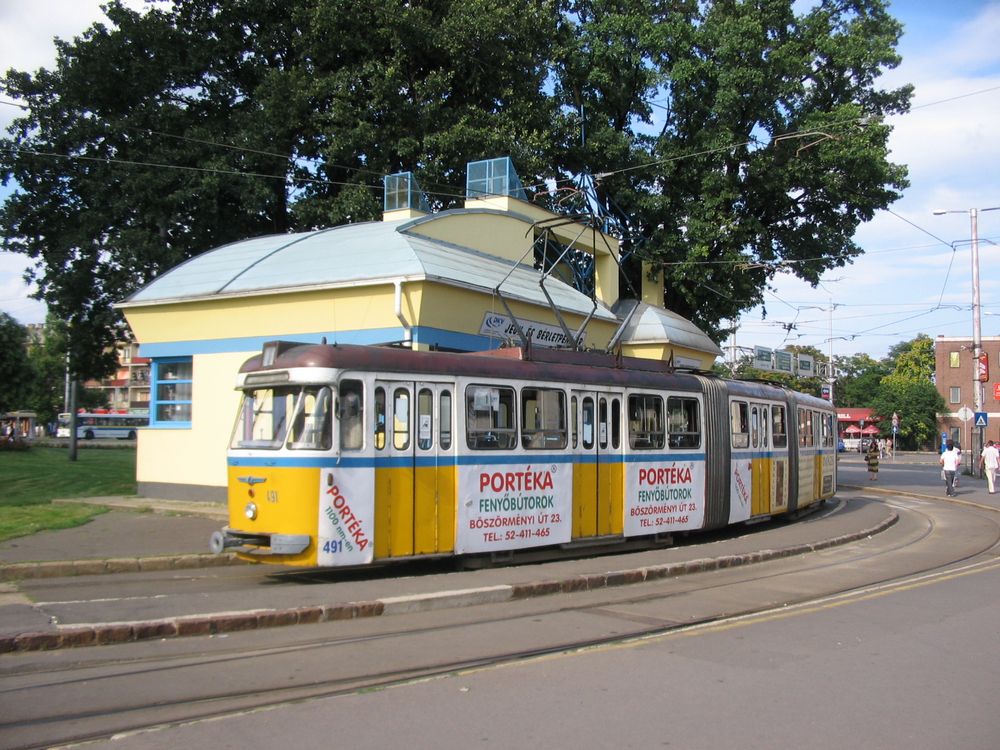
In Debrecen ten older FFV “two-rooms-and-a-bath” trams also remain in use, the surviving examples dating from the 1970s. Nicknamed “Bengálik”, these were developed in the 1960s by Budapest’s tram maintenance depot for use in the capital. The design was then adopted by Debrecen, which also built similar vehicles for Miskolc and Szeged, the two other Hungarian cities where tramways remain. These very dated vehicles are rather noisy, quite worryingly so in one case. Electrification is at 600 V DC, and all DKV’s tram are double-ended, though as the line has turning loops and outside platforms it would seem possible to use single-sided vehicles, as ran in the city in the past.

Along the line

Changing the points

The driver changes the points as a tram comes off the branch from the depot to join the main route.

A couple of sidings trail into the turning loop outside the station, while a single track branch from the depot runs in from an adjacent street, linked to the running line by a triangle giving access in and out.

Departures are very frequent, with three or four trams waiting in the loop to load up in a turn-up-and-go service. The line is double track throughout, except a short section round the park, and has 13 stops.

Tram and trolley bus wires cross in the centre of Debrecen

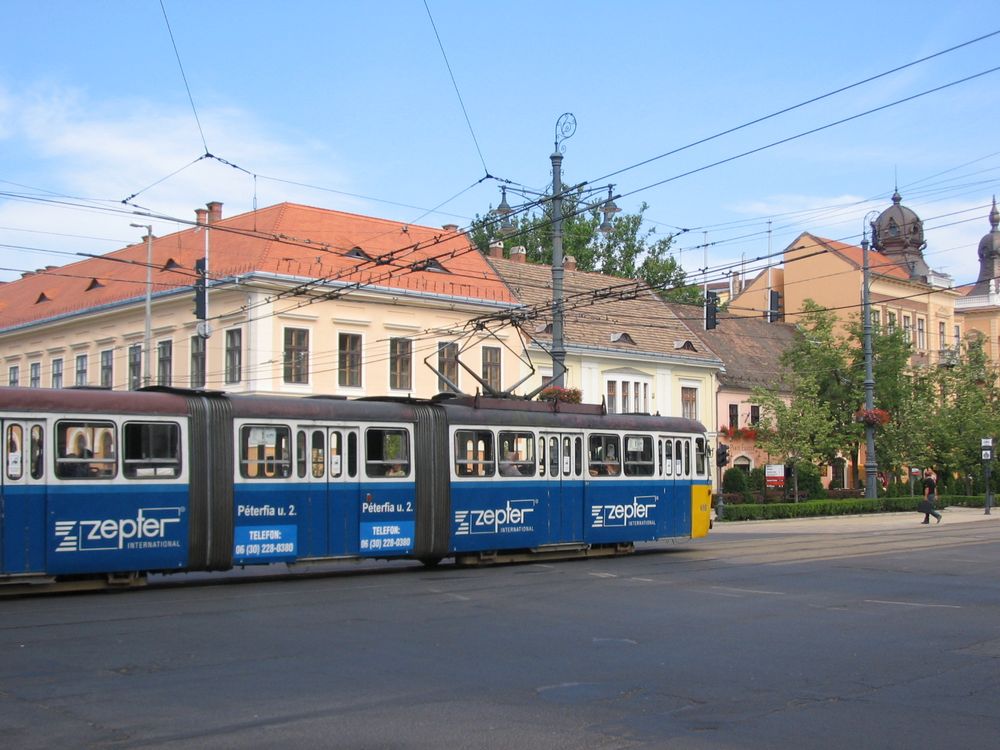
In the city centre the tramway crosses a trolleybus route at a busy junction, where the extra electrical equipment needed for rubber-tyred vehicles stands out. The locally-built trams with two four-wheel cars linked by an articulated section are showing their age, and can be rather noisy inside.

After the turning loop, the line follows reserved track through Petofi Square, which is named after a poet who lived in a house on the site now occupied by the station in 1843-44. The trams continue along Piac Utca, a road shared with other traffic. By the Small Church the trams make a right angled crossing with the city’s trolleybuses, which are also covered by the day ticket. As well as conventional electric trolleybuses, DKV has some Solaris/Ganz-Transelektro dual mode vehicles with diesel engines, and despite the presence of overhead at least one trolleybus went past in diesel mode.

The trams then continue through Kossuth Ter, the city’s main square, which has been modernised and pedestrianised to produce a pleasant car-free area. Money has been spent on public art and generally tidying the city centre up, which produces a pleasant environment which other cities could learn from.

Buildings in Debrecen

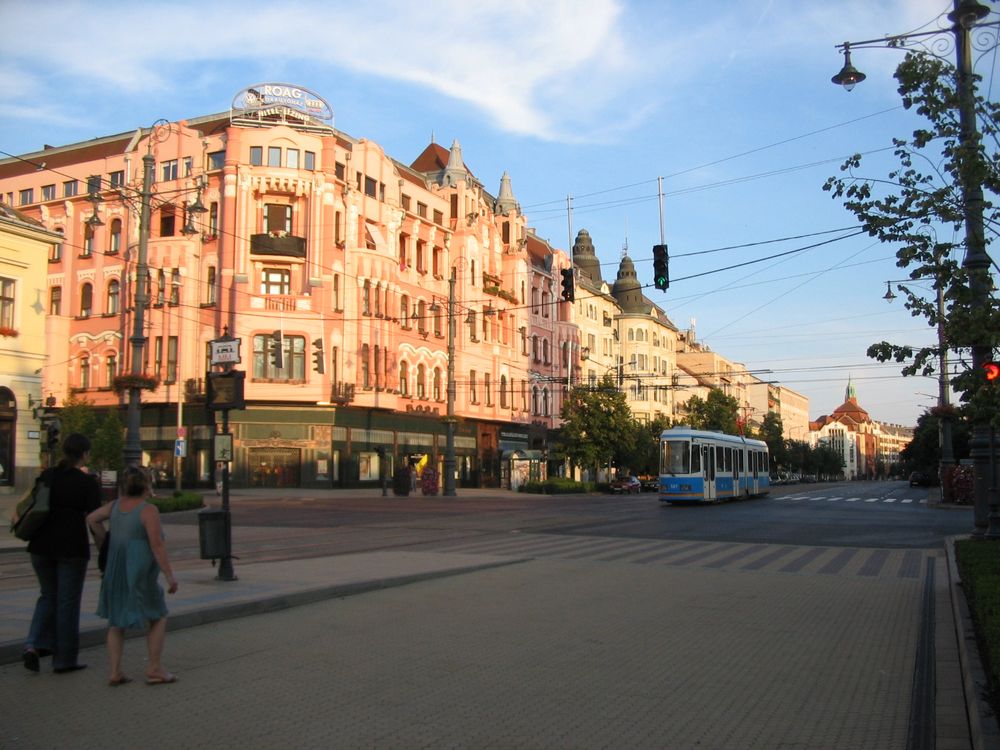
There is some interesting architecture in Debrecen, including this rather pink building.

The line then passes to the right of Debrecen’s signature building, the Calvinist Nagytemplom, or Great Church. In 1849 Kossuth declared Hungary independent of Austria in the church. The revolution was defeated by Russian military intervention, but now it is difficult to walk more than a short distance in Hungary without passing a Kossuth street, square, statue or monument.

Trams then continue down the middle of Peterfia Utca and Simonyi Utca to the Nagyerdei park, which the line enters and bisects. The reserved track through the park is double track, but only one line is used, the stops being served in one direction only as all trams travel anti-clockwise.

Tram passing the Spa, Debrecen

Tram passing the spa in the park. The double track cuts across the middle of the park, then circumnavigates one side of the tree-lined grounds along the perimeter road. Only the outermost track appeared to be in use on the section outside the thermal baths.

The route passes thermal baths fed by sulphurous springs, then at the far side of the park it swings left, completing a circuit of the western half of the park on a single track line along the perimeter road. Single platform stops serve the surrounding Kossuth Lajos university and hospital district. With potential traffic generators at either end of the line, and the city centre in the middle, the tramway is an extremely useful way of getting about, providing an excellent way to see the city.

On arriving in the park we went in search of the zoo and its narrow gauge railway. Unfortunately the zoo was closed. Peering over the fence some zebras were spotted [no, any fule kno they were striped] but no trains, so we boarded another tram for the city centre. A return trip, from the station, round the park and back to the station, takes 36 min for the journey of about 9 km.

More information

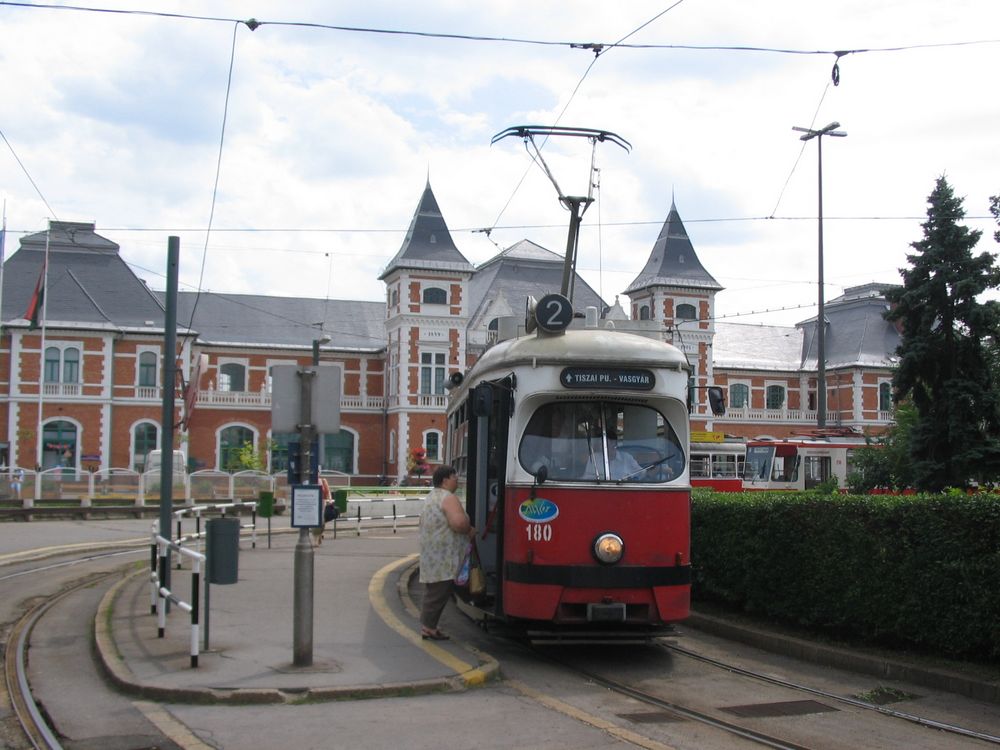
Tram at Miskolc station

Miskolc also has a single tram line. A tram stands outside the station.

  • There is a impressive amount of bilingual information on Hungarian trams for enthusiasts at Hamster‘s Trams of Hungarywebsite.
  • City transport company DKV has a surprising amount of data, including fleet lists and vehicle specifications (in Hungarian).
  • Online tramspotting is possible using a controllable webcam in Kossuth Square.
  • Plus of course the Rough Guide to Hungary and Lonely Planet Hungary are handy for planning a visit. If I could remember its name, I’d recommend a hotel where a one-armed man served us ham and eggs for breakfast, as their German names were the only food which he and us could all name in a common language.