The Hidden Teesside website has pictures of the Boulby and Redcar sound mirrors. Plus lots of interesting pictures of assorted industrial, military and other remains in the area.
Author: Andrew Grantham
Sonic Marshmallow interview
Graphics.com has an interview with Troika Design Studios which discusses the “Sonic Marshmallows” sound mirror-inspired installation at Wat Tyler country park in Essex.
We see Sonic Marshmallows more as a manifestation of people’s desire to interact with each other, rather than with things. Sonic Marshmallows can be used only in conjunction with another user. Sound mirrors were originally used on the coast of Kent to detect incoming enemy planes, not far from the location were Sonic Marshmallows is installed now. We used the same technology in a way that enables people to communicate with each other instead.
More…
Designing for Human Behavior
Garrett G Jones on sound mirrors at the Designing for Human Behavior blog at the University of Texas at Austin School of Architecture:
…. Microphones placed at foci the of the reflectors enabled a listener to detect the sound of aircrafts several kilometers out in the English Channel. My idea takes this primitive device and relocates it within modern contexts. Sound mirrors or sound theatres can be used at a more urban or residential scale as installations for people to sit and interact within. The premise is to sit within the concrete dome, which could be oriented in any direction, and that sounds of the surroundings become amplified as they are reflected and echoed within the dome.
[More]
Hythe and Denge photos
Talking parabolicality
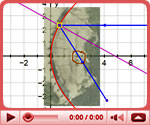 Douglas Butler illustrates how to create an Autograph file to test the parabolicality of a sound mirror, at the Association of Teachers of Mathematics website.
Boffins in Britain
Alec Muffett at Dropsafe on sound mirrors.
Britain is a hothouse of brains and creativity, doubly-so for having to make-do-and-mend from underinvesment and underappreciation, and this leads to startling solutions that fuel incredible innovation – even if most of those subsequently flop for lack of business nous.
Occasionally, these innovations leave footprints in the sand. Bletchley Park is onesuch. Another of which I have long known a little, but never known a lot, are the sound mirrors.
Music from the weather through sound mirrors
Inspired by sound mirrors, someone suggests musicalizing a weather system through landscape architecture.
BLDGBLOG here proposes a series of sound mirrors to be built in a landscape with regular, annual wind phenomena. A distant gully, moaning at 2am every second week in October, every year, due to northern winds from Canada, has its low, droning, cliff-created reverb carefully echoed back up a chain of sound mirrors to supply natural soundscapes for the sleeping residents of nearby towns.
Or a crevasse that actually makes no sound at all has a sound mirror built nearby, which then amplifies and redirects the ambient air movements, coaxing out a tone – but only for the first week of March. Annually.
Aerial view of Denge sound mirrors
An aerial photograph of the sound mirrors at Denge. Just how close these structures were to disappearing into the flooded mineral extraction workings can be clearly seen
.
Panoramic photos of Denge sound mirrors
Geoff Mather has made some wonderful panoramic photos of the three Denge acoustic mirrors, as well as lots of other panoramic pictures.
Sound Mirror Denge 200 Foot in England
Sound mirror orchestra in Belgium
According to Andreas Angelidakis‘s website, Artes Musicales is an exhibition on the relationship of contemporary art and classical music
. It is curated by Christophe de Jaeger and Joost Fonteyne, and opened at Alden Biesen castle in Belgium in July and runs to August 30.
Based on Sound Mirrors, the WWII ancient bunker-like radars, we proposed a set of musical buildings for the park surrounding the castle.
These structures, arranged in the park like instruments in an orchestra, would catch the sounds of the trees an maybe people having fun around them, and who knows what it would sound like.
I can’t quite tell from the website whether they have actually been built or not – the pictures just show models, so I guess not.