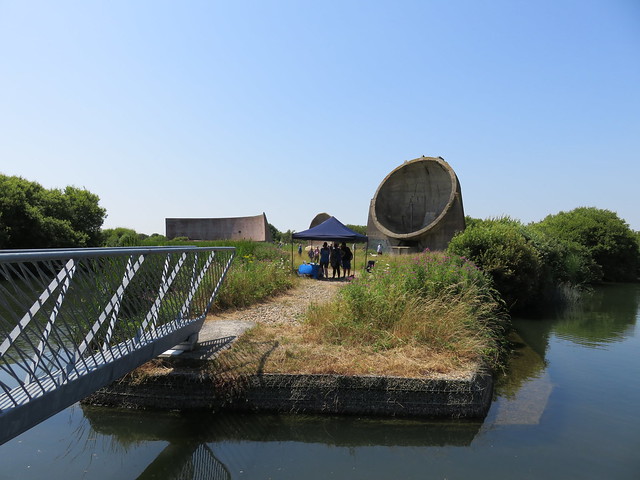
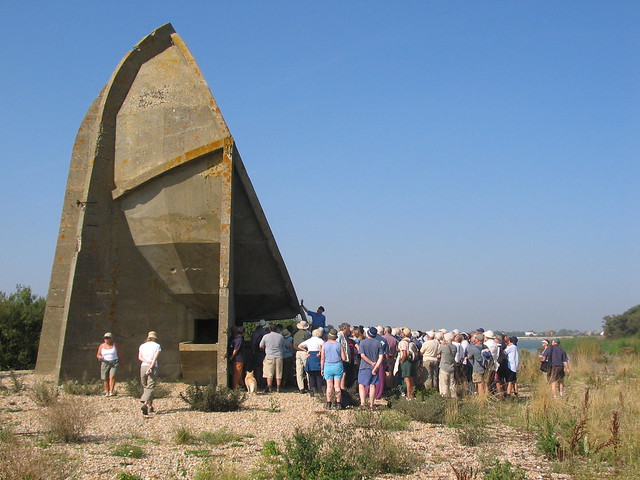
Some photos of the Hythe and Denge sound mirrors by Keith Allen.
Posts Tagged ‘Denge’
Hythe and Denge photos
Sunday, September 6th, 2009Aerial view of Denge sound mirrors
Sunday, August 9th, 2009An aerial photograph of the sound mirrors at Denge. Just how close these structures were to disappearing into the flooded mineral extraction workings can be clearly seen
.
Panoramic photos of Denge sound mirrors
Sunday, August 2nd, 2009Geoff Mather has made some wonderful panoramic photos of the three Denge acoustic mirrors, as well as lots of other panoramic pictures.
Sound Mirror Denge 200 Foot in England
Denge mirrors seem from above
Sunday, July 19th, 2009As a result of visiting Camber castle on 4 July 2009, I stumbled across RXwildlife Sightings, the weblog with the latest wildlife sightings for the Hastings, Rye Bay, Dungeness and Romney Marsh area
.
On the website is an aerial photograph from 1946 showing (if you look carefully!) the Denge sound mirrors from above. There is also a modern view for comparison, showing how the area has been developed.
This photo shows the Lade, the north eastern part of the Dungeness shingle beach in 1946. This section of the beach is relatively young with a series of beach ridges terminating in the marsh soils to the west of the shingle. The dark line bending round from the top left and cutting south across the shingle is the old railway line, with little development to the west of this feature other than the listening mirrors, which were reached by tracks from the east coast. These structures were a pre-radar attempt to focus the noise of aircraft crossing the channel for its operators, and in those days they have a relatively clear view of the sea with only scattered housing along the coast. the most extensive buildings are the beginnings of the Romney Sands holiday camp.
A series of “then and now” photos show how the coast line has changed over time.
Sound mirror open day 19 July 2009
Friday, July 17th, 2009Just a reminder about this weekend’s open day at the Denge sound mirrors, organised by the Romney Marsh Countryside Project:
Due to the overwhelming popularity of last years Echoes of the Sky tours we are making a few changes this year. We will be holding a new open day on Sunday 19th July. The island will be open from 10am in the morning until 5pm. Dr Richard Scarth, an expert on these structures, will be present to answer any questions. The Sound Mirrors are located on private land and this is the only way in which they can be accessed. We will have a number of staff stationed at key places to help direct people to the island. There will a member of staff on the bridge asking for a £2 donation per person to cover costs. Parking is available at Lade car park, opposite Taylor Road on Coast Drive (halfway between the Pilot Pub and Romney Sands) (TR 085 208). This will be a non-booking event, you just need to turn up on the day. The walk will be across shingle. For anymore details contact the Romney Marsh Countryside Project
Sound mirrors on Greatstone website
Sunday, July 12th, 2009Greatstone.net has comprehensive information on the village of Greatstone, the home to Sound Mirrors, [...] large concrete structures built in the 1920s and 1930s to detect enemy aircraft.
The history section of the website has details of the Denge mirrors, and also the railways and a US bomber which crashed nearby.
Denge and fighter control
Sunday, June 28th, 2009The Sound Mirrors of Denge at Passing Strangeness. If a technology solves a problem that’s particularly desperate (or it solves one that’s less desperate but more profitable), it’s often prefigured by other, lesser technologies.
Denge photos
Sunday, May 31st, 2009Michael Rich has a slideshow of photos of Denge taken in April 2009.
Peter King photography’s Sound Mirrors Photos were taken on 13 July 2008, and Echoes In The Sky Dungeness & Sound Mirrors are from 19 August 2007.
Conservation of the concrete mirrors
Sunday, May 24th, 2009When I went on one of the guided walks to the Denge sound mirrors, one of the other vistors was a construction worker who was somewhat critical of the quality of some of the original concrete on the mirrors. I’m not qualified to comment, but Rowan Technologies has some experts on the conservation of concrete.
Case Study #1: Dungeness
English Heritage has commissioned a series of investigative repairs on the mirrors – which are now scheduled as monuments (legal protection specifically for archaeological sites) – that will explore treatments that might be transferable elsewhere. The richly patinated surface of the mirrors is a complex amalgam of weathered aggregate and many varieties of lichen. Chris Wood from English Heritage’s building conservation team is also experimenting with yoghurt to encourage lichen reinstatement. The works were carried out by Rowan Technologies.
Source: The Architects’ Journal, 2008-11-24
Rowan Technologies has this to say:
Conservation Case Studies
The Listening Mirrors, Kent
Like-for-Like Concrete RepairsThe three early warning sound mirrors [at Denge] on the Kent coast were built using reinforced concrete in the late 1920s and the early 1930s to detect the distant sounds of enemy aircraft approaching from over the English Channel. The reinforced concrete has deteriorated in the marine environment and many parts of the structure are suffering from corrosion of the reinforcements and the delamination of the concrete cover.
Rowan Technologies undertook a series of trials of various repair and rehabilitation methods to assess their suitability for these monuments. This included ‘model’ patch repairs of the damaged concrete on a like-for-like basis, to achieving a similar texture and surface finish to the original
Source: Rowan Technologies Ltd
‘Hidden things to see and do’ from the Observer
Sunday, May 10th, 2009The sound mirrors - and this website - got a mention in the Observer’s travel section on 5 April 2009. The piece formed part of the Military sites” category in a series about Secret Britain - “All around us lie overgrown and forgotten sites with fascinating stories to tell, says Iain Sinclair”.
Acoustic mirrors, various locations
In the middle of a field in Kilnsea, Yorkshire there is a 15-foot-high concave concrete structure resembling a satellite dish. It’s actually an acoustic (or sound) mirror, used during the first world war to detect enemy engine sounds. They are a common fixture along the British coast, including at Kilnsea (OS map ref: TA 411167), Hythe in Kent (OS map ref: TR138344) and Denge on the Dungeness peninsula (OS map ref: TR070215), which recently featured in the new Prodigy music video, Invaders Must Die.
Source Observer