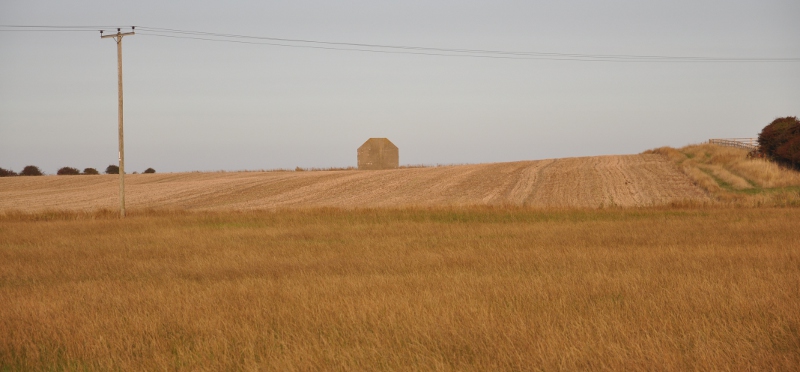
Hello, I found your website while seeking further information about a "sound mirror" which is reported to have existed at Seaham. Do you know anything about, or know someone who does? I’m afraid I’ve never been to the area.
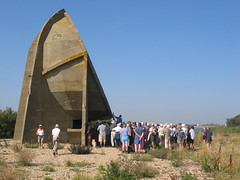
The sound mirror was one of a number built as a form of pre-Radar early warning system. It would have been built circa 1916, it still existed in 1947, and would have looked something like this: Sound Mirror -> that is, a big concrete thing, with a "dish" shape in a wall facing towards the coast. It would almost certainly have had a clear view towards the sea when it was built, but could have been up to a couple of miles or so in land.
The person who told me about it writes:
I left home (Seaham) in 1947 and have rarely been back. I do remember as a child, however, playing around an acoustic mirror (complete with metal rod for supporting the microphone) situated on the high ground (Kinley or Kilney Hill) to the south west of Dawdon, Seaham Harbour. Having looked at the photographs, I can report that it was similar to the Sunderland example in terms of shape and size. I have no idea what state it might be in now, or even if it still exists.
I’d love to know more – does anyone else remember it, can they pin-point where was it, and does it still exist? There are a number of these things, at Sunderland, Redcar, Boulby and quite possibly elsewhere. One at Hartlepool has been demolished . There are some pictures of others at /mirrors/
Thanks for any help you can give!
Andrew Grantham
Andrew, thanks for the interesting email. I know quite well the area you are talking about, Kinley Hill. There still exists an underground structure at the top of Kinley Hill, which was an early warning / lookout post. I believe it was manned by the Civil Defence. This was during the 2nd world war and after that during the cold war. This is the period when it was thought that nuclear war was a genuine possibility.
There is also another hill, maybe a mile from Kinley Hill, which is known as "False Hill". It was named such because I believe its exactly that, a false hill. That is a huge mound which is man made and houses more underground passages and rooms. It used to have small structures on it meant to look like dwellings but which house machinery and there was always a radio / radar mast there. Now its home to mobile phone masts etc.
However, I can’t remember ever seeing a sound mirror on either hill? I’ve been visiting both locations from when I was a kid, 30 + years ago now…. They were fascinating places for kids to explore, even if they were dangerous.
Maybe somebody else can shed some light on this ….. Email Me Please
[picture unfortunately not archived]
Just thought that you might be interested in a water-colour sketch that I did from memory of the ‘sound mirror’ that stood above Dalton-le-Dale. I also played around this structure as a kid and I understand my great uncle Wilf manned this Zeppelin Sounding device at some point in WW1.
I think that it was removed to make way for the B1287
Graham Way road.
The view is from the east looking towards George Weightman’s ‘West Farm,’ Waring Terrace, the garage on Stockton Road.
Kind regards
Les
Hi,
It was located above and to the north of Dalton le dale a little north east of the Overdene Estate but demolished. Put Sunderland Sound Mirror into Google for more.
Cheers for now
Raymond
Dear Webmaster,
Unless I am mistaken the sound mirror was situated behind the garage at the top of Deneside where the housing estate at the top of The Graham Way now stands. The area used to be used as pick nick area accessed from a path near the side of the garage. We used to play there and throw balls into the mirror, it was not until a TV program in the last year or so about coastal early warning systems that I found out what it was.
Hope this is of some help
Tom Westwick.
I’ve lived in Seaham all my life and can remember the mirror very well though didn’t know what it was at the time myself family and friends played on and around it for years through the 60’s and early 70’s it was about 200 yards behind Padgets garage at the top of the Deneside the site was accessed through the so called farm cut on the avenue opposite the top of Ryton cut about…..about 20 yards in front of the mirror was a large 10 ft deep hole lined with thick concrete about 20 yards by 30 yards must have been an operations room for the mirror the field was called the bully because us kids thought the hole was a bull ring the exact location is where the top of Weymouth drive is now every year the hole was used as the biggest hay jump in Seaham …….hope this helps to jog some memories ……..
Tony Snaith