Posts Tagged ‘Uzbekistan’

Escorting freight to the border

Sunday, December 19th, 2010

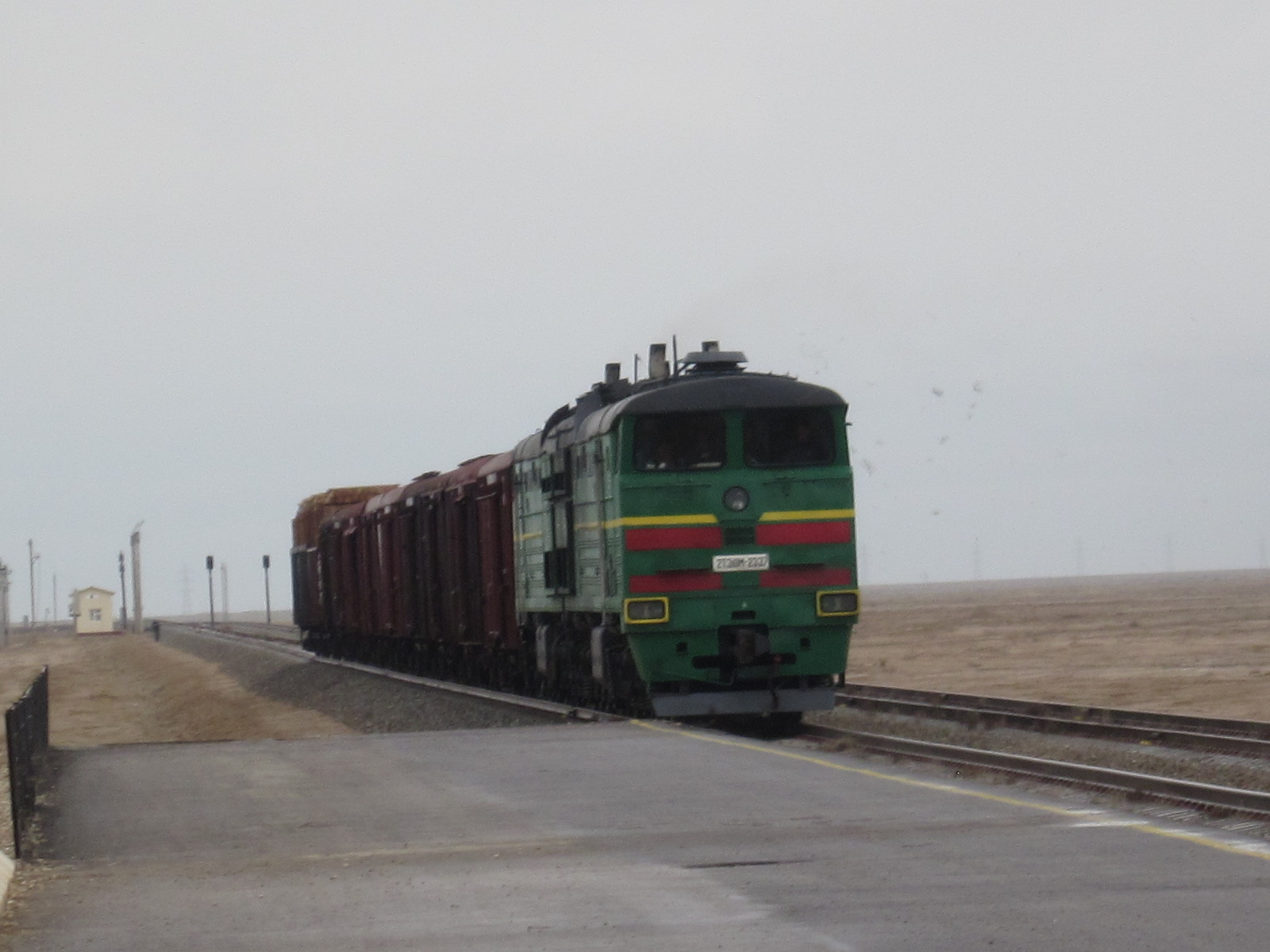
As of August 2010, BTR expanded its services to include railway cargo escort to Afghanistan border. BTR escort specialists accompany the shipments to Galabo, Uzbekistan, the closest railway station to Afghanistan, said Lithuanian firm Baltic Transit Rail on 29 November 2010.

Agreement signed for north-south corridor studies

Sunday, September 26th, 2010

This looks potentially significant, although the words if feasible are probably quite important. I will try to study the announcement in more detail later this week.

MINISTER SHAHRANI SIGNS HISTORIC RAILWAY AGREEMENT

Kabul: September 22, 2010

Mines Minister Wahidullah Shahrani today signed an historic agreement with the China Metallurgical Company (MCC) for a railway to connect Kabul to Pakistan and Uzbekistan.
This northern railway project is part of the Aynak Copper Mine Contract, signed between the Government and MCC. The contract specifies that MCC constructs a railway, if feasible, from northern Pakistan through Kabul to southern Uzbekistan. This rail link will connect Afghanistan to the railways of Pakistan, India, and South East Asia and to the extensive rail system of China, Europe and Central Asia.

Minister Shahrani said, ‘When complete, the railways will give substantial benefits for the Afghan economy in trade, employment and cheaper prices. This northern railway is part of a wider plan to extend the Afghan rail network to connect Afghanistan to ports in Iran and Pakistan.’

The next step is for MCC to commission and fund a competitive tender for a feasibility study to examine the preferred route proposed by the Government’s Inter-Ministerial Railway Committee. It will take up to two years for the detailed route study and another six months to complete the full feasibility study.

The feasibility of the second part of the railway, from Kabul through Bamyan, Doshe, Kunduse, Niadabob, Hairetan and on to Uzbekistan, will be studied for an additional 18 months with construction to follow.

MCC will build the railway according to the ‘BOOT’ principle – ‘Build, Own, Operate and Transfer’. MCC will own the railway until it has recovered its capital costs through collecting transport fees. The details of the BOOT Agreement will be negotiated once the Government have approved the feasibility study prepared by a independent contractor funded by MCC.

The railway will be designed to have the size and capacity to carry the heaviest of loads – copper cathodes, copper concentrates, and commercial goods for transit, agricultural products, passengers and normal freight.

MCC will employ Afghan labor as much as possible in the construction and operation of the railway. Prior to the transfer of ownership to the Government, MCC will complete a training program for Afghan workers to operate the railway. The training will range from

basic functions to high level executive management.
Estimated costs for the entire railway range from US $ 4 –5 billion. Completion of the entire route could be within five years from starting the detailed route survey.

Benefits
The opening the new railway will bring many benefits to Afghanistan. Costs of goods and services will fall due to lower transportation costs. Huge economic and social development opportunities will arise along the rail route as companies switch from road to rail transport. The mining and extractive industries will become more cost effective along the resource corridor developed with the railway.
Source: Ministry of Mines, 2010-09-22

Problems with transport in Uzbekistan

Saturday, August 21st, 2010

A EurasiaNet article by Deirdre Tynan discussing “a morass of inefficiency, arbitrariness and “informal” payments” in Uzbekistan.

Documents Highlight Problems with Uzbek Corridor of Afghan Supply Route

June 28, 2010

Responses to a Pentagon-issued request for information about sourcing fuel in Uzbekistan appear to suggest that the Uzbek-Afghan corridor of the Northern Distribution Network (NDN) is a morass of inefficiency, arbitrariness and “informal” payments.

In documents obtained under the Freedom of Information Act (FOIA), respondents to the Pentagon query made stark comments about severe delays at the Uzbek-Afghan border, and one – a major partner to USAID in Afghanistan – said corrupt payments “might be required to keep business moving.”

The NDN is a supply line for troops serving in Afghanistan spanning Europe, Russia and Central Asia. It was developed by US Transportation Command, US Central Command, Defense Logistics Agency, and the State Department, in conjunction with a variety of regional commercial and governmental actors. [For background see EurasiaNet’s archive [1]].

In August of 2009, the Defense Energy Support Center (DESC) solicited preliminary procurement evaluations from commercial companies in a query titled “Sources sought within the Republic of Uzbekistan for Products and Services in Support of Operation Enduring Freedom (OEF).” The query specifically sought information covering possible diesel, motor fuel and aviation fuel supplies.

According to the FOIA request submitted by EurasiaNet.org, eight companies responded to the DESC query. But only six responses were made available to EurasiaNet.org under the FOIA. Two responses, one from FMN International, the parent company of FMN Logistics, a firm that has strenuously denied any financial connections with the disgraced Uzbek conglomerate Zeromax, and another from NCS Fuels, were deemed “un-releasable.” [For background see EurasiaNet’s archive [2]].

One response – from Milio International Ltd, a company working in the fuel business in the former Soviet Union since 1997 – contended that “Uzbek Railways frequently (often for some period of time each month) bans all rail traffic going to the destination of Hairaton, Afghanistan. This is due to the thousands of rail cars both empty and full of all types of goods that have congested the rail stations for the past year while waiting to get to Afghanistan […] this is especially the case around the Termez and Karshi areas.”

Rail cars from the Baltic states and Russia also get “blocked from time-to-time,” the Milio response noted.

Meanwhile, Afghan Management Group (AMG) said rail transport from Bukhara, Uzbekistan, to Hairaton “with no ‘speed up fee’ takes up to 35 days.” But with “payment of informal fees, the time can be reduced to 7 to 18 days, (depending on amount of money paid).”

When asked to describe “the known impacts related to fuel specifications, taxes, transit leases/approvals, other local laws and challenges you may expect to face,” AMG outlined the payment of “informal fees” as a major challenge in Uzbekistan.

“Apart from refinery fees and transport costs, there are no taxes to be paid in Uzbekistan. However, payment of informal fees to authorities and individuals might be required to keep business moving,” the AMG response said.

“One of the biggest problems in both countries involved is the fact that rules are changing overnight and very frequently. To cope with this issue requires good contacts to authorities and flexibility to adapt own processes to a new situation,” the AMG response added. “AMG/Partner is very reluctant to pay bribes, but manages issues through established good relationship to authorities involved.”

AMG is listed as an “implementing partner” to USAID in Afghanistan. According to both USAID and AMG’s websites, “AMG is a leading firm supporting the reconstruction of developing nations, like Afghanistan, while promoting economic growth and higher living standards among the people of those nations.”

In another DESC response, Agility, one of Defense Logistics Agency’s top-100 contractors, said fuel trucks could be used as an alternative to the “normal delays” experienced at the Termez-Hairaton railway crossing.

“Government taxes and leases will always present challenges,” the Agility response added. However, initial talks with “government and commercial officials” signal that “they are willing to work with the United States to find suitable business arrangements.”

FMN, a firm that did not have its response to the Pentagon query released, reportedly maintained a strong relationship with Zeromax. According to a document available from the American-Uzbekistan Chamber of Commerce’s website, FMN Logistics purported to be capable of carrying out “rail cargo operations coordinated out of Tashkent using Zeromax Rail Code.” [For background click here [3]].

“Based on local presence, FMN Logistics and Zeromax Logistics transit times into and through Uzbekistan are half those of major shippers […] FMN Customs brokerage clearance services can cut Uzbek transit times in half,” the company asserted.

According to FMN’s website, “FMN was formed on 8 September 1999 as a domestic US corporation. The shareholders were, and remain its founder, Harry F. Eustace, Sr. and members of his family.”

“In 2009, FMN formed a subsidiary, FMN Logistics, with Harry F. Eustace, Jr. as its CEO and whose shareholders are the Eustace family plus David O’Connor, a Canadian citizen. FMN Logistics’ prime mission is to serve the US war fighter in Afghanistan by providing effective logistics solutions throughout the Central Asian Theater,” the website added.

The NDN carries 30 percent of goods delivered to US troops in Afghanistan, according to a White House statement on June 24.

Copyright (c) 2010 Open Society Institute. Reprinted with the permission of the Open Society Institute, 400 West 59th Street, New York, NY 10019 USA, wwwEurasiaNet.org

Photos of the Friendship Bridge

Sunday, August 8th, 2010

Some photos on Flickr. Some of the captions refer to the “Freedom Bridge”, though the road-rail crossing of the Amu Darya between Hayratan and a point east of Termez is usually called the “Friendship Bridge”.

100527-N-1928O-064

BALKH PROVINCE, Afghanistan (May 27, 2010) —An Afghan Border Policeman stands watch on the Freedom Bridge crossing the Amu Darya River. On 15th February, 1989 the last Soviet troops to withdraw from Afghanistan crossed the bridge into the, then, Uzbek Soviet Socialist Republic. The bridge now carries rail and vehicular traffic and is the only border crossing between Afghanistan and Uzbekistan. (U.S. Navy photo by Petty Officer 1st Class Mark O’Donald)

Balkh Province in Afghanistan
BALKH PROVINCE, Afghanistan (May 27, 2010) — General Stanley McChrystal, commander of NATO’s International Security Assistance Force, speaks to Afghan media during a visit to the Freedom Bridge in the town of Hairatan. The bridge, which crosses the Amu Darya River between Afghanistan and Uzbekistan, carries both rail and vehicular traffic. (U.S. Navy photo by Petty Officer 1st Class Mark O’Donald/Released)

Visiting with Afghan Border Police
BALKH PROVINCE, Afghanistan (May 27, 2010) — General Stanley McChrystal, commander of NATO’s International Security Assistance Force, speaks with Afghan Border Police officials on the Freedom Bridge crossing the Amu Darya River. On 15th February, 1989 the last Soviet troops to withdraw from Afghanistan crossed the bridge into the, then Uzbek Soviet Socialist Republic. (U.S. Navy photo by Petty Officer 1st Class Mark O’Donald/Released)

5th Zone ABP border crossing point to Uzbekistan
Heryatan – Afghan Border Police(ABP) and coalition forces tour the bridge seperating borders at 5th Zone ABP border crossing point to Uzbekistan June 8, 2010. The 5th Zone ABP guard all provinces of Regional Command North, being responsible for defending all borders against enemy threats and counter narcotics. (U.S. Air Force photo/ Staff Sergeant Matt Davis)

Railway Gazette International on Afghan rail plans

Monday, June 28th, 2010

Railway Gazette International on the latest Afghan rail plans:

Afghan rail strategy takes shape

[...]
The first phase would start at Sher Khan Bandar on the Tajik border, connect at Naibabad with the 1520 mm gauge line now under construction from Uzbekistan, and continue through Mazar-i-Sharif to Herat, with the possibility of a link to the Turkmemistan Railways line at Towraghondi. A branch would run from Shirbirghan via Andkhvoy to the Aqina border crossing with Turkmenistan.
[...]
A second phase would see a Chinese-backed line built from Mazar-i-Sharif to Kabul, Jalalabad and Torkham, near the Khyber Pass. The long-proposed extension of Pakistan Railways’ Chaman line to Kandahar is also planned.
Source: Railway Gazette International, 2010-06-28

Bringing out the Great Game in all of us

Thursday, June 3rd, 2010

Discussion of the Mazar-i-Sharif railway project at Registan. Mixing railways and Afghanistan, though, is sure to bring out the Great Game in all of us. Sigh.

ADB article about the Hayratan railway project

Sunday, April 11th, 2010

An article from the Asian Development Bank’s Media Center about the Hayratan to Mazar-i-Sharif project – with the first photographs I’ve seen of railway construction work underway.

The ADB also has an article about railway modernisation in Uzbekistan.

Railway to Regional Integration

by Philip Wood

Photograph of railway construction works in Afghanistan

Today, as new trade routes connect landlocked Central Asia with the booming economies of South Asia and the Middle East, Afghanistan’s geographic position is proving a valuable asset.

Hairatan, Afghanistan—For centuries, Afghanistan’s strategic location has been a liability, inviting unwanted attention from countries near and far. But today, as new trade routes connect landlocked Central Asia with the booming economies of South Asia and the Middle East, Afghanistan’s geographic position is proving a valuable asset.

The bulldozers on the dusty northern plains of Hairatan attest to the fact that Afghanistan is poised to become a regional hub for trade and commerce. It is here, across the river from neighboring Uzbekistan, that the building blocks of a 75-kilometer single-line railway are being laid—thanks to a $165 million ADB grant.

Photograph of railway construction works in Afghanistan

The Hairatan border post is the gateway for almost half of Afghanistan’s road imports, but the existing transport infrastructure cannot cope with expanding trade and humanitarian relief. When completed in late 2010, the new rail line will remove the major bottlenecks that have formed at the border, quadrupling capacity and boosting regional trade.

As part of the Transport Strategy and Action Plan under the Central Asia Regional Economic Cooperation Program (CAREC), the project will open alternative routes of supply for national and international trade, as well as for humanitarian relief coming into Afghanistan.

The new line will connect Afghanistan to Uzbekistan’s expansive rail network. The initial segment will run between Hairatan and Mazare-e-Sharif, Afghanistan’s second largest city. Future links are planned that will run across the north to other parts of the country and region, including Herat, Pakistan, Tajikistan, and Turkmenistan.

“The new train line will boost freight volumes, lower costs, and raise the profile of Afghanistan as a transit route,” said ADB Afghanistan Country Director Craig Steffensen. “In addition, Central Asian states and Xinjiang, People’s Republic of China, will be able to access world markets more cheaply and easily via Afghanistan and seaports on the Gulf, thus improving their competitiveness in world markets.”

Founded in 1997, CAREC is a partnership of eight countries: Afghanistan, Azerbaijan, the People’s Republic of China, Kazakhstan, the Kyrgyz Republic, Mongolia, Tajikistan, and Uzbekistan; and six multilateral institutions: ADB, the European Bank for Reconstruction and Development, the International Monetary Fund, the Islamic Development Bank, the United Nations Development Programme, and the World Bank.

At the heart of CAREC is a plan to develop a seamless network of transport corridors connecting member countries to one another, to fast-growing economies of East and South Asia, and to established markets in Europe and the Russian Federation.
Source: Asian Development Bank, 2010-03-30

Wagons delayed in Uzbekistan

Thursday, March 25th, 2010

“according to the note, about 1000 units of railway cargo intended for Tajikistan and Afghanistan have been detained in the territory of Uzbekistan within two months.”

“S. Shoislamov explained that the delay of cargoes is connected with busy cargo transportation traffic to Afghanistan.
Source: gazeta.kz, 2010-03-25

Mazar-i-Sharif line construction work

Tuesday, February 16th, 2010

Uzbekistan to build railway line in Afghanistan

Uznews.net – A wage of $500 per month, poor living and working conditions and the lack of security – this is what Uzbek railway builders are offered to build the Hairaton-Mazar-e Sharif railway line in northern Afghanistan.

The salary of $500 per month is very good in Uzbekistan but many specialists will think twice before putting their lives at risk.

Railway builders told Uznews.net on condition of anonymity that the construction of the Termez-Hairaton line started last autumn and 20 Uzbek builders had been involved in it. “Builders were sent at the beginning of last autumn to lay rails and ballasts. They returned a month ago,” a railway builder said.

A brigade of 30 militarised guards was sent to Afghanistan on 24 January but they could not get there immediately because of military operations in the country’s north.

[more]

Source: Uznews 2010-02-07

Russian discussion

Sunday, February 7th, 2010

Russian language-discussion of Afghan railways, via Google Translate

It looks like I need to find a copy of the book Выполняя Интернациональный Долг (and learn Russian).

Yes, the branch Kushka-Toragundi there a long time. I have personally seen covered freight wagons in the WCD Toragundi, when he served in Afghanistan, in 1986 and I have a small book (authorship, not mine) “In carrying out international duty”, where this branch is a little described. There an interview with a citizen of Afghanistan, a switchman employed on this road. There is in this book and excellent photo (h / b) TEM-2 diesel locomotive with a banner “Friendship with the Soviet and the Afghan people can not be undermined!

Павел Егерев 17.08.2009 01:31

Also a Ferghana article dated 4 December 2009 Why does Afghanistan need railroad?, looking at the background to the Uzbek – Afghan rail link.