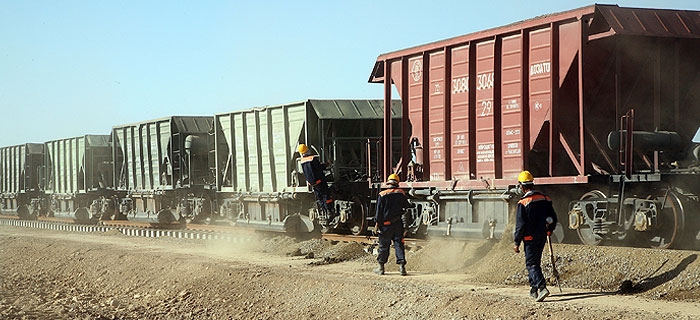
Afghan minister predicts “economic revolution” if railway project completed
Finance Minister Hazrat Omar Zakhelwal told journalists today that Afghanistan would experience unprecedented economic development by the implementation and the opening of these railway lines. The finance minister, who left for Tashkent to attend the annual meeting of the Asian Development Bank [ADB], said that during his meeting with bank officials he would also try to attract financial assistance to implement the railway project from Mazar-e Sharif [the capital of northern Balkh Province] to Herat [western Afghan Province].
…
[Finance minister speaking to camera] We are looking for a donor for the Mazar-e Sharif-Herat Province railway project and if the project is completed – and I am sure that the project will be completed over the next five years, God willing – it will make an economic revolution in Afghanistan and the region as a whole.
…
According to Ministry of Finance officials, besides the ADB, a Chinese company, which has been given the right to extract copper at the Ainak mine in Logar Province, has also promised to construct a railway line from Mazar-e Sharif to Jalalabad [the capital of eastern Nangarhar Province]. According to economists, the construction of railway lines in Afghanistan, which needs hundreds of millions of dollars, will play a key role in the economic development of the country.
…
Source: BBC Monitoring South Asia. Originally published by Arzu TV, Mazar-i-Sharif, in Dari 1 May 2010.
Posts Tagged ‘ADB’
Railways to bring ‘economic revolution’
Thursday, May 6th, 2010Bloomberg on Afghan railway projects
Wednesday, May 5th, 2010Afghan Railway to Draw Taliban Fire as It Boosts Economy, NATO
By Eltaf Najafizada and James Rupert
May 5 (Bloomberg) — Workers are laying track across north Afghanistan’s rolling grassland for the country’s first rail line, a project that will boost the economy, supply NATO troops and become a target for Taliban bombs.
…
“Railroads can reduce our isolation,” said Hamidullah Farooqi, a Kabul University economics professor and former transport minister, in a phone interview. “This is just the first line for a network that we hope can turn our country into a new trade route. That is what we need to create stability.”
[More...]
ADB article about the Hayratan railway project
Sunday, April 11th, 2010An article from the Asian Development Bank’s Media Center about the Hayratan to Mazar-i-Sharif project – with the first photographs I’ve seen of railway construction work underway.
The ADB also has an article about railway modernisation in Uzbekistan.
Railway to Regional Integration
by Philip Wood
Today, as new trade routes connect landlocked Central Asia with the booming economies of South Asia and the Middle East, Afghanistan’s geographic position is proving a valuable asset.
Hairatan, Afghanistan—For centuries, Afghanistan’s strategic location has been a liability, inviting unwanted attention from countries near and far. But today, as new trade routes connect landlocked Central Asia with the booming economies of South Asia and the Middle East, Afghanistan’s geographic position is proving a valuable asset.
The bulldozers on the dusty northern plains of Hairatan attest to the fact that Afghanistan is poised to become a regional hub for trade and commerce. It is here, across the river from neighboring Uzbekistan, that the building blocks of a 75-kilometer single-line railway are being laid—thanks to a $165 million ADB grant.
The Hairatan border post is the gateway for almost half of Afghanistan’s road imports, but the existing transport infrastructure cannot cope with expanding trade and humanitarian relief. When completed in late 2010, the new rail line will remove the major bottlenecks that have formed at the border, quadrupling capacity and boosting regional trade.
As part of the Transport Strategy and Action Plan under the Central Asia Regional Economic Cooperation Program (CAREC), the project will open alternative routes of supply for national and international trade, as well as for humanitarian relief coming into Afghanistan.
The new line will connect Afghanistan to Uzbekistan’s expansive rail network. The initial segment will run between Hairatan and Mazare-e-Sharif, Afghanistan’s second largest city. Future links are planned that will run across the north to other parts of the country and region, including Herat, Pakistan, Tajikistan, and Turkmenistan.
“The new train line will boost freight volumes, lower costs, and raise the profile of Afghanistan as a transit route,” said ADB Afghanistan Country Director Craig Steffensen. “In addition, Central Asian states and Xinjiang, People’s Republic of China, will be able to access world markets more cheaply and easily via Afghanistan and seaports on the Gulf, thus improving their competitiveness in world markets.”
Founded in 1997, CAREC is a partnership of eight countries: Afghanistan, Azerbaijan, the People’s Republic of China, Kazakhstan, the Kyrgyz Republic, Mongolia, Tajikistan, and Uzbekistan; and six multilateral institutions: ADB, the European Bank for Reconstruction and Development, the International Monetary Fund, the Islamic Development Bank, the United Nations Development Programme, and the World Bank.
At the heart of CAREC is a plan to develop a seamless network of transport corridors connecting member countries to one another, to fast-growing economies of East and South Asia, and to established markets in Europe and the Russian Federation.
Source: Asian Development Bank, 2010-03-30
ADB looking for railway consultant
Wednesday, March 31st, 2010Anyone looking for a job?
The Asian Development Bank is looking for an Advisor for Institutional and Capacity Development for the Railway Sector Development in Afghanistan.
ADB grants funds for Mazar-i-Sharif railway
Wednesday, September 30th, 2009Exciting news from the Asian Development Bank today. Uzbekistan’s national railway UTY is to be awarded contracts to build a 75 km line from the Hayratan freight terminal to Mazar-i-Sharif by June 2011.
ADB is providing a USD165m grant towards the USD170m cost, with the Afghan government paying the remaining USD5m. Normal tendering procedures are being relaxed as UTY is the only organisation in a position to build and operate the line. As it will be in effect an extension of the Uzbek rail network, the line will be to 1520 mm gauge.
“Security remains an ongoing concern”, but “the project area is deemed relatively safe”.
ADB-Funded Railway to Help Afghanistan Improve Regional Links, Boost Growth
30 September 2009
MANILA, PHILIPPINES – Afghanistan’s push to develop reliable, safer, sustainable transport systems that boost growth, and increase connectivity with neighboring countries are getting support from a $165 million Asian Development Bank (ADB) grant.
The funds will be used to build a 75 kilometer single line railway between Hairatan – a northern town at the border with Uzbekistan that is the gateway for almost half of Afghanistan’s imports and much of its humanitarian relief goods – and Mazar-e-Sharif, the second largest city in the country. The project will also upgrade Hairatan station yard, build a transshipment terminal and provide institutional support to develop a railway sector plan.
Afghanistan has the potential to play a key role as a transit route in Central Asia for goods going to ports in Pakistan and the Caspian, and onwards to South and East Asia, the Middle East and Europe. However, trade volumes are heavily constrained by weak transport systems. In the case of Hairatan, freight railed from inside Uzbekistan stops at the border and then has to be offloaded and reloaded into trucks, causing delays and raising costs.
“This line will boost freight volumes, lower costs, raise the profile of Afghanistan as a transit route, and complement two major transport corridors being developed under the Central Asia Regional Cooperation Program (CAREC),” said Balabhaskara Reddy Bathula, Transport Specialist with ADB’s Central and West Asia Department. The project is the first phase of a larger rail network planned for the country, including links to Herat, Tajikistan and Pakistan and is part of CAREC’s broad push to improve connectivity throughout the region, supporting growth and cutting poverty.
Security remains an ongoing concern in Afghanistan and while the project area is deemed relatively safe, the Government has pledged to provide all necessary security support. The project will also bring environmental benefits with double-stack containers helping increase fuel efficiency.
To overcome past problems linked to transport projects, such as cost overruns and delays, the Government will be entering into direct contracts with Uzbekistan Railways Company, both for the engineering, procurement and construction of the new facilities, and for their operation and maintenance. The decision to relax normal procurement procedures is justified by the fact that the new railway will be a de-facto extension of the company’s current line from Termez in Uzbekistan to Hairatan; it does not require investments in new rolling stock; there are no comparable companies in the region capable of designing, building, operating and maintaining a line based on the Uzbekistan system; and the company has proprietary preliminary designs, which accelerates project readiness, saving considerable time and costs.
ADB’s grant covers 97% of the total project cost of $170 million, with the Government contributing $5 million. The Ministry of Public Works will be the executing agency, with June 2011 the estimated completion date.
Source: Asian Development Bank, 2009-09-30
Hayratan to Mazar-i-Sharif project details
Sunday, September 27th, 2009Asian Development Bank has details of the Hairatan to Mazar-e-Sharif Railway Project. “Interesting to see it all in one place” says Michael G Erickson who spotted it.
The Hairatan to Mazar-e-Sharif railway link is part of the Central Asia Regional Economic Cooperation (CAREC) Program. It fits with Transport Corridors 3 and 6, which connect Central Asia to South Asia and the region to the Caucasus and the Middle East. Although the road between Hairatan and Mazar-e-Sharif has been improved, it cannot meet national and regional traffic needs. A railway from Hairatan to Mazar-e-Sharif will (i) improve links between Afghanistan and neighboring countries, as well as nearby seaports; and (ii) develop an integrated transport network that caters for different cargo.
The existing Uzbek railway network stops at the border town of Hairatan. This is a gateway to Afghanistan, but it has reached its full capacity (4,000 tons of cargo per month). The flow of goods from Central Asia to Afghanistan will increase from 25,000 tons to 40,000 tons per month over the next few years. To prevent bottlenecks at the border, the existing Uzbek railway at Hairatan needs to be extended into Afghanistan, in a first intervention, to Mazar-e-Sharif. At a later stage, the railway network will be extended to Herat in the west and Tajikistan in the east. The railway will service commercial and non-military cargo.
The project is a priority one for Afghanistan. It fits with its Railway Development Plan. It is closely linked to ADB’s Country Partnership Strategy for 2009-2013, which identifies the construction and rehabilitation of national roads and railways as a priority. It is also consistent with the CAREC Transport and Trade Facilitation Strategy.
The infrastructure:
The Project outputs will be (i) around 80kms railway line from Hairatan to Mazar-e-Sharif with support facilities including rail/road connections and terminals constructed; (ii) established signaling and management information system; (iii) productive use of available land and social safeguarded; (iv) safeguarded and protected environment along railway corridor; (vi) strengthened institutions and management capacity.
Source: Asian Development Bank
Meanwhile, New rail line between Uzbekistan, Afghanistan to serve strategic purpose, reports Central Asia Online:
The construction of the 67km-long line is included in a memorandum of understanding to expand trade and economic opportunities that was recently signed by Uzbekistan, Afghanistan and the Asian Development Bank.
A technical team from Uzbek Railway is scheduled to arrive in Afghanistan shortly to prepare for construction. The cost of the project is estimated to be US$120 million, an amount that will provided by the Asian Development Bank. Construction is tentatively slated to begin in December.
Source: Central Asia Online, 2009-08-29
Hayratan – Mazar-i-Sharif railway plan
Tuesday, June 23rd, 2009Text of report by privately-owned Afghan Arzu TV on 18 June, reported by BBC Monitoring South Asia, 2009-06-19.
Rail Road Project to Link North Afghanistan to Uzbekistan
[Presenter] After a short time, new rail road will be built from Uzbekistan to Hayratan border town and from Hayratan to Mazar-e Sharif city, says Minister of Commerce and Industries Wahidullah Shahrani in a meeting with Uzbek railway minister in Hayratan border town. Mr Shahrani said rail road’s designing and technical procedure had been started and will be completed in nine months. He added Asian Development Bank will donate 100m dollars for building the rail road and a logistic station in Mazar-e Sharif city and Uzbekistan will cooperate in its technical procedure.
[Correspondent] Minister of Commerce and Industries Wahidullah Shahrani visited Hayratan border town of Balkh Province to meet Uzbek minister of railway and speak about building a rail road between Uzbekistan and Mazar-e Sharif city. The minister said building a railway from Hayratan border town to Mazar-e Sharif city costs 80-120m dollars, its technical and designing procedure costing 1.2m dollars will be completed after nine months. The project is funded by Asian Development Bank.
[More]
Maps of planned Afghan rail projects
Sunday, June 21st, 2009Asian Development Bank’s documentation on the 7th Ministerial Conference on Central Asia Regional Economic Cooperation held in Baku on 19–21 November 2008 includes a PDF with maps of the various railway proposals currently active in Afghanistan.
Railway Development Plans in Afghanistan (2.2 MB PDF), was a presentation by Dr Wali Mohammad Rasooli, Technical Deputy Minister, Ministry of Public Works, Islamic Republic of Afghanistan.
Third Regional Economic Cooperation Conference on Afghanistan
Sunday, May 17th, 2009Islamabad Declaration
The delegates participating in the Third Regional Economic Cooperation Conference on Afghanistan having met in Islamabad on 13 – 14 May 2009:
…NOTE THAT
Transport, Trade, Energy Cooperation, Agricultural Cooperation, Capacity Building and Education, Border Management, Health, Counter Narcotics and Refugee Return and Reintegration are areas with considerable scope for mutually beneficial regional cooperation.Connectivity: Increased trade in the region will be facilitated by affording Afghanistan easy accessibility to the Sea, developing east-west and north-south corridors on the basis of mutual agreement, and further developing infrastructure links with Afghanistan and its neighbours.
Railway connection between Iran and Herat is already on going on the basis of a grant from the Government of Islamic Republic of Iran.
An 80 km railway link from Hairatan (on the Uzbekistan border) to Mazar-e-Sharif is considered a priority route for development. The planned link forms part of CAREC’s Transport and Trade Facilitation Strategy, and is in accordance with Afghanistan’s Railways Development Programme. The project will be developed with Asian Development Bank grant support.
…
HAVE DECIDED THAT
…
4. High priority will be accorded, in terms of resource allocation and political commitment to the following set of practical short-term projects of benefit to Afghanistan and the region:
a. Concluding negotiations of the Afghanistan Pakistan Trade and Transit Agreement before the end of 2009, as agreed earlier this month in Washington, DC.
b. Extension of rail link from Chaman to Kandahar.
c. In addition, the European Commission will conduct a pre-feasibility study of railways across Afghanistan linking major destinations within Afghanistan and its neigbours.
…
Read in full on the Ministry of Foreign Affairswebsite.
(thanks to Michael G Erickson for sending me a link)
ADB supports railway study
Saturday, May 9th, 2009A news release from the Asian Development Bank, dated 28 April 2009. ADB has also published Islamic Republic of Afghanistan: Railway Development Study (PDF), with some background and a handy map.
Boost for Afghan Plan to Develop Railway System
MANILA, PHILIPPINES – Afghanistan’s push to develop a railway system that will spur economic growth and make the country a key transit and trade route within Asia is to receive support from the Asian Development Bank (ADB).
ADB has approved a technical assistance grant of US$1.2 million to fund a feasibility study for two key railway routes in the north of the country. The focus will be on railway lines linking northern Afghanistan with neighboring Uzbekistan and Tajikistan.
Land-locked Afghanistan has seen major improvements in its road network in recent years, with support from ADB. However, only half the roads that connect 24 provinces in the country are serviceable throughout the year and the system remains inadequate, inefficient and, in some places, unsafe. Rail provides a more reliable and cost-effective option for moving people and goods, and can help Afghanistan unlock its significant mineral, industrial and agricultural wealth.
An expanded rail system will also help Afghanistan realize its strategic potential as a gateway linking Central, South Asia and the Middle East, and supports the Central Asia Regional Economic Cooperation (CAREC) group of countries’ transport corridors program.
“The technical assistance support for an expanded rail system will help boost sustainable economic growth and poverty reduction in the country, as well as fostering regional cooperation by boosting intra and interregional trade along the CAREC transport corridors,” says Manzoor Rehman, Senior Transport Specialist in ADB’s Central and West Asia Department. “It will enhance Afghanistan’s economic competitiveness and provide all-year accessibility to its neighbors.”
Feasibility studies will be carried out on two proposed railway lines linking Hairatan, on the border with Uzbekistan, to Herat, in west Afghanistan, and another starting at Shirkhan Bendar, on the border with Tajikistan, and traveling via Kunduz and Mazar-e-Sharif to Herat. ADB will assess long-term traffic demand, and the rail sector’s potential capacity, before making recommendations to the Government on the two routes.
The total project cost is estimated at $1.26 million with the government making an in-kind contribution equivalent to $60,000. The Ministry of Public Works will be the Executing Agency.
Since 2002, ADB has approved financial support of over $600 million for Afghanistan’s transport and communications sector, mostly for roads. This is over 40% of ADB’s overall assistance to the country and around 25% of all donor financing for Afghanistan’s roads. The new technical assistance grant is included in the ADB’s 2009 pipeline for nonlending products and services for Afghanistan, as set out in the ADB’s Country Partnership Strategy: Afghanistan, 2009-2013.
Source: Asian Development Bank 2009-04-28