Archive for the ‘Afghanistan’s railways’ Category

Tajik rail link offered

Monday, February 8th, 2010

Islamabad-Dushanbe flights will start by March: Tajik envoy

[...]
The ambassador [of Tajikistan to Pakistan, Zubaydullo N Zubaydov] said that he would like to acknowledge that at the London Conference held on January 28, 2010 on providing stability and security in Afghanistan, the Minister of Foreign Affairs of the Republic of Tajikistan announced that Tajik side has offered construction of railway and gas pipeline from Turkmenistan to Mazar-e-Sharif, Afghanistan and Tajikistan, as well as building of power transmission lines from Turkmenistan to North Afghanistan and Tajikistan, building Dashti Joom Hydropower Dam at the Tajik-Afghan border. “It will help the normalisation of the situation and restoration of the economic life in Afghanistan”, he added.
Source: Business Recorder, 2010-02-05

Russian discussion

Sunday, February 7th, 2010

Russian language-discussion of Afghan railways, via Google Translate

It looks like I need to find a copy of the book Выполняя Интернациональный Долг (and learn Russian).

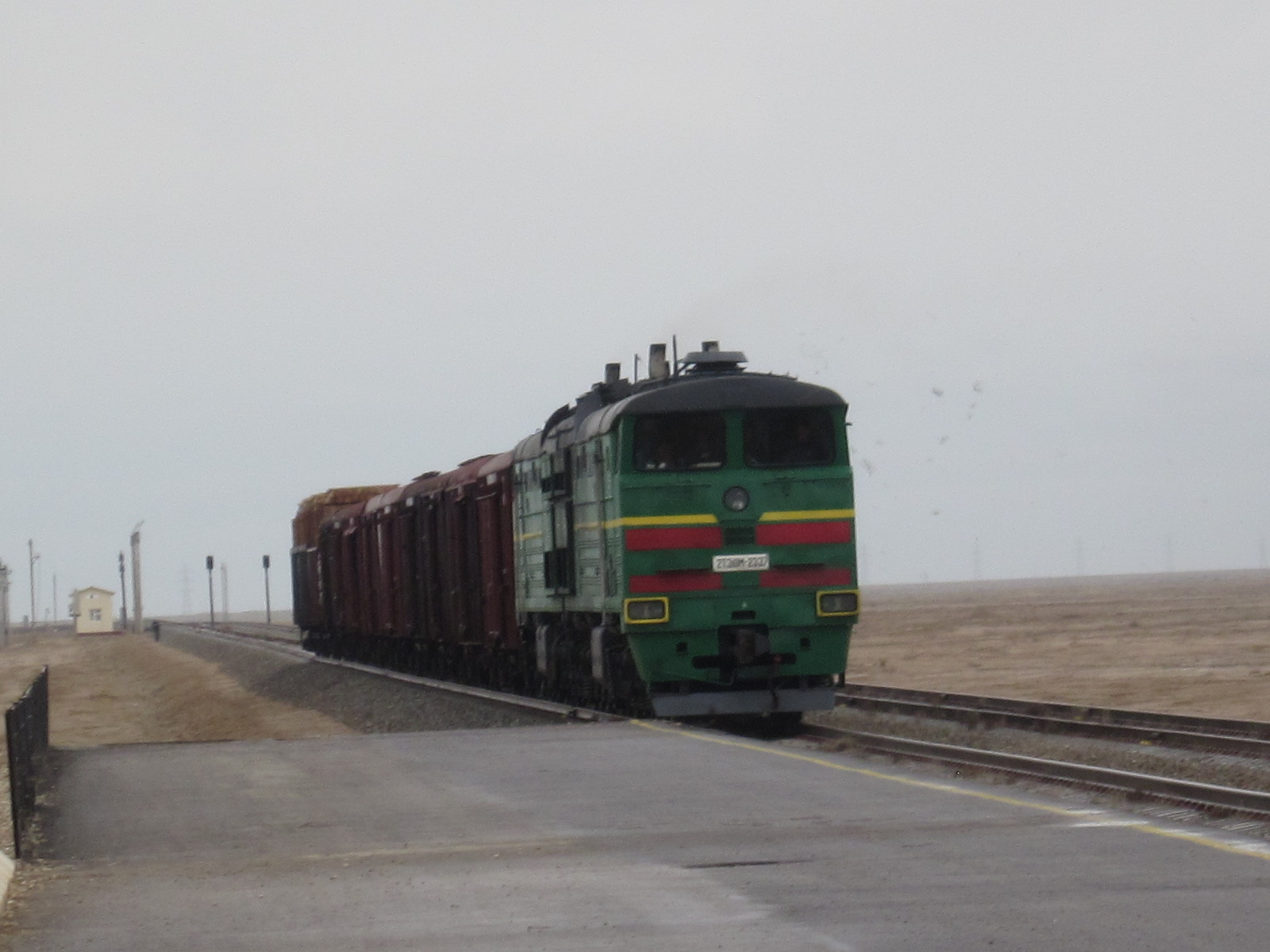
Yes, the branch Kushka-Toragundi there a long time. I have personally seen covered freight wagons in the WCD Toragundi, when he served in Afghanistan, in 1986 and I have a small book (authorship, not mine) “In carrying out international duty”, where this branch is a little described. There an interview with a citizen of Afghanistan, a switchman employed on this road. There is in this book and excellent photo (h / b) TEM-2 diesel locomotive with a banner “Friendship with the Soviet and the Afghan people can not be undermined!

Павел Егерев 17.08.2009 01:31

Also a Ferghana article dated 4 December 2009 Why does Afghanistan need railroad?, looking at the background to the Uzbek – Afghan rail link.

Uzbek bottleneck on the Northern Distribution Network

Wednesday, February 3rd, 2010

AFGHANISTAN: WASHINGTON EXPLORING CHINESE RE-SUPPLY ROUTE

Deirdre Tynan 2/02/10

[...]
On land, the NDN also appears to be experiencing some problems. Although the US Department of Defense insists the NDN is running at top capacity, Dmitri Rogozin, Russia’s mischievous envoy to NATO, told the Russian news paper Izvestia on January 26 that “there are some technical problems associated with an overload on one of the railway routes.”

Experts caution that additional land routes, whether routed through China or eastern Russia, could ultimately face the same problem — a bottleneck in Uzbekistan. “The problem isn’t the route to Central Asia, it is getting across Uzbekistan [to Afghanistan]. So you can have 10 ways to get to Termez, but what’s the difference?” a well-placed source told EurasiaNet.

Until major upgrades are completed at the Termez-Hairaton border crossing, and action taken to contain corruption and red tape, Uzbekistan is likely to continue to act as a choke point for US and NATO supplies bound for Afghanistan, the source added.
Source: Eurasianet , 2010-02-20

NATO transit traffic

Monday, February 1st, 2010

From Russian Transport Daily Report, 1 February 2010:

NATO Cargo Transit through Russia May Start within Days

Railway transit of non-lethal NATO freight through Russia and Central Asia to NATO forces in Afghanistan may start within days. This would seriously supplement transportation through the main transit route, which passes through Pakistan. Pakistan will most likely remain the main transit route for the foreseeable future. Cargo to be transported through Russia and Kazakhstan will not include weapons or ammunition. A transit deal with Russia signed in 2008 needed approval from Kazakhstan and other Central Asian countries to come into force.
Source: Interfax News Agency

Work starts on Mazar-i-Sharif line

Tuesday, January 26th, 2010

Uzbek national railway UTY has begun construction of the Hayratan to Mazar-i-Sharif railway.

Construction of Afghan railway launched

AFGHANISTAN: A ceremony on January 22 marked the start of construction of a 75 km rail link from Uzbekistan to the city of Mazar-i-Sharif in northern Afghanistan. The line is being built by Uzbek national railway UTY, which said it will be ‘a vivid testimony to the friendly relations between the two countries.’
More
Source: Railway Gazette International, 2010-01-27

Quetta to Kandahar feasibility study

Sunday, January 24th, 2010

Feasibility report of starting railway service from Quetta to Kandahar okayed

QUETTA: The feasibility report of starting railway service from Quetta to Kandahar has been prepared and sent to the Afghan government and its response is awaited.

This was stated by deputy superintendent of Pakistan Railway Balochistan while addressing a press conference at his office here on Saturday.
More…
Source: Online-International News Network, 2010-01-17

This is the Chaman – Spin Boldak – Kandahar line, which has been under discussion for a very long time.

Job opportunity

Friday, January 22nd, 2010

Anyone fancy a two-year job as Project Director on the Mazar-i-Sharif railway extension?

Some photos of Hayratan

Sunday, January 17th, 2010

Some June 2008 photos of Hayratan by Mathias Schroeder.

And some March 2007 photos of the Friendship Bridge by Conrad Blything

Russia’s March to the East

Sunday, January 10th, 2010

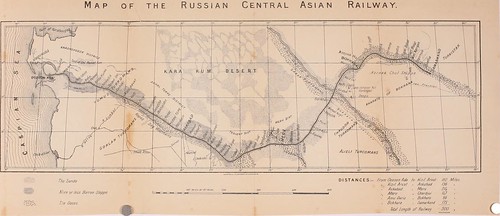
An April 1899 article form the Timaru Herald, based a journey through the Russian empire, and the railway from Merv to Kushka (Serhetabat in Turkmenistan).

RUSSIA’S MARCH TO THE EAST

Mr John W. Bookwalter, of Ohio, who has just returned to London from a two months’ journey through Russia, informed a press correspondent in an interview that he enjoyed unusual facilities for observing what is going on in that country. He travelled 17,000 miles to the terminus of the Trans-Siberian Railway, to the end of the line reaching the frontier of Afghanistan, and to the end of the one penetrating China through Manchuria. Mr Bookwalter says :—

“Russia in three years has done more to open the doors of China than Great Britian and all the rest of the world has done in 50 years. No one who has not seen it with his own eyes can have the faintest conception of what Russia has done and is still doing in Central Asia. I have travelled over twelve hundred miles of railway which she was built from the Caspian Sea to Tashkend. in Turkestan ; over a branch of this line which runs to the northern frontier of India, and over another branch which goes from Merv to the border of Afghanistan. This last branch was not completed when I was there, but it will be open to traffic shortly. There are also Russian lines all along the Persian frontier and penetrating into that country, either completed or rapidly approaching completion. All the work on these lines has been done by soldiers, who in this way are not in Russia, as elsewhere, non-producers.

“All this tremendous Asiatic railway system is owned and operated by the Government. All the lines are admirably built and splendidly equipped. Why, I saw a bridge across the Amu-Daria, in Central Asia, at a point where the river is three miles wide, that cost 20,000,000 roubles, and is the greatest piece of engineering work ever accomplished. There is nothing like it anywhere else m the world, the celebrated Forth Bridge, near Edinburgh, Scotland, not excepted.

“Wherever I went I saw cities and towns springing up – such as Askabad, in Turkomania, for example, which already has 25,000 inhabitants. Near Merv the Czar is building a magnificent palace. New Bokhara, twelve miles from Old Bokhara, has 12,000 inhabitants. The Russian policy in Central Asia is not to bring the new and the old in too close a contrast, and so she builds her railway stations a few miles away from the old centres of population, thus forming newand entirely modern centres. Where do the people come from to inhabit these towns? Why, from European Russia. The Government is turning her surplus European population into Central Asia, just as the United States turned the surplus population of her Atlantic States into her great Western territories. What I have just seen in Central Asia is almost an exact reproduction of what I witnessed years ago in Illinois, Indiana, and Missouri, when the emigrants from the East were pouring into the West. No human power can stay the onward march of the Slav through Russia, which will be the feature of the twentieth century, just as the the march of the Anglo-Saxon through America has been the feature of the nineteenth.”
Source: Timaru Herald, Volume LXII, Issue 2916, 4 April 1899, page 4, accessible at the National Library of New Zealand

Herat line delayed

Wednesday, January 6th, 2010

Afghan news agency Pajhwok reports on 28 December 2009 that the Iran to Herat railway is being delayed.

A Google Translation from Persian suggests it is down to some kind of financing problems.

There is a photograph showing some newly laid railway track – is it the Herat line, or a generic photo?