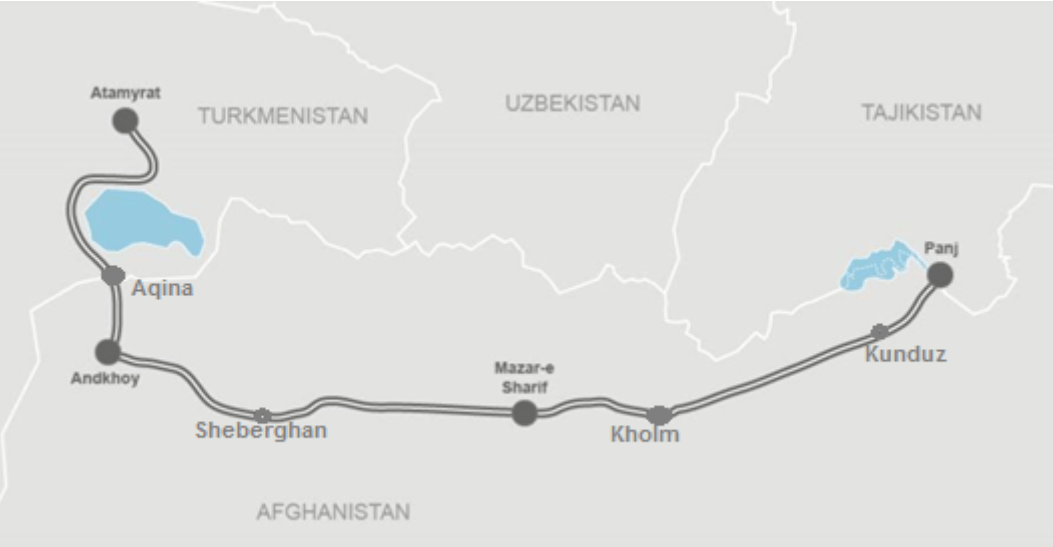
The President of Turkmenistan signed the Decree on establishment of special committee for provision of high organizational level of opening ceremony of Atamyrat – Ymamnazar (Turkmenistan) – Akina (Islamic Republic of Afghanistan) section of the first phase of International Asian railroad transport corridor as well as of hydrocarbons reception, storage and offloading terminal at Ymamnazar custom post of Atamyrat etrap of Lebap velayat.
According to the document, the Committee is assigned to develop the plan for abovementioned opening ceremonies, define measures for high organizational level and assign responsible leaders.
Source: Committee for opening ceremony of Atamyrat – Ymamnazar – Akina railroad line is approved, Turkmenistan: the Golden Age Online Newspaper, 7 October 2016
Afghanistan’s railways
ADB video of Afghan railway
Development Comes on a Train for Afghanistan’s Northern Regions is a video about the Mazar-i-Sharif railway published by the Asian Development Bank on 6 Ocotber 2016.
President Berdimuhamedov inspects construction of TAT railway
President of Turkmenistan Gurbanguly Berdimuhamedov reviewed the construction of the Turkmenistan – Afghanistan – Tajikistan railway during a working visit to Lebap velayat, Turkmenistan: the Golden Age reports.1
He travelled from Turkmenabat Airport by helicopter to Ymamnazar (or Immamnazar, or various other spellings), “where construction of Atamyrat – Ymamnazar – Akina – Andhoy steel line undergoes at full pace”. At Ymamnazar received reports about the customs facilities which handle Around 250 – 300 trucks per day, then visted an hydrocarbon terminal where “construction is at the final stage”. The terminal includes a “Railway loading rack for hydrocarbons”.
He then went to the future Ymamnazar station. As of the date of the visit, 85 km of earthworks had been built on the Atamyrat – Ymamnazar line, 82.2 km “filled with sand and gravel mixture”, 82 km of rails had been laid and a road parallel to the railway had been prepared. The earthworks on the Afghan sectioon of the railway to Akinoy “is prepared”, and construction works at two Gulistan and Ymamnazar stations “are at the final stages”.
“This railway is summoned to become the road of friendship and cooperation of the countries of the region and reliable transport main. Realization of this project, besides economic benefits, will open wide opportunities for integration of participating countries into the international economy at equal partnership.”
Turkmenistan: the Golden Age
Deputy Chairman of Cabinet of Ministers S Satlykov and Minister of Transport B Annameredov provided the president with information about the railway project. The President “expressed his interest in rates and quality of construction works at other parts of the railway”, and “emphasized that deadline for putting into operation of the railway are important requirements for construction of this complex engineering and technical infrastructure”.
During his return flight to Turkmenabat the President saw the work underway on two bridges on the Atamyrat – Ymamnazar – Akina railway. These bridges are 5 m wide, with the bridge at the 15 Years of Independence lake being 256m long and the bridge over the Karakum River being 363 m long. Construction of the reinforced concrete piers has been completed, and temporary piers and metalwork are being installed.
“Successful realization of the construction project of this strategic transport corridor will provide not only further steadfast social and economic development of Lebap region but the whole Turkmenistan as well. As it was mentioned above, the right bank of the Amudarya River has unique deposits of natural reserves. Establishment of reliable railway connection will serve as key factor of rapid development of this countless treasury.”
Turkmenistan: the Golden Age
I can’t seem to find any photos of this presidential trip, but I suspect there might be some out there somewhere – do let me know if you spot any!
References
- President Gurbanguly Berdimuhamedov inspected course of construction of Turkmenistan – Afghanistan – Tajikistan railway, Turkmenistan: the Golden Age Online Newspaper, 29 September 2016 ↩
Freight train from China arrives in Afghanistan
The first rail freight service from China arrived at Hairatan in Afghanistan on 7 September 2016, having left Nantong in eastern China’s Jiangsu province on 25 August 2016.
Afghanistan: Chinese freight train reaches Hairatan. https://t.co/9u3YIYHC9T pic.twitter.com/8IzcjROivj
— Railway Gazette (@railwaygazette) September 7, 2016
Guests at a welcoming ceremony includied the former governor of Balkh province, Mohammad Ishaq Rahguzar, and China’s ambassador.
1st trade train entered Afghanistan from China. Regional economic cooperation is key for economic growth & stability pic.twitter.com/bszoCJXpoT
— F-M Mellbin (@AmbMellbin) September 7, 2016
The same rolling stock did not run through all the way, because China uses 1435 mm standard gauge railway track while the former USSR and Afghaistan use 1520 mm (“Russian”) gauge. The containers were presumably transhipped at the break of gauge at the China-Kazakhstan border.
The train was hauled in Afghanistan by a TEM2 diesel locomotive decorated with banners and the flags of China and Afghanistan.
First direct cargo train from China arrived in Hairatan port of #Afghanistan via @pazadiradio pics by Mujib Habibzai pic.twitter.com/P8BUxGIYxm
— Anand Shukla (@anand_shukla1) September 7, 2016
First ever train (45-wagon cargo) from #China to #Afghanistan arrives at Hairatan near Afg-Uzbek border; took 12 days from Nantong, China.
— Charles Haviland (@cfhaviland) September 7, 2016
(PT) Train carried cargo of machinery – returning with #Afghan dried fruits & marble. Final railway stretch in AF built by USSR in 1980s.
— Charles Haviland (@cfhaviland) September 7, 2016
Geopolitical significance:
First ever Cargo Train from #China arrived in Hairatan Port of #Afghanistan today. Gawadar port of #Pakistan won't longer be our only option
— Javid Faisal (@Javidfaisal) September 7, 2016
There are still some technical issues:
So much fuss abt Chinese rail arriving Hairatan.Still Hairatan not have the railway code. Still Galaba(Termez, Uzbekistan) station is used.
— Your Excellency (@HarrisWadan) September 7, 2016
Tracklaying starts on Afghan section of Iran – Herat railway
A ceremony marks the start of tracklaying on the Afghan section of the Iran to Herat railway.
(PT) Also today in western #Afghanistan, another ceremony marked the first laying of track on AF portion of Herat (AF)-Khaf (#Iran) railway.
— Charles Haviland (@cfhaviland) September 7, 2016
BREAKING: #Herat-Khawaf railway has been inaugurated. pic.twitter.com/0SFY6ZP1TW
— Zakarya Hassani (@ZakariaHassani4) September 7, 2016
The locomotives are Islamic Repubic of Iran Railways Siemens/Mapna Iranrunnner or Safir locos.
Railroad track from Khaaf in Iran reaches zero point at Afghan border. Track-laying on Afghan side begins. pic.twitter.com/Bm44NsX44Z
— Mujib Mashal (@MujMash) September 7, 2016
2. Iranian ambassador Bahrami: our biggest message is that Afghanistan is no longer landlocked. Chah-bahar is there and they can always use.
— Mujib Mashal (@MujMash) September 7, 2016
3. The railroad project was delayed by several years, but Iran finally finished its half. Many will be watching Afghan portion closely.
— Mujib Mashal (@MujMash) September 7, 2016
4. The project's 1st phase inside Afghan territory, abt 62km in Ghoriyan district, was launched today & expected to be completed in 4 months
— Mujib Mashal (@MujMash) September 7, 2016
5. But 4th & most important phase that will connect it to Herat city is in early planning stages, with Italians just promising funds for it
— Mujib Mashal (@MujMash) September 7, 2016
constructing #railway #infrastructure is the turning point n #regional #economy .#ADB helps #AFG bridge the gape pic.twitter.com/t1AgiTK8R5
— Sawabdin Makhkash (@smakhkash) September 19, 2016
Another China to Afghanistan freight train
You wait for ages, then two China to Afghanistan freight services start at once.
Freight train now links E China's Yiwu, famous for small commodities, to Afghanistan https://t.co/lvvE6qd9z7 pic.twitter.com/g9HWrSTSGV
— China Xinhua News (@XHNews) August 28, 2016
This second service set off from Yiwu in eastern China’s Zhejiang Province on August 28, carrying 100 containers of goods worth more than US$4m. The 7500 km journey to Mazar-i-Sharif via Kazakhstan and Uzbekistan was expected to take 15 days. A weekly service is planned by the end of the year.1
The contaners are carried on flat wagons, rather than open wagons as with the train from Nantong.
References
- First freight train linking Yiwu to Afghanistan departs, Xinhua, 28 August 2016 ↩
First China to Afghanistan freight train departs
What is described as the first train from China to Afghanistan1 left Nantong in eastern China’s Jiangsu province on 25 August 2016, carrying 84 containers.2
It is scheduled to take 15 days to complete the journey, running via the Alataw Pass, Kazakhstan and Uzbekistan to Hairatan in northern Afghanistan.3
Two trains are scheduled to run each month, as part of China’s “Belt and Road” initiative to improve Asian transport connectivity.
The inaugural train was photographed being hauled by Class ND5 (General Electric Type C36-7) diesel-electric locomotive number 0157, which was decorated with a red pompom kind of thing on its nose and with a sign on the front saying in English:
Central Asia Trains
Nantong—Afghan – Hairatan
plus some Chinese writing, which I’m reliably informed says the same thing.
There was also a banner on the side of the locomotive saying “Congratulations on the Central Asial trains (Nantong – Afghanistan – Hairaton) launching“,4 and there were banners on some of the wagons.5
Interestingly, the containers are being carried in open wagons, rather than on flat wagons. The wagons themselves will presumably not be making the full journey, instead the containers will be shipped from China’s 1435 mm standard gauge wagons to the fomer USSR’s 1520 mm gauge at the Kazakh border.
The first #SinoAfghan cargo left Haimen for Hairatan through #OBOR @mfa_afghanistan @JananMosazai @RECCAfghanistan pic.twitter.com/yLqeuINocc
— Wahid Waissi (@WahidWaissi) August 25, 2016
References
- I have no particular reason to doubt this claim ↩
- Cargo train services launched between Nantong and Afghanistan, Xinhua, 25 August 2016 ↩
- Cargo train leaves Nantong on first journey to Afghanistan, CCTV.com, 25 August 2016 ↩
- For what it’s worth, the spelling of Hairatan/Hairaton was not consistent between the front and side banners ↩
- Central Asia freight train service starts, Xinhua, 25 August 2016 ↩
TAT railway progress
Turkmenistan’s state news agency TDH has published an update on the TAT Railway project: News about the international Turkmenistan-Afghanistan-Tajikistan railway project (TDH, 28 June 2016).
This says construction of the Atamyrat to Imanazar1 section of the TAT Railway is “well underway”, and is being implemented by the Ministry of Railway Transport of Turkmenistan “at an accelerated pace”.
The railway now runs for 80 km to the site of Imanazar station. Power transmission lines, the Gulistan and Imanazar stations, and two railway bridges 363 m and 256 m long are under construction.
TDH says this section of the line is of great importance, as it will support the industrial development of Lebap velayat (province) including a potash fertiliser mining and processing plant which is under construction. The new line will also “undoubtedly give new impetus to development of interstate trade-economic relations, promote the steady growth of their trade turnover and expand the regional transport, industrial and social infrastructure.”
- Also written Ymamnazar, Ymam Nazar, Ymymnazar etc ↩
Turkmenistan’s Foreign Minister at Afghan railway ceremony
Turkmenistan’s Foreign Minister Rashid Meredov made a rare and little publicized visit to three northwestern Afghan provinces at the end of June.
[…]
Officially, Meredov was there to discuss bilateral projects. He participated in a groundbreaking ceremony for the Turkmenistan-Afghanistan-Tajikistan railway in the town of Akina in Faryab Province
[…]
Source: Majlis Podcast: Turkmenistan’s Afghan Dilemma, Bruce Pannier, RFE/RL, 2 July 2016
News on the Iran to Herat railway
Some news reports on the railway from Khaf in Iran to Herat in Afghanistan have appeared, although I can’t spot English-language versions.
کار امتداد راه آهن ایران به داخل افغانستان بزودی شروع میشود https://t.co/lxbF9qO7OE
— BBC Persian (@bbcpersian) June 16, 2016
Using Google Translate, I think the Fars News report about progress with the railway says that the 76.8 km from Khaf to the border has been finished. It is suitable for 160 km/h passenger and 120 km/h freight trains, and services could start in October[?].
A BBC Persian article possibly says that Iran’s consul general in Herat, Mahmoud Afkhami Rashidi, has said that [construction, track-laying?] work on the Iranian border to Ghurian third section of the railway will resume after Eid al-Fitr [6 July 2016]. The fourth stage of the line will be built by the Afghan[?] government and take the line to an industrial area in Herat[?]. The governments of Afghanistan and Iran have recently held talks about security and technical co-ordination for the construction of the line.